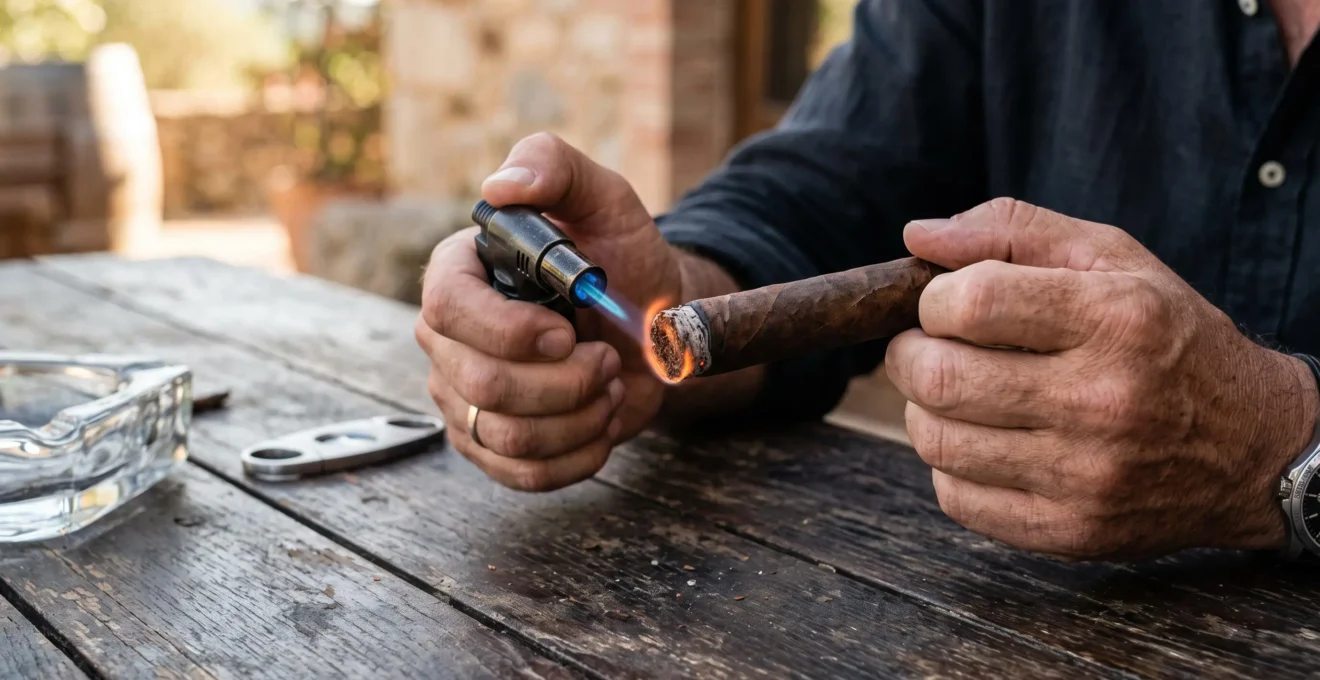
A butane torch can produce a clean-looking, virtually odourless flame and still give a cigar an unpleasantly bitter start. The usual problem is not necessarily the fuel. It is how concentrated heat reaches the tobacco during those first moments of ignition.
Hold a powerful jet too close to the foot and the outer tobacco can char before the centre catches properly. Add a typical British breeze, an oversized flame or a sputtering lighter, and the temptation to apply even more heat becomes difficult to resist. The resulting harshness may be mistaken for a badly blended or poorly stored cigar.
The solution is not simply buying a more expensive torch. Flame distance, controlled rotation, gradual toasting and a stable fuel supply matter more than raw ignition power. For UK smokers using cigars outdoors, particularly thicker ring gauges, learning to read the developing ember is the most practical way to achieve a more even light without unnecessarily scorching the wrapper.
Butane torch lighting: what matters most
- Control heat, not just flame size: keep the inner jet away from the tobacco, toast gradually and rotate the foot until ignition is even.
- Adjust for wind and cigar diameter: shelter the lighting area and choose a torch whose heat output is easy to control.
- Check fuel, lighter performance and storage: inconsistent ignition can involve trapped air, equipment faults or unevenly conditioned tobacco.
- Why Does Holding the Torch Too Close Create Bitterness in Under 30 Seconds ?
- How to Light With a Torch Outdoors in a Breeze Without Overheating the Foot ?
- Single Jet or Triple Jet: Which Is Better if You Smoke Mostly 54 Ring Gauge ?
- The Cheap-Butane Mistake That Adds a Chemical Edge to Your First Third
- When Should You Purge and Refill Your Torch to Stop Sputtering Mid-Light ?
- How to Light With a Torch in 60 Seconds Without Scorching the Wrapper ?
- Analog or Digital Hygrometer: Which Is Less Hassle if You Travel Often ?
- Why Does Cigar Ignition Decide Whether You’ll Fight Canoeing for the Next 30 Minutes ?
Why Does Holding the Torch Too Close Create Bitterness in Under 30 Seconds ?
Holding a butane torch too close concentrates intense heat on a small area of tobacco, potentially charring the wrapper and binder before the filler ignites evenly. This can produce an acrid first impression even when the fuel flame has no noticeable smell. There is no established 30-second threshold: the risk depends on flame intensity, distance and exposure.
A torch produces a concentrated jet rather than the broad, relatively gentle flame of a soft-flame lighter. That concentration is useful outdoors, but it makes positioning critical. If the hottest part of the flame is pressed directly against the foot, one area can burn aggressively while neighbouring tobacco remains comparatively cool.
The smoker then faces an awkward choice: draw harder to ignite the unlit centre or keep applying heat to the already darkened edge. Both responses can worsen the imbalance.
A better approach is to hold the torch slightly away from the foot, angle the flame towards the exposed tobacco and rotate steadily. The aim is to spread heat around the circumference before establishing the central ember.
Holt’s Cigar Company‘s torch-lighting instructions recommend adjusting the flame beforehand, avoiding direct contact between the foot and the jet, and rotating the cigar as it heats. The guidance describes a minimum separation of one-quarter inch from the flame, although that figure is not a universal setting for every torch.
Watch the tobacco rather than the clock. A developing red-orange glow across the foot suggests ignition is progressing. Dark areas indicate tobacco that has not fully caught. By contrast, a blistered wrapper or an isolated, heavily blackened area suggests excessive local heating.
Visible charring cannot be reversed by changing the lighter’s position afterwards. However, the precise effect on flavour and how long any bitterness persists cannot be predicted reliably from appearance alone.
Slower indirect heating generally gives more control than pushing the inner flame into the cigar for a faster light. The difference is particularly noticeable when using a powerful torch on a relatively small exposed area.
Once the distance is under control, the next challenge is keeping that distance consistent when the British weather starts interfering with the flame.
How to Light With a Torch Outdoors in a Breeze Without Overheating the Foot ?
When lighting a cigar outdoors in a breeze, shelter the torch and cigar from moving air before trying to increase flame intensity. Wind can deflect the jet and cool parts of the foot unevenly, encouraging repeated heating. A sheltered position, gradual rotation and gentle initial puffs provide better control than forcing a stronger flame against the tobacco.
British pub gardens, patios and exposed terraces can create awkward lighting conditions even when the wind feels moderate. Air moving around buildings may shift direction suddenly, making the flame appear to miss its target.
The natural reaction is to move the lighter closer. Unfortunately, when the flame briefly returns to its normal position, that reduced gap can expose one part of the foot to much more heat than intended.
Instead, turn away from the prevailing breeze and use a sheltered corner or suitable windbreak. Keep your body between the wind and the lighting area. A free hand can help shield the foot, but it must remain well away from the flame and hot lighter components.
Hold the torch at a slight angle, maintaining a clear separation from the tobacco. Rotate the cigar gradually rather than chasing individual unlit spots with the hottest part of the jet.
Once a reasonably uniform ember develops, take gentle initial puffs in the sheltered position. Avoid walking immediately into stronger wind while the cigar is still establishing its burn.
A useful troubleshooting comparison is to observe whether the same lighting routine produces a more even ember in calm conditions. If sharp starts and uneven burns occur mainly in windy locations, wind handling becomes a plausible explanation. It is not proof: cigar construction, moisture and equipment performance can also vary.
Repeated relighting deserves particular caution. Every correction adds heat, and repeatedly applying a strong jet to the same exposed edge can increase local scorching. Sometimes the simplest flavour-preserving decision is to stop trying to light in an exposed spot and move somewhere calmer.
If a sheltered position still leaves the cigar difficult to ignite evenly, flame geometry becomes the next consideration, especially with larger ring gauges.
Single Jet or Triple Jet: Which Is Better if You Smoke Mostly 54 Ring Gauge ?
For a 54 ring gauge cigar, a triple-jet lighter can cover more of the exposed foot and make initial ignition quicker, while a single jet offers precise control over individual areas. Neither design guarantees better flavour. The preferable choice depends on flame adjustability, outdoor conditions and how comfortably the smoker can distribute heat without scorching.
A 54 ring gauge measures 54 sixty-fourths of an inch in diameter, approximately 21.4 mm. That relatively broad foot presents more tobacco to ignite than a narrower cigar.
A single jet creates a concentrated heating point. With careful rotation, it can toast the circumference progressively and help correct small unlit areas. Its limitation is that a stationary flame can overheat one spot while the rest remains dark.
Triple jets typically produce a broader combined heating area. This may be convenient for a thick cigar outdoors, but it also means more heat can reach the tobacco at once. Poor positioning can therefore scorch a larger area.
The following comparison focuses on practical handling rather than claiming that either design has been independently proven to deliver superior flavour.
| Decision factor | Single jet | Triple jet |
|---|---|---|
| Heat distribution | Narrow, concentrated heating area | Broader combined heating area |
| 54 ring gauge ignition | Requires deliberate movement around the foot | Can cover more tobacco per pass |
| Sheltered conditions | Useful for controlled, gradual toasting | Convenient when speed is preferred |
| Breezy conditions | May require more careful shielding | May offer practical coverage, depending on design |
| Fuel consumption | Often lower for comparable operating periods | Often higher, depending on output and duration |
| Budget and maintenance | Usually simpler jet arrangement | More nozzles and potentially greater complexity |
| Main handling risk | Concentrating heat in one location | Applying excessive total heat too quickly |
For someone who mainly smokes 54 ring gauge cigars in sheltered conditions, a controllable single jet is a sensible option. For frequent outdoor use, a well-adjusted multi-jet lighter may be more convenient, provided its output can be managed comfortably.
After refilling or changing the flame setting, inspect how the jet behaves before applying it to tobacco. A flame that appears taller, less stable or differently shaped requires renewed attention to distance and movement.
Flame control is a more useful buying criterion than jet count alone. A triple jet used patiently can be preferable to a single jet held too close, and the reverse is equally possible.
Even a carefully selected lighter can become inconsistent if its fuel supply is unreliable, which is why butane quality and refilling habits deserve separate attention.
The Cheap-Butane Mistake That Adds a Chemical Edge to Your First Third
The mistake is assuming that any inexpensive butane canister is suitable for a refillable precision torch. Poorly specified fuel may contribute to unreliable lighter operation, but a chemical taste in the first third does not prove that impurities have entered the cigar smoke. Overheating, incomplete combustion, cigar condition and lighter faults must also be considered.
Butane sold for refillable lighters differs in its stated purity, intended applications and compatibility with particular mechanisms. Unknown-origin fuel with inadequate product information creates uncertainty that is difficult to justify when a torch relies on narrow jets and controlled gas flow.
However, an important distinction often disappears from cigar-lighting advice: fuel purity is not the same question as flavour transfer. Even if a fuel contains impurities, demonstrating that they produce a detectable taste in cigar smoke would require evidence beyond observing an unpleasant first puff.
A sharply burnt or acrid taste immediately after aggressive lighting is consistent with excess local heating. A fuel-like odour around the lighter, repeated misfires or abnormal flame behaviour instead makes the equipment and fuel supply worth investigating.
Neither observation establishes a definitive cause by itself.
When buying replacement butane, use a practical quality checklist:
- Choose fuel identified as suitable for refillable butane torch lighters.
- Follow the lighter manufacturer’s stated fuel compatibility requirements.
- Prefer an identifiable supplier with clear product information rather than an unlabelled or unknown-origin canister.
- Treat terms such as “multi-refined” or “ultra-pure” as commercial claims unless their meaning is supported by reliable specifications.
- Inspect whether the lighter returns to a stable flame after correct servicing rather than judging quality solely from packaging.
Low-quality or incompatible fuel is sometimes associated with concerns about deposits and nozzle obstruction, but the supplied technical evidence does not quantify how often this occurs or establish that cheap butane inevitably clogs a torch.
Persistent sputtering should not automatically be blamed on fuel impurities. Trapped air, ignition-system condition, nozzle problems and incorrect adjustment are other plausible explanations.
The real cost trap is continuing to use a malfunctioning lighter and compensating with repeated, prolonged heating. That creates a direct opportunity for poor lighting technique to affect the cigar, whatever originally caused the equipment problem.
Once suitable fuel has been selected, the next priority is making sure the lighter is refilled and operated according to its particular design.
When Should You Purge and Refill Your Torch to Stop Sputtering Mid-Light ?
Refill a butane torch when its fuel supply is low or its performance indicates that refilling is necessary, following the manufacturer’s instructions. Purging is appropriate when prescribed for the model or when its troubleshooting procedure identifies trapped air. A sputtering or non-igniting torch may have a fuel-system problem, but automatic purging before every refill is not universally required.
Inside a refillable lighter, the fuel system must deliver butane consistently to the burner. Trapped air can interfere with operation, particularly after refilling, while nozzle condition and ignition components introduce additional possible faults.
Overfilling or incorrect refill handling may also cause difficulties, although sputtering alone cannot identify which fault is present.
Zippo‘s official butane lighter troubleshooting instructions identify vapour lock, or trapped air in the tank, as a possible reason certain Zippo butane inserts fail to ignite after refilling.
For those specified inserts, Zippo documents a controlled filling and venting procedure involving a refill, brief valve operation, a further refill and a wait of at least two minutes before ignition. Its stated 5–6-second filling intervals concern the documented products and must not be applied indiscriminately to other torch capacities.
Safe handling is essential. Butane is extremely flammable, and released gas can be very cold. Refilling or manufacturer-approved venting must take place in a well-ventilated location away from flames, sparks, hot surfaces and smoking materials. The refill valve should be directed away from the face and body.
The image illustrates a refill-valve operation rather than a universal maintenance instruction. Pressing a valve with a tool should only be attempted if the specific lighter manufacturer explicitly permits that procedure and specifies how to perform it.
A sensible maintenance routine therefore follows observable signs and the model’s manual rather than an arbitrary calendar:
- If the flame weakens, check fuel level and permitted flame-height settings.
- If ignition fails immediately after refilling, consult the manufacturer’s trapped-air troubleshooting guidance.
- If the torch sputters repeatedly, stop using it until the cause has been addressed.
- If performance remains abnormal after correct servicing, investigate manufacturer-approved cleaning, professional support or replacement.
Do not compensate for an erratic jet by turning the flame adjustment higher without checking the fault. Greater output does not repair trapped air or a damaged ignition system, and it may increase heat exposure when the torch fires unexpectedly.
Refill only after the lighter has cooled, and allow the stabilisation period required by its manufacturer before testing ignition.
A reliably operating torch makes a controlled lighting routine possible, but stable equipment still needs a disciplined approach at the foot of the cigar.
How to Light With a Torch in 60 Seconds Without Scorching the Wrapper ?
A cigar can often be lit carefully in around a minute by adjusting the torch first, toasting the exposed foot gradually, rotating continuously and taking gentle initial puffs only after the tobacco begins to glow evenly. Sixty seconds is a practical target, not a validated universal limit; cigar size, moisture, weather and torch output can all change the time required.
Successful ignition involves two related but distinct stages. Toasting warms and begins igniting the exposed tobacco while the cigar is rotated. Drawing then helps establish combustion through the filler once the foot has caught sufficiently.
Confusing these stages encourages a common mistake: pressing the flame directly into the tobacco while drawing hard in an attempt to light the entire foot immediately.
A more controlled routine can be organised into approximate phases:
- Initial preparation: check that the torch produces a stable flame, adjust its height if necessary, and position the cigar in a sheltered area.
- Gradual toasting: hold the flame a short distance from the foot, avoiding contact with the inner jet, while rotating to distribute heat.
- Establishing ignition: continue until the exposed tobacco develops an increasingly even red-orange glow, then use gentle initial draws.
- Final inspection: check for remaining dark areas and make only limited corrections where needed.
The exact duration of each stage is less important than its visible result. A thicker or more humid cigar may take longer. Attempting to recover lost seconds by forcing the torch into the foot defeats the purpose of controlled ignition.
Wrapper protection is especially important near the outer circumference, where an excessively close jet can darken or damage the edge before the central filler is burning properly.
Five checks for a controlled torch light
- Check the flame: briefly test the torch away from tobacco and confirm a steady, predictable jet.
- Establish separation: position the foot beyond the inner flame cone and confirm that the jet does not touch the wrapper.
- Rotate throughout toasting: complete a gradual rotation and inspect whether heat has reached the full exposed circumference.
- Confirm the ember: look for a reasonably even red-orange glow rather than one intensely burnt spot surrounded by dark tobacco.
- Settle the ignition: take two or three gentle initial puffs, inspect the burn and identify any remaining unlit patches before deciding on a small touch-up.
These five checks provide observable results instead of relying on a stopwatch alone. They also help separate ignition technique from equipment problems: if a consistent flame repeatedly creates the same hot spot, the way heat is being applied deserves attention.
The one-minute objective is control, not speed. It is better to take slightly longer than to establish a damaged or uneven start that requires immediate correction.
If careful ignition still produces an unusually harsh or irregular burn, cigar conditioning should be examined alongside technique.
Analog or Digital Hygrometer: Which Is Less Hassle if You Travel Often ?
For frequent cigar travellers, a compact digital hygrometer is often easier to read, while an analogue instrument avoids dependence on batteries. Neither type is automatically more accurate or reliable. The least troublesome option is one that fits the travel case, tolerates expected handling and can be checked against a known humidity reference.
Humidity enters a torch-lighting discussion because tobacco condition influences how readily a cigar ignites and burns. Excessively humidified cigars can be difficult to light, leading to prolonged heating attempts. Very dry tobacco may also behave differently from properly conditioned cigars, although a specific link between dryness, torch use and bitter flavour has not been established by the supplied evidence.
For UK travellers moving between heated indoor spaces, outdoor environments and temporary accommodation, a portable storage system helps reduce uncertainty about cigar condition.
An analogue hygrometer requires no battery and may suit someone who prefers straightforward equipment. However, its reading still needs verification, and a needle display is not proof of mechanical accuracy.
A digital unit can offer more convenient numerical readings, particularly in a small travel humidor. Its practical disadvantages may include battery dependence and the need to protect electronic components from unsuitable conditions.
Neither design has been shown by the supplied sources to be categorically more resistant to knocks or moisture during travel.
Boveda‘s hygrometer calibration guidance explains that both analogue and digital instruments can drift over time. The manufacturer recommends checking new instruments before use and recalibrating approximately every six months.
Boveda also describes a 24-hour calibration process for its kit and suggests a cigar-storage range of 65–72% relative humidity. These are manufacturer recommendations, not independently established universal requirements for every cigar or storage arrangement.
| Consideration | Analogue hygrometer | Digital hygrometer |
|---|---|---|
| Reading the display | Needle and dial | Numerical display |
| Power requirements | No battery | Usually battery-powered |
| Accuracy assurance | Requires verification | Requires verification |
| Transport suitability | Depends on mechanism and case | Depends on construction and case |
| Potential unnoticed failure | Calibration drift | Calibration drift or power loss |
| Best selection criterion | Readable, protected and verifiable | Readable, protected and verifiable |
For short trips with a small case, size and readability may matter most. For frequent journeys, choose a device whose calibration can be checked conveniently and whose failure signs are easy to notice.
A recognised humidity reference or manufacturer-approved calibration kit is preferable to assuming that a newly purchased device is correct. A household salt test may provide an informal reference, but its accuracy depends on the setup and should not be treated as equivalent to a controlled calibration without qualification.
Ultimately, verification matters more than display technology. An inaccurate reading can encourage unnecessary moisture adjustments, leaving the smoker to troubleshoot a burning problem that originated before the cigar was lit.
With storage, fuel and torch handling considered together, the final question is how the quality of ignition affects the burn line after the first few puffs.
Key takeaways before the first five minutes
- Read the ember, not just the flame: an even-looking jet does not guarantee that all areas of the foot have ignited.
- Separate causes before correcting: wind, tobacco moisture, cigar construction and lighting technique can produce similar-looking burn defects.
- Avoid unnecessary intervention: minor unevenness may settle naturally, while persistent imbalance deserves a measured response.
Why Does Cigar Ignition Decide Whether You’ll Fight Canoeing for the Next 30 Minutes ?
Cigar ignition strongly influences the early burn because tobacco that catches unevenly can leave one side advancing faster than the other. This uneven progression, often called canoeing, may require correction as smoking continues. However, lighting is only one cause, and an uneven start does not guarantee 30 minutes of problems: moisture, construction and wind also affect combustion.
When the foot is lit unevenly, one section may already be producing a substantial ember while another remains partly unlit. As the cigar burns, the established side can advance more quickly, creating an irregular burn line.
If the smoker repeatedly applies a torch to the slower side without considering the overall ember, the corrections themselves may introduce further local heating.
Holt’s explanation of uneven cigar burns identifies incomplete lighting, humidity and cigar construction among the causes of irregular combustion. It also recognises that some initially uneven burns correct themselves without intervention.
That distinction matters. A slightly irregular edge during the opening minutes is not automatically a defect requiring immediate flame contact.
The first five minutes provide a useful observational period, although this is a practical diagnostic window rather than a scientifically established cutoff.
Look for three related signs:
- Ember continuity: does the glowing area extend reasonably evenly across the exposed foot, or is a substantial region still unlit?
- Burn-line progression: is one side advancing persistently ahead of the other, or is the small difference beginning to settle?
- Ash and draw behaviour: does the ash develop irregularly alongside a persistent burning problem, or does the cigar otherwise draw and burn normally?
For minor unevenness, allowing the cigar to burn for a short period may be reasonable. Gentle rotation during ordinary smoking may help manage exposure to a breeze, although it cannot correct an underlying construction fault.
If one side continues to race ahead, a limited touch-up to the slower-burning area may help. The objective is to establish combustion where tobacco remains unlit, not to reheat the entire foot or repeatedly attack the advanced edge.
Persistent canoeing despite careful ignition can indicate uneven filler distribution or unsuitable moisture conditions. An underfilled area may allow greater airflow and burn faster, while an overly humidified cigar may resist ignition in other regions.
These factors are not always distinguishable from appearance alone. Treat lighting technique as something to check first, not a guaranteed explanation for every poorly burning cigar.
The wider lesson connects all the preceding decisions. Flame distance influences local heating; wind affects how evenly that heat reaches the tobacco; jet configuration changes the area exposed; fuel-system condition determines flame stability; and cigar storage influences the material being ignited.
There is no established guarantee that getting the first 60 seconds right prevents canoeing for the next half-hour. Nevertheless, an even initial ember removes one avoidable source of burn imbalance and reduces the need for unnecessary corrections.
On the next cigar, start with a stable lighter, choose shelter from the wind, toast the foot gradually and inspect the ember before drawing. If the burn remains irregular, observe whether it begins to correct itself before using a single restrained touch-up. This sequence offers a practical way to identify avoidable lighting errors without automatically blaming the cigar.
Does an odourless blue butane flame guarantee a clean-tasting cigar?
No. An odourless flame does not guarantee that tobacco will be heated evenly. A concentrated jet held too close can char part of the cigar before the remainder ignites. Taste is also influenced by the cigar’s blend, condition and combustion behaviour, so unpleasant first puffs should not automatically be attributed to fuel contamination.
Should the flame physically touch the cigar when using a torch?
The inner jet should generally be kept away from direct contact with the foot and wrapper during gradual toasting. Rotate the cigar to distribute heat and use the developing red-orange ember to judge progress. Torch designs vary, so a fixed distance should not be treated as universally correct.
Can a torch lighter work poorly straight after being refilled?
Yes. Certain refillable butane lighters may experience trapped-air problems after filling. Manufacturer instructions should determine whether venting is appropriate, how the model must be refilled and how long to wait before ignition. Never attempt improvised disassembly or release butane near ignition sources.
Is a soft-flame lighter automatically better for cigar flavour?
Not automatically. A soft flame generally distributes heat differently from a concentrated torch jet, but flavour outcomes depend on how the lighter is used and how the cigar burns. A controlled torch light can establish an even ember, while poor technique with either lighter may produce an unsatisfactory start.
When should an uneven cigar burn be left alone instead of corrected?
A small, early irregularity may settle without intervention. If the cigar otherwise draws normally and the burn line is becoming more uniform, immediate torch correction may be unnecessary. If the imbalance persists or becomes pronounced, inspect the slower-burning area and consider a restrained touch-up, while recognising that tobacco construction and moisture can also be responsible.