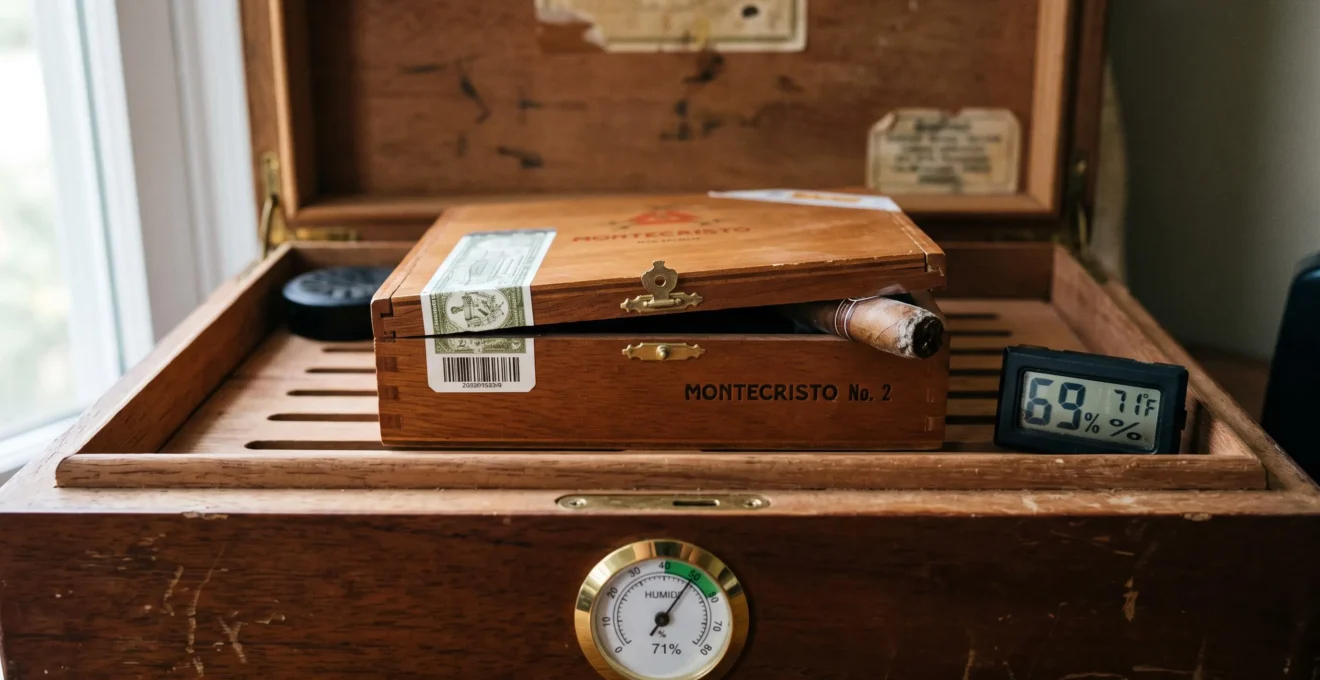
A premium cigar can arrive in apparently excellent condition and still produce a disappointing first smoke. The wrapper looks intact, the hygrometer reads normally, yet the flavour seems unusually quiet. This experience is often described as tobacco oils being dormant after shipping.
However, there is no established scientific rule that cigar oils crystallise during delivery and reactivate exactly 14 days later. The two-week recommendation is better understood as a practical resting interval, allowing recently transported cigars to adjust to stable storage conditions before their flavour is judged.
Temperature exposure, internal leaf moisture, storage history and natural tobacco variation can all influence the smoking experience. A hygrometer cannot independently establish what happened inside a cigar during transit.
For UK online buyers, the useful question is therefore not simply how long dormant oils take to wake up. It is whether a delivered cigar is properly conditioned, whether moisture needs correcting, and when a controlled tasting will produce meaningful information.
Post-delivery cigar recovery at a glance
- Two weeks is a practical checkpoint, not a chemical deadline. No reliable evidence establishes a universal 14-day oil-reactivation process.
- Stable storage matters more than frequent adjustments. Keep cigars away from temperature extremes and manage humidity without repeated corrections.
- Test condition before judging flavour. An early disappointing cigar does not necessarily represent the entire box, particularly after difficult transport.
- Why Do Delivery Temperature Swings Mute Oils Even When Humidity Looks Perfect?
- How to Re-Settle Oils After Delivery in About 14 Days Without Overhandling the Box?
- Smoke Now or Rest: Which Is Better if Your Delivery Took More Than 48 Hours?
- The Rapid-Rehydration Mistake That Keeps Oils ‘Closed’ and Flavour Flat
- When Should You Do a Single-Stick Test to Check If Oils Have Recovered: Day 7 or Day 21?
- Leaf Tastes Flat on Day 1: Why Do Cultivated Tobacco Leaves From the Same Farm Taste Different After 12 Months of Storage?
- How to Stabilise Humidity After Opening a New Box in 72 Hours Without Overcorrecting?
- Why Do Slightly High Moisture Levels Mute Flavour in the First 25 Minutes?
Why Do Delivery Temperature Swings Mute Oils Even When Humidity Looks Perfect?
Delivery temperature swings may alter a cigar’s physical condition even when its storage hygrometer displays an acceptable reading. Temperature influences relative humidity and moisture exchange, while the hygrometer measures surrounding air rather than water distributed through the tobacco. However, ordinary shipping fluctuations have not been shown to place cigar oils into a reversible dormant state.
Consider a hypothetical winter delivery to the UK. A cigar box moves from a heated warehouse into a cold distribution vehicle, spends time in an unheated depot, and finally reaches a warm home. Each environment has different temperature and moisture conditions.
On arrival, the receiving humidor may display 69% relative humidity (RH). That reading describes the air around the sensor. It does not prove that the filler, binder and wrapper have already reached moisture equilibrium with their new environment.
Two explanations are worth distinguishing:
- Temperature-related effects: cold conditions can affect the physical properties of tobacco constituents, while rapid warming of cold packaging may create condensation under suitable conditions. A specific mechanism of shipping-induced oil crystallisation remains unproven.
- Moisture-related effects: tobacco containing excessive moisture can burn differently from properly conditioned tobacco. Draw resistance, combustion and flavour perception may consequently change.
Scientific evidence also requires careful interpretation. A 2026 study of volatile compounds during cigar tobacco curing and fermentation examined relationships involving moisture, microbial activity and aroma-related compounds. It investigated tobacco processing, not the recovery of finished cigars following delivery.
Travel history provides useful context even without specialised monitoring. Note whether the shipment crossed several climate zones, encountered exceptional heat or cold, spent an extended period outdoors, or arrived with visibly damp packaging.
A tight draw or irregular burn during the first few days may indicate a conditioning issue, but it can also reflect cigar construction. Neither symptom proves that oils have stopped moving through the leaf.
Once the obvious transport problems have been ruled out, a period of controlled storage offers a more informative starting point than immediately blaming the manufacturer.
How to Re-Settle Oils After Delivery in About 14 Days Without Overhandling the Box?
A practical 14-day resting routine involves placing delivered cigars in stable, suitable storage and avoiding unnecessary changes. This gives the tobacco time to adjust to its new environment, although the exact equilibration period varies. There is no demonstrated requirement for cigar oils to migrate or reactivate over precisely two weeks.
For a box that arrives in apparently good condition, begin by checking the storage environment rather than manipulating individual cigars. A properly maintained humidor or suitable airtight cigar-storage container should already have established temperature and humidity conditions.
Manufacturer guidance offers a useful reference. Boveda‘s cigar storage humidity recommendations identify 69% RH as a general-purpose option and 65% RH for those who prefer a drier profile. These are product-specific storage recommendations, not evidence of oil recovery at those settings.
A reasonable routine for a normally conditioned delivery is:
- Arrival: inspect the packaging for damage, significant dampness or obvious defects without repeatedly handling every cigar.
- Days 1–3: allow the box and its contents to adjust within a stable storage environment. Avoid placing cold packaging beside a heater or in direct sunlight.
- Days 4–7: monitor the humidor rather than constantly opening the box. Investigate persistent environmental problems instead of reacting to every small reading change.
- Days 8–14: continue stable storage if the cigars appear sound. Consider a representative test only when conditions have remained consistent.
The preference for minimal handling is practical. Each opening may expose the cigars to a different surrounding environment, but it would be inaccurate to claim that every opening restarts a proven biological recovery clock.
Several observations can help assess storage without disturbing every cigar. A steady hygrometer reading is reassuring about the surrounding air, while the absence of visible condensation reduces concern about recent moisture accumulation. An unusual sour or ammonia-like smell warrants investigation, although its presence or absence cannot conclusively establish cigar condition.
Visible fuzzy growth or suspicious spotting deserves particular caution. It should not automatically be described as harmless tobacco bloom. Affected products should be isolated and assessed rather than smoked on the assumption that the deposit is normal.
Five checks for a controlled two-week cigar rest
- Record the delivery date, approximate transit duration and any visible packaging damage. Keep one dated arrival note.
- Check the storage hygrometer and confirm its reliability according to its instructions. Record the initial RH reading.
- Place the box in suitable stable storage, without direct heat or sunlight. Record its storage location.
- Log humidity and any notable temperature fluctuations at consistent intervals. Produce a short condition log rather than repeatedly adjusting the setup.
- At the end of the chosen rest period, record whether the packaging is dry, the tobacco appears sound and a representative test is appropriate. Keep a dated assessment.
If the cigars arrived genuinely dry, the same two-week schedule may be inadequate. Rehydration is a different process and generally requires more conservative expectations.
Smoke Now or Rest: Which Is Better if Your Delivery Took More Than 48 Hours?
After a delivery lasting more than 48 hours, resting is generally the more conservative choice when storage conditions are uncertain. Transit duration alone cannot establish cigar damage or determine a mandatory waiting period. The decision should also account for seasonal exposure, the retailer’s storage standards and the physical condition of the cigars on arrival.
A two-day journey through controlled indoor environments is not equivalent to two days involving significant heat, cold or moisture exposure. Nor does a longer delivery necessarily mean poor conditioning.
For UK buyers, winter shipments may involve cold outdoor handling, while summer deliveries may expose parcels to elevated temperatures in vehicles or collection locations. The packaging and final delivery conditions matter alongside the calendar.
The following decision grid is a practical guide, not a scientifically validated rest-time formula.
| Delivery situation | Reasonable approach | What to check |
|---|---|---|
| Over 48 hours, reputable specialist, no visible damage | Allow a short settling period if convenient; a test may be reasonable once conditions are stable. | Storage RH, packaging and cigar condition. |
| Over 48 hours, exceptionally cold or hot conditions | Prefer additional stable storage before judging flavour. | Temperature history, condensation and visible damage. |
| Over 48 hours, unknown storage history | Use a conservative resting approach. | Retailer information, condition and storage readings. |
| Any duration, clearly dried-out cigars | Assess whether gradual rehydration is feasible. | Wrapper integrity and evidence of dryness. |
| Any duration, damp or suspiciously mouldy cigars | Investigate the condition rather than attempting an immediate smoke. | Contamination, excess moisture and retailer support. |
The decision involves an important asymmetry. Testing immediately uses a cigar before its condition has been established. Waiting, provided the storage environment is suitable, preserves the opportunity to make a more informed assessment later.
However, waiting is not entirely risk-free when the humidor itself is poorly maintained. Prolonged excessive humidity or temperature can create additional problems. Rest only helps when the storage conditions are appropriate.
For an unavoidable celebration or tasting, choose an individual cigar whose loss would be less disappointing. Record that it was smoked soon after delivery, particularly if its flavour seems unusually subdued.
One disappointing sample should not be treated as a definitive judgement on the entire box. Construction variation, individual preferences and smoking technique can all influence the result.
The next distinction matters even more when a box arrives dry: stabilising an otherwise sound cigar is not the same as restoring moisture to damaged tobacco.
The Rapid-Rehydration Mistake That Keeps Oils ‘Closed’ and Flavour Flat
Rapid rehydration can worsen the condition of a genuinely dry cigar by creating uneven moisture uptake and placing stress on its wrapper. It may also leave the cigar over-humidified. However, the claim that rapid moisture absorption traps sugars and oils inside the tobacco has not been established by the available evidence.
A dry wrapper may feel brittle and can crack when the cigar is handled. As a dried cigar absorbs moisture, its different layers may not respond identically or at the same speed.
This is why trying to restore a severely dry shipment by suddenly applying very high humidity is a poor default. Increasing the humidity does not guarantee that the tobacco will recover its original flavour or mechanical condition.
Boveda’s instructions for rehydrating dry cigars recommend an airtight container with 69% RH humidity-control packets and suggest checking progress after approximately one month. The manufacturer advises allowing additional time if the cigar remains too dry and warns about moisture-related damage.
Those instructions are relevant to genuine dehydration, not ordinary resting after shipping. Their approximate recovery period is manufacturer guidance rather than a universal laboratory-derived duration.
For a box that has clearly dried out, use the following distinctions before acting:
- Brittle wrapper or visible cracking: substantial dryness or existing damage is possible. Humidity correction cannot repair every physical defect.
- Unusually soft or damp feel: excess moisture may be present. Adding more humidity could make the condition worse.
- Normal physical condition but muted aroma: the cause remains uncertain. Oil dormancy cannot be diagnosed from aroma alone.
- Fuzzy growth, spreading spots or musty contamination: treat this as a potential spoilage issue rather than a cue to increase or decrease humidity experimentally.
A staged recovery using progressively higher humidity settings is sometimes proposed, but the supplied manufacturer’s documentation does not independently validate such a schedule. Its published procedure provides a more defensible starting point than improvising repeated humidity changes.
Likewise, a high-humidity pack is not automatically a faster recovery tool. Products intended to season an empty wooden humidor should not be confused with products intended to store cigars.
It is also worth distinguishing a muted flavour from genuinely lost volatile aroma compounds. If a cigar has experienced damaging storage conditions, restoring moisture does not establish that its original sensory characteristics will return.
Once the physical condition is acceptable and the storage environment is stable, a measured single-cigar test provides better evidence than making further adjustments simply because the calendar has advanced.
When Should You Do a Single-Stick Test to Check If Oils Have Recovered: Day 7 or Day 21?
Day 7 and day 21 are useful observation points, but neither proves that tobacco oils have recovered. The better approach is to test once storage has remained stable and the cigar shows no obvious conditioning problem. A day-21 result may be more informative than an immediate test, although it cannot isolate oil movement as the cause of flavour changes.
The decision should satisfy two practical conditions: the cigar has had a reasonable opportunity to adjust to suitable storage, and there is no unresolved sign of excessive moisture, severe dryness or damage.
Day 7 may be a reasonable checkpoint for an apparently healthy box whose delivery involved no notable exposure. Day 21 provides additional storage time for a questionable shipment, but there is no controlled evidence establishing either date as optimal.
The format and construction of the cigar also affect how straightforward the assessment will be. A large cigar with substantial filler is not necessarily comparable to a smaller format, even when stored in the same box.
If an adult smoker chooses to conduct a tasting, a consistent record is more useful than relying on a vague memory of how the cigar performed previously. The assessment can include aroma before lighting, draw resistance, combustion behaviour and the smoker’s subjective flavour impressions.
For example, record whether aroma is noticeable at the unlit foot, whether the opening third seems unusually subdued, and whether the burn requires repeated correction. Sweetness or harshness perceived during a retrohale is also subjective and cannot function as a chemical test for oil recovery.
The observations need context. A poor day-7 result may reflect conditioning, construction or sensory variation. A disappointing day-21 result raises questions about storage or the particular cigar, but it does not prove shipping damage.
To make comparisons meaningful, retain the same basic assessment method and note the storage conditions before testing. Comparing cigars of the same blend and format is more informative than comparing unrelated products.
Repeated sampling also has a cost: each test consumes another cigar without necessarily resolving the uncertainty. One well-documented sample, followed by continued suitable storage if warranted, is often more useful than daily experimentation.
Even a carefully controlled test must account for variation that began long before the cigar was packed or shipped.
Leaf Tastes Flat on Day 1: Why Do Cultivated Tobacco Leaves From the Same Farm Taste Different After 12 Months of Storage?
Tobacco leaves from the same farm can differ because their position on the plant, growing conditions and subsequent processing influence their chemical composition. Curing and fermentation also change aroma-related compounds. However, there is no basis for assuming that all leaves follow the same flavour trajectory after exactly 12 months of storage.
A tobacco plant does not produce chemically identical leaves at every height. Upper, middle and lower positions can differ in physical structure, maturity and the balance of compounds relevant to processing.
Research examining cigar tobacco from different plant positions has identified changes in characteristic volatile compounds during air-curing. One study reported 17 significantly changing characteristic compounds in upper leaves and 38 in middle leaves over the investigated curing stages.
These figures describe compounds detected under specific experimental conditions, not a count of flavours perceived by smokers or a direct comparison after one year of commercial ageing.
The broader significance is that the same farm does not mean identical tobacco chemistry.
Fermentation conditions introduce another source of variation. Moisture, microbial communities and enzymatic activity can influence the chemical changes occurring during tobacco processing. The resulting blend depends on decisions made long before delivery to the consumer.
Storage over months may also change aroma profiles. Some volatile compounds can dissipate or undergo transformation, but the direction and sensory consequence depend on the material and storage conditions. A smoother or quieter taste should not automatically be classified as either improvement or degradation.
Most importantly, the biochemical processes associated with curing and fermentation should not be equated with a finished cigar resting for a fortnight in a domestic humidor.
A manufacturer may use months or years of processing and storage to influence tobacco characteristics. A buyer’s two-week resting period has the more limited purpose of allowing the finished product to adapt to its storage environment.
This distinction explains why cigars from one box can deliver different sensory experiences without requiring a shipping-related oil-recovery explanation. Blending consistency reduces variation but cannot establish absolute chemical or sensory uniformity between individual cigars.
For the buyer, the practical response remains straightforward: establish suitable storage conditions before drawing conclusions about a blend’s quality or consistency.
How to Stabilise Humidity After Opening a New Box in 72 Hours Without Overcorrecting?
The first 72 hours after opening a new cigar box are best treated as an observation period rather than a race to achieve an exact reading. Opening the box exposes its contents to the surrounding environment, but the speed of moisture adjustment varies. Small, deliberate corrections are preferable to repeatedly adding humidity after every fluctuation.
A newly opened box may have a different internal humidity from the storage container receiving it. Its packaging, cedar components and tobacco can all influence how moisture is exchanged.
For UK buyers using a wooden humidor, a key question is whether that humidor is already properly conditioned. A new or poorly maintained wooden container may behave differently from an established airtight storage box.
The following 72-hour sequence is a practical monitoring framework rather than a scientifically established equilibration deadline.
| Period | Practical action | Decision principle |
|---|---|---|
| 0–24 hours | Place the box in stable storage and record the surrounding RH. | Avoid reacting to a single reading unless there is clear evidence of a problem. |
| 24–48 hours | Review the trend and inspect for obvious moisture problems only when necessary. | Investigate a persistent discrepancy rather than a brief fluctuation. |
| 48–72 hours | Check whether readings have become reasonably consistent. | Continue observation if conditions remain unstable; 72 hours is not a guaranteed finish point. |
Whether to leave a box lid slightly open or closed depends on the packaging and storage arrangement. In a stable, appropriately humidified environment, limiting unnecessary exposure is often sensible. If the box and humidor differ markedly in condition, their actual state matters more than following an arbitrary lid-position rule.
An airtight container using a suitable two-way humidity pack has different operating characteristics from a ventilated or imperfectly sealed wooden humidor. Humidity-control products should be used according to the manufacturer’s instructions, including compatibility and recommended pack quantities.
The most common adjustment problem is responding too aggressively to transient readings. A hygrometer displays local air conditions and may not immediately reflect moisture changes throughout the contents of the box.
For that reason, do not combine different humidity-control products or settings without checking their compatibility. Adding more humidification is not necessarily a solution to an unstable reading.
Keep a short log showing time, RH and any intervention. If readings remain persistently inconsistent, investigate the sensor, seal and humidification system before changing the cigars’ environment again.
Once storage conditions are stable, the remaining question is whether moisture already inside a cigar could still affect its behaviour when smoked.
Key takeaways before evaluating flavour
- A suitable humidor reading is useful, but it cannot independently confirm the moisture distribution inside an individual cigar.
- High moisture, dryness and construction problems can create overlapping symptoms. None proves that tobacco oils are dormant.
- Assess storage history, draw and combustion together rather than interpreting the first minutes of a smoke through a fixed recovery formula.
Why Do Slightly High Moisture Levels Mute Flavour in the First 25 Minutes?
Excess moisture can alter cigar combustion and draw, potentially affecting perceived flavour during the opening part of a smoke. However, there is no established rule that a cigar must evaporate excess water for exactly 25 minutes before its oils begin releasing aroma. The effects depend on moisture distribution, construction, combustion conditions and smoking behaviour.
A properly conditioned cigar contains moisture, and some moisture is necessary for the tobacco’s physical integrity. The objective is not to remove all water, but to avoid excessive or uneven moisture that interferes with the intended smoking characteristics.
When tobacco is unusually moist, additional heat may be involved in evaporating water during combustion. Moisture can also influence how readily the cigar burns and how air moves through the filler.
These physical effects can contribute to an unsatisfactory smoking experience. They do not justify describing the first 25 minutes as a predictable period of steam production followed by oil activation.
Several observations may nevertheless help an adult smoker assess cigar condition:
- Unusually difficult draw: may result from excessive moisture, dense construction or a localised obstruction.
- Cool or noticeably damp wrapper: can raise questions about conditioning, although touch alone is not a calibrated moisture measurement.
- Uneven burn or tunnelling: may reflect moisture distribution, construction or smoking conditions.
- Muted or unexpectedly sharp flavour: is a subjective observation that cannot independently distinguish moisture from blend characteristics.
These signs should be interpreted collectively. A tight draw paired with an uneven burn is a reason to investigate, not proof of excess moisture.
Pausing between puffs can change the cigar’s combustion behaviour, but it is not a demonstrated method for repairing over-humidification. Similarly, drying the exposed foot during a smoke cannot reliably correct moisture distributed throughout the filler.
If a box repeatedly produces cigars with similar problems, review the storage environment and compare the results with a sound cigar of the same blend and format. Consider whether humidity readings have remained consistent and whether the storage container itself is functioning correctly.
It is also important to separate the question of flavour from tobacco-smoke exposure. A smoother or better-conditioned cigar is not a safer product: combustion still produces harmful substances, and no resting method eliminates the health risks associated with smoking.
The most useful next step is to maintain appropriate storage, review the delivery and humidity log, and avoid further intervention without evidence of a real problem. Two weeks can be a reasonable personal checkpoint, but cigar condition—not an assumed oil-activation clock—should determine whether another assessment is worthwhile.
Can cigar oils really crystallise during cold shipping?
Some components of complex natural mixtures can change physical properties with temperature, but the available evidence does not establish that ordinary cold shipping causes the aromatic oils in finished cigars to crystallise and then reactivate after warming. Claims of temporary oil dormancy should therefore be treated as an unverified explanation rather than a confirmed diagnosis.
Does vacuum-sealed packaging eliminate the need for resting?
Packaging that limits moisture exchange can help protect cigars during transit, but it does not independently establish the condition of the tobacco or eliminate temperature exposure. A sealed delivery in good condition may require little adjustment, while damaged or improperly stored cigars may still need assessment. Resting remains a practical choice rather than a universal requirement.
Should cellophane be removed before resting delivered cigars?
There is no demonstrated requirement to remove cellophane to reactivate tobacco oils. Cellophane can provide some protection against handling damage while allowing moisture exchange to occur over time. The appropriate approach depends on the cigar’s packaging, the storage environment and the manufacturer’s instructions. Avoid unnecessary handling solely to accelerate an assumed recovery process.
Can an accurate hygrometer prove that delivered cigars are ready?
No. A hygrometer indicates relative humidity in the air at the sensor’s location, not the internal moisture content of the cigar. A reliable, stable reading is useful evidence about the storage environment, but readiness also depends on the tobacco’s history, condition and physical integrity. A single humidity reading cannot confirm flavour recovery.
Will resting restore flavour permanently lost through poor storage?
Not necessarily. Resting and controlled rehydration may improve the physical condition of some cigars, but they cannot be assumed to restore volatile compounds lost during damaging storage or repair cracked wrappers. If the original cigar condition has been substantially compromised, more time in a humidor may not produce the expected flavour.