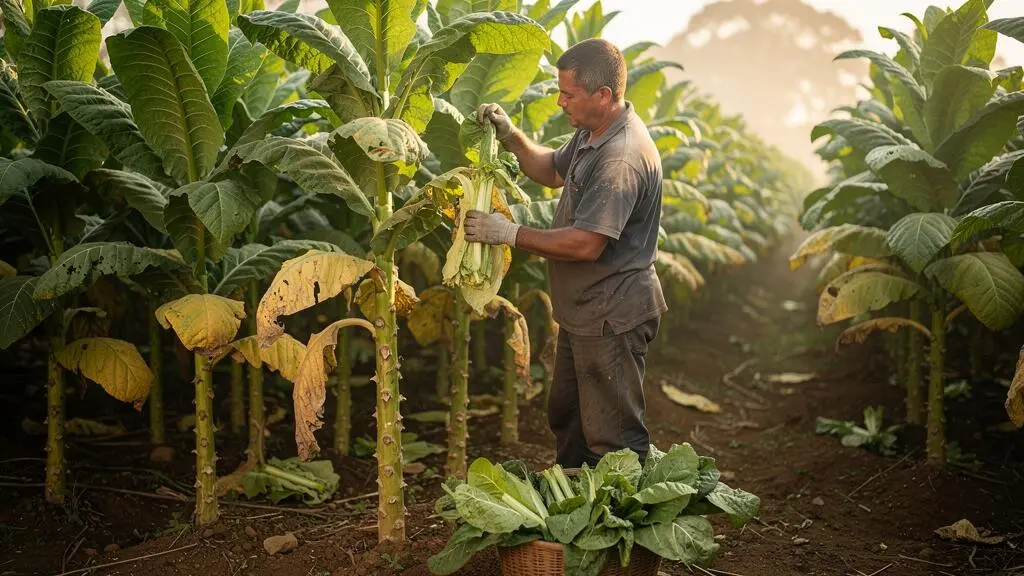
Two cigars carrying the same blend name can deliver noticeably different experiences. One may begin with restrained woody flavours and an even burn, while another feels peppery, dense or unexpectedly strong. The recipe may be unchanged, yet the tobacco entering that recipe is not necessarily chemically identical.
Harvest timing helps explain the difference. Tobacco leaves mature at different positions on the plant, and successive harvests, known as primings, collect leaves with distinct physical and chemical characteristics. Upper leaves often have greater nicotine potential than lower leaves, although the relationship depends on variety, cultivation and processing.
Those differences continue through curing, fermentation, storage and cigar construction. They influence flavour development and combustion without determining the nicotine dose received by an individual smoker.
For UK cigar buyers comparing batches, the useful distinction is between agricultural strength potential, sensory intensity and actual nicotine exposure. Understanding each makes unexpected variations easier to interpret without treating wrapper colour, burn speed or a manufacturer’s strength description as laboratory evidence.
What matters most about harvest timing and cigar strength
- Upper primings often have higher nicotine concentrations, but their presence does not establish the nicotine delivered by a finished cigar.
- Curing, fermentation, moisture and construction can change flavour and combustion even when the stated blend proportions remain constant.
- Choose cigar format according to available time, assess strength claims cautiously and treat uncomfortable nicotine-related symptoms as a reason to stop.
- Why Do Cultivated Tobacco Leaves From the Same Farm Taste Different After 12 Months of Storage?
- Why Do Top-Priming Leaves Often Feel Stronger Within the First 10 Minutes?
- Why Do Upper-Plant Dark Leaves Feel Rougher and More Aggressive on the Palate?
- How to Infer Priming Level From a Cigar’s Feel and Burn in the First 5 Puffs?
- Which Matters More for Smoothness: Lower Primings or Upper Primings When You Smoke After Dinner?
- Early-Harvest Sweetness or Late-Harvest Intensity: Which Fits a 30-Minute Break?
- The Empty-Stomach Error That Can Make Late-Harvest Cigars Feel Much Stronger
- When Should You Rest Fresh Deliveries: 7 Days or 21 Days for More Stable Flavour?
Why Do Cultivated Tobacco Leaves From the Same Farm Taste Different After 12 Months of Storage?
Tobacco leaves from the same farm can taste different after twelve months because they did not necessarily begin with identical chemical compositions. Their position on the stalk, maturity when harvested, curing conditions and fermentation history all matter. Storage can further modify aroma and perceived smoothness, but it does not reliably erase the differences established before the leaves entered storage.
A tobacco plant is not chemically uniform from bottom to top. Lower leaves are generally harvested earlier in successive priming systems, while upper leaves remain attached longer. During growth, stalk position, nitrogen availability, maturity and cultivation practices influence nicotine accumulation and other characteristics.
An Agronomy Journal review on nicotine concentration in flue-cured tobacco reports historical average nicotine concentrations of 18.7 g/kg in lower leaves, 26.5 g/kg in middle leaves and 32.6 g/kg in upper leaves.
These figures describe research on flue-cured tobacco, not universal reference values for premium cigar tobacco. They nevertheless illustrate why stalk position deserves attention when examining raw-leaf variability.
Processing adds another layer. Curing transforms freshly harvested leaves, while fermentation changes their chemical composition and develops characteristic tobacco aromas. Subsequent storage may allow further sensory evolution, depending on conditions and the material involved.
A scientific study of fermentation in cigar tobacco leaves examined material from Hainan and Sichuan over 28 days. Nicotine concentrations fell by 35.38% and 35.61%, respectively, under those experimental conditions. These results cannot be transferred to twelve months of ordinary cigar storage.
18.7 / 26.5 / 32.6 g/kg
Historical average nicotine concentrations reported for lower, middle and upper thirds of flue-cured tobacco plants. These are not standard values for cigar filler leaves.
Agronomy Journal, 2019 review of agronomic research.
To investigate two harvest lots properly, compare documented leaves from the same variety and farm, with equivalent fermentation, storage and blend proportions. A shared commercial blend name alone cannot exclude undocumented substitutions or changes in processing.
The distinction matters because a manufacturer can preserve a blending formula while still working with naturally variable agricultural material. That variability becomes particularly relevant when upper primings are involved.
Why Do Top-Priming Leaves Often Feel Stronger Within the First 10 Minutes?
Upper-stalk tobacco, commonly associated with ligero in cigar blending, often has greater nicotine potential and a thicker leaf structure than lower primings. This can contribute to a more assertive smoking profile. However, the first ten minutes do not reliably measure nicotine delivery: lighting, puffing behaviour, cigar construction and filler placement all influence the initial experience.
Ligero develops towards the upper part of the tobacco plant, where leaf maturity and growing conditions can produce substantial physical and chemical differences. In many blending traditions, these leaves contribute body and intensity, while other primings provide complementary aromatic or combustion characteristics.
Yet flavour strength and nicotine strength are not interchangeable. Pepper, bitterness and dense smoke are sensory observations. Nicotine exposure is a physiological matter influenced by tobacco composition, smoke chemistry, puffing patterns and absorption.
The first few minutes are especially variable because the cigar has only recently been lit. An uneven initial burn, frequent puffs or a concentrated pocket of filler can affect sensations before combustion becomes more consistent.
A cigar may therefore taste forceful immediately without delivering more nicotine than another cigar with a smoother flavour profile. Conversely, a relatively gentle taste does not prove low nicotine exposure.
For buyers comparing two batches, it is more informative to record whether the difference persists through the session, whether the cigars share the same dimensions and whether smoking conditions were comparable. An early peppery impression alone is weak evidence of a change in priming proportions.
The National Cancer Institute information on cigar smoking explains that nicotine can be absorbed through the lining of the mouth as well as through the lungs. Not inhaling does not eliminate nicotine exposure.
This also explains why a dark, aggressive-tasting cigar should not automatically be classified as stronger than a lighter-looking alternative.
Why Do Upper-Plant Dark Leaves Feel Rougher and More Aggressive on the Palate?
Some upper-plant tobacco leaves feel more assertive because their thickness, maturity and chemical composition differ from those of lower leaves. Dark colour, however, does not prove upper-stalk origin or high nicotine content. Harshness can also reflect processing, moisture and combustion temperature, making appearance and palate irritation unreliable measures of physiological strength.
Leaf colour develops through several interacting factors, including tobacco variety, cultivation, curing and fermentation. A dark wrapper is therefore not a direct visual measurement of nicotine concentration.
Likewise, thicker upper leaves may contribute concentrated flavours without necessarily producing rough smoke. Properly processed tobacco can deliver substantial flavour complexity while remaining relatively smooth to the palate.
Sharpness can arise from differences in leaf chemistry or incomplete processing. Residual irritating compounds may influence the sensory experience, but identifying a specific cause requires more than tasting the finished cigar.
Smoking conditions can create an additional source of confusion. Moisture imbalance may disrupt combustion, while repeated rapid puffing can increase heat and intensify bitterness or irritation.
A useful distinction is whether the cigar’s assertive character remains relatively consistent or whether harshness develops as combustion becomes hotter and less stable. The second pattern suggests that smoking conditions may be contributing, although it cannot establish the precise cause.
Consider two hypothetical cigars. One has a dark wrapper, rich earthy flavours and a relatively smooth palate impression. Another has a lighter wrapper but becomes noticeably abrasive during uneven combustion. Neither observation identifies the nicotine concentration or exact stalk position of its filler.
Wrapper colour describes appearance, not a verified strength category. Manufacturer specifications, when sufficiently detailed, are more informative about the blend than visual assumptions.
That uncertainty becomes even more important when attempting to identify primings from the opening puffs alone.
How to Infer Priming Level From a Cigar’s Feel and Burn in the First 5 Puffs?
The first five puffs can reveal draw resistance, initial combustion stability, smoke texture and flavour concentration, but they cannot reliably identify the cigar’s exact priming levels. Thicker upper-stalk leaves may influence combustion, yet bunch density, binder, wrapper and moisture can produce similar effects. Treat the observations as an assessment of current smoking behaviour, not proof of agricultural composition.
Start by separating what can be observed from what must be inferred. A firm draw may reflect bunching or moisture rather than a high proportion of ligero. A slow burn may involve leaf thickness, but it can also result from construction or storage conditions.
The following comparison shows how to interpret opening observations without overstating their diagnostic value.
| Observation | What it may indicate | What it cannot establish |
|---|---|---|
| Firm draw | Resistance associated with construction or moisture | A high proportion of upper primings |
| Uneven burn | Early combustion or moisture inconsistency | The presence of ligero |
| Dense smoke | Smoke texture and concentration | An exact nicotine dose |
| Peppery flavour | An assertive sensory profile | High nicotine concentration |
| Gentle opening | A restrained initial palate impression | Low nicotine exposure throughout the session |
Traditional cigar-blending terminology can provide more meaningful information when supported by documented specifications. Ligero commonly denotes upper-stalk material, while viso, seco and volado refer to other leaf classifications used in particular production systems. Their precise application may vary by origin and manufacturer.
Descriptions such as full-bodied, rich or powerful are not equivalent to a verified list of filler primings.
To compare batches meaningfully, observations should be recorded under reasonably consistent conditions. The purpose is to identify recurring differences, not to create a false sense of certainty from a tiny sample.
Five checks for a documented batch comparison
- Record the cigar’s brand, blend name, format and batch identification where available; produce a product identification record.
- Request or retain any manufacturer disclosure of ligero, viso, seco or volado components; produce a list distinguishing confirmed details from unknowns.
- Record the storage conditions and time since delivery; produce a dated storage note.
- Document draw, burn behaviour, smoke texture and flavour observations without assigning unverified primings; produce a consistent comparison sheet.
- Compare repeated observations across equivalent cigars and flag differences that remain unexplained; produce a short batch comparison summary.
Even repeated sensory observations cannot replace laboratory analysis or verified manufacturing records. They can, however, help distinguish a persistent batch difference from an isolated construction or storage issue.
Once the limits of sensory diagnosis are understood, the more useful question is which balance of flavour, duration and nicotine impact fits the occasion.
Which Matters More for Smoothness: Lower Primings or Upper Primings When You Smoke After Dinner?
Neither lower nor upper primings guarantee a smoother after-dinner cigar. Lower leaves may offer less nicotine potential, while properly fermented upper leaves can contribute richness without necessarily causing harshness. Smoothness depends on the complete blend, processing and combustion, whereas the smoker’s physiological response also depends on nicotine exposure and individual sensitivity.
Lower-priming tobacco, including material classified as seco or volado in some traditions, may contribute lighter characteristics or useful combustion properties. Upper-priming ligero can add body and intensity.
However, a blend combining several primings may be more balanced than one dominated by a single leaf classification. The relationship is not simply lower leaves equal smooth and upper leaves equal harsh.
For an after-dinner comparison, three preferences should be distinguished: restrained nicotine impact, balanced flavour development and pronounced sensory intensity. These are not interchangeable objectives.
Meal context can complicate the experience. The type and duration of a meal, individual nicotine sensitivity and existing tolerance may influence how a smoker feels, but eating does not make nicotine exposure harmless or reliably prevent adverse symptoms.
Cigar dimensions matter as well. Ring gauge, length and construction influence the amount of tobacco and expected smoking duration. A cigar that begins smoothly may still expose the smoker to substantial nicotine during an extended session.
The National Cancer Institute notes that large cigars commonly contain 5–20 grams of tobacco and may take one to two hours to smoke. These are general product characteristics rather than predictions for a particular cigar.
For buyers, manufacturer information about blend composition and format is more useful than assuming that a cigar described as smooth will necessarily produce a mild physiological experience.
Available time introduces a further constraint: a cigar can fit a short break in physical dimensions while still delivering an unexpectedly intense experience.
Early-Harvest Sweetness or Late-Harvest Intensity: Which Fits a 30-Minute Break?
Neither early-harvest sweetness nor late-harvest intensity reliably determines whether a cigar suits a thirty-minute break. Earlier lower primings may contribute more delicate characteristics, while later upper primings may provide greater body, but these are tendencies rather than fixed flavour categories. Cigar size, construction, moisture and smoking pace are more directly relevant to expected session length.
Harvest sequence is often confused with a flavour classification. Early harvesting does not guarantee sweetness, just as late harvesting does not guarantee pepper, richness or higher nicotine delivery in the finished cigar.
In successive priming systems, lower leaves are commonly removed before upper leaves. The timing also reflects leaf maturity and the cultivation practices of the growing region.
Upper leaves may have thicker structures that affect combustion, but overall smoking duration cannot be inferred from stalk position alone. A short-format cigar containing assertive filler may provide a more concentrated sensory experience than a larger cigar blended for a restrained profile.
For a scheduled break, the practical comparison involves both flavour preference and physical format.
| Decision factor | More restrained profile | More assertive profile |
|---|---|---|
| Flavour preference | Delicate or balanced aromas | Concentrated or pronounced flavours |
| Priming information | Lower-leaf contribution may be relevant | Upper-leaf contribution may be relevant |
| Format | Check stated dimensions and expected duration | Check stated dimensions and expected duration |
| Burn behaviour | Construction and moisture remain important | Thicker leaves may affect combustion |
| Nicotine exposure | Cannot be inferred from mild flavour | Cannot be quantified from strong flavour |
A thirty-minute smoking window is not a nicotine-dosing measure. Shortening the session or selecting a smaller cigar does not establish a proportionally smaller absorbed dose. Actual exposure depends on multiple variables, including the tobacco and smoking behaviour.
For buyers comparing formats, the manufacturer’s dimensions and any documented strength information offer a better starting point than assuming that early-harvest tobacco is automatically suitable for a shorter occasion.
Even a carefully selected format can feel unexpectedly uncomfortable under different circumstances, particularly when nicotine sensitivity and smoking conditions change.
The Empty-Stomach Error That Can Make Late-Harvest Cigars Feel Much Stronger
A cigar may feel more uncomfortable when smoked without eating, but there is no reliable basis for claiming that an empty stomach doubles nicotine absorption or perceived strength. Nausea, dizziness, sweating and lightheadedness can occur with excessive nicotine exposure. Individual sensitivity, total exposure and smoking behaviour matter more than a simple early-versus-late-harvest explanation.
Later-harvested upper leaves may have higher nicotine potential, depending on variety and growing conditions. That agricultural tendency does not predict the immediate physiological response of every smoker.
Two cigars with similar stated blend specifications may be experienced differently because nicotine tolerance, puff frequency, duration and individual circumstances are not identical.
Eating beforehand may change subjective comfort for some people, but it does not neutralise nicotine or prevent tobacco-related health risks. A cigar previously tolerated after a substantial meal should not be assumed to produce the same response in another setting.
Symptoms require particular care because dizziness or nausea during smoking cannot automatically be attributed to nicotine alone. Other medical causes may be involved.
North Carolina Poison Control identifies nausea, vomiting, sweating and headache among possible symptoms of nicotine toxicity. Its guidance is relevant to recognising potential exposure problems, although its regional contact information is not applicable to every country.
If unpleasant symptoms develop, stop smoking immediately. Move to fresh air, avoid further nicotine exposure and seek appropriate medical advice. Severe, persistent or worsening symptoms require urgent medical assessment. In the UK, emergency services can be contacted on 999 or 112 when immediate emergency assistance is needed.
Trying to compensate for symptoms by continuing to smoke while eating or drinking is not an appropriate response.
There is also no dependable way to translate the subjective description of a cigar feeling twice as strong into a measured increase in absorbed nicotine.
Because immediate sensations are affected by more than the harvest, consistent storage and product condition deserve attention before attributing every batch difference to the tobacco itself.
Key takeaways before comparing freshly delivered cigars
- Confirm what is known about the blend and its primings before interpreting a difference as a harvest effect.
- Separate changes in draw or combustion from changes in flavour and nicotine-related sensations.
- Use consistent storage conditions and documented observations rather than treating a fixed resting period as a guarantee.
When Should You Rest Fresh Deliveries: 7 Days or 21 Days for More Stable Flavour?
Seven and twenty-one days are possible checkpoints for assessing freshly delivered cigars, not scientifically established universal resting periods. Post-shipping acclimatisation primarily concerns moisture and physical smoking condition. Stable storage may improve consistency, but resting does not reliably remove nicotine or make tobacco from stronger primings equivalent to a milder blend.
Shipping exposes cigars to changing temperatures and potentially changing moisture conditions. Packaging, transit duration, initial condition and the stability of the destination humidor all influence how quickly a delivery may settle.
A cigar that arrives with an imbalanced moisture condition may show changes in draw, wrapper condition or combustion as it adjusts. These effects should not be confused with the chemical transformations associated with curing and fermentation.
Long-term tobacco ageing is another distinct process. It cannot be reduced to a choice between seven and twenty-one days after delivery.
A controlled comparison can help determine whether a particular delivery becomes more consistent under stable storage. This is an observational method, not a validated universal acclimatisation protocol.
For a hypothetical comparison, take several cigars from one documented delivery and store them under the same stable conditions. Record the delivery date, packaging condition and storage environment.
At seven days, examine wrapper condition and any available observations about draw and burn. Repeat the assessment with equivalent cigars at twenty-one days, keeping the comparison conditions as consistent as reasonably possible.
Differences may suggest that storage stabilisation influenced performance. They do not prove that the additional fourteen days caused every observed change, because individual cigars can vary even within one batch.
The available scientific sources do not establish a universal seven-day or twenty-one-day threshold for improved flavour. Neither period should be presented as a guaranteed solution for a disappointing delivery.
Three decisions therefore need to remain separate: priming composition for the intended strength profile, cigar dimensions for the available time, and storage stability for a more representative assessment.
For the next purchase, retain the batch information, check any disclosed blend composition and choose a format whose expected duration suits the occasion. If a delivery seems inconsistent, document its condition before drawing conclusions about harvest timing. Resting may improve smoking consistency, but it cannot guarantee a milder nicotine experience or remove the health risks of cigar smoking.
Can two cigars with the same blend name contain different nicotine concentrations?
Yes. Agricultural tobacco varies with stalk position, maturity, cultivation and processing. Even when nominal blend proportions remain unchanged, the raw leaves may differ chemically. The size of any nicotine difference cannot be established from the blend name alone.
Does a darker cigar wrapper mean the filler contains more ligero?
No. Wrapper colour depends on tobacco variety, growing conditions and processing. It does not independently identify the stalk positions of the filler leaves or establish the finished cigar’s nicotine content.
Can cigar ash colour reveal whether the tobacco came from upper primings?
Ash colour is not a validated standalone test for priming position. Combustion conditions and tobacco characteristics can influence ash appearance. Documented blend information is more reliable than visual interpretation of the ash.
Does ageing a cigar always make it weaker in nicotine?
No. Fermentation can change nicotine concentration under particular conditions, but those findings cannot be applied automatically to ordinary cigar storage. Ageing may change perceived smoothness or aroma without reliably reducing nicotine exposure.
What should a buyer ask a manufacturer about an unexpectedly strong batch?
Useful questions concern batch identification, tobacco origin, disclosed priming composition, documented leaf substitutions and relevant processing differences. A manufacturer may not disclose every blending detail, and even complete specifications cannot predict an individual’s absorbed nicotine dose.