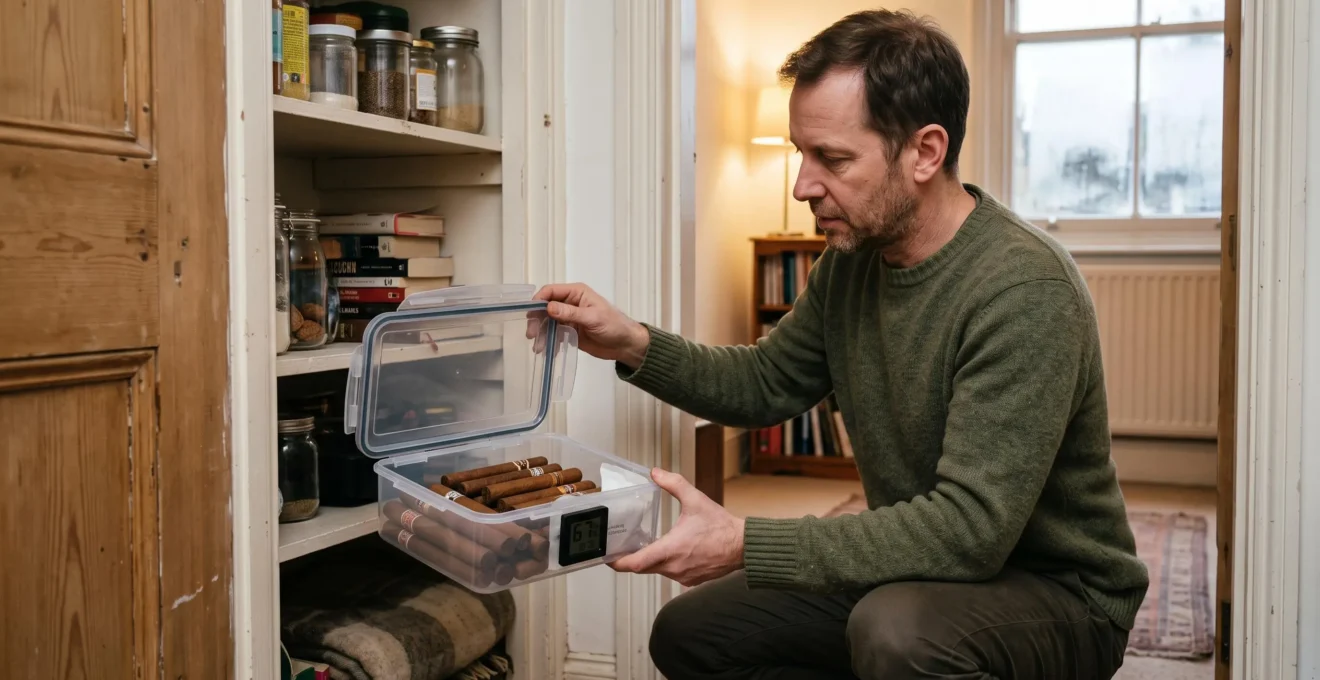
Keeping cigars in good condition inside a British flat is primarily a problem of environmental stability, not finding the perfect humidity percentage. Central heating, cold windows, limited cupboard space and frequent temperature changes can all complicate storage. Yet a small collection does not require an expensive cabinet or constant attention.
For fewer than 50 cigars, a well-sealed container, a reliable hygrometer and correctly sized two-way humidity control can provide a practical foundation. The container should sit in a location protected from direct sunlight, radiators and significant temperature fluctuations. A starting humidity setting around 65–69 % relative humidity (RH) may suit many traditional cigars, although individual preferences and tobacco conditions vary.
The important distinction is between what the hygrometer reports and what is happening inside the tobacco. Cigars exchange moisture gradually, so an apparently sudden environmental change does not always justify immediate intervention. A successful storage system combines appropriate placement, measured adjustments and enough patience for the collection to stabilise.
Cigar storage essentials for UK flats
- Choose a thermally stable internal cupboard before adjusting humidity settings.
- Use an appropriately sized humidity-control pack and a checked hygrometer inside a reliably sealed container.
- Monitor persistent trends rather than reacting to every reading, and keep infused cigars separate from traditional blends.
- Why Does Central Heating Cause Cracked Wrappers and Draw Problems in Winter?
- Desktop Humidor or Airtight Box: Which Works Better for Fewer Than 50 Cigars?
- How to Calibrate a Hygrometer With a Salt Test in Around 8 Hours?
- How to Set Up Stable Storage With One Hygrometer and One Boveda Pack in 20 Minutes?
- How to Stabilise Humidity After Opening a New Cigar Box Without Overcorrecting in the First 72 Hours?
- The Mixing Mistake That Can Make Different Cigars Taste Similar After 30 Days
- Why Can Slightly High Moisture Levels Mute Cigar Flavour During the First 25 Minutes?
- When Should You Check and Rotate Stored Cigars to Avoid Micro-Swings Without Obsessing?
Why Does Central Heating Cause Cracked Wrappers and Draw Problems in Winter?
Central heating reduces indoor relative humidity because warmer air can hold more water vapour without necessarily receiving additional moisture. This can gradually dry exposed cigar tobacco, making wrappers brittle and vulnerable to cracking. However, a tight draw is more commonly associated with excess moisture or cigar construction, so dryness alone should never be blamed for every smoking problem.
The distinction matters particularly in UK flats, where heating may operate intermittently throughout winter. As explained in Condair‘s UK technical guide to indoor humidity control, heating air does not itself remove water vapour. It changes the relationship between temperature and relative humidity.
For illustration, the guide describes air at 0°C and 80% RH reaching approximately 20% RH when warmed to 20°C without additional moisture. This is a physical example, not a prediction for every British home.
The storage location can therefore matter as much as the humidification equipment.
| Location | Main exposure | Practical assessment |
|---|---|---|
| Beside a radiator | Repeated heating and temperature changes | Avoid; move storage away from the heat source. |
| Near a draughty window | Cold surfaces, sunlight and changing temperatures | Avoid direct exposure and possible condensation. |
| Internal cupboard | Usually less direct thermal exposure | Often preferable, provided it stays dry, clean and reasonably stable. |
A cigar does not instantly match the humidity of the surrounding air. Its wrapper, binder and filler exchange moisture at different rates. In a well-sealed container, a brief change in the room’s RH may have little immediate effect on the tobacco itself.
Before increasing humidification in winter, perform a simple seasonal location test. Record the room temperature and container humidity before and after a normal heating period. Repeat under comparable conditions and observe whether the readings recover or continue drifting.
If humidity remains stable inside the container while room readings fluctuate, the seal may already be doing its job. If the internal readings repeatedly change, inspect the lid and storage position before altering the humidity target.
Start by reducing temperature variation. Humidity control becomes easier once the storage environment is no longer exposed to repeated heating and cooling.
Desktop Humidor or Airtight Box: Which Works Better for Fewer Than 50 Cigars?
For a small cigar collection in a centrally heated UK flat, a food-safe airtight box is often the simpler and more space-efficient choice. Its reliable seal can reduce moisture exchange with the room, and it requires no wood seasoning. A well-built Spanish cedar desktop humidor remains suitable when properly prepared, sealed and maintained, especially when appearance and traditional storage matter.
The two options manage moisture differently. Spanish cedar absorbs and releases moisture, providing some buffering against changes. However, dry cedar can initially absorb moisture intended for the cigars, which is why a new wooden humidor requires appropriate seasoning.
Plastic does not provide comparable moisture buffering, but it also does not require seasoning. Its effectiveness depends heavily on the gasket, clips and humidification system.
| Criterion | Spanish cedar humidor | Food-safe airtight box |
|---|---|---|
| Seal reliability | Depends on construction and lid fit | Often easier to verify with a gasket and locking clips |
| Initial preparation | Requires seasoning when new or dry | Clean, dry and check for odours |
| Moisture buffering | Cedar absorbs and releases moisture | Little material buffering |
| Maintenance | Monitor wood condition and humidification | Monitor seal, pack and hygrometer |
| Small-flat practicality | Attractive but may occupy display space | Compact, stackable where safe and easy to conceal |
| Temperature protection | Limited without stable placement | Limited without stable placement |
Neither option can prevent overheating simply by holding the correct RH. A sealed box beside a radiator remains a poor storage environment.
Capacity also deserves scrutiny. A container advertised for 50 cigars may not comfortably hold 50 mixed-format cigars. Long Churchill-sized cigars, larger ring gauges, original packaging and humidity-control equipment all reduce usable space.
Leave sufficient room to retrieve individual cigars without squeezing neighbouring wrappers. Avoid placing a hygrometer where it is obscured or a humidity pouch where it compresses the collection.
Three practical ownership patterns help clarify the choice:
- Occasional smoker: a small airtight box suits a rotating selection and infrequent access.
- Collector with unopened boxes: several appropriately sized sealed containers can support organisation and separation.
- Living-room display: a quality wooden humidor may be preferable if the owner accepts seasoning, monitoring and careful placement.
Before purchasing either option, measure the intended cupboard or shelf and consider the actual cigar formats you plan to store. The advertised capacity is a starting point, not a guarantee of convenient access.
Once the container is selected, the next requirement is trustworthy measurement. An inaccurate hygrometer can make a perfectly adequate storage system appear unstable.
How to Calibrate a Hygrometer With a Salt Test in Around 8 Hours?
A homemade salt test checks a hygrometer against the approximately 75 % RH environment produced by saturated sodium chloride at ordinary room temperatures. Place damp salt with undissolved crystals and the hygrometer inside a sealed enclosure, keeping them separate. Eight hours can serve as an initial observation point, but reliable calibration requires stable readings rather than a guaranteed eight-hour deadline.
The reference works because saturated sodium chloride establishes a characteristic equilibrium humidity when excess solid salt remains present. A watery solution with no undissolved crystals is not the intended reference condition.
- Place ordinary table salt in a small, shallow open dish.
- Add just enough water to make the salt thoroughly damp while leaving visible undissolved crystals and no standing pool.
- Put the dish inside a clean, airtight container or suitable sealed bag.
- Position the hygrometer nearby without allowing it to touch the salt or water.
- Seal the enclosure and keep it at a reasonably constant room temperature.
- Check whether the reading has stabilised before recording an offset or adjusting the instrument.
At around eight hours, the reading may still be changing. Traditional homemade procedures often allow the test to continue overnight, and longer equilibration may be necessary.
For comparison, Boveda‘s hygrometer calibration instructions specify at least 24 hours for the manufacturer’s controlled 75% RH calibration kit, at 19.5–23.5°C. That requirement applies to its commercial kit and does not establish an exact duration for every homemade salt test.
Once the reading is stable, calculate the difference from the reference. For example, if a hygrometer consistently displays 72% RH against a 75% reference, it reads three percentage points low. A later displayed reading of 66% would therefore correspond to an estimated corrected value of 69%, assuming the offset remains consistent.
This example is a calculation, not evidence that the instrument has laboratory-grade accuracy. Record the offset or adjust the hygrometer if its design allows. If readings continue drifting under stable conditions, the problem may be sensor instability rather than a fixed offset.
Homemade tests can be affected by leaking enclosures, temperature changes, incorrectly prepared salt and limited sensor accuracy. A commercially prepared calibration reference is preferable when greater confidence is required.
With a checked instrument and a suitable container, the storage system can be assembled without introducing additional humidification methods.
How to Set Up Stable Storage With One Hygrometer and One Boveda Pack in 20 Minutes?
A basic airtight cigar storage system can be assembled in approximately 20 minutes using a clean, previously prepared container, a checked digital hygrometer and an appropriately sized two-way humidity pack. Inspect the seal, arrange the cigars loosely, position the instrument and pack, then close the lid. Calibration and subsequent moisture equilibration require additional time.
The first decision is the humidity target. For many traditional cigars, 65% and 69% RH are both commonly used settings. A 65% option may suit smokers who prefer a somewhat drier smoking condition, while 69% is Boveda’s general starting recommendation.
Neither setting is universally ideal. Tobacco condition, container characteristics and personal draw preferences all matter. Avoid selecting a higher percentage simply because it appears to provide more protection.
Pack capacity is equally important. According to Boveda’s official humidity-pack sizing chart, the quantity should be based on the container’s stated cigar capacity rather than its current contents.
1 Size 60 pack per 25 cigars
Boveda’s manufacturer recommendation is based on container capacity. A 50-cigar container therefore calls for two Size 60 packs, even when only partly filled.
Boveda Inc., official humidity-pack sizing guidance.
A one-pack system is appropriate only when the chosen pack is rated for the container’s capacity. Larger correctly rated formats can provide an alternative to several smaller packs. The manufacturer’s Size 320 guidance covers a 100-cigar capacity, although the appropriate configuration should always follow the specific product instructions.
Your five-step, 20-minute storage setup
- Inspect the container: check the gasket, clips and interior for damage or residual food odours. Deliverable: a clean, dry container with a visibly intact seal.
- Confirm the location: select an internal cupboard away from radiators, direct sunlight and damp surfaces. Deliverable: a recorded storage position.
- Arrange the cigars: leave sufficient clearance for the lid, sensor and humidity pack. Deliverable: a collection that can be accessed without compression.
- Install the controls: position the checked hygrometer for easy reading and add the correctly rated humidity pack. Deliverable: a visible reading and confirmed pack specification.
- Close and document: secure the lid and note the initial temperature, RH, pack rating and date. Deliverable: the first entry in a simple storage log.
The assembly should not include a wet sponge or a second humidity-control method competing with the pack. Do not combine packs with different RH ratings in the same enclosure, because their regulation targets differ.
Two-way humidity control manages moisture exchange within the sealed space. It cannot prevent overheating, correct an inaccurate hygrometer or immediately restore a severely dried cigar.
After assembly, resist the temptation to adjust the system immediately. The next challenge is recognising normal equilibration when new cigars enter the container.
How to Stabilise Humidity After Opening a New Cigar Box Without Overcorrecting in the First 72 Hours?
Use the first 72 hours after adding cigars as an observation period, not a deadline for complete moisture equilibration. Opening the container changes its air conditions quickly, while the cigars themselves exchange moisture more slowly. Record the baseline, compare subsequent readings under similar temperatures and investigate persistent trends before changing the humidity-control system.
A new box may introduce cigars conditioned differently from those already in storage. Even if the hygrometer quickly returns to the chosen RH, moisture may still be redistributing through the wrapper, binder and filler.
Begin by recording the container’s temperature and RH before adding the cigars. Once they are placed inside and the lid is closed, note the initial reading without treating it as a reliable indication of the tobacco’s final condition.
Over the following three days, check readings at reasonably consistent times and temperatures. A small change immediately after opening is less informative than a repeated movement in the same direction.
| Stage | What to record | How to respond |
|---|---|---|
| Before adding cigars | Baseline RH, temperature and pack condition | Keep as the comparison reference |
| Immediately after closing | Initial reading and incoming cigar condition | Avoid reacting to a temporary disturbance |
| During the first 24 hours | Direction of change under comparable conditions | Check whether readings begin settling |
| At 48–72 hours | Persistent trends and any visible tobacco changes | Investigate if the deviation continues |
If the readings remain unexpected, check four possibilities before intervening: the hygrometer’s known offset, the container closure, humidity-pack capacity and the incoming cigars’ apparent condition.
Repeatedly opening the lid introduces fresh air and can make the readings harder to interpret. Adding water to compensate for an unexplained drop may also create excessive moisture.
Cigars that arrive noticeably dry or damp deserve separate acclimatisation, particularly if their condition differs substantially from the existing collection. Full adjustment may take much longer than 72 hours, and severely dried cigars may require gradual conditioning over several weeks.
Do not assume that every newly purchased cigar requires the same treatment. Reasonably conditioned cigars may need little more than stable storage and observation.
Once moisture conditions are under control, the next consideration is preventing unwanted aroma exchange between different cigars sharing the same storage space.
The Mixing Mistake That Can Make Different Cigars Taste Similar After 30 Days
The most consequential mixing mistake is storing artificially flavoured or infused cigars alongside traditional, non-infused cigars in the same enclosed environment. Strong added aromas can transfer through shared air and potentially affect neighbouring tobacco or absorbent cedar. Thirty days is a useful inspection checkpoint, not a scientifically established deadline at which every cigar develops the same flavour.
Infused cigars may contain pronounced added aromas that are not characteristic of conventional tobacco blends. In a sealed environment, these compounds can influence other cigars over time.
The risk is different when storing ordinary traditional cigars together. Conventional blends can exchange subtle aromas, but separating every origin, strength or wrapper type is generally a matter of storage preference rather than a strict preservation requirement.
Original packaging helps organise a mixed collection and can reduce direct contact. However, the packaging material determines how much separation it actually provides.
| Method | What it helps with | Main limitation |
|---|---|---|
| Ordinary cellophane | Reduces direct contact and offers some protection | Not a completely airtight aroma barrier |
| Cedar dividers | Organises cigars and reduces direct contact | Does not isolate the shared atmosphere |
| Separate sealed containers | Provides independent storage environments | Each container needs suitable humidity control |
For strongly infused cigars, independent airtight storage is the more dependable choice. Each container should have its own humidity-control arrangement and, where practical, a readable hygrometer.
A small inventory can make separation manageable even in a compact flat. Record the cigar type, arrival date, container and whether the product is infused. Review the collection after approximately 30 days to check for unexpected odours, without treating that interval as a proven contamination threshold.
Before reusing a container previously occupied by strongly scented cigars, inspect it for lingering aromas. Clean and air it appropriately for the material, and do not reuse it for traditional cigars if a noticeable foreign odour remains.
Separating aromas preserves the intended character of the collection, but flavour can still disappoint when the tobacco itself contains too much moisture.
Why Can Slightly High Moisture Levels Mute Cigar Flavour During the First 25 Minutes?
Excess moisture can make cigar tobacco burn less consistently, restrict airflow and produce dull or muddled flavours. These effects may be apparent during the opening portion of a smoke, particularly when the cigar requires repeated relighting. However, 25 minutes is not a universal threshold: cigar construction, size, smoking pace and actual tobacco moisture all influence the experience.
The central mechanism involves combustion. Tobacco that contains more moisture than is suitable for its construction may resist even burning, while swelling can contribute to a tighter draw. Frequent relighting can further change the flavour experience.
Tobacconist University’s cigar preservation guidance distinguishes excessive moisture from drying-related wrapper damage and emphasises that tobacco moisture takes time to redistribute through the cigar.
Not every tight draw or disappointing flavour indicates over-humidification. A tightly rolled cigar may restrict airflow even when properly conditioned. Underfilled tobacco, incomplete lighting, aggressive puffing and the intended characteristics of the blend can also affect combustion and flavour.
| Observation | Possible explanation | What to examine |
|---|---|---|
| Resistant draw and repeated relighting | Excess moisture or dense construction | Storage history and comparison with the same blend |
| Uneven burn from the beginning | Moisture imbalance, lighting or construction | Initial lighting and repeated behaviour |
| Harshness after rapid puffing | Smoking pace and combustion temperature | Whether slower puffing changes the experience |
| Brittle or cracked wrapper | Drying or rapid moisture changes | Wrapper condition and storage history |
| Muted flavour without draw problems | Blend characteristics or conditioning differences | Comparable cigars under consistent conditions |
A hygrometer measures the humidity of the storage environment, not the moisture inside the cigar filler. A cigar recently transferred from wetter storage can therefore remain over-conditioned even after its new container reaches the intended RH.
For troubleshooting, compare cigars of the same blend that have been stored consistently. Record draw resistance, relighting frequency and perceived flavour clarity. Look for repeated patterns rather than relying on a single disappointing smoke.
If the evidence suggests excessive moisture, allow gradual conditioning under a stable, appropriate environment. Do not try to compensate by deliberately making the cigar burn hotter; that introduces another variable and can distort flavour further.
Better flavour consistency depends on stable conditions over time, which makes a restrained maintenance routine more valuable than frequent adjustments.
Key takeaways for long-term cigar storage
- Judge storage performance through persistent temperature and humidity trends, not isolated readings.
- Move cigars only when the container layout or repeated evidence suggests uneven conditions.
- Inspect promptly when a seal fails, a humidity pack deteriorates or tobacco shows visible damage.
When Should You Check and Rotate Stored Cigars to Avoid Micro-Swings Without Obsessing?
Check storage conditions regularly without opening the container unnecessarily, and rotate cigars only when there is a practical reason. A readable digital hygrometer and simple log can reveal persistent changes while limiting disturbances. In a small, well-sealed container with relatively uniform conditions, routine rearrangement may offer little benefit and can increase handling-related damage.
The most useful maintenance routine separates external observation from physical inspection. If the hygrometer is visible through a transparent lid, readings can be checked without exposing the cigars to room air.
A weekly external review is a reasonable starting routine for a stable small collection, although the appropriate frequency depends on the seal, sensor reliability and recent changes. Record temperature and RH, noting whether the readings are consistent with previous observations.
Opening the container should be driven by a practical purpose: retrieving a cigar, adding stock, checking the humidity pack or investigating an unexpected condition.
Rotation is sometimes useful in a crowded wooden humidor where humidification is uneven or where cigars remain pressed against particular surfaces. It is less compelling in a small airtight box with adequate clearance and reasonably uniform internal conditions.
Several events justify closer attention:
- Beginning of the heating season: reassess cupboard temperature and exposure to radiators.
- Unusually warm weather: check whether the chosen storage location is overheating.
- New cigar arrivals: observe changes after introducing tobacco with a different storage history.
- Humidity-pack deterioration: replace a spent pack according to its product instructions.
- Persistent unexplained readings: check the hygrometer offset, gasket and container closure.
Escalation should depend on evidence rather than an arbitrary universal RH threshold. A sustained deviation beyond the instrument’s expected uncertainty, a damaged seal, visible wrapper deterioration or suspicious growth on tobacco deserves investigation.
If mould is suspected, isolate the affected cigars and inspect the storage environment. Do not assume that increasing ventilation or rotating the collection will solve the problem. Avoid smoking visibly mould-affected cigars.
A useful maintenance record can be very short: date, temperature, RH, pack condition and any unusual observation. This creates enough history to distinguish a genuine trend from an ordinary temporary fluctuation.
Choose a stable location, confirm that the container seals correctly and establish a baseline reading. Then allow the system to work, intervening when repeated measurements or the condition of the cigars provide a clear reason.
Can cigars be stored safely in a bedroom cupboard?
A bedroom cupboard can be a practical location if it remains clean, dry and reasonably temperature-stable. Avoid cupboards against excessively hot or cold surfaces, and keep the container away from radiators and direct sunlight. Confirm suitability by monitoring temperature and humidity rather than assuming every internal cupboard behaves identically.
Should a cigar storage box be opened every day?
No. A well-sealed container with suitable humidity control does not need daily opening simply to refresh the air. Unnecessary opening introduces disturbances. External hygrometer checks and occasional purposeful inspections are generally more useful.
Can a hygrometer display the correct humidity while cigars remain too damp?
Yes. The instrument measures the surrounding air, while moisture within the wrapper, binder and filler changes more slowly. Cigars recently moved from a wetter environment may require additional conditioning time even after the container reaches its target RH.
Is a wooden cigar box enough for long-term storage?
An ordinary wooden cigar box should not automatically be treated as a properly sealed humidor. It may provide useful organisation and some moisture buffering, but long-term storage requires adequate humidity control and protection from environmental fluctuations. A separate airtight container or correctly maintained humidor is generally more dependable.
Does a UK summer require a different cigar humidity setting?
Not automatically. Seasonal temperature and room humidity changes should prompt a review of storage placement and actual container conditions, not an immediate change in target RH. If the existing setting remains stable and the cigars are properly conditioned, a seasonal adjustment may be unnecessary.