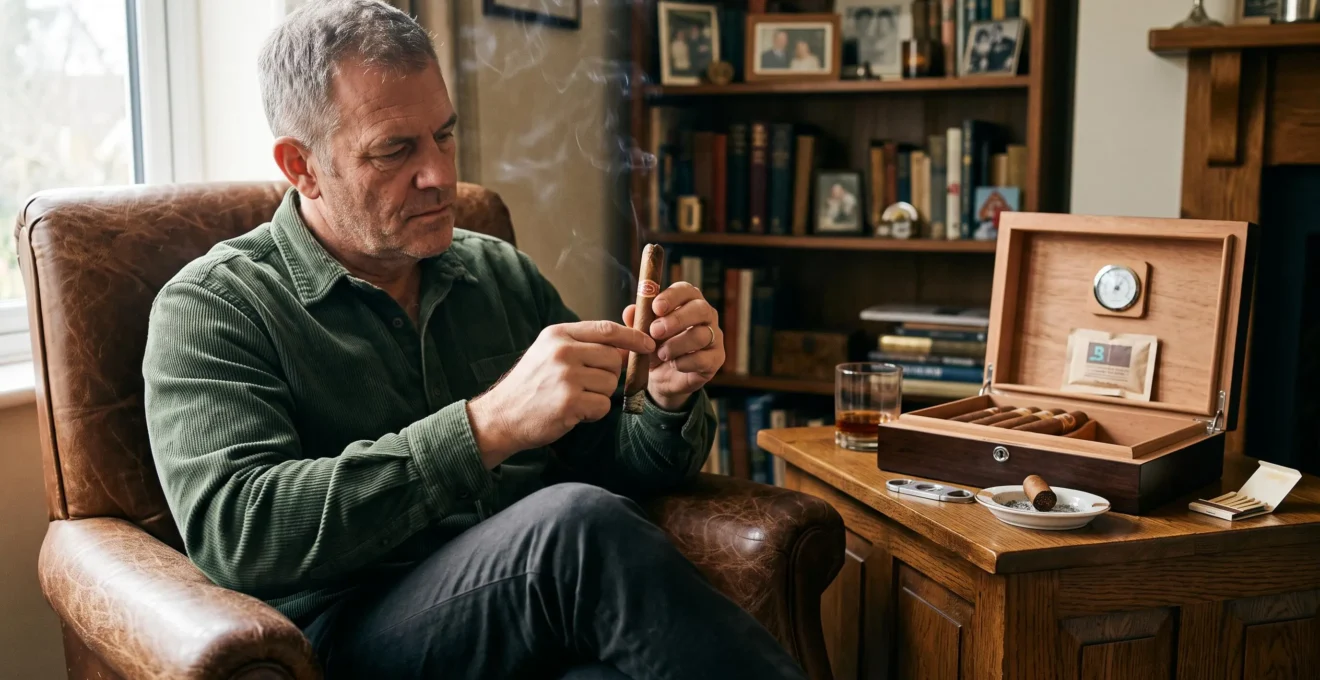
A cigar can draw reasonably well, produce visible smoke and still taste disappointingly flat during its opening third. When tobacco retains more moisture than its construction and blend can comfortably accommodate, combustion may become less consistent. Aromas that should be distinguishable can seem subdued, while the smoke may feel damp or heavy.
The first 25 minutes are a useful observation window, not a scientifically established threshold. A cigar’s burn rate depends on its length, ring gauge, construction and smoking pace. Excess moisture can influence flavour early, throughout the smoke or hardly at all, depending on those variables.
For a UK home smoker, the practical challenge is identifying whether the problem comes from storage humidity, an inaccurate hygrometer or the cigar’s construction. The answer usually begins with three observations: how the cigar feels, how freely it draws and whether the burn line advances evenly.
A methodical approach to relative humidity (RH), acclimatisation and instrument calibration can replace repeated adjustments with measured changes and more consistent smoking results.
What matters most when cigar flavour seems muted
- Excess tobacco moisture can contribute to difficult ignition, uneven combustion and subdued flavour, although these symptoms do not prove over-humidification.
- Use 65–69% RH as a practical initial comparison range, then account for the humidor, environment and individual cigar rather than chasing one supposedly perfect setting.
- Calibrate the hygrometer before adjusting humidification. A stable displayed reading can still be systematically inaccurate.
- Why Over-Humidified Cigars Taste “Steamy” — Even When the Draw Feels Normal
- How to Stabilise a Freshly Opened Box in 72 Hours Without Overcorrecting
- 62% vs 69% Storage — Which Suits Weekend-Only Smokers?
- The Uncalibrated Hygrometer Error That Quietly Ruins Flavour Over 30 Days
- Tuning Humidity for Delicate Wrappers Through the Winter Heating Season
- Why Binder Porosity Decides Whether a Cigar Tunnels or Canoes
- How a Hygrometer Can Read “Stable” While Being Off by 6%
- Why Uncalibrated Hygrometers Make Your Humidor Look “Perfect” While Your Cigars Smoke Badly
Why Over-Humidified Cigars Taste “Steamy” — Even When the Draw Feels Normal
An over-humidified cigar can taste steamy because excessive moisture changes how the tobacco ignites and burns, even when the air passage remains open. Some heat is spent evaporating water rather than sustaining combustion. The result may be subdued flavour, inconsistent smoke production or difficulty keeping the cigar lit. However, taste alone cannot establish excessive moisture.
A cigar consists of combustible tobacco leaves containing moisture distributed through their structure. During smoking, heat dries and heats the tobacco ahead of the combustion zone. When the leaf contains more water, additional energy is required for evaporation, potentially changing the local burning conditions and the delivery of aromatic compounds.
This does not mean water vapour literally blocks every pore or that an over-humidified cigar always burns at one predictably lower temperature. Combustion depends on oxygen availability, tobacco packing, moisture distribution and smoking technique.
A normal draw does not guarantee normal combustion. Air can pass through a cigar whose tobacco is too moist for reliable burning. Conversely, a tightly rolled cigar may resist airflow even at an appropriate moisture level.
The distinction is easier to investigate by combining several observations:
- Possible mechanical obstruction: persistent draw resistance, potentially concentrated around a densely packed section, including before lighting.
- Possible excessive moisture: unusually yielding tobacco, reluctant ignition, repeated relights or subdued flavour across otherwise unobstructed draws.
- Possible construction defect: an irregular burn or restricted airflow that persists after appropriate storage and acclimatisation.
A gentle squeeze can provide a clue, but it is not a validated moisture test. Wrapper thickness and tobacco packing also affect firmness. Excessive squeezing may damage the cigar.
Why might the first 25 minutes taste particularly flat? One plausible explanation is that progressive heating evaporates moisture ahead of the ember. If the tobacco’s local moisture condition changes, later portions may burn differently and release aromas more clearly. However, this pattern has not been established as universal by controlled measurements in the supplied sources.
Similarly, late bitterness should not automatically be attributed to moisture-driven tar accumulation. Condensate, smoking pace, temperature, blend composition and proximity to the head can all affect perceived bitterness.
Industry interviews reported in Cigar Aficionado‘s interviews on cigar construction and flavour support the broader observation that humidity, draw and uneven burning can influence a blend’s smoking characteristics. They do not establish a fixed early-smoking time threshold.
The most useful diagnostic clue is a repeatable pattern across comparable cigars, not one disappointing first third. Before changing the humidor setting, determine whether newly acquired cigars have had enough time to adjust.
How to Stabilise a Freshly Opened Box in 72 Hours Without Overcorrecting
The first 72 hours after opening a cigar box should be treated as an initial observation and acclimatisation period, not a guarantee of complete moisture equilibrium. Keep the cigars in a controlled environment, avoid adding competing humidifiers and record humidity conditions. Depending on box size, previous storage and container design, adjustment may require considerably longer.
Cigars can pass through different warehouse, transport and retail environments before reaching a home humidor. Their initial moisture condition therefore may not match the humidity of the owner’s storage space. A newly opened box may contain cigars that need time to adjust, even when the hygrometer appears reassuring.
Spanish cedar, tobacco filler, binder and wrapper do not necessarily exchange moisture at identical rates. A settled air-humidity reading describes the air near the sensor; it does not directly measure the moisture content of every leaf inside the box.
For an initial three-day assessment, use the following conservative sequence:
- Hours 0–24: check the hygrometer’s calibration status and establish a consistent storage environment. Remove excessive external wrapping where appropriate, but do not disturb protective packaging unnecessarily.
- Hours 24–48: monitor humidity without repeatedly opening the container. If using compatible two-way packs, follow the manufacturer’s quantity and placement instructions.
- Hours 48–72: review the readings, check for obvious wrapper damage and compare the cigars’ condition with their arrival state. Avoid large humidity changes based on one measurement.
- After 72 hours: continue acclimatisation if the cigars or container have not settled. Assess one cigar only when its condition appears suitable.
A lightly opened box inside an adequately sized, properly controlled environment can expose the cigars to the surrounding RH, but the correct arrangement depends on airflow and container construction. A sealed protective bag with correctly sized humidity control may be more predictable than an unstable wooden humidor.
Do not add a second humidification system simply to accelerate adjustment. Combining independently controlled devices can make the resulting environment harder to interpret, while mixed-setting humidity packs may not provide the intended control.
The distinction between an observation window and complete acclimatisation is important. In its winter storage guidance, Boveda gives an example involving a 50-cigar box and recommends at least one week for adjustment, rather than assuming that three days will be sufficient.
Trying to fix suspected excess moisture by rapidly drying cigars can be equally counterproductive. The wrapper may lose flexibility, while different parts of the cigar respond at different rates. Small, gradual changes are preferable to abrupt environmental swings.
Once the box has acclimatised, the next decision is which storage humidity best fits the smoker’s routine rather than the calendar alone.
62% vs 69% Storage — Which Suits Weekend-Only Smokers?
For weekend-only smokers, 62% and 69% RH represent different storage conditions rather than universally better or worse choices. Lower humidity may suit smokers who prefer a comparatively drier cigar, while 69% provides a commonly recommended general-storage setting. Smoking frequency alone does not establish which is best; container stability, wrapper condition and burn performance matter more.
A smoker who removes one cigar each Saturday does not automatically smoke wetter tobacco than someone who smokes daily at the same RH. If both cigars have reached equilibrium in comparable storage, their moisture condition should primarily reflect the storage environment and tobacco characteristics, not how frequently other cigars are removed.
What can differ is the time between removing a cigar and lighting it. A cigar left in dry household air may lose moisture, while one held in a more humid environment may gain or retain moisture. The direction and extent depend on the conditions.
For a practical comparison, the key trade-offs are:
| Criterion | 62% RH | 69% RH |
|---|---|---|
| Storage character | Comparatively dry environment | Higher-moisture general storage environment |
| Potential smoking effect | May favour easier ignition or a drier-feeling smoke | May retain more leaf flexibility but can be less forgiving if the cigar becomes too moist |
| Wrapper consideration | Monitor for stiffness or cracking, especially with delicate wrappers | Monitor for excessive softness or reluctant burning |
| Weekend use | Potential starting point for smokers preferring drier cigars | Established mainstream starting point for general storage |
| Evidence limitation | No direct comparative result in the supplied sources | Manufacturer recommendation, not proof of superior flavour |
Boveda’s cigar humidity recommendations identify 69% RH for most environments and first-time buyers, while 65% is an option for smokers who favour a drier cigar or easier burn. These recommendations do not directly validate 62% against 69% for weekend-only use.
A hybrid storage approach can separate long-term preservation from short-term experimentation. A smoker might maintain a stable primary humidor and use a smaller controlled container for a cigar intended for the coming weekend. Such an experiment should avoid extreme RH changes and use an accurately measured environment.
Moving a cigar from a lower setting to a higher one 24–48 hours before smoking may change its surface condition, but full internal equilibration is not guaranteed. Nor is raising humidity necessarily desirable when the original complaint is a muted or reluctant burn.
UK winter heating, summer indoor humidity, cigar dimensions and wrapper characteristics can all change the practical outcome. Compare similar cigars under consistent smoking conditions before deciding that a lower setting improves flavour.
Whichever setting is chosen, its value is only meaningful if the hygrometer reports the conditions accurately. A persistent measurement offset can make a carefully selected target ineffective.
The Uncalibrated Hygrometer Error That Quietly Ruins Flavour Over 30 Days
An uncalibrated hygrometer can quietly mislead cigar storage decisions because its displayed humidity may differ from the true RH for weeks. A persistent five-percentage-point error can make the humidor appear correctly maintained while the tobacco adjusts to another environment. Thirty days is an illustrative monitoring period, not a proven threshold for flavour deterioration.
Consider a hypothetical humidor displaying 69% RH while its hygrometer consistently reads five percentage points lower than the actual conditions. The true air humidity would be approximately 74% RH. A smoker who trusts the display might mistakenly continue adding moisture rather than investigating the sensor.
The reverse error is possible. A sensor reading too high could encourage unnecessary moisture removal and eventually contribute to dry-wrapper problems.
These are measurement examples, not evidence that every five-point offset produces a specific flavour defect. The effect on the tobacco depends on its starting condition, packaging, temperature, storage duration and the humidor’s behaviour.
Calibration must precede correction. A seemingly stable display only demonstrates that the instrument is reporting a similar value repeatedly. It does not establish that the displayed value is correct.
A controlled 75% RH calibration reference provides a practical way to assess the instrument. Boveda’s documented procedure calls for keeping its calibration kit sealed with the hygrometer for at least 24 hours, within the specified temperature range of approximately 19.5–23.5°C.
A saturated-salt test using sodium chloride is another commonly used reference method, but an improvised container, excess free water, temperature fluctuations or incomplete equilibration may introduce error. A homemade test should therefore not be treated as equivalent to a verified calibration kit.
For the manufacturer’s specific procedure, consult Boveda’s hygrometer calibration instructions. The guidance also recommends checking new instruments and recalibrating every six months.
If an adjustable hygrometer fails a reference check, follow its calibration instructions. For a non-adjustable device, record the observed offset and account for it when interpreting subsequent readings, provided the sensor remains sufficiently consistent.
Comparing two hygrometers can reveal disagreement, but agreement does not independently prove accuracy. Both could share a similar offset. Likewise, a single-point calibration does not guarantee performance across every humidity level.
Five checks to document before changing humidor humidity
- Record the current display: note the date, temperature and RH reading to establish a baseline.
- Check calibration: complete the reference procedure and record the displayed value against the expected reference.
- Calculate the offset: write down the difference in percentage points and whether the instrument reads high or low.
- Inspect one representative cigar: record wrapper condition, draw resistance and burn behaviour without treating any single symptom as conclusive.
- Choose one controlled adjustment: document the intended RH change, observation period and result before making another alteration.
Once the instrument is trustworthy, seasonal conditions become the next variable to control. Winter heating presents a particularly useful example because dry room air can undermine an otherwise sensible storage plan.
Tuning Humidity for Delicate Wrappers Through the Winter Heating Season
Delicate cigar wrappers need stable moisture conditions during the winter heating season because dry indoor air can increase moisture loss from imperfectly sealed humidors. The goal is not automatically to raise or lower the RH target. First control temperature, drafts, humidification capacity and measurement accuracy, then adjust the setting only when observations justify it.
Central heating can reduce indoor relative humidity even when the amount of water vapour in the air has not changed dramatically. If a wooden humidor loses moisture to its surroundings, the internal control system must compensate.
Glass-top humidors, poorly sealed lids and containers placed near heating outlets can be particularly vulnerable. Spanish cedar also exchanges moisture with the surrounding air, adding another influence on the behaviour of a wooden humidor.
A delicate wrapper may become less flexible after excessive drying. Once stressed, the leaf can develop a hairline crack, especially when handled, cut or exposed to changing environmental conditions.
The solution is stability rather than maximum humidity. Raising the target indiscriminately can leave the tobacco wetter than preferred for combustion, while deliberately lowering it during already dry winter conditions may increase wrapper risk.
A reliable winter routine involves keeping the humidor away from radiators, direct sunlight and heating vents, verifying the seal, monitoring readings at comparable times and ensuring that the humidification system has sufficient capacity for the container.
Boveda’s winter guidance identifies approximately 65–72% RH as a preferred storage range within its product recommendations. It also notes that drafty wooden humidors may operate below the humidity setting printed on a control pack. These observations support assessing the container before changing the nominal setpoint.
When a wrapper already feels brittle, gradual reconditioning is preferable to direct wetting. Place the cigar in a stable, appropriate storage environment and allow time for moisture adjustment. Do not spray the wrapper with water or place it against a wet sponge.
A short, superficial crack may remain manageable if the leaf stays attached and the cigar retains structural integrity. A long split, lifting wrapper or exposed filler is more serious. Rehumidification cannot be assumed to restore the original construction or repair fractured tobacco.
Before smoking, avoid abrupt movement between markedly different temperature and humidity environments where possible. Gentle acclimatisation can help prevent further handling stress, although it cannot guarantee that a compromised wrapper will remain intact.
If humidity conditions are consistent but the cigar continues to burn unevenly, the problem may lie in tobacco distribution and construction rather than in the storage environment.
Why Binder Porosity Decides Whether a Cigar Tunnels or Canoes
Binder porosity can contribute to tunnelling or canoeing by influencing how air and heat move through a cigar, but it is not the sole deciding factor. Filler distribution, rolling density, seams, wrapper condition and moisture differences can also create uneven burning. Identifying the pattern helps distinguish a possible construction problem from a storage-related one.
The binder surrounds the filler and helps maintain the cigar’s structure beneath the wrapper. Because combustion and airflow involve the entire tobacco assembly, a thick vein, unevenly distributed tobacco or different local packing densities may influence how the ember advances.
It would be inaccurate to claim that the binder alone governs internal airflow. The filler contributes much of the internal resistance, while the binder and wrapper influence the cigar’s overall structure and burning behaviour.
Tunnelling occurs when the inner tobacco burns ahead of the surrounding material, leaving an outer layer that has not burned at the same rate.
Canoeing describes a visibly uneven burn line where one side advances farther than the other, producing a curved or sloping burn pattern.
The distinction matters because similar flavour complaints can have different causes.
| Observation | Tunnelling | Canoeing |
|---|---|---|
| Visible pattern | Inner material advances while outer tobacco lags | One side burns ahead of the opposite side |
| Possible contributors | Uneven filler density, combustion differences or construction faults | Uneven lighting, airflow, packing, seams or moisture distribution |
| Practical response | Pause and inspect the burn; consider careful correction if feasible | Allow the burn to self-correct or cautiously touch up the lagging side |
| Long-term diagnosis | Compare cigars from the same box under stable storage | Check lighting technique and repeatability across cigars |
Excess moisture may aggravate uneven burning, but it does not necessarily make airflow distribution more uniform. Nor does the available evidence establish that the same cigar will reliably tunnel at one RH and canoe at another.
If canoeing develops, a modest touch-up of the lagging portion may help restore a more even burn. Avoid prolonged direct heating, which can char the wrapper or alter flavour.
For tunnelling, attempts to excavate or aggressively clear the burning centre can damage the cigar and worsen its construction. Allowing the cigar to settle, removing loose ash carefully and assessing whether a restrained relight is possible are less disruptive initial responses.
Rotating the cigar may help manage the effects of ambient airflow, but it will not repair a persistent internal packing defect.
To investigate the underlying cause, compare similarly stored cigars from the same box. A defect isolated to one cigar suggests a different diagnostic direction from a problem repeated across the entire collection.
Construction-related symptoms are valuable evidence, but the humidity reading still needs independent verification. Otherwise, a sensor error can make an environmental problem appear to be a manufacturing fault.
How a Hygrometer Can Read “Stable” While Being Off by 6%
A hygrometer can remain stable while being six percentage points inaccurate because consistency and accuracy are separate measurement properties. A sensor may repeatedly display the same value even when its calibration is offset. Stable readings therefore indicate repeatability under the observed conditions, not necessarily the true relative humidity inside the humidor.
Consider a hypothetical digital hygrometer that repeatedly displays 69% RH while a reliable reference indicates 75% RH. The instrument has a negative offset of six percentage points at that test condition.
If the user only observes the display, the humidor appears perfectly stable. In reality, the cigar storage environment is more humid than the reading suggests.
Several factors can contribute to disagreement between a sensor and the actual conditions. These include factory tolerance, gradual sensor ageing, contamination, inadequate stabilisation time, temperature effects and changes in the sensing element.
Battery condition may also affect certain instruments, but the direction and magnitude of any resulting measurement error depend on the specific device. It should not be assumed that every ageing battery produces a predictable RH offset.
Traditional analogue hygrometers may require mechanical adjustment. Digital instruments may provide an electronic offset function or no adjustment facility at all.
A correction must account for the direction of error. If a sensor reads six points too low, a displayed 69% corresponds to approximately 75% at the calibration condition. Adding humidity because the displayed value looks insufficient would be the wrong response.
The 75% reference method described earlier provides a practical initial check, but a single reference point does not establish the sensor’s accuracy throughout its complete operating range.
For a basic verification routine:
- Check the instrument against a suitable reference under the specified conditions.
- Allow adequate time for stabilisation rather than accepting an early reading.
- Record the difference between the display and the reference.
- Compare with a second instrument where available, recognising that agreement alone is not proof.
- Repeat the assessment if the original device behaves inconsistently or the correction seems implausible.
An additional complication arises when a humidity device supplies more moisture than the storage container requires. A negatively biased hygrometer may conceal the resulting high RH, giving the impression that the system is working precisely as intended.
The relevant risk is not the six-point example itself, which is illustrative. It is the habit of using an unchecked instrument as the sole basis for changing a cigar’s storage conditions.
Once readings can be trusted, combine them with physical cigar observations. That creates a more reliable diagnosis than either instrument data or subjective tasting alone.
Key takeaways before making your next adjustment
- Separate measurement accuracy from storage stability: a steady reading is not proof of a correct setting.
- Look for a repeated pattern across cigars rather than changing humidity after one poor smoke.
- Change one variable at a time and allow enough time to observe its effect before deciding whether the adjustment helped.
Why Uncalibrated Hygrometers Make Your Humidor Look “Perfect” While Your Cigars Smoke Badly
An uncalibrated hygrometer can make a humidor appear perfect because its displayed RH may be stable, plausible and consistently wrong. Meanwhile, the cigars may show reluctant ignition, uneven burns, wrapper damage or disappointing flavour. Effective troubleshooting uses both verified instrument measurements and repeatable cigar observations rather than treating the displayed number as definitive.
The important distinction is between identifying a symptom and diagnosing its cause. A cigar that feels unusually soft and burns reluctantly may be too moist, but similar symptoms can also involve packing density, tobacco composition or smoking conditions.
Likewise, a cracked wrapper may suggest excessive drying, yet handling damage, construction faults and abrupt environmental changes remain possible explanations.
A practical diagnostic framework can narrow the possibilities without overstating what any observation proves.
| Observed problem | Possible explanation | First verification |
|---|---|---|
| Muted or damp-feeling flavour | Excess moisture, blend characteristics or combustion differences | Check calibrated RH and compare similar cigars |
| Repeated relights or reluctant burn | Moist tobacco, inadequate ignition or construction | Review storage conditions and lighting technique |
| Very tight draw | Dense packing, obstruction or possible moisture contribution | Assess resistance before lighting and compare another cigar |
| Canoeing or tunnelling | Uneven construction, ignition or moisture distribution | Check whether the pattern repeats across cigars |
| Dry or splitting wrapper | Moisture loss, physical damage or environmental swings | Inspect the seal, temperature and calibrated RH |
| Large RH fluctuations | Container leakage, changing temperature or inadequate control capacity | Check readings over time and inspect the storage system |
The next decision is whether the hygrometer needs recalibration, replacement or simply a documented correction.
Recalibrate when the instrument has not been checked since installation, shows a persistent plausible offset or has reached its recommended maintenance interval.
Replace it when readings remain erratic after proper testing, adjustment is impossible and the offset is unreliable, or the device cannot provide sufficiently dependable readings for the intended use.
Adjust storage only after distinguishing the sensor error from the actual humidity conditions. Where an adjustment is justified, use small, deliberate steps and allow time for the humidor and cigars to respond.
A hypothetical weekend smoker might discover that a humidor displaying 69% RH actually measures closer to 75% on a trusted reference. The appropriate next action is to verify the measurement and humidification arrangement, not immediately replace every cigar or lower the target by an arbitrary amount.
After correcting the underlying issue, the smoker can compare one cigar from the affected box with another after a suitable period of stable storage. Notes on draw, ignition, burn progression and perceived flavour will reveal more than an isolated tasting impression.
For long-term consistency, calibrate a new hygrometer before relying on it, recheck it at the recommended interval and inspect the humidor during seasonal changes. In a UK home, the transition into and out of the central-heating season is a sensible moment to review storage conditions.
The goal is not to force every cigar to behave identically. Different blends and constructions will still burn differently even when stored under carefully managed conditions.
For the next cigar, start with one calibrated reading, a gentle inspection and a record of the first third’s draw and burn. Repeat the observation under consistent conditions. A small, documented adjustment supported by several observations is more useful than repeatedly chasing a perfect-looking percentage.
Can a cigar be too wet even if the draw feels normal?
Yes. Draw resistance and tobacco moisture are related but separate characteristics. Air may pass through the cigar adequately while excess moisture makes ignition or combustion less reliable. A normal draw therefore does not rule out excessive moisture, just as a tight draw does not prove it. Compare burn behaviour, physical condition and verified storage readings before reaching a conclusion.
Is 65% RH a better compromise than choosing 62% or 69%?
65% RH is a manufacturer-recognised option for smokers who prefer a drier profile or easier burn. It can be a reasonable starting point between the two settings, but there is no supplied controlled comparison proving that it delivers superior flavour. Humidor performance, wrapper condition and personal burn preferences remain relevant.
How long should a newly purchased box stay in a humidor before smoking?
There is no universal adjustment period. Three days can provide an initial monitoring window, but full acclimatisation may take longer. Boveda’s published example for a box of 50 cigars allows at least one week in controlled storage. Previous storage conditions, box size, packaging and humidor performance influence how long adjustment takes.
Can a homemade salt test prove that a hygrometer is accurate?
A properly prepared saturated sodium chloride reference can provide a useful calibration check, but an improvised test is sensitive to temperature, container sealing and preparation errors. A purpose-designed reference kit offers a more controlled procedure. Neither a homemade salt test nor a single-point calibration proves accuracy across the instrument’s entire range.
Will lowering humidor humidity restore flavour to an over-humidified cigar?
Moving an excessively moist cigar towards a suitable storage condition may improve its burning behaviour, but no flavour recovery is guaranteed. Moisture adjustment takes time and should be gradual. If construction, ageing, blend characteristics or smoking technique caused the muted flavour, changing RH alone may not help. Avoid aggressive drying that could damage the wrapper.