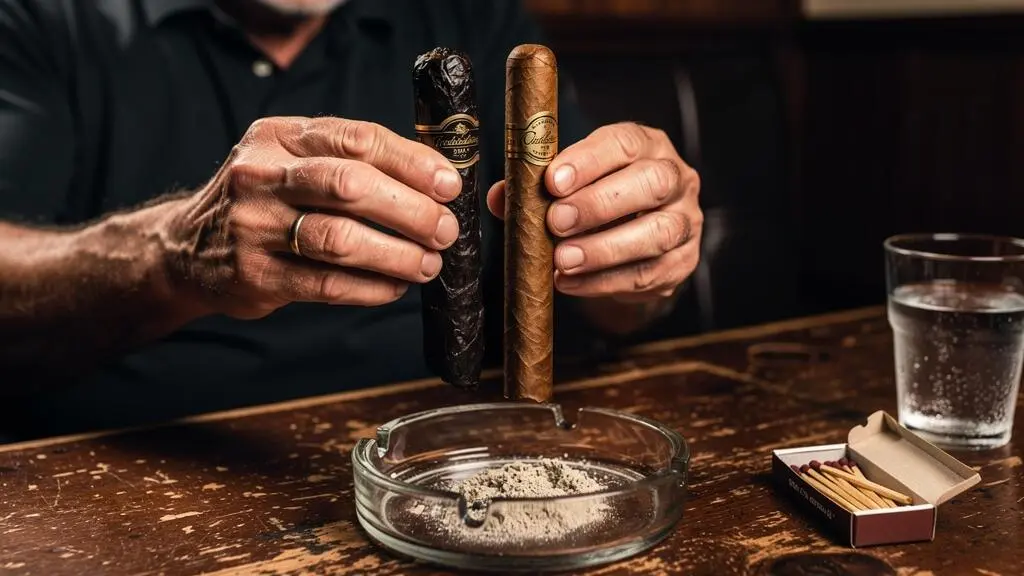
An Oscuro cigar can deliver a sharp, black-pepper-like sensation even when every draw feels measured. The smoke catches the tongue, prickles the back of the throat or stings the nose during a retrohale. Slowing down may reduce the irritation, yet the underlying character can remain surprisingly forceful.
The explanation goes beyond wrapper darkness. Leaf position, tobacco variety, fermentation, filler composition, combustion temperature and individual sensory sensitivity all contribute to the experience. Crucially, pepper intensity, flavour body and nicotine exposure are not interchangeable. A cigar can feel aggressively spicy without producing the systemic effects commonly associated with high nicotine exposure.
For UK smokers drawn to almost-black wrappers but uncomfortable with their sharper edge, the useful question is not simply whether Oscuro is stronger than Maduro. It is which characteristics can be anticipated before lighting, which smoking conditions can worsen irritation and when choosing a different blend makes more sense than trying to endure an unpleasant one.
Oscuro pepper intensity: the essentials
- Darkness does not predict nicotine strength. Wrapper processing, tobacco priming and the complete blend matter more than colour alone.
- Pepper and roughness involve sensory irritation. Heated smoke and its chemical constituents can stimulate sensitive nerves in the mouth and nose, even with a restrained puffing rhythm.
- Selection matters more than persistence. Wrapper condition, blend composition and smoking environment influence comfort, but stopping an irritating cigar is preferable to forcing the experience.
- Why Do Upper-Plant Dark Leaves Feel Rougher and More Aggressive on the Palate?
- How to Handle an Oscuro Without Getting Pepper Burn in the First 10 Minutes?
- Oscuro or Maduro: Which Is Less Aggressive if You Still Want Dark Aromas?
- The Outdoor-Weather Mistake That Makes Oscuro Cigars Feel Twice as Harsh
- When Should You Eat Before an Oscuro to Avoid the Nicotine Wall at Minute 20?
- Why Do Top-Priming Leaves Often Feel Stronger Within the First 10 Minutes?
- Why Can Pepper Sensation Feel Stronger Than Nicotine on the Same Cigar?
- Why Does Peppery Strength Hit Your Nose Even When the Cigar Isn’t High Nicotine?
Why Do Upper-Plant Dark Leaves Feel Rougher and More Aggressive on the Palate?
Upper-plant tobacco leaves often develop a more substantial structure and can contain more nicotine than lower leaves, depending on variety and growing conditions. In certain cigar blends, these characteristics contribute to a fuller, more assertive smoking experience. However, upper priming does not automatically create pepper, and an Oscuro wrapper’s darkness cannot independently establish how rough it will feel.
Tobacco leaves are harvested according to their position on the stalk, commonly called their priming. Upper leaves generally experience greater sunlight exposure during growth and may develop thicker tissue than leaves from lower positions. Their chemical composition also reflects nitrogen availability, maturity, cultivation practices and genetics.
The Agronomic Practices Affecting Nicotine Concentration in Flue-Cured Tobacco review reports a general tendency for nicotine concentration to increase towards the upper stalk. One cited comparison records average concentrations of 18.7 g/kg in lower leaves, 26.5 g/kg in middle leaves and 32.6 g/kg in upper leaves.
Those figures concern flue-cured tobacco, not a direct experiment on Oscuro cigar wrappers. They establish a useful agronomic distinction, but they cannot prove that upper leaves contain more pepper-producing compounds or that their nicotine concentration determines what a cigar smoker absorbs.
18.7 / 26.5 / 32.6 g/kg
Illustrative nicotine concentrations for lower, middle and upper stalk positions, respectively, in flue-cured tobacco research cited by the 2019 agronomic review. These are not measured values for Oscuro cigars.
American Society of Agronomy, Agronomy Journal review, 2019.
An Oscuro’s appearance results partly from leaf selection and processing. The Scandinavian Tobacco Group‘s explanation of cigar wrappers describes Oscuro as the darkest Maduro classification and associates it with extended time on the plant and fermentation. These descriptions are useful industry terminology, not universal production specifications.
Before lighting, examine the wrapper under natural light. Look for prominent veins, an even surface and visible oils, then gently assess whether it feels resilient rather than brittle or excessively soft. Comparing two cigars can reveal physical differences, but surface oiliness or visible veins cannot reliably quantify nicotine, chemical irritation or eventual pepper intensity.
A dark wrapper with a pronounced texture may suggest an assertive presentation, yet the filler and binder can either reinforce or balance that impression. **The blend, not the colour, remains the better predictor.**
Once that distinction is clear, the next consideration is whether combustion and draw conditions are making an already assertive blend feel unnecessarily abrasive.
How to Handle an Oscuro Without Getting Pepper Burn in the First 10 Minutes?
An Oscuro’s opening can feel especially sharp if the tobacco burns unevenly, the draw requires excessive effort or repeated puffs produce increasingly hot smoke. Checking construction before lighting and avoiding aggressive overheating may reduce avoidable irritation. Neither technique guarantees comfort: a naturally pepper-forward blend can remain irritating even when handled carefully.
Start with the unlit cigar. Examine the cap, wrapper integrity and firmness along the body. A very firm section may indicate restricted airflow, although external inspection cannot fully establish how the cigar will draw. A clean cap cut should preserve the shoulder rather than remove more material than necessary.
With an Oscuro, an excessively restricted draw can tempt the smoker into pulling harder or more frequently. That behaviour may change the combustion pattern and increase exposure to hot, irritating smoke. Cutting progressively rather than removing a large section immediately also avoids unnecessary damage to the cap.
At lighting, avoid prolonged direct flame contact that chars one area of the foot. An uneven or excessively charred start can introduce bitterness and make the initial smoke feel harsher. The practical aim is even ignition without unnecessarily reheating the tobacco.
A distinction also matters between prevention and correction. Before lighting, the relevant controls concern cigar condition, construction and blend choice. Once the tongue or nose already feels irritated, continuing to adjust technique may offer little benefit. Stop exposing the affected area to smoke rather than repeatedly testing whether the sensation has disappeared.
Water can relieve a dry mouth, but it does not neutralise smoke irritants or nicotine exposure. Likewise, a longer pause is not a guarantee that irritation will resolve sufficiently for smoking to resume.
Five checks before deciding whether to light an Oscuro
- Inspect the wrapper. Record whether it appears intact, brittle, cracked or unusually soft; the deliverable is a clear condition assessment.
- Check the cap and construction. Identify any visible damage or pronounced hard spots; the deliverable is a decision on whether the cigar appears suitable for cutting.
- Review the blend description. Identify any disclosed wrapper origin, filler composition or priming information; the deliverable is a short list of confirmed characteristics.
- Check the surroundings. Note strong wind, excessive dryness or other conditions likely to complicate combustion; the deliverable is a decision to proceed or postpone.
- Set a stopping criterion. Decide not to continue if irritation, dizziness or nausea develops; the deliverable is a clear boundary rather than a target duration.
The first ten minutes should not be treated as a challenge to complete. If the smoke is immediately unpleasant, abandoning that cigar is a reasonable judgement about its suitability, not evidence of poor technique.
When a well-conditioned Oscuro remains consistently uncomfortable, changing the wrapper or blend is more dependable than continually modifying the way it is smoked.
Oscuro or Maduro: Which Is Less Aggressive if You Still Want Dark Aromas?
A Maduro is often the more promising starting point for someone seeking dark chocolate, coffee or molasses-like aromas without the pronounced pepper associated with certain Oscuros. Extended fermentation can contribute to a mellower flavour profile, while Oscuro represents an especially dark wrapper classification. However, neither term guarantees a particular level of irritation, nicotine exposure or sweetness.
Maduro describes a dark wrapper condition associated with processing, particularly fermentation involving heat and moisture. Oscuro is commonly used for the darkest expression of that classification, although manufacturers differ in the way they select and describe their tobacco.
There is also an important distinction between flavour and mouthfeel. A cigar may offer intense roasted-coffee notes but remain relatively rounded on the palate. Another may appear sweeter in aroma yet produce substantial nasal irritation. The presence of dark flavours is not itself evidence of greater physiological strength.
The following grid describes tendencies and selection considerations, not universal technical standards.
| Criterion | Oscuro | Maduro |
|---|---|---|
| Wrapper appearance | Very dark brown to almost black | Dark brown, with substantial variation |
| Fermentation and processing | Often associated with extended maturation and fermentation; methods vary | Generally associated with substantial fermentation; methods vary |
| Wrapper origin | Depends on the producer, seed and growing region | Equally dependent on the producer, seed and growing region |
| Dark flavour expectations | May suggest earth, dark roast, cocoa or concentrated tobacco character | May suggest cocoa, coffee, molasses or rounded roasted notes |
| Pepper and sweetness | Some blends emphasise sharp pepper and dry intensity | Some blends emphasise smoother sweetness, but others remain peppery |
| Palate texture | Can be dense, assertive or abrasive | Can be rounder, although not necessarily mild |
| Food and drink tolerance | Pairing comfort depends on the drink, blend and individual sensitivity | Potentially easier to match with less intense flavours, without any guarantee of reduced irritation |
A practical comparison is to examine Maduro and Oscuro offerings from the same manufacturer, preferably with comparable filler descriptions and formats. This reduces some variables, although a shared brand or wrapper seed does not guarantee comparable strength.
Independent tasting descriptions can help identify recurring terms such as black pepper, sharp finish, creamy texture or dry cocoa. Agreement between several informed reviewers is more useful than relying on one colour photograph or a product’s strength label.
Even then, reviewers describe their own experiences. Their sensory impressions are not controlled measurements of irritation or nicotine delivery.
For someone repeatedly overwhelmed by Oscuro’s pepper, selecting a darker-flavoured but less abrasive blend is a legitimate preference. There is no meaningful benefit in treating tolerance of harsh smoke as a qualification for appreciating premium tobacco.
This comparison also becomes more useful when the cigar’s storage condition and the surrounding weather are considered, because even a familiar blend can behave differently outside.
The Outdoor-Weather Mistake That Makes Oscuro Cigars Feel Twice as Harsh
The outdoor mistake is assuming that a cigar will behave exactly as it does in a stable indoor environment. Dry conditions can affect tobacco moisture, while strong wind can disturb combustion and make smoke difficult to manage. Together, these factors may increase perceived harshness. However, there is no established evidence that outdoor weather literally doubles Oscuro pepper intensity.
Two separate issues are involved: the moisture condition of the cigar itself and the weather during the session.
Premium cigar tobacco is hygroscopic, meaning it exchanges moisture with its environment. A cigar that has become excessively dry can develop brittle wrappers, cracking and altered burning behaviour. Conversely, tobacco containing too much moisture may swell, draw poorly, burn unevenly or struggle to remain lit.
Tobacconist University‘s cigar preservation guidance discusses traditional storage around 70% relative humidity and reports that many premium cigars are successfully maintained between 65% and 70% relative humidity. These figures are general preservation guidance, not an experimentally validated Oscuro-specific requirement.
More moisture is therefore not always preferable. A very soft cigar with an obstructed draw can be just as frustrating as one with a dry, cracking wrapper.
Wind introduces a different problem. Moving air can affect the burning foot and the direction of smoke. In cold weather, a smoker may also be tempted to draw differently or more frequently, although this behavioural response varies and has not been established as a universal effect.
The distinction matters because moving to shelter does not recondition tobacco that has already become excessively dry. Equally, a properly stored cigar cannot eliminate strong wind.
Before an outdoor session, confirm that the cigar has been kept under stable conditions, inspect the wrapper and assess whether the location is sufficiently sheltered. If the wind is repeatedly disturbing combustion, postponing the session is more sensible than attempting to compensate through repeated drawing.
Storage humidity should also not be confused with the relative humidity of the outdoor air. A reading from a humidor reflects storage conditions; it does not establish how a cigar will behave after prolonged exposure to a changing environment.
With environmental variables accounted for, the next issue is more personal: whether sensations attributed to pepper are actually signs of nicotine exposure.
When Should You Eat Before an Oscuro to Avoid the Nicotine Wall at Minute 20?
There is no scientifically established meal timing that prevents an Oscuro smoker from experiencing excessive nicotine exposure at minute 20 or any other point. Eating beforehand may feel preferable to smoking on an empty stomach for some individuals, but it is not a reliable protective measure. The safest response to nausea, dizziness or weakness is to stop smoking immediately.
The expression nicotine wall describes an informal experience rather than a recognised clinical threshold. Smokers may use it for a combination of queasiness, sweating, light-headedness, weakness or a sudden sense that continuing is unpleasant.
These symptoms should not be interpreted as an inevitable milestone in a strong cigar. They can indicate excessive nicotine exposure or another health problem requiring attention.
Nicotine exposure depends on more than wrapper colour. Relevant variables include the tobacco’s composition, the cigar’s overall construction, smoking behaviour and the individual’s sensitivity. Upper-position leaves can contain comparatively high nicotine concentrations in certain tobacco production systems, but raw-leaf concentration does not directly establish the dose received by an individual smoker.
The suggested twentieth-minute threshold is therefore misleading if treated as a prediction. One person might feel unwell much earlier, another later, and neither timing is a reliable indicator of a cigar’s chemical strength.
Body weight, individual tolerance, smoking duration and stomach contents may be relevant to personal experiences, but the supplied evidence does not quantify their separate effects or establish a preventive meal schedule.
For someone considering an Oscuro, ordinary eating and hydration habits should be maintained for general wellbeing rather than treated as a way to make nicotine exposure safe. There is no supported basis for prescribing a substantial meal a particular number of minutes before lighting, nor for claiming that specific foods measurably improve nicotine tolerance.
If nausea, dizziness, cold sweating or marked weakness develops, stop smoking and move away from the smoke. Seek urgent medical advice if symptoms are severe, persistent or worsening. Chest pain, breathing difficulty, fainting or confusion warrant emergency medical attention.
Pushing through these symptoms to finish a cigar provides no sensory advantage and risks worsening the experience. A cigar can be put down unfinished without any need to justify the decision.
The better question is not how to prepare the body to tolerate an aggressive cigar, but how the blend’s composition may influence the intensity encountered from its opening draws.
Why Do Top-Priming Leaves Often Feel Stronger Within the First 10 Minutes?
Top-priming tobacco can contribute pronounced body and intensity from the beginning because its characteristics are present throughout the portion of the blend being burned. When a cigar contains substantial amounts of assertive upper-position tobacco, its opening may feel forceful rather than gradually developing. Nevertheless, the first ten minutes are not a universal strength window, and not every Oscuro uses upper-priming tobacco in the same way.
Cigar blenders work with tobacco from different positions on the plant and different stages of processing. The terms ligero, seco and volado are commonly used to describe leaf categories and their functions in cigar blends, although terminology and blending practices vary between producers.
Ligero is generally associated with tobacco from higher plant positions and a more substantial contribution to body and strength. Seco is often discussed in connection with aroma, while volado is associated with combustion characteristics. These broad descriptions should not be taken as fixed chemical specifications.
A blender can use contrasting tobaccos to balance flavour, combustion and perceived intensity. The wrapper contributes to the smoking experience, but the filler and binder also matter considerably.
For example, consider two hypothetical Oscuro cigars with similarly dark wrappers. One contains a substantial proportion of assertive upper-position filler; the other uses a different filler composition designed for a less forceful profile. Their visible colour could be comparable while their opening impressions differ noticeably.
Illustrative blend comparison: identical appearance, different intensity
In this hypothetical comparison, Cigar A has a dark Oscuro wrapper and a filler described as rich in upper-priming tobacco. Cigar B has a similarly dark wrapper but a filler presented as more balanced between different leaf positions.
It would be reasonable to investigate whether Cigar A offers a more assertive opening, but the descriptions alone cannot prove how much pepper either cigar produces. Construction, tobacco origin, processing and individual sensory response remain relevant.
Some lighter-coloured cigars seem to develop in intensity as the session progresses, while certain fuller-bodied blends appear expressive immediately. This contrast is familiar in tasting descriptions but should not be attributed exclusively to priming.
When reviewing a cigar before purchase, prioritise specific information about wrapper origin, binder, filler countries and disclosed priming categories. A vague label such as full-bodied provides less insight than an informative blend description.
Where a manufacturer does not disclose these details, the absence should remain an uncertainty rather than be filled with assumptions based on wrapper darkness.
Even detailed blend knowledge cannot answer every sensory question, because the irritation perceived as pepper and the physiological effects associated with nicotine involve partly different mechanisms.
Why Can Pepper Sensation Feel Stronger Than Nicotine on the Same Cigar?
Pepper-like irritation can feel more immediate than the systemic effects of nicotine because the mouth and nose contain sensory nerves that respond directly to heat and chemical irritants. These responses are not identical to nicotine absorption and its effects throughout the body. However, nicotine itself can contribute to sensory irritation, so the two experiences cannot be separated completely.
When smoke produces a biting sensation on the tongue or a sharp response inside the nose, the trigeminal sensory system is relevant. This system helps detect chemical irritation, heat and other potentially harmful stimuli.
The Surgeon General report on tobacco sensory perception explains how trigeminal nerves respond to chemical and thermal stimulation. Its discussion includes sensory effects of heated smoke and pungent substances such as black pepper, mustard and wasabi.
This helps explain why a smoker may describe an intense pepper sensation even without reporting obvious dizziness or nausea. The sensation is a direct response to smoke exposure, not a measurement of the total nicotine absorbed.
It does not establish that the chemicals producing an Oscuro’s pepper profile are identical to those found in culinary pepper. Nor does it mean that an irritating cigar necessarily contains little nicotine.
Individual sensations can be organised into a practical interpretation grid, provided it is not mistaken for a medical diagnostic tool.
| Reported sensation | Possible explanation | Appropriate interpretation |
|---|---|---|
| Sharp tongue or mouth bite | Chemical or thermal irritation | Stop exposure if uncomfortable; the sensation does not quantify nicotine |
| Stinging or burning in the nose | Trigeminal stimulation from smoke constituents or heat | Avoid further nasal exposure rather than trying to develop tolerance |
| Dizziness, sweating or nausea | Possible excessive nicotine exposure or another medical cause | Stop smoking; seek medical assistance when warranted |
| Dense flavour and lingering roasted notes | Perceived flavour body and aromatic characteristics | Not a dependable measure of either nicotine delivery or irritation |
| Increasingly hot or bitter smoke | Potential changes in combustion and smoke temperature | Consider the condition of the cigar, but do not continue through irritation |
A further complication is that people use the word strength differently. One reviewer may mean intense flavour, another substantial nicotine impact, and a third a pepper-heavy finish.
Descriptions such as full-bodied, pepper-forward and high nicotine should therefore be read as different claims requiring different kinds of evidence. A tasting note cannot establish laboratory nicotine content or individual nicotine uptake.
This distinction becomes especially important when smoke is directed through the nose, where a brief exposure can produce a strikingly sharp sensation.
Key takeaways before considering nasal pepper intensity
- Identify the sensation before interpreting strength: immediate nasal stinging is not proof of high systemic nicotine exposure.
- Do not confuse familiarity with safety: becoming accustomed to a sensation does not make smoke exposure harmless.
- Let comfort determine suitability: a consistently irritating blend does not need to be endured to appreciate its darker aromatic qualities.
Why Does Peppery Strength Hit Your Nose Even When the Cigar Isn’t High Nicotine?
Peppery smoke can produce an intense nasal sensation because the nasal passages contain trigeminal nerves sensitive to chemical irritants and heat. During a retrohale, smoke enters this sensitive region and may trigger immediate stinging or burning. That response does not require a high systemic nicotine dose, although nicotine can also participate in irritation and cannot be excluded as a contributing factor.
Retrohaling is the practice of passing some smoke from the mouth through the nasal passages during exhalation. It is sometimes used in cigar tasting to perceive aromatic characteristics that may be less apparent through the mouth alone.
The nose, however, is not merely an aroma detector. Its sensory nerve endings also respond to potentially irritating substances. This is why a peppery cigar can feel markedly more aggressive during nasal exposure than during an ordinary mouth-only tasting experience.
Descriptions of volatile pepper compounds should be interpreted cautiously. Tobacco smoke contains many chemical constituents, and the available evidence does not identify a single Oscuro-specific compound responsible for every pepper sensation.
For someone who experiences strong nasal discomfort, the sensible adjustment is to avoid deliberately directing smoke through the nose. A partial retrohale may reduce the amount of smoke routed nasally compared with a full one, but it is not a proven safe technique and can still cause irritation.
Likewise, reducing the frequency of nasal exposure does not eliminate the harmful constituents of tobacco smoke. A less painful sensory experience should not be mistaken for reduced health risk.
Some experienced smokers report that intense sensations feel less surprising after repeated encounters. Such familiarity may alter subjective perception, but the evidence supplied does not establish reliable physiological acclimatisation to Oscuro smoke or show that repeated exposure becomes beneficial.
There is no reason to train the nose to tolerate burning, nor to use repeated exposure as a test of cigar expertise.
The broader explanation for Oscuro pepper is therefore a combination of tobacco selection, processing, blend architecture, combustion conditions and sensory physiology. Its characteristic darkness is only one part of that picture.
Practical choices remain available before purchase: investigate the blend rather than relying on the wrapper label, compare Maduro alternatives for dark aromatic character, and avoid products repeatedly associated with uncomfortable irritation in personal experience.
If an Oscuro consistently feels unpleasant, the next useful step is to compare its documented blend characteristics with a Maduro or another less irritating alternative. Choose according to flavour preference and comfort, rather than pursuing greater exposure or treating pepper tolerance as an achievement.
Does an almost-black Oscuro wrapper mean the cigar contains more nicotine?
No. Wrapper darkness reflects tobacco selection and processing, but does not independently establish nicotine concentration or the dose a smoker absorbs. Leaf position, tobacco variety, filler composition and smoking behaviour also matter. A dark appearance is not a reliable nicotine-strength measurement.
Can a premium Oscuro be genuinely mild despite its dark appearance?
Yes, a cigar with an Oscuro wrapper may be described as mild or moderate in flavour intensity or nicotine impact, depending on its overall blend. Those descriptions remain subjective unless supported by specific measurements. The colour of the wrapper alone cannot resolve the question.
Does an oily Oscuro wrapper guarantee a peppery smoking experience?
No. Visible oils can describe part of the wrapper’s surface appearance, but they do not provide a dependable measurement of pepper-producing irritants. A cigar’s taste and texture depend on its wider blend and combustion behaviour. Surface oiliness is best treated as an observation, not a prediction.
Is a cigar that feels smoother necessarily less harmful?
No. Smoothness describes a sensory impression, not a health-risk assessment. Cigars with mild or rounded flavour profiles still expose users to nicotine and harmful smoke constituents. Neither choosing Maduro over Oscuro nor avoiding retrohaling makes smoking safe.
Should a dry or excessively moist Oscuro be smoked immediately?
Neither condition is ideal. Excessively dry tobacco may become brittle and crack, while excess moisture can impair the draw and combustion. Stable, appropriate storage is preferable to smoking a visibly compromised cigar or trying to correct its condition through aggressive lighting. Proper conditioning addresses preservation, not the health risks of tobacco smoke.