A Maduro can begin with convincing dark chocolate, espresso and toasted-earth flavours, then finish with an unpleasant burnt edge. The temptation is to blame the fermentation that produced those appealing aromas in the first place. Yet fermentation and smoking heat are separate processes, and the distinction matters when choosing a cigar.
During fermentation, tobacco undergoes changes involving heat, moisture, microorganisms and chemical reactions. Those changes can contribute to the rounded, cocoa-like character associated with certain Maduro wrappers. Once the cigar is lit, however, combustion conditions, tobacco moisture, construction and smoking behaviour increasingly affect the experience.
The notorious 40-minute bitterness is therefore not a universal Maduro defect or a scientifically established deadline. It is a useful personal observation that deserves investigation.
For UK smokers moving towards darker wrappers, the practical goal is not simply finding the darkest leaf. It is identifying a blend that delivers enjoyable roasted flavours without excessive harshness, unwanted nicotine effects or an exhausting finish.
Maduro fermentation and bitterness: the essentials
- Fermentation can contribute cocoa-like aromas and reduce certain harsh characteristics, but wrapper darkness does not guarantee chocolate flavour or low nicotine strength.
- Late bitterness may reflect changing combustion conditions, accumulated smoke residues, unsuitable moisture, aggressive puffing or the blend itself. Forty minutes is not a universal threshold.
- Choose cigars using wrapper and filler information, documented flavour development across all thirds, consistent storage and personal tolerance for concentrated flavours.
- Why Does Fermentation Heat Reduce Harshness Even When Nicotine Feels Strong?
- Why Does High-Heat Fermentation Create Cocoa Aromas but Raise Bitterness Risk Later?
- How to Smoke a Maduro Without Overheating It in the First 25 Minutes?
- The High-Humidity Mistake That Makes Maduros Taste Sour and Bitter by Minute 30
- When Should You Rest a Box of Maduros for 30 Days to Get a Smoother First Third?
- Maduro or Colorado: Which Delivers Roasted Depth Without Feeling Heavy at 9pm?
- Why Can a Full-Bodied Maduro Feel Too Much Even When Nicotine Isn’t Extreme?
- Why Does a Full-Bodied Maduro Feel Overwhelming Even After a Big Meal?
Why Does Fermentation Heat Reduce Harshness Even When Nicotine Feels Strong?
Fermentation heat helps transform tobacco compounds and facilitates the reduction of volatile substances associated with raw, irritating flavours, including ammonia. However, reduced harshness does not mean reduced nicotine strength. A carefully fermented Maduro wrapper can taste smooth and rounded while the cigar’s filler blend still produces substantial nicotine exposure and noticeable physical effects.
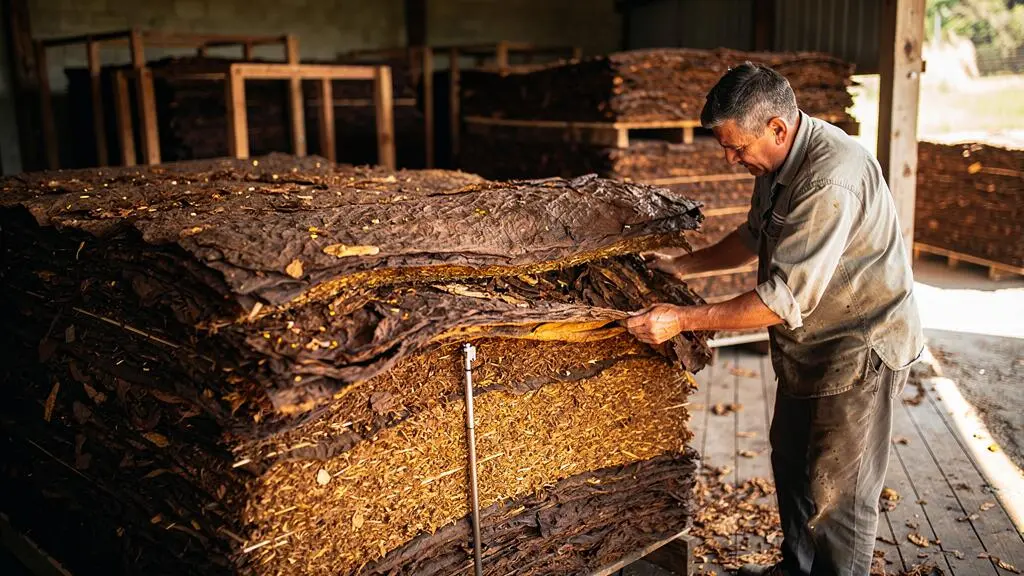
Fermentation takes place before a cigar is rolled. Tobacco leaves are assembled into substantial piles, where biological activity and chemical processes generate heat. Moisture, pressure, oxygen availability and the turning of leaves influence how the tobacco develops.
During appropriate processing, ammonia and other volatile substances can dissipate while the leaf undergoes further chemical changes. The resulting tobacco may lose some of the sharp, raw character associated with insufficiently processed leaf.
This is fundamentally different from heating tobacco through combustion. Fermentation aims to condition the leaf under controlled manufacturing conditions; burning tobacco creates smoke through combustion and thermal decomposition, introducing new compounds and potentially harsher sensations.
The National Academies report chapter on cigar characteristics explains that nicotine exposure depends on tobacco properties, smoke chemistry and smoking behaviour. Smooth flavour is therefore not a dependable measure of nicotine delivery or health risk.
Three separate observations are useful when evaluating a Maduro:
- Chemical harshness: sharp, ammonia-like irritation or an aggressively raw sensation that overwhelms the underlying tobacco flavour.
- Flavour intensity: concentrated cocoa, roasted coffee, earth, pepper or wood that may be powerful without being physically irritating.
- Nicotine-related sensations: lightheadedness, nausea, sweating or other physical effects that should not be confused with an intense flavour profile.
A cigar can score low for harshness, high for roasted flavour and high for nicotine impact simultaneously. The dimensions overlap in subjective experience, but they are not interchangeable.
Fermentation is also only one part of the finished product. Tobacco variety, leaf position on the plant, the proportion of stronger filler leaves, maturation and rolling quality all affect the final result.
Fermentation establishes part of Maduro’s aromatic foundation. The next question is why that appealing foundation can seem to disappear as the cigar burns.
Why Does High-Heat Fermentation Create Cocoa Aromas but Raise Bitterness Risk Later?
More intensive fermentation can influence tobacco’s aromatic compounds and contribute to cocoa-like, roasted and earthy impressions. But fermentation heat does not directly explain bitterness appearing after 40 minutes. Later harshness is more plausibly investigated through changing smoke temperature, combustion conditions, moisture, accumulated condensates and the cigar’s underlying blend. Forty minutes is an observation, not a universal chemical trigger.
Cocoa notes do not necessarily mean that the tobacco contains chocolate, has been flavoured with chocolate or possesses unusually high sugar content. They are sensory descriptions arising from the combined perception of aromatic substances.
A 2023 Frontiers in Microbiology study on cigar tobacco fermentation identified cocoa-like sweetness among the sensory characteristics of fermenting cigar tobacco. The researchers also examined relationships between microbial communities and aroma compounds.
That supports the complexity of fermentation-related aroma development, not a single chemical explanation for every chocolate-tasting Maduro.
More recent Springer Nature research on fermentation temperature and cigar tobacco aromas examined tobacco from Dominica and Yunnan under a 20–60 °C experimental temperature gradient. The samples showed different volatile-compound responses, reinforcing why fermentation temperature alone cannot predict a finished cigar’s flavour.
What the 2026 fermentation experiment actually establishes
The researchers compared microbial communities and volatile compounds in cigar tobacco leaves from two origins exposed to different fermentation temperatures.
Dominica samples exhibited substantial ester, alcohol and ketone production across temperature stages, while Yunnan samples accumulated more pyrazines, indole and terpenoids at temperatures of at least 50°C. These were experimental findings about tobacco leaves, not evidence that commercial Maduros become bitter after a particular smoking duration.
The transformation continues in a completely different way once the cigar is lit. As smoking progresses, the unburnt portion becomes shorter, the smoke travels through changing lengths of tobacco, and moisture and smoke-derived residues can accumulate.
The Cancer Council Victoria chapter on tobacco smoke emissions describes evidence that cigar smoke temperature and chemistry can change during consumption. The reviewed measurements are not Maduro-specific, and they do not establish a reliable 40-minute tipping point.
A practical flavour diagnosis separates two experiences:
- Desirable roasted bitterness: dark chocolate, espresso or charred wood impressions that remain balanced, recognisable and compatible with the cigar’s other flavours.
- Unpleasant acridity: burnt, metallic, persistently sour or sharply irritating sensations that dominate the finish and suppress the earlier cocoa character.
If harshness appears alongside a tightening draw, frequent relights or increasingly rapid puffing, combustion deserves attention. If the cigar burns evenly and remains manageable but the roasted flavour becomes unappealing, the blend’s natural progression or personal taste may be more relevant.
For purchasing, request information beyond the Maduro designation. Wrapper variety and origin, filler composition, fermentation details where available, and credible tasting descriptions covering the second and final thirds all carry more value than darkness alone.
Two equally dark wrappers may have different leaf chemistry, processing histories and blends. Neither the colour nor an impressive opening cocoa note guarantees an enjoyable finish.
Once that distinction is clear, smoking technique becomes the first variable worth observing before rejecting an otherwise promising cigar.
How to Smoke a Maduro Without Overheating It in the First 25 Minutes?
To limit overheating during a Maduro’s opening stage, take gentle draws and allow the burning end to settle between them. Watch for smoke that becomes noticeably hotter, sharper or less aromatic, particularly when the burn line advances quickly. The first 25 minutes are a useful observation period, not a scientifically validated point at which overheating begins.
Frequent or forceful puffing can sustain a more active combustion zone. As heat and smoke production intensify, subtle cocoa sweetness and toasted nuances may become harder to recognise beneath sharper sensations.
The solution is not to impose an exact number of seconds between draws. Cigar dimensions, filler density, ambient conditions and construction vary too much for a universal rhythm.
Instead, establish a baseline during the opening portion. Notice the smoke temperature, flavour clarity, resistance of the draw and rate at which the ember consumes the wrapper.
If the smoke becomes aggressive after several closely spaced puffs, allow a longer pause rather than drawing harder. If flavours recover when the ember settles, smoking pace may have contributed to the earlier harshness.
Not every abnormal burn is caused by the smoker. An uneven burn line, tunnelling, persistent tightness or unusually rapid combustion despite restrained puffing can indicate a construction or conditioning problem.
A useful personal comparison involves two cigars of the same production line stored under similar conditions. Record the opening roasted character, burn progression, draw resistance and point at which bitterness emerges. Compare a restrained rhythm with a naturally faster one, without deliberately pushing either cigar into an unpleasant state.
This is a personal observation exercise, not a laboratory experiment. Differences between individual cigars can affect the result, and one comparison cannot establish a universal puffing rate.
A five-step Maduro heat-control check
- Record the opening profile: write down the first recognisable cocoa, coffee or earth notes and the initial smoke temperature. Deliverable: an opening flavour note.
- Observe the burn: inspect the ember and burn line between draws rather than relying on a fixed puffing interval. Deliverable: a note on burn stability.
- Respond to sharpness: note whether a longer pause changes the next draw’s temperature and flavour. Deliverable: a before-and-after observation.
- Check resistance: record whether tightening airflow, tunnelling or repeated extinguishing accompanies the bitterness. Deliverable: a construction assessment.
- Compare a second example: repeat the observations with the same cigar line under similar storage conditions. Deliverable: a side-by-side tasting record.
If measured smoking still produces repeated extinguishing, unstable combustion or sour flavours, the next variable to examine is tobacco moisture.
The High-Humidity Mistake That Makes Maduros Taste Sour and Bitter by Minute 30
Excessively moist Maduro tobacco can restrict airflow, encourage uneven burning and increase the need for relighting. Those problems may contribute to sour, stale or bitter impressions during a session, especially when the smoker compensates with repeated strong draws. However, high humidity does not automatically create bitterness at minute 30, and dry tobacco can produce unpleasant flavours through different combustion problems.
The fundamental mistake is treating every dark, harsh-tasting Maduro as a fermentation problem while ignoring how the tobacco has been stored.
Moisture changes physical smoking behaviour. A cigar that repeatedly goes out or resists airflow may tempt the smoker to draw harder, creating a cycle of unstable combustion and unwanted flavour.
Diagnosis should use several indicators together:
- Unusually spongy tobacco combined with persistent draw resistance.
- Frequent extinguishing despite restrained smoking.
- Uneven burning and inconsistent smoke production.
- Unpleasant flavours appearing alongside relights or airflow problems.
None of these indicators independently proves over-humidification. A tight draw can also arise from construction, while dry tobacco may burn rapidly and produce sharp smoke without displaying the same damp, resistant behaviour.
Humidor relative humidity is an environmental measurement, not a direct reading of moisture throughout each leaf. A displayed humidity value therefore cannot establish the internal condition of every cigar in the box.
A more useful comparison involves similarly constructed cigars maintained under stable temperature and humidity conditions, with readings taken from a calibrated hygrometer. Allow any conditioning changes to occur gradually, then observe whether draw resistance and combustion behaviour become more consistent.
Avoid attributing improvement to one factor when temperature, handling, cigar construction or smoking behaviour have also changed.
Importantly, conditioning cannot transform an inherently unbalanced blend into a different cigar. If the draw and burn become reliable but the same unpleasant roasted finish remains, the flavour profile itself may be the problem.
When a newly delivered box behaves inconsistently, temporary acclimatisation may provide a clearer assessment than immediate conclusions about tobacco quality.
When Should You Rest a Box of Maduros for 30 Days to Get a Smoother First Third?
Resting a box of Maduros for 30 days may be useful when shipping or handling has exposed the cigars to fluctuating temperature and humidity. Stable storage can make subsequent comparisons more meaningful, but 30 days is a practical observation interval, not a proven maturation requirement. A properly conditioned box may already be ready for evaluation, and resting cannot guarantee a smoother opening flavour.
Two processes are frequently confused: acclimatisation and aging.
Acclimatisation concerns bringing a cigar into more consistent storage conditions after changes in its environment. Aging describes longer-term development within the tobacco, which may affect aroma and perceived balance but does not guarantee improvement.
For a newly acquired box, record delivery conditions where known and inspect the general condition of the cigars. Keep the remaining examples under stable conditions rather than repeatedly adjusting humidity in pursuit of an immediate flavour change.
A before-and-after comparison is more informative than assuming that every cigar improves with time. Evaluate one example at the outset, noting its first-third flavour, draw resistance, burn stability and any raw or irritating sensations.
After an observation period such as 30 days, assess another comparable example from the same box. Record whether the opening flavours seem better integrated and whether combustion is more predictable.
The comparison is imperfect because individual cigars vary. Nevertheless, it provides more useful personal evidence than a general claim that Maduro tobacco needs a particular number of days to settle.
Crucially, assess the first third separately from the final third. An initially harsh cigar may reflect moisture imbalance or inherent tobacco characteristics. Bitterness arising much later may reflect changes in combustion, concentrated residues or the flavour development of the blend.
Improvement in the opening and more stable construction support continued observation. Persistently unpleasant flavours under stable conditions suggest that a different cigar may be a better purchase.
Extended storage also has trade-offs. Aromatic qualities that one smoker values can change over time, so resting should not be treated as a guaranteed upgrade.
Once storage and combustion are reasonably consistent, wrapper and blend selection become the more productive route towards the desired roasted flavour.
Maduro or Colorado: Which Delivers Roasted Depth Without Feeling Heavy at 9pm?
A Maduro may suit smokers seeking pronounced cocoa, dark coffee and earthy richness, while a Colorado wrapper may offer brighter wood, spice, nuts and toasted flavours. Neither category guarantees a particular strength or finish. For a 9pm cigar, the better choice depends on the whole blend, intended smoking duration and personal tolerance, not on wrapper colour or an established time-of-day effect.
Maduro describes a dark wrapper category associated with particular tobacco characteristics and processing approaches. Colorado generally refers to a reddish-brown wrapper appearance, with flavour tendencies that may differ according to leaf variety and production.
These categories overlap. A Colorado Maduro can occupy a middle ground in appearance and perceived character, and a carefully constructed Colorado cigar may deliver considerable roasted depth.
The evening context matters because smokers may prefer different levels of intensity, lingering aftertaste or time commitment at the end of the day. There is no established rule that a Maduro becomes inherently heavier at 9pm.
The following matrix provides a practical comparison of typical tendencies, not guaranteed characteristics.
| Selection criterion | Maduro | Colorado |
|---|---|---|
| Typical flavour direction | Cocoa, dark coffee, earth, rounded sweetness | Wood, spice, nuts, toast, sometimes lighter roasted notes |
| Perceived roast intensity | Often more prominent, depending on the blend | Can be moderate or pronounced |
| Perceived body | May feel dense or lingering | May feel brighter, but can also be full-bodied |
| Nicotine strength | Cannot be inferred from wrapper darkness | Cannot be inferred from lighter colour |
| Smoking duration | Primarily determined by format, construction and behaviour | Primarily determined by format, construction and behaviour |
| Evening suitability | Consider shorter formats and balanced medium-strength blends | Consider toasted flavour profiles with a documented clean finish |
A full-strength Colorado can feel considerably more demanding than a medium-strength Maduro. Wrapper appearance alone does not disclose the filler blend, nicotine impact or how much flavour concentration develops during the final third.
For someone who wants chocolate or toasted notes without a lengthy, heavy finish, compare smaller formats across both categories. Read descriptions of the full smoking progression rather than concentrating exclusively on the opening flavours.
Pay attention to whether reviewers distinguish body from strength and whether the finish remains clean. Broad claims such as “rich” or “dark” are less useful without information about balance and persistence.
Even a well-chosen cigar may eventually feel excessive, however, when the intensity of its flavours outlasts the smoker’s enjoyment.
Why Can a Full-Bodied Maduro Feel Too Much Even When Nicotine Isn’t Extreme?
A full-bodied Maduro can feel overwhelming because flavour intensity and nicotine impact are different dimensions. Dense smoke, prolonged earthy flavours, concentrated espresso notes and persistent pepper can exhaust a smoker’s palate even without obvious nicotine-related discomfort. As a session progresses, these sensations may accumulate, making later draws less enjoyable despite a balanced and pleasant opening.
The vocabulary used in cigar descriptions can obscure this distinction. Body describes aspects of perceived weight, density and mouthfeel; flavour intensity describes how strongly particular tastes and aromas register; nicotine strength concerns a separate pharmacological effect.
A cigar may deliver a broad, concentrated roasted profile while producing few noticeable physical nicotine sensations for a particular smoker. Conversely, a cigar with comparatively restrained flavour can still produce uncomfortable nicotine effects.
Sensory fatigue is especially relevant to a Maduro built around persistent dark flavours. An enjoyable combination of espresso, black pepper and earth in the opening may become monotonous or excessive when those notes dominate for an extended period.
That change does not necessarily indicate a fermentation defect or poor construction. It may reflect a mismatch between the cigar’s sensory concentration and the duration for which the smoker enjoys it.
Consider three separate observations:
- Opening enjoyment: are the first cocoa or roasted notes genuinely appealing, or merely impressive in intensity?
- Concentration tolerance: does the same flavour density remain satisfying as the session continues?
- Aftertaste persistence: does the finish remain pleasant, or does it linger as an unwanted bitter, smoky or peppery sensation?
These observations establish a personal intensity profile without equating subjective flavour satisfaction with nicotine exposure.
It also helps to identify the point at which continued smoking stops offering something desirable. If the cocoa notes have disappeared and every subsequent draw feels excessive, finishing the cigar is not an obligation.
Ending a cigar before its final third can be a reasonable preference. It does not, by itself, establish that the product is defective or badly fermented.
This distinction becomes particularly important when smokers assume that eating beforehand will make an otherwise demanding cigar easier to tolerate.
Key takeaways before choosing your next Maduro
- A smooth wrapper and a full stomach do not establish how much nicotine exposure a cigar will produce or how an individual will react.
- Richness should be judged over the expected smoking duration, not by the intensity of the opening cocoa note.
- When a cigar repeatedly becomes unpleasant, compare the blend, size, construction and storage history before buying another box.
Why Does a Full-Bodied Maduro Feel Overwhelming Even After a Big Meal?
A large meal does not reliably prevent a full-bodied Maduro from feeling overwhelming. The discomfort may result from intense, lingering flavours, individual nicotine sensitivity or nicotine exposure during the session. Eating beforehand cannot guarantee protection against nausea, sweating or dizziness. Physical symptoms warrant stopping smoking, rather than attempting to overcome them by continuing or changing the smoking rhythm.
The first step is distinguishing two experiences that can be described with the same word: overwhelming.
A flavour experience may become excessively rich, bitter, peppery or persistent without obvious physical nicotine symptoms. A nicotine-related response may involve lightheadedness, nausea, sweating or a generally unpleasant physical sensation that cannot be explained by flavour intensity alone.
These experiences can coexist, but they should not be treated as identical.
The composition of a meal may affect how receptive someone feels to concentrated flavours. After a rich dinner, another dense roasted profile may be less appealing than a brighter, shorter or more restrained cigar. Beverage choices, earlier flavour exposure and personal preferences can also influence the subjective experience.
None of those factors establishes a scientifically validated food pairing that neutralises nicotine. Eating does not eliminate the exposure or make cigar smoking safe.
All cigars contain nicotine, and cigar smoke contains harmful substances, including toxicants and carcinogens. Avoiding inhalation does not eliminate nicotine absorption or other tobacco-related health risks.
If symptoms such as dizziness, nausea or sweating appear, stop using the cigar. Do not attempt to compensate by smoking more slowly while symptoms persist. Severe or persistent symptoms warrant appropriate medical advice.
For a smoker who repeatedly finds dark cigars too demanding after dinner, purchasing decisions should start with the actual smoking experience rather than with assumptions about what a large meal should permit.
The most useful purchase criteria combine sensory preference with evidence about the complete cigar.
| What to assess | Useful evidence | Decision implication |
|---|---|---|
| Wrapper and filler | Leaf information and credible blend-strength descriptions | Do not equate a dark wrapper with mild nicotine strength |
| Opening flavour | Specific cocoa, coffee, earth or toasted observations | Check whether the appealing notes fit personal preferences |
| Later development | Second- and final-third descriptions | Look for balance rather than an impressive opening alone |
| Storage reliability | Consistent handling, conditioning and observable construction | Reduce uncertainty about moisture-related performance |
| Format and duration | Realistic expected session length and cigar dimensions | Avoid committing to more concentrated flavour than desired |
| Personal tolerance | Previous flavour-fatigue and nicotine-related experiences | Do not rely on food or smooth taste to predict physical effects |
Descriptions of clean finishes and consistent roasted character are often more informative for this particular preference than marketing centred on darkness, intensity or strength.
A smaller-format, balanced cigar may better suit someone who enjoys Maduro’s opening cocoa qualities but dislikes prolonged flavour concentration. That remains a preference-based selection, not a guarantee of lower nicotine exposure or reduced health risk.
The practical next step is to compare documented wrapper and filler characteristics, full-session tasting notes and personal observations of burn behaviour. Prioritise consistently enjoyable flavour over the darkest appearance or strongest opening cocoa impression. Choosing not to smoke remains the only way to avoid the exposure from that cigar.
Does a darker Maduro wrapper always contain more cocoa flavour?
No. Wrapper darkness does not reliably indicate the concentration of cocoa-like aromas. Tobacco variety, fermentation conditions, aging and the filler blend all contribute to the final sensory result. Two similarly dark cigars can taste substantially different.
Can cocoa notes be present even when the cigar has not been flavoured?
Yes. Cocoa is a sensory descriptor that can arise from tobacco’s natural aromatic compounds and their combined perception. Fermentation research has identified cocoa-like sweetness in cigar tobacco without establishing that chocolate ingredients are necessary.
Does cutting more tobacco from the head fix a bitter Maduro?
An inadequately opened head may contribute to restricted airflow, so checking the original cut can be useful when the draw is unusually tight. Further cutting cannot reliably correct intrinsic flavour imbalance, excess moisture, overheating or accumulated smoke residues. Excessive cutting can also damage the wrapper.
Can a cigar taste bitter without becoming physically hot?
Yes. Perceived bitterness depends on flavour compounds, smoke composition and individual sensory responses, not simply the temperature felt at the mouth. A cigar can remain manageable in temperature while developing an unpleasant bitter profile through its blend or changing smoke characteristics.
Will a Maduro improve if it remains in a humidor for several months?
Possibly, but improvement is not guaranteed. Stable storage may help resolve conditioning inconsistencies, while longer-term aging can change the aromatic profile in ways that may or may not suit the smoker. A consistently unpleasant blend should not be expected to become balanced merely because it has spent longer in storage.