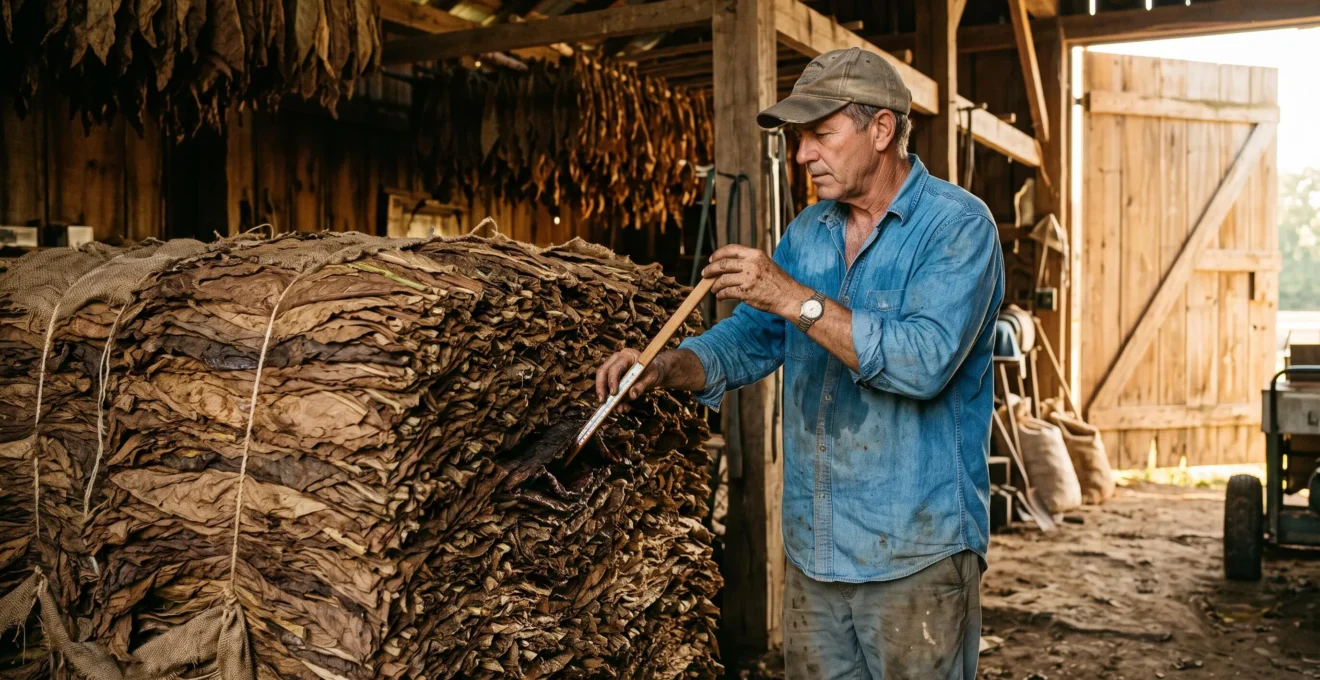
Tobacco can taste noticeably sweeter after extended fermentation even when its measurable sugar content has fallen. The apparent contradiction makes sense once sweetness is treated as a sensory impression rather than a simple measurement of sugar in the leaf. Fermentation changes nitrogen compounds, carbohydrates and aroma precursors, altering what the smoker can detect beneath the tobacco’s sharper characteristics.
Ten days and 60 days do not represent universal chemical thresholds. A tobacco pile’s temperature, moisture, microbial activity, leaf variety and turning schedule determine how far fermentation progresses. Some changes occur early; others require sustained, carefully managed processing. Longer fermentation can improve balance, but it can also reduce desirable aromas if conditions are unsuitable.
For UK cigar enthusiasts, this distinction matters when comparing labels such as “fermented”, “aged” and “maduro”. Those descriptions refer to different parts of the leaf’s journey. Understanding them helps explain why one cigar tastes creamy yet powerful, another tastes sharp despite an expensive band, and a third develops bitterness towards the final third.
Tobacco fermentation and sweetness: the essentials
- Sixty days is not a magic threshold: extended fermentation allows additional chemical transformations, but sweetness depends on processing conditions rather than elapsed time alone.
- Strength and harshness are different: nicotine-related effects can remain noticeable even when fermentation produces a cleaner sensory profile.
- Ageing and humidity change the result: finished-cigar storage can alter aroma integration, while excess moisture and fast smoking can obscure sweetness.
- Why Does Fermentation Heat Reduce Harshness Even When Nicotine Feels Strong ?
- How to Judge “Aged 5 Years” Claims When You Only Have the Band and the Price Tag ?
- Fermented or Aged: Which One Usually Drives Creaminess in a 45-Minute Smoke ?
- The Over-Humidifying Error That Makes Young Tobacco Taste Sour Within 20 Minutes
- Blend Feels Disjointed: How to “Marry” Flavours at Home in 21 Days Without Losing Aroma
- Why Can Air-Dried Tobacco Taste Cleaner Even When the Cigar Is Full-Bodied ?
- Why Does High-Heat Fermentation Create Cocoa Aromas but Raise Bitterness Risk Later ?
- Why Does Maduro Fermentation Create Cocoa Notes but Also Turn Bitter After 40 Minutes ?
Why Does Fermentation Heat Reduce Harshness Even When Nicotine Feels Strong ?
Fermentation can reduce the sharpness of cigar tobacco because heat-supported microbial and chemical reactions change the compounds responsible for its raw, pungent character. Nicotine-related strength, however, does not necessarily decline at the same rate. A properly fermented leaf can therefore feel powerful while tasting comparatively smooth, although neither outcome is guaranteed by fermentation time alone.
In traditional bulk fermentation, cured leaves are stacked into large piles known as pilones. Biological activity and chemical reactions generate internal heat. Workers monitor these piles and redistribute the leaves when necessary to control temperature and promote more even processing.
The chemistry is more complicated than heat simply destroying ammonia. The Microbiology Spectrum study on cigar tobacco fermentation documents microbial transformations of carbohydrates and nitrogen-containing compounds. Protein breakdown can release ammonia during fermentation, particularly as amino acids undergo further reactions.
Ammonia is associated with the pungent odour of fermenting tobacco. Its production, movement and eventual reduction depend on the progression of processing rather than a single heat-driven reaction. The study also reports internal pile temperatures reaching 45–55 °C under its investigated conditions, demonstrating the intensity that biological activity can produce.
From a tasting perspective, harshness and strength are separate observations:
- Harshness: an acrid, sharp or irritating sensation affecting the mouth, tongue or throat.
- Strength: the physiological effects associated with nicotine exposure, which may include light-headedness, nausea or other bodily sensations.
- Body: the perceived weight, density and intensity of the smoke, which is not a direct measurement of nicotine.
A short fermentation period may leave more immature sensory characteristics than a longer, properly managed cycle. But comparing ten days with 60 days only makes sense when the same leaf and processing conditions are considered. Initial moisture, pile construction, temperature history and turning all influence the outcome.
Excessive heat is not a shortcut. Poorly managed piling can compromise desirable aroma development and create a flat or unbalanced result. The aim is controlled transformation, not the highest possible temperature.
Once sharpness has been reduced, ageing becomes another variable. It can modify the finished cigar’s aroma, but a long ageing claim does not establish that its original fermentation was successful.
How to Judge “Aged 5 Years” Claims When You Only Have the Band and the Price Tag ?
An “aged five years” claim is difficult to verify from a cigar band and price alone. The stated age might refer to harvested tobacco, fermented leaves stored before blending, or finished cigars held after rolling. The most useful first step is identifying exactly what was aged, then looking for reliable production information rather than treating the price as proof.
The distinction matters because leaf age and finished-cigar age are not interchangeable. A blend can contain leaves from different harvests, each with its own curing, fermentation and storage history. A finished cigar may also spend time resting after those leaves have been combined.
When evaluating a claim, separate the available evidence from sensory clues:
| Clue | Useful information | Important limitation |
|---|---|---|
| Box date or production code | May help establish packaging or production timing | Does not automatically identify the harvest year or every leaf’s age |
| Manufacturer’s ageing statement | Can specify whether the claim concerns tobacco or finished cigars | Requires clear wording and trustworthy documentation |
| Wrapper oiliness and elasticity | May suggest the cigar’s present physical condition | Cannot independently establish age |
| Foot aroma | Can reveal the current aromatic character or possible deterioration | A quiet or flat aroma is not proof of prolonged ageing |
| Burn consistency | Helps evaluate the cigar’s present performance | Also depends on construction, moisture and smoking conditions |
| Premium price | May reflect inventory holding costs or market positioning | Does not verify the claimed duration or sensory quality |
Ageing does not simply mean that fermentation continues at a slower speed. Finished cigars undergo their own changes in volatile compounds under storage conditions. A Frontiers in Plant Science research study on aroma evolution during cigar aging followed a fixed cigar blend over 18 months at approximately 20°C and 60% relative humidity. It identified changing concentrations of aroma-associated compounds, including terpenoids, esters and ketones.
Those measurements demonstrate continuing chemical evolution, but they do not prove that a five-year-old cigar is sweeter, smoother or better than a younger example.
A practical comparison is to taste two documented production releases of the same cigar line under similar storage and smoking conditions. Record sweetness, aroma definition, irritation and burn behaviour independently. A softer older cigar might show greater integration, but it could also have lost characteristics that made the younger version interesting.
What matters next is the specific sensation being sought. A longer-rested cigar can feel more integrated without necessarily developing the creamy texture many enthusiasts associate with ageing.
Fermented or Aged: Which One Usually Drives Creaminess in a 45-Minute Smoke ?
Both fermentation and ageing can contribute to a cigar perceived as creamy, but their individual contributions cannot reliably be separated during a single 45-minute smoke. Fermentation changes the leaf’s chemical composition and pungency; ageing can further alter its aroma profile. Blend construction, smoke temperature, moisture and individual sensory perception also influence whether the result feels creamy.
Creaminess is primarily a tasting description, often referring to a rounded mouthfeel, subdued irritation and aromas reminiscent of cream, butter, nuts or soft sweetness. It is not a direct measurement of sugar or oil content.
Leaf composition helps establish the conditions in which these impressions develop. Fermentation changes carbohydrates, amino acids and aromatic compounds, while subsequent storage can modify the volatile mixture reaching the smoker. Oils and other constituents may contribute to texture and combustion behaviour, but the available research does not establish that residual sugars, wrapper oils or low ammonia alone cause creaminess.
Consider a hypothetical tasting comparison. Two cigars from the same blend have been stored under controlled conditions, but one has rested longer after manufacture. The younger example begins with distinct woody and nutty notes; the older one seems softer and more unified. That could be consistent with ageing-related aroma changes, although the comparison would not isolate ageing from differences in individual cigars.
Within a single smoke, the progression can still be useful to record:
- First third: note immediate aroma character, texture and irritation before the cigar becomes especially warm.
- Middle third: observe whether creaminess becomes more noticeable as the blend’s balance and combustion conditions change.
- Final third: distinguish a genuine flavour transition from rising temperature, concentrated smoke or increased bitterness.
These observations are sensory clues, not a diagnostic test. Creaminess appearing early does not prove successful fermentation, just as late creaminess cannot establish that ageing was responsible.
Smoking technique can outweigh subtle processing differences. Frequent puffing increases the demand on the burning zone and can produce hotter, more irritating smoke. Slowing the pace and allowing the cigar to cool may make delicate flavours easier to perceive, regardless of how long the leaf was fermented.
Before drawing conclusions about processing, check moisture. A cigar that is too damp can burn inconsistently, affecting the very texture and sweetness being evaluated.
The Over-Humidifying Error That Makes Young Tobacco Taste Sour Within 20 Minutes
Excess moisture can make a young cigar taste sour or steamy early in a smoking session because it interferes with stable combustion and smoke delivery. Poorly fermented tobacco may already contain pungent or unbalanced characteristics, making those problems more noticeable. However, sourness within 20 minutes is not a reliable test of either excessive humidity or insufficient fermentation.
A humid cigar requires additional energy to evaporate water as it burns. When moisture contributes to an uneven burn, smokers may compensate by puffing harder or more frequently. That can introduce abrupt temperature changes and additional irritation.
The physical problem is therefore not as simple as damp tobacco always burning cooler. A cigar can alternate between sluggish combustion and hot, corrective puffing. The result may include sour, bitter or muddled impressions that obscure the intended blend.
Young or inadequately processed leaf may make interpretation harder because moisture problems and residual chemical pungency can produce overlapping sensations. A single unpleasant session cannot establish whether the fault lies in fermentation, storage or construction.
For a cigar suspected of being overly moist, dry-boxing is one possible comparison method. This means temporarily keeping it in a clean, suitable container without an active humidification source. A day or two may provide a practical observation period, but the moisture change depends on the cigar and environment; the duration is not a universal prescription.
Keep the experiment controlled. Compare the result with another cigar of the same line, ideally from the same box, while recording the storage conditions and smoking pace. A calibrated hygrometer provides a more dependable starting point than repeated guesses about humidity.
Avoid compensating for every unfavourable taste by adding more humidification liquid or repeatedly adjusting the humidor. Flavoured solutions can introduce additional odours, while unstable conditions make comparisons harder.
Dry-boxing is also not a substitute for checking whether the cigar is damaged, contaminated or showing signs of mould. Suspect tobacco should not be treated as a simple humidity problem.
Once storage is stable, a different question arises: can additional rest make otherwise separate flavours feel more coherent?
Blend Feels Disjointed: How to “Marry” Flavours at Home in 21 Days Without Losing Aroma
Resting a finished cigar for 21 days may change its perceived flavour balance, particularly if it arrived with uneven moisture or has recently experienced changing storage conditions. This is not equivalent to factory fermentation. Twenty-one days should be treated as a controlled comparison period, not a proven time required for filler, binder and wrapper flavours to merge.
Blenders sometimes describe flavour integration as marrying. In practical terms, this refers to a finished blend seeming more unified rather than presenting disconnected or competing notes. During storage, moisture can redistribute and volatile compounds may change, but the extent to which aroma migration between individual cigar components explains that sensation has not been established by the supplied research.
A cigar with a woody wrapper impression, earthy filler character and a sharp finish might seem disjointed. Stable storage could make the smoking experience more consistent, particularly if the initial problem was environmental. It cannot reverse unsuitable fermentation or fundamentally redesign the blend.
The experiment should be designed to preserve as many variables as possible. Keep the cigar away from strong odours, avoid frequent humidity changes and use a storage arrangement that does not expose it to rapid drying. Cellophane can be retained or adjusted according to the storage setup, but removing it is not a scientifically validated requirement for flavour integration.
A five-step, 21-day cigar rest experiment
- Record the baseline: write down the cigar’s brand, line, size, storage history and initial flavour impressions; deliverable: a dated tasting entry.
- Check the environment: use a calibrated hygrometer and note the storage temperature and relative humidity; deliverable: a starting conditions record.
- Set up stable storage: place an unsmoked comparison cigar in a clean, odour-free humidor with minimal handling; deliverable: a storage setup note.
- Review at the midpoint: record the conditions around day 10 or 11 and, if a comparable cigar is available, make a separate tasting note; deliverable: a midpoint comparison.
- Evaluate on day 21: taste another comparable cigar under similar conditions and compare aroma clarity, harshness and overall balance; deliverable: a before-and-after assessment.
These comparisons need multiple cigars because the same cigar cannot be smoked before and after resting. Individual construction differences remain a limitation, even within the same box.
If persistent bitterness, acrid smoke or a fundamental mismatch between components remains after stable storage, the issue may lie in the blend or its processing. More rest cannot be assumed to fix it.
Long storage is not automatically favourable either. Delicate aromatics may become less noticeable, particularly when humidity is unstable or storage introduces foreign odours. The aim is to evaluate better integration without losing character.
Resting also cannot replace curing. To understand why a cigar can remain strong yet taste clean, the process must be traced further back to the treatment of the harvested leaf.
Why Can Air-Dried Tobacco Taste Cleaner Even When the Cigar Is Full-Bodied ?
Air-cured cigar tobacco can taste relatively clean while remaining full-bodied because curing and nicotine-related strength describe different characteristics. Slow curing changes the harvested leaf’s moisture, pigments and chemical composition, reducing some green or raw sensory qualities. A strong cigar can therefore develop a cleaner aromatic foundation without losing the substantial flavour intensity intended by its blender.
After harvesting, air-curing involves hanging tobacco in a ventilated environment while the leaf gradually loses moisture and undergoes biochemical changes. Yellowing, browning and the transformation of plant constituents prepare it for subsequent processing.
Chlorophyll degradation is particularly important to the disappearance of the leaf’s fresh green appearance and some of its immature characteristics. Other components also evolve during curing, influencing the chemistry available for subsequent fermentation.
Air-curing should not be confused with actively heating a fermentation pile. The two stages have different functions and operating conditions:
| Characteristic | Air-curing | Bulk fermentation |
|---|---|---|
| Main purpose | Dry and chemically transform harvested tobacco | Further transform cured leaf and develop processing quality |
| Typical arrangement | Leaves suspended in a ventilated curing structure | Conditioned leaves stacked in controlled piles |
| Important variables | Air movement, temperature, humidity and drying progression | Pile temperature, moisture, microbial activity and turning |
| Possible sensory contribution | Reduction of immature, green characteristics | Changes in pungency, aroma chemistry and balance |
Alternative curing methods use different temperature and airflow profiles. They can yield distinct chemical and sensory outcomes, but faster curing does not necessarily mean defective tobacco. The appropriate method depends on the tobacco type and intended product.
For a full-bodied cigar, an effective cure followed by appropriate fermentation can help produce an intense yet less acrid profile. The resulting body is influenced by the blend and its combustion, not simply by how dark the wrapper appears.
Visual inspection offers limited clues. Wrapper colour, elasticity and surface condition may help identify obvious damage or poor storage, while unpleasant musty or abnormal odours warrant caution. However, these observations cannot independently verify how patiently the tobacco was cured.
Once cured leaf enters fermentation, temperature becomes a particularly important influence on aroma development. Darker tobacco styles make that relationship more noticeable, although the chemistry is less predictable than a simple recipe for sweetness.
Why Does High-Heat Fermentation Create Cocoa Aromas but Raise Bitterness Risk Later ?
Warmer tobacco fermentation can change the chemical precursors and volatile compounds associated with roasted or cocoa-like impressions, but heat alone does not guarantee cocoa aromas. Excessive or poorly controlled processing can also reduce desirable components and compromise sensory balance. Bitterness during smoking may then reflect the leaf, the blend or combustion conditions rather than one identifiable fermentation reaction.
Dark maduro-style tobacco is commonly associated with flavours described as cocoa, coffee, molasses or dark chocolate. Those are sensory comparisons, not evidence that the leaf contains those foods or that every aroma was created through the same reaction.
Maillard reactions provide a useful chemical analogy. In many heated materials, reactions involving amino compounds and reducing sugars can contribute to roasted aroma development and darker compounds. However, traditional tobacco fermentation is a complex biological and chemical process, and it would be misleading to attribute every cocoa note directly to Maillard chemistry without compound-specific evidence.
Temperature nevertheless matters. A PubMed record of the cigar wrapper fermentation temperature study describes experiments conducted at chamber temperatures of 20°C, 27°C and 34°C. Warmer chamber conditions increased temperatures inside the tobacco stacks and were associated with decreases in proteins, total sugar, starch and total alkaloids, alongside increases in amino acids and aroma components.
20°C, 27°C and 34°C
The three fermentation chamber temperatures investigated in the wrapper-leaf experiment. These were chamber settings, not universal target temperatures for every tobacco pile, and the results do not establish a cocoa-production threshold.
Ren and colleagues, Applied Microbiology and Biotechnology, 2023.
The experiment supports the importance of heat management, but not the claim that increasing temperature inevitably produces sweeter or more chocolate-like cigars.
In practice, the production trade-off involves encouraging desirable transformation while protecting the leaf’s aromatic range. Turning and monitoring the piles help manage uneven temperature development. Longer exposure is not necessarily better if the chosen process already meets the intended sensory target.
A bitterness problem deserves equally careful diagnosis. A cigar that becomes progressively bitter might have processing-related characteristics, but fast puffing, changing burn temperature, moisture and the concentration of smoke constituents can create similar impressions.
Brief bitter notes early in a smoke do not prove that fermentation is correct, and a bitter finish does not prove over-fermentation. The most useful distinction is whether the problem persists across comparable cigars under consistent smoking conditions.
That distinction becomes especially relevant with maduro cigars, where a pleasant cocoa-like opening can give way to a bitter final stretch without establishing that the wrapper was badly fermented.
Key takeaways before assessing a maduro’s finish
- Track when bitterness appears relative to the cigar’s burn progression, not just the elapsed minutes.
- Separate wrapper-related flavour expectations from changes caused by heat, draw and smoking pace.
- Compare smoking conditions before attributing a bitter finish to fermentation quality or prolonged ageing.
Why Does Maduro Fermentation Create Cocoa Notes but Also Turn Bitter After 40 Minutes ?
A maduro cigar can begin with cocoa-like aromas and become bitter later because its aromatic composition interacts with changing combustion conditions throughout the smoke. As the burning end approaches the mouth, heat exposure and smoke delivery may become less comfortable. Forty minutes is only an illustrative point in a session, not a scientifically established threshold for maduro bitterness.
Maduro describes a dark wrapper style associated with particular leaf selection and processing traditions. Extended or carefully managed fermentation is often involved, although the precise techniques differ among producers. Not every maduro wrapper is equally thick, oily or fermented for the same duration.
The cocoa impression comes from the smoker’s perception of an aromatic mixture. The darker wrapper may contribute roasted, earthy or sweet-seeming notes, but its colour does not reveal how those compounds were produced or predict how they will taste when burned.
During a smoking session, several variables evolve together. The remaining cigar becomes shorter, the ember moves closer to the smoker and the tobacco near the burning zone experiences repeated heating. Smoke constituents and condensates can deposit within the remaining tobacco, while changes in puffing behaviour can influence the intensity of the smoke.
Those effects can make the final portion taste more concentrated, hot or bitter. They do not demonstrate that sugars are continually caramelising at the cigar’s foot in a way that explains a particular 40-minute transition.
When bitterness develops, a cautious comparison can help:
- Notice whether the cigar has begun to feel unusually hot or whether puffing has become more frequent.
- Allow it to rest briefly and observe whether the next few draws taste less aggressive.
- Check for an irregular burn or obstructive ash, avoiding unnecessary handling of the hot end.
- Drink water to reset the palate, then distinguish residual bitterness in the mouth from bitterness in the smoke itself.
- Record the flavour progression and compare it with another example of the same cigar stored under similar conditions.
These steps are practical sensory checks, not a method for proving the cause. A purge or ash adjustment may alter the smoking experience, but neither is a validated test for identifying over-fermented tobacco.
The same caution applies to humidity. Some enthusiasts prefer smoking certain maduros after a modest reduction in moisture, but there is no established rule that every maduro should be stored or smoked drier than a lighter-wrapper cigar. Physical condition, stable storage and the manufacturer’s guidance remain relevant.
When buying, look for sound construction and a wrapper without obvious damage. Even colour and an attractive surface may be reassuring, but neither guarantees desirable fermentation or a smooth finish. If a particular blend repeatedly turns unpleasant under consistent conditions, its flavour profile or construction may simply be unsuitable for the desired smoking experience.
The next useful step is to keep a concise tasting record across comparable cigars, including storage conditions, the approximate point where bitterness begins and any change in smoking pace. Patterns across several sessions provide a more useful basis for evaluating fermentation, ageing and blend quality than a single disappointing final third. Cigar smoke is harmful regardless of how smooth or sweet it tastes, so sensory cleanliness should never be mistaken for reduced health risk.
Does fermentation actually increase the sugar content of tobacco?
Not necessarily. Fermentation can consume or transform sugars while changing other substances that influence flavour perception. A cigar may seem sweeter because its sharp or pungent characteristics are less prominent and its aromatic balance has changed. Perceived sweetness and laboratory-measured sugar concentration are different quantities.
Is 60 days of fermentation always better than 10 days?
No. Appropriate duration depends on tobacco type, leaf condition, moisture, temperature and the chosen production method. Longer processing may allow additional transformations, but there is no universal 60-day threshold at which sweetness appears or harshness disappears.
Can a home humidor finish fermenting an under-processed cigar?
Ordinary humidor ageing is not a substitute for controlled industrial fermentation. Stored cigars can undergo chemical and aromatic changes, and their moisture distribution may become more stable. However, those processes do not reliably correct inadequate fermentation or fundamental blending defects.
Why can an older cigar smell different without tasting sweeter?
Aroma-related compounds continue changing during storage, but their concentrations do not translate directly into sweetness. Some aromatic families may become more prominent while others diminish. The resulting perception depends on the blend, storage conditions, combustion and individual sensory sensitivity.
Does a darker maduro wrapper mean a cigar contains more nicotine?
No reliable nicotine estimate can be made from wrapper darkness alone. Colour reflects several factors, including tobacco variety and processing. Nicotine exposure depends on the tobacco blend and smoking behaviour, while perceived body, harshness and strength are not interchangeable measures.