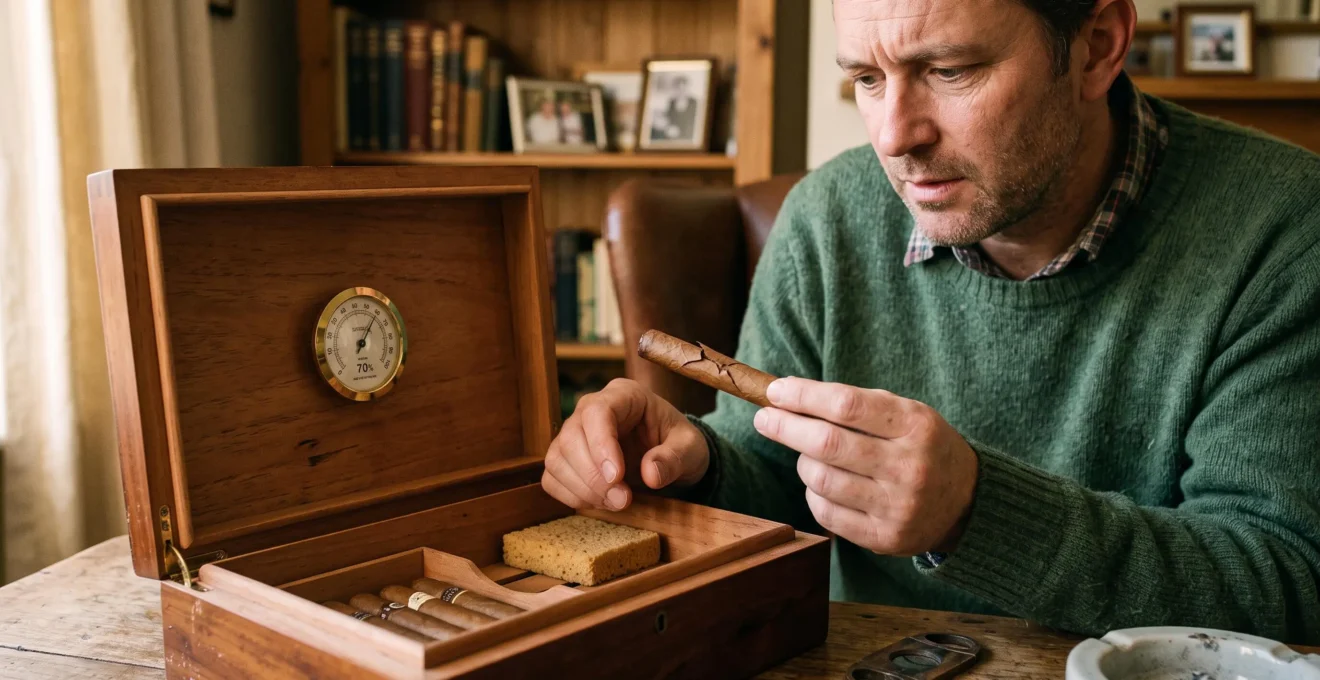
Your humidor has displayed 70% relative humidity for weeks. Yet your cigars require repeated relights, taste unexpectedly harsh or develop wrappers that crack when handled. The apparent contradiction may come from the instrument you trust most: the hygrometer.
A hygrometer can display a consistent number while measuring humidity incorrectly. Sensor ageing, environmental exposure and calibration errors can leave the indicated relative humidity several percentage points away from the actual conditions surrounding your cigars. A displayed 70% could therefore conceal noticeably wetter or drier storage.
For collectors in the UK, seasonal heating, temperature changes and imperfect humidor seals make reliable measurement particularly important. Fortunately, diagnosing the problem does not require an expensive monitoring system. It requires a trustworthy reference, a correctly interpreted calibration result and a consistent method for checking cigar condition.
The objective is not to force every humidor to display exactly 70%. It is to establish whether the displayed number reflects reality, then maintain suitable conditions without unnecessary adjustments.
Hygrometer accuracy: the essentials
- A stable display proves repeatability, not accuracy. Check the hygrometer against a known humidity reference.
- Saturated table salt provides an approximately 75% RH reference under appropriate conditions, but an improvised test requires careful preparation and sufficient equilibration time.
- Watch the cigars as well as the instrument. Brittle wrappers, soft tobacco and persistent combustion problems can indicate unsuitable storage conditions.
- Why Can a Hygrometer Read ‘Perfect’ at 70% While Your Cigars Tell a Different Story?
- How to Calibrate a Hygrometer With the Salt Test (and Read the Result Correctly)
- Analog vs Digital Hygrometer: Which Handles Travel and Life on the Road Better?
- The ‘Calibrate Once’ Mistake That Slowly Ruins Your Storage
- Where Should You Place Two Hygrometers in a Humidor to Catch Hot Spots?
- How a Mis-Reading Hygrometer Quietly Damages Flavour Over Weeks, Not Years
- How to Set Up Trustworthy Storage With One Hygrometer and One Boveda Pack in 20 Minutes
- How to Store Cigars in a UK Flat Without Wild Humidity Swings
Why Can a Hygrometer Read ‘Perfect’ at 70% While Your Cigars Tell a Different Story?
A hygrometer can show exactly 70% RH every day while the true humidity is considerably different. The device may be repeatable without being accurate: its sensing mechanism or measurement offset has changed, but the display continues producing plausible readings. Only comparison against a known reference can establish whether that apparently perfect number is trustworthy.
This distinction matters because relative humidity is a measurement of the surrounding air, not a direct reading of moisture inside a cigar. Tobacco gradually absorbs and releases water according to its environment. If the hygrometer overstates humidity, the collection may be drying out while the display reassures its owner that everything is normal.
The opposite error is equally important. If a hygrometer understates relative humidity, an owner may add unnecessary moisture to storage that is already sufficiently humid.
Different instruments develop errors for different reasons. Mechanical hygrometers may use elements whose characteristics change with age or handling. Electronic humidity sensors can also be affected by ageing, contamination, temperature and hysteresis.
As explained in Vaisala’s technical explanation of measurement accuracy and calibration, repeatability, accuracy and long-term stability are separate measurement characteristics. A reading that barely changes is not necessarily close to the true value.
Consider a hypothetical hygrometer that consistently over-reads by six percentage points. When it displays 70% RH, the actual humidity near its sensing element may be approximately 64% RH. The exact correction must be established by testing; the example simply illustrates why apparently small errors matter.
Factory calibration does not eliminate the need for independent verification. Nor does the familiar appearance of an analogue dial or the precision of a digital display.
Use the cigars as an additional warning system. A brittle wrapper suggests excessive dryness, while a noticeably soft cigar, persistent tight draw or frequent relights can suggest excessive moisture. None of these symptoms establishes humidity error on its own: cigar construction and smoking conditions also affect performance.
The practical diagnostic question is straightforward: does the physical condition of the collection agree with the instrument’s reported environment?
Once a false reading becomes plausible, the next step is measurement against a known reference rather than guessing how far the instrument has drifted.
How to Calibrate a Hygrometer With the Salt Test (and Read the Result Correctly)
A saturated table-salt solution creates an equilibrium environment close to 75% RH at ordinary room temperatures. To check a hygrometer, place damp salt and the instrument inside an airtight container without allowing contact between them, maintain a stable temperature and allow sufficient time for equilibrium. Compare the resulting reading with the appropriate reference value and calculate the correction.
The scientific basis is established in Greenspan’s published saturated-salt humidity reference tables. They report approximately 75.47% RH at 20°C and 75.29% RH at 25°C for saturated sodium chloride.
These are equilibrium reference values, not promises that a homemade test will achieve laboratory accuracy.
- Prepare the salt. Put ordinary sodium chloride table salt into a small clean container. Add a little water until it forms a damp slurry with some undissolved salt remaining. Avoid turning it into a fully dissolved solution or leaving excessive free water.
- Separate the instrument. Place the salt container and hygrometer inside a larger airtight enclosure. Keep the sensing opening exposed to the enclosed air, not pressed against salt, liquid or the container wall.
- Seal the enclosure. Close the lid securely and leave the arrangement undisturbed in a location with a reasonably stable room temperature, away from direct sunlight, radiators and draughts.
- Allow equilibration. Leave the container sealed for several hours and, for a more conservative household check, overnight or longer as needed. There is no scientifically established universal eight-hour completion time for every improvised setup.
- Interpret the result. Check whether the reading has settled, then compare it with the salt reference appropriate to the temperature. Record the displayed value, reference value and resulting offset.
For a numerical example, suppose the salt environment is at 25°C and the hygrometer settles at 71% RH. Against the published reference of approximately 75.29% RH, the instrument under-reads by 4.29 percentage points.
If its offset remains reasonably constant near the operating range, a later displayed reading of 66% RH would correspond to approximately 70.29% RH after correction. This is a one-point correction, not proof that the instrument is equally accurate at every humidity level.
75.29% RH
Published equilibrium relative humidity for saturated sodium chloride at 25°C. The experimental reference has an estimated uncertainty of ±0.12 percentage points; a household test has additional, potentially much greater uncertainties.
Lewis Greenspan, National Bureau of Standards, 1977.
Look for suspicious behaviour during the test. A reading that keeps climbing may mean the arrangement has not equilibrated or that excess water is affecting the conditions. A reading that fluctuates with room conditions may indicate inadequate sealing or temperature instability. Two identical readings alone do not establish a valid calibration.
Some analogue instruments have adjustment screws. Certain digital models provide an offset setting. Others cannot be adjusted, in which case the correction must be recorded and applied manually. Follow the manufacturer’s instructions rather than forcing a mechanism.
If the instrument exhibits a large or inconsistent error, repeat the check with a better-controlled reference. Replacement becomes sensible when the error is unreliable or the device cannot meet the accuracy required for the collection.
For a more standardised alternative, Boveda’s official hygrometer calibration instructions specify at least 24 hours in its sealed 75% RH calibration kit at approximately 19.5–23.5°C. That minimum applies to the manufacturer’s kit, not automatically to every homemade salt arrangement.
Five checks before trusting your calibration
- Confirm that undissolved salt remains in the damp mixture. Record the slurry preparation.
- Check that the sensor cannot contact liquid or salt. Record its position inside the enclosure.
- Confirm that the container is securely sealed and away from heat sources. Note the test location.
- Allow adequate equilibration and record the final stable reading, temperature and observation time.
- Calculate the reference-minus-display offset and label the hygrometer with its correction and test date.
A properly documented calibration provides a starting point for reliable storage. Whether that reliability survives travel and daily handling depends partly on the instrument itself.
Analog vs Digital Hygrometer: Which Handles Travel and Life on the Road Better?
For frequent travel, a compact digital hygrometer is often the more practical choice because it is generally easier to read and can offer convenient measurement features. A well-maintained analogue instrument remains useful, particularly when battery independence matters. Neither technology is automatically more accurate: calibration quality, environmental tolerance and repeatability determine reliability.
The differences matter most when equipment is moved between a stable home cabinet, a car boot, a hotel room and a portable cigar case.
Instrument design varies considerably, so the comparison below describes practical considerations rather than experimentally established performance rankings.
| Criterion | Analogue hygrometer | Digital hygrometer |
|---|---|---|
| Power | Usually battery-free | Typically requires a battery or power source |
| Reading the display | Dial position may be harder to interpret precisely | Numerical display is generally straightforward |
| Calibration | Some models offer mechanical adjustment | Some offer software offsets; others are fixed |
| Movement and shocks | Mechanical assemblies may be sensitive to handling | Electronic designs also require suitable protection |
| Temperature changes | Allow conditions to stabilise before interpretation | Allow the instrument to acclimatise before interpretation |
| Long-term accuracy | Depends on construction, ageing and verification | Depends on sensor quality, ageing and verification |
| Typical practical fit | Traditional home humidor or battery-free preference | Travel case, portable humidor or convenient monitoring |
A common travel mistake is interpreting a number immediately after moving the hygrometer into a different environment. Relative humidity depends on temperature, while the sensing element and surrounding materials may require time to adjust.
For example, an instrument brought from a cold vehicle into a warm room should be allowed to acclimatise before its reading is used to change the humidity-control system. The direction and duration of any temporary error depend on the device and conditions; a digital sensor cannot universally be assumed to read low after such a move.
Use the same known reference before and after travel when checking whether handling has affected an instrument. This is more useful than comparing two unverified hygrometers and assuming whichever looks more plausible is correct.
For collectors who travel frequently, a sensible arrangement is a verified reference hygrometer kept at home and a portable unit checked against it periodically, particularly after unusual environmental exposure.
This does not prove the home unit is permanently correct. It simply creates a consistent comparison process between formal reference checks.
Price alone is also a weak guide. A cheap digital hygrometer with unstable readings can be less useful than a carefully verified analogue model, but there is no sound basis for claiming that one entire category necessarily drifts faster than the other.
The best travelling hygrometer is the one whose performance you can verify repeatedly, not the one offering the most reassuring display.
The ‘Calibrate Once’ Mistake That Slowly Ruins Your Storage
A hygrometer calibrated once should not be assumed accurate indefinitely. Sensors age, environmental exposure alters measurement characteristics and temperature changes can reveal errors that were not obvious during the original check. Without periodic verification, the displayed value may gradually become less reliable while remaining entirely plausible.
The dangerous feature of gradual drift is that it seldom announces itself through a sudden display change.
A collector who sees 68% RH every morning may reasonably believe the humidor is stable. Yet if the instrument’s measurement offset has shifted, that same display could represent a different actual environment from the one it represented months earlier.
There is no defensible universal drift rate for all consumer cigar hygrometers. Claims that every instrument loses one or two percentage points of accuracy annually would require model-specific evidence.
What is established is that ageing, temperature, chemical interference and changes in sensor sensitivity can affect measurement performance. A previously calibrated instrument therefore needs continued verification.
Boveda recommends recalibration every six months for hygrometers used with its calibration approach. Treat this as manufacturer guidance rather than a universal rule covering every device.
A practical routine should also respond to events. Recheck the instrument when:
- Two previously verified hygrometers begin disagreeing substantially.
- A device has experienced unusual temperature changes, moisture exposure or mechanical shocks.
- The collection becomes noticeably softer or more brittle despite apparently stable conditions.
- A new humidification system is installed and observed readings unexpectedly change.
- A seasonal check is due after prolonged changes in the room environment.
Keep a calibration log. A short entry showing the date, reference humidity, displayed reading, correction and test conditions creates a useful history of instrument performance.
For example, a hypothetical log might record a reference of 75%, a measured display of 72% and a correction of +3 percentage points. Later checks can then establish whether that offset remains reasonably consistent.
Also distinguish calibration from adjustment. Calibration establishes the measurement error; adjustment changes how the instrument responds. Recording the result remains useful even when the device is reset to display the reference correctly.
Sudden battery failure is usually easier to notice than gradual sensor error. Nevertheless, weak batteries, display faults and manufacturer-specific electronic behaviour should be checked when a digital instrument acts unpredictably.
Even a recently verified instrument only describes the conditions where it is positioned. Larger humidors introduce a separate measurement problem: differences between locations inside the same enclosure.
Where Should You Place Two Hygrometers in a Humidor to Catch Hot Spots?
Place one calibrated hygrometer close to the storage area representative of your regularly used cigars and a second in a contrasting location, preferably farther from the humidification source. Keep both away from direct contact with humidity packs or reservoirs. Comparing their readings helps identify whether the humidor has a local humidity difference rather than a uniform environment.
Large cabinets and densely packed desktop humidors do not necessarily maintain identical conditions everywhere. Shelves, cigar boxes, dividers and limited air movement can contribute to local differences.
A single gauge mounted near the lid may therefore miss the conditions surrounding cigars stored deeper inside the cabinet.
Start by checking both hygrometers against the same reference. Without that step, a difference between their displayed values may simply represent different instrument offsets rather than a genuine humidity gradient.
Once both instruments are verified, choose locations that answer a useful question.
- Sensor one: Position it near the level of the cigars you regularly select, while leaving sufficient space for surrounding air to reach the sensing element.
- Sensor two: Place it at a contrasting location, such as a far corner or upper shelf when the humidification source is near the bottom.
Avoid placing either sensor against the humidification medium, directly on a cold external wall, in sunlight or where moisture might condense.
Interpret the difference as a trend, not an immediate verdict. A persistent separation may indicate a genuine spatial difference, especially if it remains after the sensors have equilibrated and both have been checked for measurement error.
A widening difference deserves attention. It may reflect changed air circulation, a newly obstructed shelf, a poorly positioned humidification source or a local temperature variation.
For example, imagine two verified devices that usually differ by one percentage point but later show a substantially larger and persistent difference. Before adding another humidity source, inspect the arrangement of boxes, available air gaps and recent changes in storage layout.
Possible corrective measures include leaving space between tightly packed boxes, periodically rotating stored boxes where appropriate and moving the humidification source to a position that better serves the enclosure.
After a change, allow conditions to settle before comparing the readings again. A short-lived difference immediately after opening the lid is not equivalent to a persistent storage problem.
There is no universally acceptable numerical difference between two sensors for every humidor. The magnitude matters alongside instrument uncertainty, enclosure size, temperature and the stability of the readings over time.
Mapping the internal environment is especially valuable when cigar quality seems to vary according to where individual boxes are stored.
How a Mis-Reading Hygrometer Quietly Damages Flavour Over Weeks, Not Years
An inaccurate hygrometer can leave cigars exposed to unsuitable humidity for weeks without obvious external warning. Excessively dry storage makes wrappers fragile and can change smoking characteristics, while excessive moisture may restrict airflow, disrupt combustion and increase mould risk. The progression varies with cigar construction, storage conditions and exposure duration; no fixed 30-day damage timetable applies.
Cigars are hygroscopic. Tobacco absorbs and releases moisture according to the surrounding environment, with exposed surfaces responding before all the internal tobacco has fully equilibrated.
This explains why a cigar can show early warning signs at the wrapper or exposed foot while the remainder of its structure is still adjusting.
On the dry side, a falsely high humidity reading may encourage an owner to leave the humidor under-humidified. The wrapper can become brittle, crack or begin to unravel. Smoking may become less satisfactory as tobacco moisture moves outside the preferred condition.
However, a dry wrapper does not establish that a particular flavour compound or quantity of tobacco oil has been lost. Precise claims about aromatic deterioration over a specified number of days are not established by the available evidence.
On the wet side, a falsely low reading can provoke repeated additions of moisture. Tobacco may swell, produce a tight draw, burn unevenly and require more relights.
The professional guidance in Tobacconist University‘s cigar preservation reference also identifies excessive moisture as a condition that can mute flavours and increase mould risk.
Consider the following explicitly hypothetical progression. A collector trusts a hygrometer that consistently understates the actual humidity. During the first week, the reading appears slightly low, so additional humidification is introduced. Over subsequent weeks, cigars become softer and combustion problems become more noticeable. The owner blames the blend, although the actual storage environment has become too humid.
This is a diagnostic illustration, not a documented trial or evidence that every collection deteriorates at the same rate.
Dryness and mould do not carry equal consequences. Some cigars affected by modest dryness can be gradually reconditioned, although severe or prolonged dehydration may cause lasting damage. Suspected mould requires isolation and careful assessment; confirmed mouldy cigars should be discarded rather than treated as ordinary humidity damage.
A musty smell deserves investigation, but smell alone does not conclusively identify mould. Likewise, relights and a restricted draw can arise from cigar construction, smoking technique and other factors unrelated to storage.
For practical diagnosis, consider the combination of cigar texture, combustion behaviour, visible condition and verified environmental measurements.
Accurate measurement is not a guarantee of perfect flavour, but it removes a major source of uncertainty when evaluating the condition of a collection.
How to Set Up Trustworthy Storage With One Hygrometer and One Boveda Pack in 20 Minutes
A basic monitoring arrangement can be assembled in approximately 20 minutes using a suitable humidor, a previously verified hygrometer and a correctly sized two-way humidity-control pack. The setup itself is quick; stabilising the cigars and the enclosure takes longer. A new installation should not be declared accurate simply because the display reaches a reassuring number immediately.
Begin with the enclosure. Check that the lid or seal closes properly and that the interior is clean and free from obvious moisture damage or contamination.
For a wooden humidor, determine whether the wood has been properly conditioned. If the enclosure is new and unseasoned, complete the manufacturer’s recommended seasoning process before treating the 20-minute arrangement as ready for stable storage.
Next, select an appropriate two-way humidity pack for the enclosure and intended storage conditions. Pack capacity must be sufficient for the volume and cigar load, following the manufacturer’s sizing instructions.
Many collectors use a target around 65–70% RH, but the traditional 70% figure is not universally ideal. Preferences and appropriate conditions can vary with the cigars and the owner’s requirements.
Position the pack so that it can exchange moisture with the enclosed air without obstructing the hygrometer’s sensing area.
Fit the previously verified gauge in a location representative of the cigars, away from direct contact with the pack. Load the cigars, close the enclosure and record the initial reading.
The 20-minute sequence is therefore straightforward:
- Inspect the humidor’s cleanliness, condition and seal.
- Confirm that any required wooden-humidor seasoning is complete.
- Install a correctly sized two-way humidity pack at the chosen target RH.
- Place the calibrated hygrometer in a representative position and load the cigars.
- Close the enclosure, record the setup conditions and allow adequate stabilisation before making corrections.
Do not use the pack’s labelled RH as a substitute for a calibration reference. A humidity pack is designed to regulate conditions, but the actual humidity inside a wooden humidor also depends on sealing, loading, temperature and the pack’s remaining capacity.
If the settled hygrometer reading differs substantially from the pack’s nominal setting, possible explanations include instrument error, air leakage, insufficient pack capacity or incomplete equilibration. The gauge should be checked independently before deciding which component is responsible.
Two-way packs have finite capacity. Inspect them according to the manufacturer’s guidance and replace them when exhausted. Hardening may provide a useful condition cue for some products, but the correct replacement decision depends on the specific pack design.
A single hygrometer also cannot establish that every corner of a larger humidor has the same conditions.
The most useful next step is to observe the settled readings and cigar condition over time, then adapt the enclosure’s position to the temperature and humidity conditions of the room.
Key takeaways for UK home storage
- A trustworthy gauge and a sound enclosure seal matter more than an elaborate collection of humidity accessories.
- Room temperature changes can complicate humidity readings even when the humidification system is functioning as intended.
- Seasonal checks are more useful than relying indefinitely on a calibration performed under different conditions.
How to Store Cigars in a UK Flat Without Wild Humidity Swings
For cigar storage in a UK flat, choose a location with relatively stable temperatures, avoid radiators and direct sunlight, and use a well-sealed container with suitable humidity control and a verified hygrometer. Keep the enclosure away from damp rooms and cold window areas. Seasonal heating changes justify renewed checks, but a stable microclimate matters more than chasing every small daily fluctuation.
British flats can present contrasting indoor environments across the year. During colder months, central heating can lower indoor relative humidity as air warms. At other times, damp conditions, inadequate ventilation or local condensation may create moisture problems.
The severity of these conditions depends on building construction, ventilation, heating patterns and the specific room. It would be misleading to assign one typical humidity level to all UK flats.
Temperature matters because relative humidity describes the amount of water vapour in the air relative to saturation at that temperature. A change in temperature can therefore alter the measured RH even without an equivalent change in the total amount of water vapour.
A practical location is often an interior part of a room with relatively consistent heating and limited exposure to sunlight.
Avoid keeping the humidor directly beside radiators, frequently opened windows, exterior window ledges, ovens or bathrooms. Kitchens can also experience local heat and moisture fluctuations.
In a small flat, the available location may be imperfect. In that case, prioritise temperature stability and enclosure performance rather than trying to find an aesthetically ideal display position.
A sealed food-safe container with suitable humidity control can be a practical alternative to a poorly sealed wooden humidor. Acrylic, plastic and other suitable containers may maintain appropriate conditions when properly selected and managed.
However, airtight storage does not eliminate temperature variation. A sealed container beside a radiator remains a poor location, regardless of the quality of its humidity pack.
Make calibration part of seasonal maintenance. A hygrometer last checked during mild summer conditions is worth verifying before or during the heating season, particularly if readings or cigar condition become inconsistent.
At the same time, resist unnecessary adjustments. Opening an enclosure repeatedly to correct every one-point change can introduce new variation and make long-term trends harder to interpret.
For a consistently dry or damp room, investigate the broader indoor conditions as well. The humidor’s humidity-control system has limited ability to compensate for excessive heat, poor sealing or persistent environmental extremes.
Finally, retain a simple written record of where the humidor is kept, the hygrometer’s latest verified offset and any seasonal changes in its behaviour. This makes it easier to distinguish genuine environmental problems from misleading instrument readings.
Start with one reliable check: verify the gauge, observe the collection after conditions have settled and make only the adjustment supported by the evidence. That is a more dependable approach than trusting a permanently displayed 70%.
Can two hygrometers both be wrong in the same humidor?
Yes. Two instruments can have different calibration errors, and agreement between their readings does not independently establish accuracy. Both should be checked against a suitable humidity reference. Once their errors are understood, comparing them at different locations becomes more useful.
Is 70% RH always the correct humidity for premium cigars?
No. Professional cigar-preservation guidance recognises that many cigars store successfully around 65–70% RH, while some smokers prefer approximately 60–65%. The appropriate target depends on the cigars and intended storage conditions. Accurate measurement is necessary before evaluating which target works best.
Can a hygrometer be accurate at 75% but wrong at 65% RH?
Yes. A single-point reference check primarily evaluates instrument behaviour around that reference humidity. Sensor sensitivity and other measurement characteristics can produce errors elsewhere in the range. A two-point calibration or additional verified reference can provide greater confidence where the instrument supports it.
Should cigars be smoked immediately after correcting low humidor humidity?
Not necessarily. Tobacco requires time to exchange moisture with its surroundings, and exposed surfaces can respond before the interior fully equilibrates. Gradual reconditioning is generally preferable to sudden exposure to excessively humid conditions. The time required depends on the cigar’s previous condition and the storage environment.
Does a Boveda humidity pack eliminate the need for a hygrometer?
No. A two-way humidity pack helps regulate moisture, but it cannot guarantee a specific RH in every enclosure under every condition. Sealing, temperature, loading and pack capacity affect results. A verified hygrometer provides independent information about the storage environment and helps identify unexpected changes.