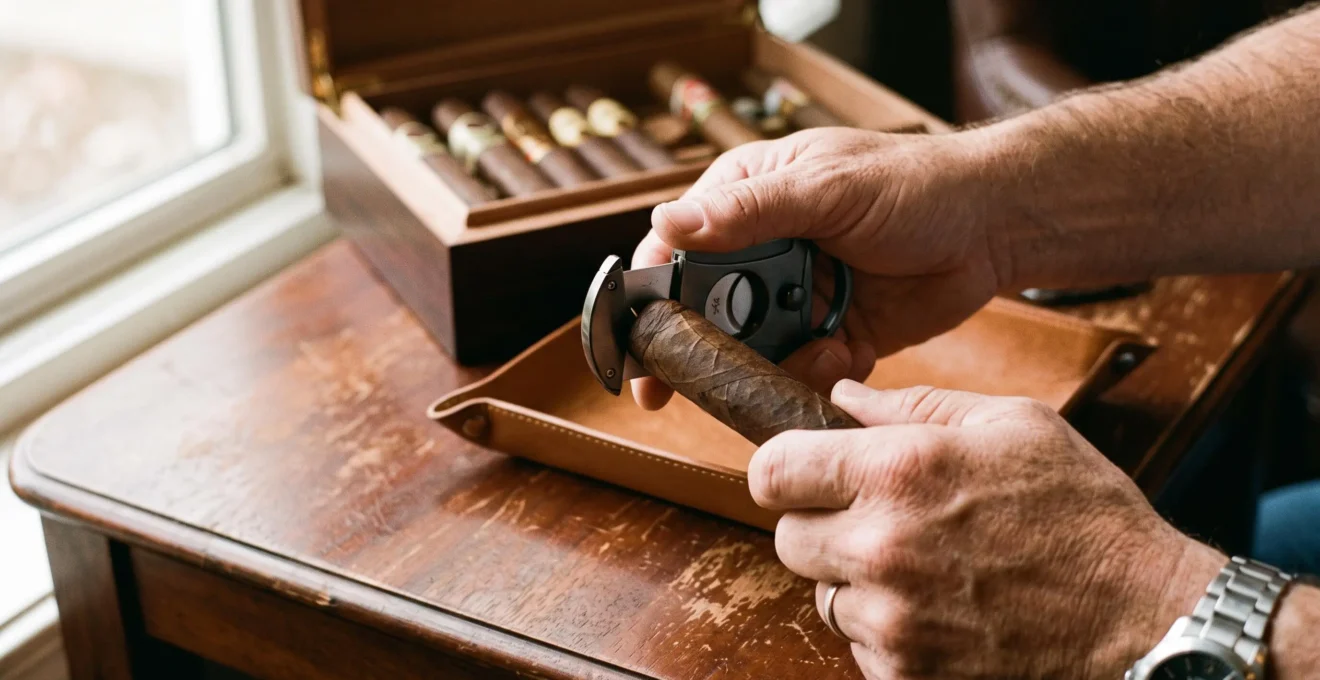
A double guillotine cutter can feel razor-sharp yet leave a premium cigar with a cracked shoulder, dangling wrapper or mouthful of loose tobacco. The problem is not necessarily the cutting edge. Blade alignment, residue, aperture size, cutting depth and the way pressure is applied all influence whether the head separates cleanly.
On larger cigars, particularly 52 to 60 ring gauges, these weaknesses become harder to ignore. A cutter that handles a slender corona perfectly may squeeze or distort a thicker head. One hesitant cut can also damage the cap even when the blades themselves are serviceable.
The practical solution is to diagnose the cutter before sacrificing another cigar: check blade movement and alignment, confirm the opening genuinely accommodates the ring gauge, locate the shoulder and complete the cut with controlled, even pressure. Then examine the result before lighting. A clean cut should open the draw without sacrificing the cap structure that keeps the wrapper attached.
Clean cigar cuts: the essentials
- A sharp blade is not enough: alignment, blade cleanliness and a suitable opening matter.
- Use one confident cutting motion and leave part of the cap intact above the shoulder.
- Check the cold draw and cap before lighting; a cutter cannot correct poor cigar construction.
- Why Can a Sharp Cutter Still Tear the Cap if the Blades Don’t Close Evenly?
- How to Cut in One Motion on 52 to 60 Ring Gauges to Avoid Wrapper Splits
- Double Guillotine, Punch, or V-Cut: Which Is Best if You Hate Loose Tobacco Bits?
- The Too-Deep Cut Mistake That Makes the Cap Unravel Mid-Smoke
- When Should You Clean a Guillotine Cutter to Keep Cuts Clean After Many Uses?
- How to Cut a 56 Ring Gauge Cleanly Without Creating a Tight Draw
- How to Do a 90-Second Pre-Light Check That Predicts Burn Problems Before You Commit
- How Can You Tell a Premium Hand-Rolled Cigar Before You Light It Without Being Fooled?
Why Can a Sharp Cutter Still Tear the Cap if the Blades Don’t Close Evenly?
A sharp double guillotine can tear a cigar cap when its blades move out of alignment, fail to meet consistently or drag against the wrapper. Instead of separating the leaf cleanly, the cutter compresses part of the head while the opposing edge catches and pulls. Sharpness reduces cutting resistance, but it cannot compensate for poor blade alignment.
A double guillotine approaches the cigar head from opposing sides. Its cutting action depends on consistent contact and controlled blade movement. Although often compared with scissors, the mechanism varies between cutter designs, so there is no universal blade-gap tolerance that guarantees a clean result.
Begin with the cutter empty. Open and close it slowly while observing whether both blades travel smoothly and symmetrically. Hold it towards a bright window with the blades nearly closed. An unexpected uneven gap, visible lateral movement or inconsistent meeting point may indicate a mechanical problem.
This is a practical screening check, not a calibrated alignment measurement. Certain cutters have intentional clearances, and apparent gaps can change with the viewing angle.
For a supplementary check, cut a loosely rolled strip of ordinary paper rather than risking a premium cigar. Look for dragging, folding or pinching. Paper does not behave like tobacco leaf, so passing this test does not establish cigar-cutting performance.
Different mechanical faults can leave different visible clues. A worn or loose pivot may allow lateral movement, creating an irregular snag. In a spring-assisted design, a displaced component may interfere with blade travel, sometimes leaving one side of the head more compressed. Neither pattern proves a particular fault without inspecting the cutter.
A cutter that moves unevenly should not automatically be sharpened. Home grinding can alter edge geometry and make an alignment problem worse. If cleaning fails and the mechanism is damaged, professional servicing where supported, or replacement, is generally more sensible than amateur regrinding.
Once the cutter operates consistently, the next variable is how it meets the cigar head. This becomes particularly important with large ring gauges.
How to Cut in One Motion on 52 to 60 Ring Gauges to Avoid Wrapper Splits
To reduce wrapper splits on a 52 to 60 ring gauge cigar, make sure the cutter fully accommodates the head, position the blades just above the shoulder and complete the cut in one swift, even motion. Avoid stopping halfway through: partial compression followed by a second squeeze can disturb the wrapper before the cap separates.
The diameter matters because large cigars occupy more of the cutter’s opening. A 56 ring gauge measures 56/64 of an inch in nominal diameter, approximately 22.2 mm. This conversion describes cigar size, not the minimum opening a cutter requires in every design.
A cutter with insufficient clearance may force the cigar off-centre, prevent the blades from reaching the intended point or require an awkward angle. All three can compromise the cut.
Before positioning the cigar, open the cutter completely and confirm that the head fits without pressure against the blades. If the fit is marginal, choose a larger cutter rather than forcing the tobacco through.
Next, identify the shoulderthe transition between the rounded head and the straighter body. Keep the intended cut above that transition, leaving enough cap material to retain the wrapper.
For positioning, follow this sequence:
- Support the cigar gently without squeezing its head out of shape.
- Centre the head within the fully opened blades.
- Use a cutter’s built-in stop only if its design and depth suit that cigar’s cap.
- Bring the blades lightly into contact to confirm the cutting position.
- Finish with one decisive, even squeeze rather than two separate compressions.
This approach is consistent with Cigar Aficionado’s instructions for cutting a cigar, which emphasise the shoulder, proper positioning and swift, even pressure.
Do not confuse commitment with excessive force. The aim is smooth blade travel, not crushing the head. If the cutter binds before the cut begins, stop and reassess its fit.
At 58 ring gauge and above, compatibility deserves particular attention. A cutter may advertise a large maximum gauge yet leave little room to position the cap correctly. Check the manufacturer’s capacity and the cutter’s actual geometry rather than relying on diameter alone.
Even a perfectly executed straight cut exposes tobacco at the head. If loose fragments are your main frustration, cutter type becomes the next decision.
Double Guillotine, Punch, or V-Cut: Which Is Best if You Hate Loose Tobacco Bits?
A punch cutter is often worth considering when loose tobacco fragments are the main complaint because it removes a small circular section of the cap while leaving much of the surrounding leaf intact. A double guillotine offers a broader opening and greater flexibility, while a V-cutter creates a channel. The best choice depends on head shape, ring gauge and preferred draw.
Each design changes the exposed tobacco surface. None guarantees a fragment-free smoke, particularly when the cap is fragile or poorly constructed.
| Criterion | Double guillotine | Punch | V-cut |
|---|---|---|---|
| Loose tobacco | Exposes more filler; fragments can appear if the cut is ragged. | Typically leaves more of the cap intact and can reduce loose bits. | Can retain fragments in the channel if the cut is uneven. |
| Draw opening | Broad, adjustable through careful positioning. | Smaller, concentrated opening. | Channel-shaped opening, dependent on blade geometry. |
| Large ring gauges | Useful when the aperture genuinely accommodates the cigar. | Practical on suitable rounded heads, though opening size matters. | Useful with an appropriately sized and shaped blade. |
| Delicate wrapper | Requires alignment and accurate cutting depth. | May preserve more surrounding cap, but can crack a dry head. | A deep or poorly positioned cut may damage the shoulder. |
| Maintenance | Keep both blade edges and the mechanism clean. | Remove lodged tobacco and residue from the punch. | Clean the cutting groove and blade surfaces. |
The comparison in Cigar Aficionado’s overview of punch cutters identifies fewer loose tobacco fragments as a practical punch-cutting advantage. It also notes that punch cutters are unsuitable for pointed cigar heads.
A thin, delicate Connecticut wrapper may encourage a conservative cutting approach, but its colour or type does not establish that a punch is automatically safer. A thicker Colorado wrapper may still crack if dry, poorly applied or mishandled. Construction and condition matter more than wrapper colour alone.
There is also a trade-off for smokers who continue towards the nub. A small punch opening can become less comfortable if moisture, oils or tobacco particles accumulate. The actual effect varies; it is not established that every punch will clog or change flavour in a predictable way.
If the punch opening feels restrictive, a suitable V-cut may offer an alternative without removing as much of the surrounding cap as a broad straight cut. However, V-cutters differ substantially in depth and geometry.
For a large, rounded cigar whose wrapper tends to unravel, a properly aligned double guillotine remains a flexible starting point. Choose a V-cut when the cigar’s shape and your draw preference favour a channel opening. Choose a punch when minimising fragments takes priority and the head is compatible.
Whichever tool you choose, preserving the cap is critical. An unnecessarily deep cut can unravel a cigar even when its initial edge looks remarkably neat.
The Too-Deep Cut Mistake That Makes the Cap Unravel Mid-Smoke
Cutting too deeply can remove the portion of the cigar cap that helps secure the wrapper around the head. The opening may initially look clean, but the wrapper can progressively loosen as the cigar is handled and smoked. To reduce this risk, remove only the necessary part of the cap and preserve material around the shoulder.
On many handmade cigars, the cap consists of additional wrapper leaf applied over the rounded head. Its seams can be visible as fine lines or overlapping edges. The exact construction varies, including single, double and triple-cap arrangements.
Look at the cigar under good light. Identify where the rounded head transitions into the straight body. This transition is the shoulder, and the intended straight cut generally belongs above it.
Fine changes in seam direction or the arrangement of wrapper leaf may help you see the cap boundary. They are visual guides, not a universal measurement. Some heads have very shallow caps, making positioning less forgiving.
After cutting, inspect the head before lighting. A broad opening alone does not prove overcutting: exposed filler is expected. The more concerning clues are a severed shoulder seam, a lifted wrapper edge or a cap that no longer appears firmly attached.
If the wrapper has started to lift, avoid repeatedly touching or pulling it. A very slight amount of moisture may temporarily help a minor loose edge lie flat, but it does not reconstruct the cap or reliably repair a serious tear. Avoid soaking the tobacco.
When damage is extensive, the realistic choice may be to accept a compromised cigar rather than keep trimming it. A second, deeper cut usually removes still more of the material holding the wrapper together.
One useful diagnostic is to compare successive cuts made with a depth-limiting cutter. If its stop consistently positions the blade below shallow shoulders, the problem may be cutter geometry rather than user hesitation.
Maximum blade travel is not the same as correct cutting depth. A backstop is only helpful when it positions the cut appropriately for the particular head.
Correct placement protects the cigar’s construction. Keeping the blades clean protects the cut itself, especially after repeated use.
When Should You Clean a Guillotine Cutter to Keep Cuts Clean After Many Uses?
Clean a double guillotine when residue begins affecting blade movement or cut quality, rather than waiting for a fixed number such as 50 uses. Tobacco particles, oils and moisture can accumulate around the cutting edges and mechanism. If the blades start dragging, leave visible leaf fibres or move unevenly, inspect and clean them before assuming they are blunt.
The accumulation rate depends on how frequently the cutter is used, the condition of the cigars and how the accessory is stored. An oily or moist cigar may leave more contamination than a relatively dry one, although no universal maintenance interval is established.
Begin with visual inspection. Look for tobacco dust, sticky deposits, trapped cellophane or material lodged near the blade tracks. A blade that fails to open completely might simply be obstructed.
According to Holt’s instructions for cleaning a cigar cutter, rubbing alcohol applied with a cotton swab can help remove residue from accessible blade surfaces. The instructions also caution against inappropriate products such as WD-40, brake cleaner and vegetable oil.
Use a small amount of suitable rubbing alcohol on a cloth or cotton swab, keeping fingers away from the cutting edges. Clean accessible surfaces, avoid forcing the mechanism or flooding enclosed components, and dry the cutter completely before storing or using it. Check the manufacturer’s instructions where available, particularly for coated blades or unusual finishes.
Five checks before your next premium cigar
- Inspect the mechanism: open and close the empty cutter, recording whether the blades move smoothly and meet consistently.
- Remove contamination: clean accessible residue and confirm that no visible tobacco fibres or sticky film remain.
- Verify the aperture: compare the cutter opening with the intended ring gauge and confirm that the head fits without compression.
- Locate the shoulder: identify the safe cutting position visually, with enough cap material remaining to support the wrapper.
- Check the finished cut: inspect for lifted edges, loose fragments and an unobstructed opening before lighting.
After cleaning, repeat the empty movement check. If the blade travels smoothly and subsequent cuts improve, residue was plausibly contributing to the problem. That is a practical observation rather than proof of a particular mechanical cause.
If the cutter still snags, shifts laterally, binds or leaves recurring crushed edges, investigate wear or damage. Cleaning will not straighten a bent blade or restore a badly worn pivot.
Do not repeatedly test a failing cutter on expensive cigars. Replacement may cost less than the tobacco wasted through recurring cap damage, although the decision depends on the cutter’s value and whether proper servicing is available.
Once residue and blade travel are under control, a large cigar still needs the right opening. The next test concerns airflow rather than wrapper damage alone.
How to Cut a 56 Ring Gauge Cleanly Without Creating a Tight Draw
A clean cut on a 56 ring gauge cigar needs a cutter large enough to make a level opening without crushing the head. Preserve the shoulder, remove only the necessary cap material and test the draw before lighting. If airflow remains restricted, examine the cut for an obstruction before assuming the cutter or rolling density is responsible.
A 56 ring cigar has a nominal diameter of approximately 22.2 mm. That does not mean you need to expose the entire head diameter to obtain a satisfactory draw. The required opening depends on the cigar’s construction and your preferred resistance.
The problem with a marginally sized cutter is not simply a smaller opening. Inadequate clearance may produce an angled cut or compress one side of the head. Loose tobacco can then partially obstruct the opening, creating an uneven sensation when drawing.
Inspect the result from directly above. Ideally, the cut should be level, the wrapper edge intact and the opening clear of visibly detached fragments.
Then take a gentle cold draw. A reasonable result is perceptible resistance with airflow that feels steady and comfortable. If it requires unusually strong suction, something may be restricting the passage. An extremely loose draw can also be undesirable.
The cold draw is subjective and cannot reliably identify the exact cause of resistance. An obstructed opening is a possible cutter-related explanation; dense bunching, a hard spot or other internal construction features may be responsible instead.
Distinguish these possibilities systematically:
- Visible fragments at the head: inspect for loose tobacco that can be removed without disturbing the cap.
- Angled or compressed edge: consider whether the cutter’s opening or positioning caused an incomplete cut.
- Uniformly tight draw with a clean opening: internal rolling density becomes a plausible explanation.
- Noticeable hard section along the body: construction may be contributing, although touch alone cannot confirm a blockage.
A very small corrective trim may sometimes help an obviously undersized cut, but it is not a universal fix. If the shoulder is already close to the opening, further cutting risks unraveling the cigar.
Do not enlarge a head indiscriminately just to chase a freer draw. A well-constructed cigar often has deliberate resistance, and the objective is a comfortable, consistent draw rather than minimum resistance.
A cut that looks acceptable is only the first part of the diagnosis. A short pre-light inspection helps identify other construction and storage problems before they become harder to separate.
How to Do a 90-Second Pre-Light Check That Predicts Burn Problems Before You Commit
A 90-second pre-light check combines cap inspection, wrapper examination, a gentle firmness test, the cold draw and aroma at the foot. These observations can reveal damage or construction concerns before lighting, although they cannot reliably predict every burn defect. The purpose is to catch obvious problems early and avoid blaming the cutter for unrelated faults.
Start immediately after the cut. Use the following sequence as a practical timing target rather than a formally validated diagnostic protocol.
- First 15 seconds — cap integrity: look for lifted seams, ragged edges and loose tobacco around the opening. A visible crack merits attention before handling the head further.
- Next 20 seconds — wrapper condition: examine the body under reasonable light. Notice obvious cracks, splits, patchy damage or sections that appear unusually dry.
- Next 20 seconds — firmness: gently feel the body along its length. Pronounced hard or soft spots may indicate inconsistent construction. Avoid pressing hard enough to damage the wrapper.
- Next 20 seconds — cold draw: assess whether airflow feels consistent, unusually restricted or excessively loose. Compare the sensation with your normal preference rather than treating it as a numerical measurement.
- Final 15 seconds — aroma and visible construction: smell the foot and inspect its exposed tobacco. Look for obvious gaps, loose folds or other irregularities.
The inspection produces several different kinds of evidence. A cracked cap directly identifies existing physical damage. A tight cold draw indicates resistance, but does not establish whether a future cigar will tunnel. A soft spot raises a construction question without proving that the burn will become uneven.
Aroma is similarly informative but not decisive. Unusual or unpleasant notes might justify closer inspection, yet there is no reliable smell-only test that establishes fermentation quality or future smoking performance.
Use the results comparatively. If several cigars cut with one accessory repeatedly show similarly damaged shoulders, inspect the cutter. If one box repeatedly presents inconsistent firmness or unusually tight draws despite clean cuts, storage conditions or construction become plausible alternative explanations.
Keep observations specific. Record what you can actually see or feel rather than automatically attributing every symptom to a single fault.
This quick routine also reveals an important limitation: some problems originate in the cigar long before the cutter touches it. Assessing construction quality is therefore the final part of the decision.
Key takeaways before judging cigar quality
- A clean cutter cannot compensate for a badly constructed or damaged cap.
- Even firmness, intact seams and a reasonable cold draw offer useful clues, not guarantees.
- Appearance and band printing cannot establish authenticity without reliable provenance.
How Can You Tell a Premium Hand-Rolled Cigar Before You Light It Without Being Fooled?
A premium hand-rolled cigar can show careful cap application, consistent wrapper condition, resilient firmness and a reasonably even cold draw. These are useful quality indicators, but none independently proves that the cigar is premium, genuine or well constructed internally. Reliable purchasing provenance remains essential, especially when authenticity is in question.
Begin with the cap. On a rounded handmade cigar, carefully applied overlapping wrapper leaf often creates visible seam lines. Some premium cigars have triple caps, but the number of visible seams is not a universal authenticity test or exclusive sign of origin.
Inspect the wrapper next. Consistent colour and a supple surface can be favourable, while obvious cracks or dry, brittle areas deserve caution. Natural variations in shade, veins and leaf texture are not necessarily defects.
Press gently along the cigar’s length. Ideally, the body feels resilient without large contrasts between unusually hard and soft areas. A very hard section may indicate dense construction, while a conspicuous soft patch may reflect a less uniform bunch. Neither finding provides a definitive diagnosis on its own.
The cigar’s foot can also reveal how the tobacco is arranged. Look for broadly consistent folds and the absence of obvious hollow pockets. However, the external appearance of the foot does not disclose every aspect of internal construction.
These checks are broadly consistent with Holt’s assessment of cigar construction and quality, which discusses wrapper condition, cap construction, firmness and draw resistance while recognising that final quality cannot be established fully before smoking.
Be especially careful with claims about counterfeit cigars. An exceptionally uniform wrapper may be genuine; a visible cap seam may be imitated; and differences in band printing require comparison with authenticated examples. None should be treated as a stand-alone verdict.
Packaging, retailer reputation, traceable provenance and manufacturer-specific authentication methods, where available, provide stronger context than visual folklore. If authenticity matters, buy through a reputable source and check the manufacturer’s current guidance.
Smelling the foot can reveal pleasant, subdued or unusual tobacco aromas. A cold draw may suggest how easily air passes through the construction. Neither guarantees flavour complexity, curing quality or authenticity. An ammonia-like smell deserves caution, but does not independently prove a particular production defect.
The link to cutting performance is straightforward: a properly secured cap is better positioned to remain intact when cut correctly. Conversely, a poorly attached wrapper or damaged head may fail even when the guillotine is clean, aligned and operated correctly.
For your next cigar, start with an intact head and a cutter that fits its gauge. Identify the shoulder, make one controlled cut and check the result before lighting. If the wrapper still tears, compare the cutter’s behaviour with the cigar’s construction rather than removing more cap in the hope of repairing the problem.
Can a brand-new double guillotine cutter still damage a cigar?
Yes. A new cutter can have an unsuitable aperture, a mechanical defect or blade movement that does not suit a particular cigar. Positioning, cap depth and wrapper condition also influence the result. Newness alone does not establish cutting performance.
Should you sharpen a double guillotine cutter yourself?
Usually not without manufacturer guidance and suitable equipment. Removing material from the cutting edges can change their geometry and potentially worsen the interaction between the blades. Clean and inspect the cutter first, then consider supported servicing or replacement.
Does a ragged cigar cap always mean the cutter is blunt?
No. Residue, an unsuitable aperture, uneven blade movement, an excessively deep cut or a damaged wrapper can all contribute. Compare the cut pattern and cutter movement before identifying bluntness as the cause.
Can you save a cigar after its wrapper starts unraveling?
Minor lifting may sometimes remain manageable with careful handling, but there is no guaranteed repair once the cap has lost its hold. Avoid pulling the loose leaf or repeatedly cutting deeper. Extensive damage may leave the cigar permanently compromised.
Is a punch cutter always better for preventing loose tobacco in your mouth?
No. A punch can reduce loose fragments by preserving more of the surrounding cap, but it creates a smaller opening and does not suit every cigar head. The best choice depends on the cigar’s shape, construction and preferred draw resistance.