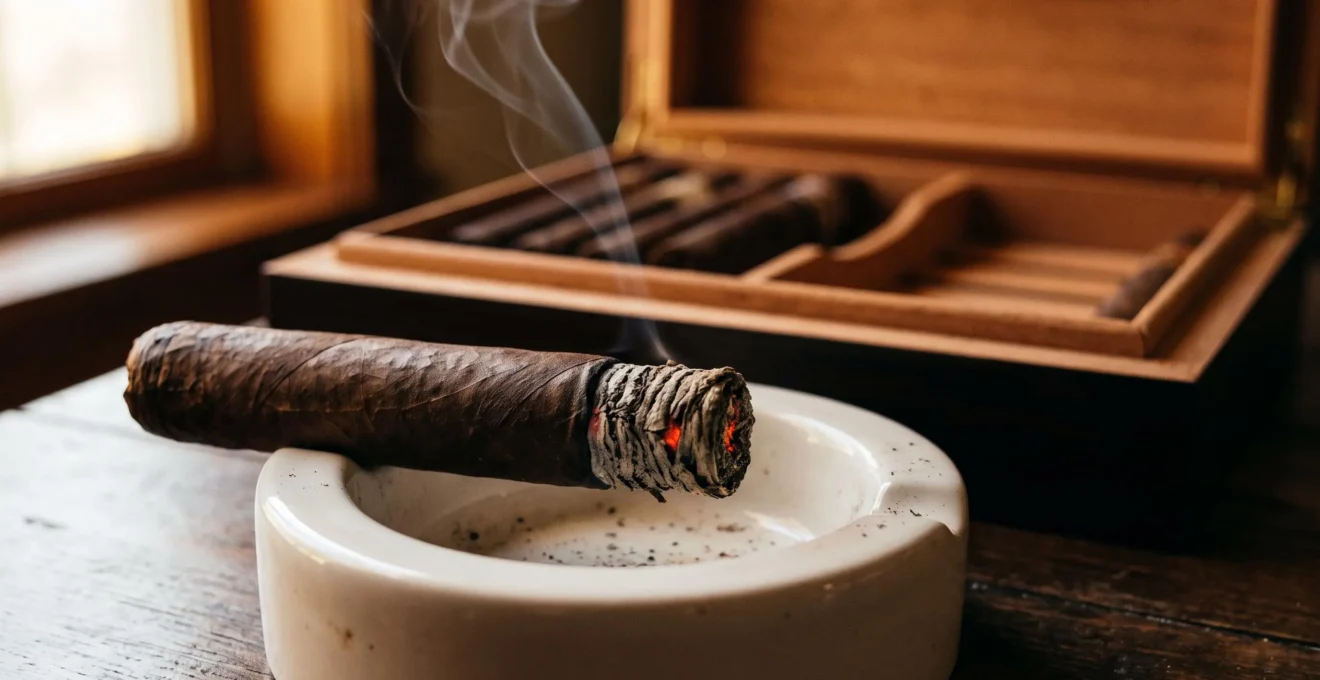
A cigar can begin with restrained tobacco and woody aromas, develop an appealing sweet cedar character through its middle third, then finish with noticeably drier, sometimes bitter sensations. That progression does not necessarily mean the cigar was badly stored or poorly made. The changing combustion conditions, tobacco blend, smoking rhythm and sensory adaptation can all influence what reaches the palate.
The important distinction is between sweetness genuinely changing in the smoke and sweetness becoming harder to perceive. These situations can feel almost identical, yet they suggest different explanations.
Spanish cedar storage introduces another variable. Cedar used in cigar boxes and humidors can contribute familiar aromas, but a cedar-like tasting note may also arise from the tobacco’s own aromatic profile. One should not automatically be mistaken for the other.
Understanding these differences makes it easier to interpret a cigar’s progression, recognise overheating and assess whether storage or a drink pairing is changing the experience. The observations remain subjective: no precise minute, humidity adjustment or smoking interval guarantees that cedar sweetness will persist.
What matters most about sweet cedar notes
- Sweet cedar can become prominent as combustion conditions change, but there is no universal middle-third aromatic peak.
- Rapid puffing can contribute to hot, bitter smoke; a steadier rhythm helps distinguish overheating from normal flavour evolution.
- Spanish cedar storage and drink pairings may influence perceived aromas, but neither reliably creates or preserves sweetness in every cigar.
- Why Does Cedar Shift From Sweet to Dry as the Cigar Heats Up ?
- Why Does Sweetness Show Up Mid-Smoke Instead of on the Cold Draw ?
- Why Does Caramel Sweetness Appear Only After the Burn Line Settles ?
- Why Does Caramel Sweetness Show Up Late and Then Disappear After 10 Minutes ?
- How to Use Cedar in Storage Without Overpowering the Cigar in 30 Days ?
- The Fast-Cadence Mistake That Turns Sweet Cedar Into Dry Wood by Minute 35
- When Should You Slow Down After Cedar Appears to Make It Last Longer ?
- Rum, Whisky, or Coffee: Which Keeps Cedar Notes Sweet Instead of Dry ?
Why Does Cedar Shift From Sweet to Dry as the Cigar Heats Up ?
Sweet cedar can turn into a drier woody impression because the composition of the smoke and the smoker’s perception change as the cigar burns. Heat affects tobacco chemistry, while repeated exposure can alter the prominence of individual aromas. However, no established chemical rule requires cedar sweetness to peak halfway through every cigar.
During smoking, tobacco undergoes several heat-driven transformations, including pyrolysis and reactions involving carbohydrates. These processes contribute to the complex mixture of compounds responsible for smoke aroma.
A scientific review of carbohydrates and tobacco aroma formation, published in Molecules in 2020, explains that thermal reaction products depend strongly on temperature and reaction conditions.
That chemistry helps establish why burning conditions matter, but it does not demonstrate that wrapper sugars disappear before heavier woody compounds, or that a specific temperature marks the transition from sweet cedar to dry wood.
Two sources of cedar character also need separating. Spanish cedar used in storage and packaging may contribute aromas, whereas a cedar descriptor can emerge from the cigar’s tobacco blend. The same tasting word does not establish an identical origin.
To investigate a changing flavour, compare three observations:
- Cold draw: note whether cedar, sweetness or dry wood is detectable before lighting.
- Middle third: identify when the cedar impression becomes most noticeable and whether the smoke feels comfortable or unusually hot.
- Final third: record whether sweetness declines gradually, disappears suddenly or returns after a pause.
A sudden association between hotter smoke and bitterness makes overheating a plausible explanation. A gradual change without obvious heat may instead reflect the tobacco’s evolving flavour profile or reduced sensory sensitivity. Neither observation is conclusive on its own.
The key is to treat temperature as a significant variable rather than an all-purpose explanation. This distinction becomes particularly useful when comparing what an unlit cigar promises with what its burning tobacco actually delivers.
Why Does Sweetness Show Up Mid-Smoke Instead of on the Cold Draw ?
Sweetness may become more apparent during the middle third because an unlit cigar releases a different range and quantity of aromas from burning tobacco. Lighting introduces heat-driven chemical reactions, while the developing combustion zone changes the smoke. A faint cold-draw cedar note is therefore an indicator of possible flavours, not a reliable prediction.
The cold draw samples aromas available without combustion. It may reveal woody, earthy, vegetal or sweet impressions, but it cannot reproduce the chemical conditions created once tobacco burns.
The first third also includes the effects of ignition and the establishment of the burning zone. A cigar that initially tastes restrained may develop a broader aromatic profile as smoking continues.
Although enthusiasts frequently describe a more expressive middle third, this is a tasting observation, not a universal combustion timetable. Some cigars display their strongest sweetness early; others retain a remarkably consistent profile.
If cedar appears only after the first third, there is no immediate reason to assume anything is wrong. If the expected note never emerges, consider the possible explanations without treating any single one as a diagnosis.
| Observation | Possible explanation | What it tells you |
|---|---|---|
| Faint cedar before lighting, stronger cedar later | Different aromatic compounds become perceptible during smoking | The cold draw did not represent the complete flavour profile |
| Sweetness absent throughout | Blend characteristics, smoking conditions or palate sensitivity | Storage is not automatically responsible |
| Woody bitterness from the beginning | Lighting conditions, tobacco characteristics or storage issues | Several variables require consideration |
| Sweetness appears after a pause | Possible changes in smoke temperature or sensory perception | The apparent loss may not be permanent |
Strongly flavoured food and beverages can complicate this assessment. Coffee, for example, introduces roasted aromas and bitterness that may change how subtle cedar notes are perceived. That does not prove that coffee prevents those notes from emerging.
Similarly, a quiet first third does not justify immediately changing humidor humidity. Such an adjustment alters the storage environment for reasons that may have nothing to do with the initial tasting impression.
Once the cigar begins producing a more developed flavour, the next useful observation is whether the burn remains regular and whether caramel-like impressions accompany the emerging cedar.
Why Does Caramel Sweetness Appear Only After the Burn Line Settles ?
Caramel-like sweetness may become noticeable after the burn line settles because the cigar’s combustion conditions have changed and the smoke profile has developed. An initially uneven burn can contribute inconsistent sensations. However, tasting caramel does not prove that sugars are literally caramelising at the burn line or that a regular burn guarantees sweeter smoke.
Caramel is a sensory descriptor. It may refer to impressions resembling cooked sugar, toffee or browned sweetness, without identifying a single molecule or reaction.
Research on tobacco carbohydrates describes multiple thermal decomposition processes, including the production of compounds that influence aroma. It does not establish that cigar caramel notes arise exclusively from direct caramelisation.
The visual burn line remains useful because it helps identify combustion irregularities. Three common patterns deserve different interpretations:
- Canoeing: one side burns ahead of the other, indicating uneven combustion. The flavour may become inconsistent, although the visible pattern alone cannot predict a specific taste.
- Tunnelling: the inner tobacco burns ahead of the outer layers, potentially changing the proportion of tobacco contributing to the smoke.
- Relighting: combustion is interrupted and restarted, introducing another variable into the tasting progression.
It would be misleading to claim that these three conditions interrupt a verified caramelisation sequence. Their practical significance is that they can make comparisons less consistent.
Suppose two cigars of the same blend begin differently. One is lit evenly and develops a clear caramel impression. The other burns irregularly and tastes harsher. The difference makes combustion conditions worth examining, but does not prove that the irregular burn alone caused the flavour difference.
A common response to subdued initial flavour is to increase draw frequency. That can make the smoke hotter and may introduce bitterness rather than the expected sweetness.
Instead, observe whether the initial flavour becomes more defined without forcing the pace. If the cigar has gone out, a relight creates a new combustion phase; do not assume the first subsequent draws must recreate the exact flavour of the previous stage.
A stable-looking burn provides a more consistent basis for tasting, not a guarantee of sweetness. Even when caramel appears distinctly, its apparent intensity may fluctuate or fade as the experience continues.
Why Does Caramel Sweetness Show Up Late and Then Disappear After 10 Minutes ?
Caramel sweetness can appear late and seem to vanish shortly afterwards because both the smoke and the smoker’s perception are changing. A difference in combustion conditions may alter the actual flavour, while repeated exposure may reduce the apparent intensity of familiar aromas. Ten minutes is an illustrative interval, not an established limit.
These explanations involve two separate processes: the ongoing evolution of the cigar and adaptation within the sensory system.
As the burning zone progresses, the smoke is produced under changing physical conditions. Temperature, airflow, remaining tobacco and the characteristics of the blend may all influence flavour.
Meanwhile, repeated exposure to a recognisable aroma does not necessarily maintain the same perceived intensity.
An experimental study of human olfactory adaptation examined responses to repeated presentations of selected odorants in 35 participants. Perceived intensity tended to decrease for several tested substances, although the researchers did not find a significant overall reduction in the measured peripheral electro-olfactogram response.
The experiment was not conducted with cigar smoke. It supports the relevance of changing odour perception, not a specific ten-minute schedule for losing caramel sweetness.
For practical interpretation, compare the following situations:
| Observation | Changing smoke characteristics | Sensory adaptation |
|---|---|---|
| Sweetness declines | Smoke composition may have changed | The same note may feel less intense |
| Bitterness increases | Hotter or harsher smoke is possible | Reduced sweetness may make bitterness more noticeable |
| Sweetness seems clearer after a pause | Smoking conditions may also have changed | Reduced recent exposure may influence perception |
| Aroma remains subdued | Blend or combustion differences remain possible | Adaptation cannot be excluded or confirmed |
A short pause and some neutral water can provide a less cluttered setting for another assessment. They should not be described as scientifically validated methods for restoring cedar sensitivity within a fixed time.
Excessive or insufficient storage humidity may also affect the smoking experience, but a quickly disappearing caramel note cannot diagnose either condition. Check actual storage conditions and other burn behaviour before drawing that conclusion.
Because perception and combustion can change simultaneously, the most useful conclusion is often conditional rather than definitive. Storage provides a further variable worth examining separately from what happens during a single smoke.
How to Use Cedar in Storage Without Overpowering the Cigar in 30 Days ?
Spanish cedar can contribute familiar woody aromas to a cigar’s storage environment, but thirty days is not a proven period for achieving a particular flavour intensity. The amount of aromatic transfer is not reliably predictable from time alone. The safest interpretation is to observe the existing storage arrangement rather than assume additional cedar creates sweetness.
Spanish cedar is widely associated with cigar boxes and humidors. Despite its common name, it is botanically different from true cedar, and should not be confused with red or aromatic cedar.
Cigar Aficionado‘s glossary entry on cedar identifies both its traditional use in cigar storage and cedar as an established cigar-flavour descriptor. It also distinguishes Spanish cedar from unsuitable aromatic cedar woods.
That distinction matters because cedar used for storage and cedar perceived in smoke are not necessarily the same phenomenon. A tobacco blend may express woody aromas without recent contact with a cedar-lined box.
Storage configurations also differ. A lined humidor, a cedar tray and a thin packaging strip offer different arrangements of wood near the cigars. Yet there is insufficient evidence in the supplied research to rank their aromatic influence quantitatively or prescribe a reliable exposure period.
The wrapper’s appearance or oiliness does not provide a validated formula for predicting cedar absorption. Nor is there evidence that additional cedar exposure manufactures sweetness in otherwise dry-tasting tobacco.
To evaluate whether cedar is becoming too prominent, use comparable cigars from the same blend and record their storage history. Distinguish a strong cedar smell on the wrapper from actual sweetness experienced when smoked.
If a cigar already seems overwhelmingly woody, changing the cedar exposure may be considered, but the evidence does not establish a standard neutral-resting period or guarantee that an unwanted aroma will dissipate. Any alternative storage environment still needs appropriate humidity control.
Five checks for a cedar-storage observation log
- Identify the storage wood. Record whether the humidor or packaging uses Spanish cedar. Deliverable: a written description of the storage materials.
- Check the storage environment. Note the hygrometer reading and whether humidity control is functioning. Deliverable: a dated storage record.
- Establish a baseline. Describe the wrapper aroma and cold draw of a cigar before making changes. Deliverable: a brief initial aroma profile.
- Document exposure. Record whether cigars are stored in a lined humidor, on a tray or with packaging strips. Deliverable: an exposure history without an assumed transfer rate.
- Compare observations. Reassess a comparable cigar after a documented interval, keeping other conditions as consistent as possible. Deliverable: a comparison distinguishing any perceived difference from proven causation.
This is an observational method rather than a validated thirty-day cedar-treatment programme. Different cigars may produce different results, and even a perceived change cannot be attributed exclusively to wood exposure without appropriate controls.
Storage history can help explain differences between cigars, but it does not replace examining combustion conditions. Once the cigar is lit, smoking pace introduces a different and more immediate source of variation.
The Fast-Cadence Mistake That Turns Sweet Cedar Into Dry Wood by Minute 35
Frequent, closely spaced puffs can make cigar smoke hotter and more bitter, potentially obscuring delicate sweet cedar impressions. The relevant issue is smoking cadence, not a universal thirty-five-minute turning point. Format, draw resistance, lighting conditions and smoking behaviour vary too widely to assign a reliable minute when pleasant woodiness becomes dry.
Each draw increases airflow through the burning portion of the cigar. Taking repeated draws with little separation can affect combustion and the temperature of the smoke entering the mouth.
Practical cigar guidance links excessively rapid puffing with unpleasant hot, burnt or bitter flavours. Holt’s explanation of burnt and bitter cigar flavors identifies rapid puffing, uneven lighting and inadequate storage among possible contributors.
The specialist retailer recommends approximately 30 seconds to one minute between puffs as practical guidance. This is not an experimentally established optimum for every cigar, smoker or blend.
Consider two hypothetical experiences with cigars of the same blend:
Illustrative comparison: rushed and measured smoking
Scenario A: A smoker takes frequent draws as the middle third develops. The smoke becomes noticeably hotter, and the previously recognisable sweet cedar impression gives way to bitterness.
Scenario B: Another smoker takes more widely spaced draws from a comparable cigar. The smoke feels cooler, and the cedar impression remains easier to identify.
These are hypothetical observations, not results from a controlled trial. Their purpose is to show what could be recorded when evaluating cadence, without claiming that the two experiences are guaranteed or that a particular aroma compound has been preserved.
A practical self-check is whether the smoke has become uncomfortably hot or acrid relative to its earlier character. This subjective signal suggests reassessing the smoking rhythm, but it does not reveal an exact combustion temperature.
Another tempting explanation is that overly rapid draws permanently destroy a limited reserve of sweet compounds in the unburnt tobacco. Although heat undeniably changes tobacco chemistry, the supplied research does not establish that specific mechanism or prove that later relighting cannot restore a previously perceived aroma.
Equally, a naturally drier final third does not prove that smoking cadence was excessive. Some blends develop progressively stronger woody or bitter impressions even when the experience appears consistent.
The practical lesson is to avoid interpreting a fixed timestamp as a flavour deadline. Paying attention to changes in smoke character is more informative than watching for minute thirty-five.
When Should You Slow Down After Cedar Appears to Make It Last Longer ?
When sweet cedar becomes noticeable, a measured smoking rhythm can help avoid the hot, bitter smoke associated with excessive puffing. Slowing down does not guarantee that the note will last longer, however. The useful objective is to avoid overheating while allowing the cigar to continue burning consistently, rather than preserving a proven finite reserve of sweetness.
The appearance of cedar can serve as a convenient observation point. Record how the smoke feels, whether the flavour is balanced and whether the next draws change its character.
If the smoke becomes noticeably hotter and more bitter, rapid puffing is one plausible contributing factor. More space between draws may reduce that influence, but the evidence does not support a specific cadence change that reliably extends cedar sweetness.
There is also a trade-off between pace and relighting. Leaving an already struggling cigar untouched for too long may allow it to go out. Relighting introduces another change to the burning conditions, making the flavour progression harder to compare.
Format matters as well. A cigar with a relatively narrow ring gauge or an open draw may behave differently from a thicker format with greater draw resistance. The available sources do not establish a universal adjustment for either type.
Some enthusiasts use techniques such as expelling accumulated smoke before continuing, but the source material does not validate such a procedure as a way of preserving cedar aroma. It should not be treated as a proven corrective method.
The most informative approach is to observe whether changes in cadence coincide with changes in heat and flavour, without assigning causality prematurely.
Even with a consistent rhythm, the final third may taste different from the middle. Once combustion and pacing have been considered, drink pairing offers another way to examine the perceived balance of woody, sweet and bitter notes.
Key takeaways before choosing a pairing
- Distinguish a genuine change in smoke character from a change in how strongly an aroma is perceived.
- Use consistent storage and tasting observations before attributing a dry finish to one specific cause.
- Assess drinks for how they change the overall tasting experience, rather than assuming they protect cedar compounds in the cigar.
Rum, Whisky, or Coffee: Which Keeps Cedar Notes Sweet Instead of Dry ?
No available evidence establishes that rum, whisky or coffee chemically preserves sweet cedar notes in cigar smoke. Each drink can introduce sensations that change the perceived balance of sweetness, woodiness and bitterness. Rum may offer a contrasting sweet impression, whisky can introduce oak and spice associations, and coffee can contribute roasted bitterness. Water provides a simpler comparison.
A drink pairing changes the overall sensory context. It does not necessarily change the aroma compounds produced by the burning tobacco.
Rum styles with noticeable sweetness may complement a caramel-like cedar impression, whereas a drier rum can offer a very different experience. The category alone is not enough to predict the result.
Whisky presents an equally broad range of profiles. Oak-associated flavours may feel harmonious with cedar, but strong spice, smoke or alcohol sensations can compete with a subtler cigar note.
Coffee contributes roasted and often bitter sensations. Depending on the coffee and the individual palate, those characteristics may complement a cigar or make delicate sweetness less prominent.
The comparative effects remain subjective. In particular, neither alcohol nor coffee has been shown by the supplied research to prolong a cigar’s cedar phase.
For a clearer assessment, compare the same cigar blend across separate occasions, using plain water as a baseline. Keep the smoking environment and storage conditions as similar as practicable.
During such a comparison, record whether the woody aroma remains identifiable, whether sweetness seems more prominent and whether bitterness becomes more noticeable towards the end. These observations can reveal a personal preference without establishing that one drink preserves tobacco aromatics.
| Drink | Possible sensory contribution | Important limitation |
|---|---|---|
| Sweet-style rum | Sweet and caramel-like impressions may complement cedar | Does not demonstrate preservation of cigar sweetness |
| Whisky | Oak, spice or smoky notes may complement or compete with woodiness | Results depend on the particular whisky and individual perception |
| Black coffee | Roasted flavours and bitterness create contrast | May obscure rather than clarify subtle sweet notes |
| Water | Provides a relatively neutral tasting comparison | Does not guarantee a measurable restoration of olfactory sensitivity |
Higher-strength alcoholic drinks may also make the overall experience feel harsher to some people. A pairing that seems agreeable during the middle third may feel less balanced when bitter or dry impressions become dominant.
It is worth separating sensory enjoyment from health implications. Tobacco smoking is harmful, and adding alcohol introduces its own risks. A pleasant flavour pairing should not be interpreted as reducing the harms associated with either substance.
For the next tasting comparison, record the cedar note with water first, then compare any accompanying drink on a separate occasion. Focus on the differences you can actually perceive, without expecting a pairing to prevent the natural changes that occur during smoking.
Does a strong cedar aroma on the wrapper mean the cigar will taste sweet?
No. Cedar aroma on the wrapper may reflect storage or packaging, while the flavour experienced during smoking depends on the tobacco and combustion conditions. A strong unlit woody scent does not reliably predict how sweet the smoke will taste.
Can a cigar taste dry even when the humidor humidity is appropriate?
Yes. Perceived dryness may reflect the tobacco’s flavour profile, combustion conditions or sensory adaptation. A dry-tasting finish alone does not prove that the cigar was stored at an unsuitable relative humidity.
Is Spanish cedar the same as ordinary aromatic cedar wood?
No. Spanish cedar used in traditional cigar packaging and humidors is botanically distinct from red or aromatic cedar. Specialist cigar-storage guidance warns against substituting those other aromatic cedar woods.
Does a longer ash indicate that sweet cedar will last longer?
Not reliably. Ash appearance and length may offer observations about combustion, but the supplied evidence does not establish a relationship between ash length and the duration of sweet cedar flavour. Aroma and smoke characteristics need to be assessed separately.
Can the same cigar blend taste different on two occasions?
Yes. Differences in storage history, lighting, smoking rhythm, accompanying food or drinks and individual sensory perception can contribute to different experiences. Comparing cigars from the same blend under similar conditions helps identify potential influences, although it cannot eliminate every source of variation.