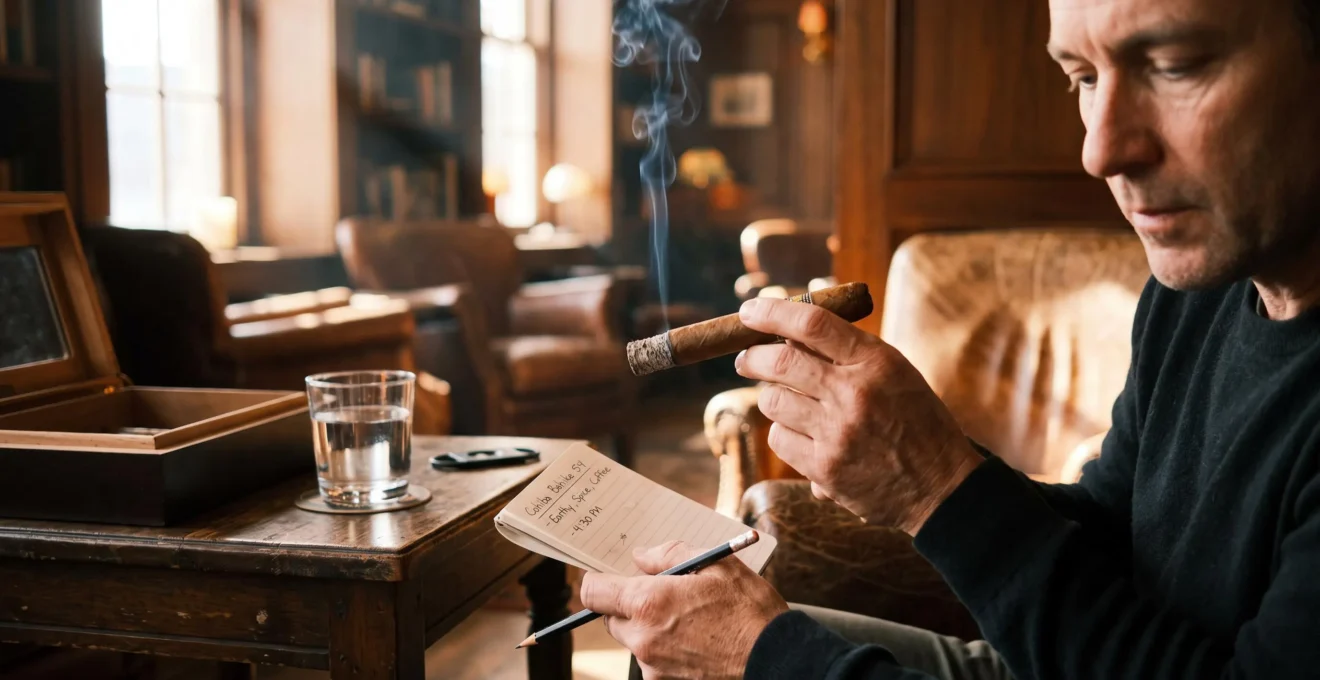
A cigar can smell wonderfully complex before lighting, deliver relatively little aromatic definition during its opening puffs, then reveal cedar, dried flowers, sweet spice or roasted nuts halfway through. That apparent transformation raises a useful question: has the tobacco changed, or has the smoker finally become able to perceive its full aromatic character?
The answer involves combustion, airflow, tobacco construction and human sensory perception. A changing burn line alters the conditions under which smoke is produced, while repeated exposure, surrounding odours and palate fatigue influence how that smoke is interpreted. Consequently, a restrained opening is not necessarily evidence of a disappointing blend.
For UK enthusiasts who value aromatic complexity over sheer strength, the practical challenge is separating a cigar’s genuine flavour development from changes caused by the smoking environment or evaluation method. A structured comparison across the thirds offers a more useful purchasing reference than an enthusiastic description of the first few draws.
One important distinction remains: analysing cigar aromas does not make smoking safe. Cigar smoke contains harmful substances, and exposure occurs even without deliberate inhalation.
Cigar bouquet development: the essentials
- A muted opening can reflect combustion conditions, tobacco moisture and sensory perception rather than an inherently weak blend.
- Compare the cold aroma, opening impressions and middle-third characteristics before drawing conclusions about aromatic complexity.
- Room fragrances, repeated smoke exposure, overheating and intense drinks can mask delicate notes that might otherwise be noticeable.
- Why Does the Aroma Open Up After 20 Minutes, Even if the Blend Is the Same?
- How to Sample the Bouquet With 3 Gentle Retrohales Without Burning Your Nose
- Aroma-Forward or Body-Forward: Which Should You Choose for a 1-Hour Weekend Smoke?
- The Room-Fragrance Mistake That Destroys Bouquet Perception in 5 Minutes
- In What Order Should You Smoke Bouquet-Heavy Cigars to Avoid Palate and Nose Fatigue?
- Why Does the Same Cigar Taste Like 3 Different Blends Over 60 Minutes?
- Why Are Botanical Notes the First to Vanish When the Smoke Gets Hotter?
- Why Do Subtle Botanical Essences Disappear as Soon as You Pair With a Strong Drink?
Why Does the Aroma Open Up After 20 Minutes, Even if the Blend Is the Same?
A cigar may appear to develop a richer bouquet after approximately twenty minutes because its combustion conditions and the smoker’s sensory experience have changed. The initial lighting phase can produce uneven burning and different smoke characteristics from those encountered later. However, twenty minutes is an observation point, not a scientifically established threshold for aromatic development.
At first light, the foot is transitioning from unburnt tobacco to sustained combustion. The ember, incoming airflow and moisture distribution interact, potentially producing irregular initial impressions. As the burn becomes more consistent, the balance of aromatic and irritating sensations may change.
The WHO Technical Report Series review of tobacco flavour science explains that tobacco flavour involves taste, smell, temperature and chemical irritation. It also describes how temperature can affect volatile-compound release. This provides a scientific basis for changing perceptions, although it does not prove that every cigar develops a richer bouquet during its second third.
Three different sensory layers deserve separate attention:
- Pre-light aroma: the smell of the wrapper and unburnt tobacco, which might suggest hay, cedar, leather or dried fruit.
- Initial combustion aroma: the first burning impressions, sometimes dominated by toast, pepper or general tobacco character.
- Established-burn aroma: the profile noticed after combustion has become more regular, which may reveal previously obscured nuances.
These stages are not interchangeable. A floral impression on an unlit wrapper does not guarantee an equally floral smoking experience, and an initially peppery cigar can subsequently develop a more recognisable woody or sweet profile.
Humidity adds another variable. A cigar that has retained excessive moisture may burn inconsistently or require repeated corrections, complicating aromatic evaluation. Storage should therefore be considered alongside the blend, without assuming that a particular humidity level will produce a predictable opening time.
A useful diagnostic is to record three observations from the same cigar: its cold-draw impression, its early smoking aroma and its middle-third profile. Mark whether notes become clearer, stronger, sweeter or simply different. Repeat with another example of the blend before treating the pattern as characteristic.
The second third may be where a particular cigar expresses its most satisfying balance, but it is not a universal destination. The more informative question is what changes between stages and whether those changes repeat.
How to Sample the Bouquet With 3 Gentle Retrohales Without Burning Your Nose
Retronasal olfaction helps explain why smoke aromas can seem different from sensations perceived in the mouth alone. Smoke-related odorants may reach the olfactory system during exhalation, but deliberately directing cigar smoke through the nose also exposes sensitive tissues to irritants. Three retrohales are not a validated safe or optimal assessment method.
Traditional tasting discussions distinguish mouth sensations such as bitterness, warmth and irritation from aromatic impressions commonly described as cedar, herbs, flowers or sweet spice. This distinction is valuable because flavour intensity and aromatic variety are not the same thing.
For example, a powerful pepper sensation can dominate attention even when other odour characteristics are present. Conversely, a comparatively restrained tobacco profile may seem complex because several aromatic families remain distinguishable.
The sensory vocabulary can be organised into four broad groups:
- Botanical: floral, grassy, herbal or dried-leaf impressions.
- Sweet: associations with honey, dried fruit, vanilla or caramel.
- Woody: cedar, oak, sandalwood or dry timber.
- Toasted: roasted nuts, bread crust, cocoa or coffee-like notes.
These descriptors describe perceived similarities, not proof that the corresponding ingredients or added flavourings are present.
Repeated nasal exposure may make subsequent aromas harder to distinguish. Human olfactory adaptation can occur following repeated or sustained stimulation, so sensory impressions collected in rapid succession should not automatically be treated as independent observations.
For a structured review, three separate observation moments—opening, middle and final third—can provide a useful comparison without requiring three deliberate nasal smoke exposures. Aromas can also be described from the unlit wrapper, cold draw and surrounding smoke, recognising that these observations reveal different aspects of the tobacco.
Anyone experiencing nasal burning, coughing, dizziness or discomfort should stop the exposure rather than attempting to overcome irritation. Lower perceived intensity does not establish lower toxic exposure.
The CDC information on cigars and their health effects explains that cigar smoke contains toxic and cancer-causing substances and that smokers can be exposed even when they do not inhale. Gentle smoking, partial retrohaling and shorter sessions do not remove those risks.
The most useful aromatic record is one that can be repeated and understood without treating nasal discomfort as evidence of a particularly sophisticated blend.
Aroma-Forward or Body-Forward: Which Should You Choose for a 1-Hour Weekend Smoke?
An aroma-forward cigar prioritises recognisable flavour nuances, whereas a body-forward cigar emphasises weight, intensity and a stronger overall sensory impression. For someone studying complexity, aroma descriptors are more informative than strength labels alone. A one-hour window does not automatically favour either category, however, because format, construction and individual smoking pace affect the experience.
Strength and aromatic richness are often confused in reviews. A cigar described as full-bodied may feel intense because of pronounced bitterness, pepper, warmth or nicotine-related sensations. These do not necessarily imply a greater range of distinguishable aromas.
A comparatively mild cigar can have an intricate character built around cedar, delicate spice and sweet or floral impressions. Equally, a powerful blend can be aromatic. The categories are tendencies rather than mutually exclusive product classes.
For a prospective purchase, consider what the review actually describes rather than relying on a numerical strength rating.
| Evaluation factor | Aroma-forward profile | Body-forward profile |
|---|---|---|
| Primary interest | Variety and clarity of aromatic notes | Overall intensity and sensory weight |
| Useful review vocabulary | Floral, cedar, herbal, sweet spice, changing finish | Full-bodied, forceful, peppery, concentrated |
| Focused sensory evaluation | May make subtle distinctions easier to describe | May emphasise intensity over delicate details |
| Distracted occasion | Fine nuances may receive little attention | Broad characteristics may remain more obvious |
| One-hour availability | Choose a format with a plausible duration, not a promised flavour curve | Apply the same format and duration considerations |
The distinction is also supported by long-established cigar-industry observations. Cigar Aficionado‘s Cigars 101 discussion of construction and taste reports professionals differentiating the wrapper’s contribution to flavour nuances from the filler’s influence on strength. These are useful blending insights, although they are not a universal formula for predicting taste.
Timing deserves similar caution. A short format can fit a limited occasion but does not guarantee that its complete aromatic progression will be experienced. Nor does a longer cigar necessarily produce more complex flavour. Construction, draw and combustion quality all matter.
For a UK reader comparing retailer descriptions, it is sensible to separate the review’s language into two columns: aromatic families and intensity markers. A description rich in specific changing aromas tells more about perceived complexity than the word “premium” or an impressive strength rating.
Remember that lighter-tasting tobacco is not demonstrated to be safer than stronger-tasting tobacco. Sensory categories must not be mistaken for health-risk categories.
A thoughtful purchase decision begins with the desired sensory information, not the assumption that greater strength must deliver greater aromatic sophistication.
The Room-Fragrance Mistake That Destroys Bouquet Perception in 5 Minutes
Strong ambient fragrances can interfere with cigar-bouquet perception because competing odours and olfactory adaptation make subtle differences harder to recognise. Perfume, scented candles, cooking aromas and accumulated smoke may all affect an evaluation. The effect is plausible, but no reliable evidence in the supplied research establishes that bouquet perception collapses after exactly five minutes.
The nose does not behave like a passive instrument delivering an unchanging reading. Its response is influenced by exposure history, attention and the mixture of odours present at a particular moment.
In the experimental study of human olfactory adaptation, researchers examined responses to repeated presentations of selected odorants using recordings from the human olfactory epithelium. The study supports the existence of peripheral adaptation, although it did not test cigar smoke or establish a recovery schedule for tobacco tasting.
Imagine an explicitly hypothetical comparison. A smoker notices faint herbal notes during an initial evaluation but later struggles to identify them after scented products have been introduced nearby. The changing sensory background offers one possible explanation. It would not prove that the tobacco itself had lost those characteristics.
For a clearer assessment, note whether the environment contains identifiable competing smells. A pause in genuinely fresh air can change the sensory context, although it should not be described as an instant or guaranteed reset of olfactory sensitivity.
Sniffing one’s own forearm is sometimes suggested as a neutral reference, but there is insufficient evidence here to establish it as a reliable method of restoring sensitivity. Skin products, soap and personal fragrance can also make the reference less neutral than expected.
Outdoor air may reduce the persistence of some ambient odours, but wind can change how aromas reach the nose. An enclosed lounge, meanwhile, may accumulate tobacco smoke even when its ventilation is managed. Ventilation should never be described as eliminating secondhand-smoke risks.
The most valuable distinction is between the absence of a detectable note and proof that the note is absent from the cigar’s evolving flavour profile.
Repeated evaluations are more meaningful when environmental conditions are documented rather than silently changing between samples.
In What Order Should You Smoke Bouquet-Heavy Cigars to Avoid Palate and Nose Fatigue?
If several cigar profiles are being compared, evaluating delicate characteristics before very intense ones is a reasonable sensory-testing convention. Strong residual flavours, chemical irritation and prolonged odour exposure may influence later judgements. However, no research in the supplied sources establishes an ideal multi-cigar sequence, a safe recovery interval or a scientifically validated palate-cleansing routine.
The underlying issue is sensory carry-over. A dominant bitter or peppery impression from one sample can influence how the next is described, while repeated exposure to odours may reduce their perceived intensity.
It is useful to distinguish three phenomena that are frequently grouped together as palate fatigue:
- Olfactory adaptation: reduced responsiveness associated with repeated or prolonged odour exposure.
- Lingering taste and irritation: residual mouth sensations that can influence subsequent perceptions.
- Attention fatigue: declining concentration during extended sensory comparison, which can make tasting descriptions less precise.
These processes do not necessarily develop or recover at identical rates. The supplied evidence does not justify claiming that the nose always recovers faster than the palate, or the reverse.
Water and plain food may help establish a consistent routine between evaluations, but neither should be presented as a proven way to remove smoke-related compounds or reverse physiological adaptation. Coffee, flavoured drinks and strongly seasoned food introduce additional sensory variables.
For those reviewing existing tasting notes or comparing tobacco samples, a reproducible framework is more useful than a lengthy informal session.
Build a five-point aromatic comparison record
- Identify the sample: record the cigar name, format and relevant batch information. Deliverable: one clearly labelled sample entry.
- Record the conditions: note storage history where known, ambient odours and the evaluation setting. Deliverable: a short conditions log.
- Separate aroma from strength: list up to three perceived aromatic families independently of the overall intensity rating. Deliverable: two distinct assessment fields.
- Map changes over time: describe opening, middle and finishing impressions from available tasting observations. Deliverable: a three-stage sensory profile.
- Check reproducibility: compare the record with a second independently documented assessment before forming a purchasing conclusion. Deliverable: a comparison note identifying agreements and differences.
For a hypothetical review involving a delicate floral profile, a moderately woody profile and an intense peppery profile, the least intense may be assessed first to minimise possible carry-over. That is an evaluation convention, not a safety recommendation or evidence that smoking several cigars is beneficial.
Purchasing multiple cigars merely to complete a comparative session also introduces avoidable tobacco exposure. Written reviews, pre-light aroma descriptions and previous tasting records can contribute to comparison without requiring repeated smoking.
The objective is not to maximise the number of cigars assessed but to understand how much confidence each aromatic observation deserves.
Why Does the Same Cigar Taste Like 3 Different Blends Over 60 Minutes?
A cigar can seem to have three distinct flavour personalities because combustion conditions, tobacco composition and sensory perception evolve as smoking progresses. Its wrapper, binder and filler contribute different characteristics, while heat, airflow and accumulated exposure affect the resulting impressions. The three-thirds model is a useful descriptive framework, not proof of three separate blends or predetermined chemical phases.
Premium cigar construction involves several tobacco components. Their properties may differ because of leaf origin, position on the plant, fermentation, ageing and blending decisions.
Although the cigar’s overall composition remains broadly the same, it is not scientifically accurate to assume that the wrapper, binder and individual filler primings ignite in a fixed, sequential order as the burn line advances. These components extend along the cigar and interact throughout combustion.
Changes in burn regularity, airflow and the smoker’s sensory response provide more defensible explanations for perceived variation.
In practical tasting vocabulary, the thirds can be mapped as follows.
| Stage | What to document | Possible interpretation |
|---|---|---|
| Opening third | Initial sweetness, bitterness, wood, spice or muted impressions | Initial combustion and early sensory exposure |
| Middle third | New aromatic families, greater clarity or changes in balance | Evolving combustion conditions and perceived flavour development |
| Final third | Persistence or loss of delicate notes; increasing heat, sharpness or concentration | Changes in smoke conditions and cumulative sensory effects |
These descriptions are possibilities rather than universal stages. Some blends remain remarkably consistent. Others fluctuate between woody, creamy, earthy or peppery impressions without following a neatly ascending progression.
A hypothetical tasting record might read: opening—dry cedar and light pepper; middle—cedar, sweet spice and roasted nuts; final—toast and stronger bitterness. This is an illustration of how a profile can be documented, not an authenticated tasting result from a particular cigar.
The same nominal blend can also deliver different impressions between samples. Construction variations, tobacco moisture, draw resistance and burn irregularities may all contribute. Consequently, one disappointing opening should not be used to infer the typical development of an entire cigar line.
For buying decisions, compare descriptions of the complete aromatic arc. A blend that receives praise exclusively for an intense first impression may be less relevant to someone seeking sustained nuance than a blend whose reviews describe several recognisable transitions.
Once the whole progression is considered, the next question becomes whether later changes reflect desirable complexity or simply the effects of rising heat.
Why Are Botanical Notes the First to Vanish When the Smoke Gets Hotter?
Floral, herbal and other delicate aromatic impressions may become difficult to detect as smoke grows hotter because temperature, irritation and stronger competing sensations alter the overall flavour experience. However, it is not established that every botanical aroma compound disappears first or is universally more heat-sensitive than woody or toasted compounds.
Aroma is produced by a complex mixture of volatile substances rather than one molecule representing each tasting descriptor. A perceived floral note may arise from several interacting compounds, while the same compound can contribute different impressions depending on the surrounding mixture.
As smoking conditions change, the balance between aroma, bitterness, thermal sensation and chemical irritation can shift. Increasingly prominent roasted, sharp or ashy impressions may make an earlier botanical association less noticeable.
This is better understood as a change in relative sensory prominence than as proof that all floral molecules have been destroyed.
The difference matters when interpreting a cigar’s final third. A narrower flavour profile does not automatically mean that the tobacco was poorly blended. It may reflect changes in combustion, cumulative exposure or the relative dominance of particular sensations.
Conversely, an unusually hot or irregular burn can make an evaluation difficult. Specialist cigar commentary has long linked combustion quality and smoking temperature with changes in perceived flavour balance, although precise causal relationships vary by construction and conditions.
Two dimensions should be recorded separately:
- Aromatic breadth: how many distinct note families remain recognisable.
- Sensory intensity: how forceful the overall flavour, heat, bitterness or irritation feels.
A cigar can become more intense while simultaneously appearing less aromatically varied. This explains why a powerful finish is not necessarily a complex finish.
Size and shape can also influence combustion and smoke characteristics, but the evidence supplied does not demonstrate that robustos inevitably reach an overheated phase sooner or that larger ring gauges consistently preserve botanical aromas better. Vitola alone should not be treated as a reliable predictor of floral complexity.
If smoke becomes unpleasantly hot, sharp or irritating, stopping exposure is preferable to trying to recover earlier tasting notes through continued smoking.
Understanding this distinction also helps explain why a seemingly suitable drink can unexpectedly obscure the very botanical characteristics that made a cigar interesting in the first place.
Key takeaways before considering a pairing
- Aromatic complexity and sensory strength are separate qualities; one does not reliably predict the other.
- Delicate notes can become less noticeable because of competing sensations, even without evidence that their underlying compounds have disappeared.
- Any drink introduces additional taste, aroma and temperature variables, so paired and unpaired impressions should not be treated as equivalent.
Why Do Subtle Botanical Essences Disappear as Soon as You Pair With a Strong Drink?
Strongly flavoured or high-alcohol drinks can make delicate cigar aromas harder to recognise through sensory competition, lingering flavours and alcohol-related irritation. A peated whisky, intensely oaked spirit or heavily sweetened drink may dominate the flavour experience. The magnitude of that masking varies, however, and the supplied research does not establish a predictable effect for every cigar-and-drink pairing.
A pairing combines two complex sensory profiles. The drink contributes its own smell, taste, texture and sometimes chemical irritation, all of which can alter attention and the perceived balance of subsequent sensations.
Consider a hypothetical cigar described as having dry cedar, mild floral notes and restrained sweetness. A heavily smoky whisky might introduce powerful peat-derived associations that make those subtler descriptors more difficult to identify.
That does not necessarily mean a chemical reaction has eliminated the cigar’s aromatic compounds. The change may occur primarily in perception: one set of sensory signals dominates another.
The same distinction applies to alcoholic strength. A spirit’s alcohol concentration does not, by itself, provide a scientifically established measure of its masking effect. Intensity of flavour, serving temperature, dilution and individual sensitivity also influence the experience.
For comparing tasting descriptions, the following hierarchy is a useful conceptual guide rather than a tested pairing formula.
| Drink category | Relevant sensory characteristic | Possible limitation |
|---|---|---|
| Still water | Relatively neutral aroma and taste | Does not eliminate smoke exposure or restore receptors |
| Plain sparkling water | Low aromatic intensity but noticeable carbonation | Carbonation changes mouth sensation |
| Mild coffee | Recognisable roasted aroma | May overlap with or obscure subtle tobacco descriptors |
| Strongly flavoured spirits | Potentially intense oak, peat, spice or ethanol sensations | Can dominate a delicate aromatic comparison |
| Sweet fortified wines | Pronounced sweetness and sometimes concentrated fruit or spice | May affect perceived sweetness and flavour balance |
Water is a convenient reference in comparative sensory settings, but calling any drink completely neutral would be inaccurate. Temperature, carbonation and mineral composition can all influence mouthfeel.
A comparative tasting record can distinguish observations made without a pairing from those made alongside a drink. Reviewing the difference helps identify whether a description belongs primarily to the tobacco, the beverage or their interaction. Such a record is an individual observation, not experimental proof of causality.
The relationship between alcohol and tobacco also has an important health dimension. Combining alcohol use with tobacco smoking is associated with additional health concerns, particularly involving cancers of the mouth and throat. A pairing should never be framed as harmless because it improves or complements sensory impressions.
For aroma-focused purchasing, tasting descriptions that identify botanical, woody and sweet characteristics independently of a named alcoholic pairing are easier to compare across brands. Reviews built around dramatic whisky or rum combinations may describe an enjoyable subjective experience without establishing how much complexity belongs to the cigar itself.
The next practical step is to compare existing reviews using a consistent set of aromatic descriptors, paying particular attention to whether notes remain recognisable across the opening, middle and final stages. This provides a more defensible basis for an aroma-led purchasing shortlist than strength ratings or pairing claims alone.
Does a closed opening mean a cigar is poorly blended?
No. An initially restrained aromatic profile can be associated with combustion irregularity, tobacco moisture, sensory competition or the blend’s evolving flavour balance. A first impression alone is insufficient to establish a construction or blending defect. Repeated, consistently documented observations provide a stronger basis for comparison.
Can the cold draw predict the cigar’s second-third aromas?
The cold draw can provide useful descriptive clues, including associations with hay, cedar, spice or sweetness. It cannot reliably predict the later smoking profile because combustion creates a different chemical and sensory environment. Treat cold-draw impressions as a reference, not a guarantee.
Is a stronger cigar automatically more aromatically complex?
No. Strength describes intensity, whereas aromatic complexity concerns the number, distinctiveness and development of perceived flavour characteristics. A restrained cigar may present several identifiable aromatic families, while a powerful cigar may be dominated by fewer intense sensations. Neither strength category establishes a lower health risk.
Can storage conditions change when a cigar’s bouquet seems to emerge?
Storage history and tobacco moisture can influence burning behaviour and the quality of a sensory comparison. However, the supplied evidence does not support a precise formula connecting relative humidity with the minute at which a cigar becomes aromatically expressive. Storage should be documented without assuming a universal opening threshold.
How many cigars should be assessed before trusting a flavour review?
There is no scientifically established sample count in the supplied research. A single assessment may be informative but can reflect individual construction, storage and environmental conditions. Comparing several independent tasting descriptions and their stated conditions is a reasonable way to judge consistency without undertaking additional tobacco exposure.