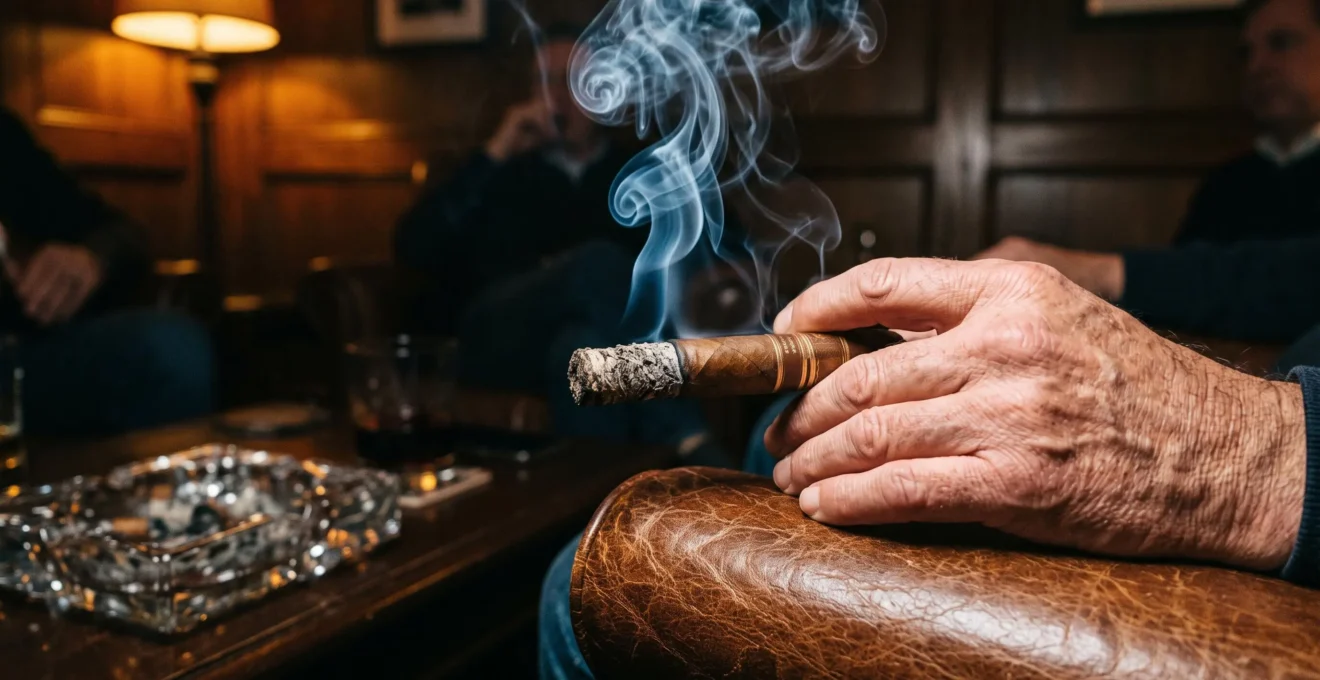
A cigar can feel wonderfully substantial halfway through a session, offering a dense, leather-like mouthfeel with notes of wood, earth and spice. Yet the same cigar may finish with a rough, drying sensation, even when those familiar flavours remain identifiable.
The apparent contradiction comes from the difference between flavour and texture. Smoke is perceived through aroma, taste, temperature, oral touch and chemical irritation. These sensations do not necessarily change together as combustion progresses.
At approximately 30 minutes, a smoker might interpret increasing smoke density as richness. Later, a shorter unburned tobacco column, changing smoke composition and repeated exposure to irritants can make that density feel harsh rather than satisfying. Thirty minutes is a useful observation point, not a scientifically established turning point.
Understanding the transition requires attention to combustion, sensory adaptation, relighting and the difference between genuine aromatic complexity and simple smoke heaviness. None of these techniques makes tobacco smoke safe; the objective here is to explain the sensory experience accurately, not to claim reduced health risks.
What changes when leathery cigar smoke turns harsh?
- Texture and flavour are different sensations: smoke may feel heavier or drier even while its recognisable aromatic notes remain.
- Combustion conditions matter: puffing intensity, accumulated smoke constituents and relighting can alter the experience throughout a session.
- Bitterness is a useful stopping signal: if the finish becomes persistently acrid or irritating, continuing is unlikely to recover the earlier sensory balance.
- Why Does Chewy Texture Increase as Temperature Rises Even When Flavour Stays Similar?
- How to Keep Leathery Texture Pleasant by Slowing Down Over the Next 15 Minutes?
- Sherry, Whisky, or Black Coffee: Which Complements Leathery Texture Without Drying You Out?
- The Over-Purge Mistake That Makes Smoke Feel Thin and Destroys Texture
- When Should You Stop at the Last Inch to Keep the Finish Rich, Not Ashy?
- Why Does Rising Heat Kill Creaminess Even When the Flavour Notes Stay Similar?
- Why Do Multiple Relights Make a Cigar Taste Bitter Even if the Draw Feels Fine?
- Why Does Internal Smoking Temperature Spike After 3 Relights and Kill Complexity?
Why Does Chewy Texture Increase as Temperature Rises Even When Flavour Stays Similar?
Chewy cigar smoke can feel more substantial as a smoking session progresses because its temperature, chemical composition and oral sensations change. Familiar leather, wood or spice aromas may remain recognisable while dryness, irritation or smoke density become more noticeable. This does not establish that increasing heat produces desirable chewiness; perceived richness and harshness can overlap.
The important distinction is between what smoke tastes like and how it feels in the mouth. Flavour combines taste and aromas perceived through the nose, whereas mouthfeel involves tactile sensations, temperature, lubrication and chemical stimulation.
A WHO scientific review of tobacco flavour perception explains how these sensory pathways contribute to the overall tobacco experience. It provides a sound basis for treating leathery body and aromatic character as related but distinct perceptions.
Descriptions such as oily, resinous or chewy are useful tasting vocabulary. However, there is insufficient evidence to conclude that a particular oily or resinous coating deposited by cigar smoke is responsible for a leather-like sensation.
Combustion adds another variable. An experimental study of cigar combustion and smoking intensity, published in 2017, examined how puff frequency, puff volume and smoking progression influenced emissions. Under the studied conditions, carbon monoxide emissions increased approximately linearly as the cigar was consumed, whereas nicotine and water emissions increased nonlinearly.
Those measurements confirm that smoke composition evolves during a session. They do not establish a direct relationship between any measured constituent and leathery mouthfeel, nor a universal moment when richness becomes acridity.
There are two practically different experiences that a smoker might call chewy:
- Integrated richness: a dense sensation accompanied by identifiable aromas that remain distinguishable after exhaling.
- Flat heaviness: substantial smoke accompanied mainly by dryness, irritation or an indistinct burnt impression.
A useful sensory distinction is whether the lingering impression still contains identifiable aromas or is dominated by irritation. It is a subjective observation, not a validated diagnostic test.
Palate adaptation may further complicate the comparison between the middle and final portions of a cigar. Repeated exposure can change how sensations are reported, although evidence does not show that flavour perception necessarily fatigues faster than texture perception in cigar smoking.
Heavier smoke is therefore not automatically richer smoke. That distinction becomes particularly important when assessing whether a session is approaching an unpleasant finish.
How to Keep Leathery Texture Pleasant by Slowing Down Over the Next 15 Minutes?
During a hypothetical 15-minute observation period, changes in harshness, mouthfeel and aftertaste can help distinguish a temporary sensory fluctuation from a persistently unpleasant finish. Puffing intensity affects cigar combustion and emissions, but no scientifically established 15-minute pacing method guarantees a smoother texture or prevents bitterness. Slowing down should not be presented as reducing smoking-related harm.
A universal interval between puffs is unreliable because cigars differ in size, construction, moisture condition and combustion behaviour. Ambient conditions also affect how a cigar burns.
The experimental combustion research discussed earlier demonstrates that changing puff frequency and volume changes measured smoke emissions. This supports the importance of smoking intensity, although it does not prove that a specific slower rhythm preserves sweetness or reduces the amount of tar delivered per puff.
Consider a hypothetical cigar that feels rounded at the midpoint but develops an increasingly dry finish. The useful observation is not simply how many seconds have elapsed between draws. It is whether the same unpleasant sensation recurs and whether identifiable aromatic detail remains.
Extending the pause between draws may allow the ember to cool between active puffs. Nevertheless, continued combustion, cooling and chemical accumulation interact in complex ways; a cooler-feeling cigar does not necessarily produce less harmful smoke.
For an individual smoker describing an experience, the approximately 30-minute point can serve as a personal comparison rather than a universal threshold. Recording whether smoke remains aromatic, whether the mouth feels increasingly dry and whether bitterness persists creates a more precise vocabulary than merely labelling the cigar strong.
Purging is sometimes proposed as a correction when harshness appears. Its effects on texture have not been established through controlled sensory comparisons, and repeated manipulation of the ember can introduce further combustion variability.
Five checks for recognising texture deterioration
- Identify the starting sensation: record two descriptive terms, such as rounded and woody, as a baseline.
- Separate aroma from touch: note one identifiable aroma and one mouthfeel sensation in different columns.
- Observe the change: record whether dryness or irritation is occasional or persistent, producing a simple comparison.
- Check for sensory overlap: identify whether a burnt impression is replacing previously distinguishable aromas, producing a clear yes-or-no observation.
- Apply a stopping criterion: note whether the cigar has become unpleasant and end the session if it has, leaving a final sensory assessment.
This checklist is an editorial observation framework, not a validated smoking protocol or a means of making tobacco consumption safer.
Once a drying sensation dominates, the beverage alongside the cigar may also influence how the mouth interprets the experience.
Sherry, Whisky, or Black Coffee: Which Complements Leathery Texture Without Drying You Out?
Sherry, whisky and black coffee can create different mouthfeel contrasts with leathery cigar smoke, but there is no controlled evidence establishing one as the best pairing. Sweetness may soften the perceived contrast with bitter notes, while some beverages produce their own astringency. Water provides a straightforward alternative without introducing additional alcohol, acidity or pronounced beverage flavours.
Pairing by texture requires distinguishing three sensations that are often confused: bitterness, astringency and smoke-related irritation.
Bitterness is a taste. Astringency is typically experienced as drying, puckering or roughness. Smoke-related irritation can include burning or harsh sensations mediated by chemically sensitive nerve endings.
A Chemical Senses review of oral astringency mechanisms discusses how changes in lubrication, oral friction and sensory receptor responses contribute to astringency. The review concerns foods and beverages rather than controlled cigar-pairing experiments.
Consequently, claiming that alcohol strips away a coating of cigar oils, or that sweet sherry replenishes that coating, would go beyond the available evidence.
The following comparison describes plausible sensory contrasts rather than demonstrated effects on cigar texture. Individual beverages and personal responses differ substantially.
| Drink | Potential sensory interaction | Important limitation |
|---|---|---|
| Sweet sherry | Residual sweetness may contrast with bitter or roasted impressions. | Sherry ranges from very dry to sweet; alcohol may also cause oral irritation. |
| Whisky | Wood, spice or roasted aromas may echo familiar cigar descriptions. | Alcohol strength and whisky style vary; higher alcohol can feel irritating. |
| Black coffee | Roasted aromas may reinforce similar perceived notes. | Coffee can contribute bitterness and astringency of its own. |
| Still water | Offers a comparatively neutral beverage and helps maintain hydration. | It does not remove the chemical hazards or necessarily reverse smoke-related irritation. |
Temperature provides another variable. Chilling a drink can change aromatic release and immediate oral sensation, but there is no direct evidence that chilled spirits preserve cigar chewiness or extend texture longevity.
For the final portion of an already harsh cigar, adding whisky or coffee can make it harder to distinguish beverage sensations from smoke sensations. Choosing water avoids introducing another strongly flavoured or alcoholic variable, although it does not neutralise smoke constituents.
Pairing remains subjective, and no beverage corrects poor combustion or makes cigar smoking safe. This matters when harshness is being attributed to the drink rather than to the cigar itself.
The Over-Purge Mistake That Makes Smoke Feel Thin and Destroys Texture
Over-purging means repeatedly forcing air through a lit cigar in an attempt to clear unpleasant smoke or accumulated combustion gases. Such airflow can alter ember behaviour and combustion conditions, but evidence does not establish that repeated purging necessarily destroys cigar oils or produces thin smoke. The technique is therefore better understood as an uncontrolled combustion variable than a proven texture-repair method.
Purging differs from an ordinary puff because air is driven towards the burning end rather than smoke being drawn towards the mouth. Enthusiasts sometimes use this technique when a cigar tastes stale or acrid.
The attraction is understandable: a harsh draw can make the next intervention feel urgent. Yet a temporary change in taste following a purge is not proof that the underlying cause has disappeared.
Combustion involves multiple interacting processes, including heating, decomposition, oxidation and the movement of volatile and particulate constituents. Introducing additional air may affect these processes, but the result depends on airflow, ember condition and cigar construction.
It would be misleading to define a precise number of seconds, exhalation pressure or purge frequency as scientifically optimal. The available sources do not test such a protocol.
Likewise, the proposition that an aggressive purge combusts the exact oils responsible for leatheriness has not been established. Leather-like chewiness itself lacks an identified, uniquely measurable chemical mechanism.
When a cigar has developed unpleasant smoke, repeated attempts to force a sensory recovery can obscure the simpler observation that the session has deteriorated. A normal draw after a purge may briefly seem different without demonstrating a sustained improvement.
There is also an important diagnostic distinction. Thin-feeling smoke can coexist with a satisfactory physical draw. That does not identify purging as the cause: tobacco blend, construction, moisture condition, combustion irregularity and sensory perception remain possible contributors.
An aggressive breath-through technique can additionally disturb the ash or burning end. No evidence in the supplied research establishes that it is superior to a gentle purge for restoring sensory complexity.
If unpleasantness persists, continuing to manipulate the cigar offers no demonstrated benefit. The more relevant question is whether the final portion remains worth smoking at all.
When Should You Stop at the Last Inch to Keep the Finish Rich, Not Ashy?
The sensible stopping point is when the cigar becomes persistently bitter, irritating, excessively hot to handle or otherwise unpleasant. The last inch is a common descriptive marker, not a scientifically established threshold for flavour collapse. Cigar size, construction and burning conditions vary, and continuing beyond a pleasant sensory finish does not guarantee that desirable complexity will return.
The final section of a cigar presents different conditions from the beginning. As combustion progresses, the remaining unburned tobacco column shortens and smoke emissions evolve.
Experimental findings on cigar combustion support the general conclusion that constituents accumulate and that smoke composition changes throughout consumption. They do not establish that every cigar accumulates a specific concentration of tar near the band or that this alone explains a universal ashy ending.
Less remaining tobacco can also alter the thermal environment and the path travelled by smoke before it reaches the mouth. However, the exact consequences depend on the cigar and cannot be reduced to a single rule about the last inch.
Three sensory observations are especially useful:
- Loss of definition: recognisable woody, earthy or spicy impressions become difficult to distinguish from a general burnt character.
- Persistent irritation: harshness remains dominant rather than appearing briefly.
- Uncomfortable heat: the mouth-end or surrounding wrapper becomes unpleasantly warm to handle.
A metallic impression during nasal exhalation may be another subjective sign of an unpleasant finish. It is not a validated indicator of internal temperature, tar concentration or any specific chemical constituent. Inhaling smoke through the nose can also cause irritation and exposure to harmful substances.
Removing the band and checking the warmth of the wrapper may reveal that the remaining cigar is hot, but touching the burning region risks injury and does not provide an objective measurement of smoking quality.
The psychological temptation to finish every inch is separate from sensory evaluation. Completion does not make an unpleasant final portion more rewarding.
Allowing a cigar to rest can alter its ember condition, but there is no guarantee that the original complexity will return. Extinguishing it is the clearer option once the finish has become persistently harsh.
This distinction also helps explain why some smokers describe a loss of creaminess before they notice an obvious change in aromatic character.
Why Does Rising Heat Kill Creaminess Even When the Flavour Notes Stay Similar?
Rising smoke temperature can change the perception of creaminess without eliminating familiar flavour notes because mouthfeel, aroma and chemical irritation are processed through different sensory pathways. A cigar may continue to suggest wood or spice while feeling less rounded. However, there is insufficient evidence that cigar creaminess depends specifically on fats or oils that are progressively destroyed by heat.
In tasting language, creaminess usually describes a smooth, rounded or enveloping sensation rather than the literal presence of dairy-like fat.
That distinction matters because descriptions of creaminess can combine several perceptions. Smoke may feel soft because irritation is relatively unobtrusive, because aromatic impressions seem rounded, or because the smoker interprets density as smoothness.
As combustion conditions change, thermal and chemical stimuli can become more prominent. A familiar woody aroma may still be perceived, while increasing dryness or irritation makes the overall experience less creamy.
This creates an apparent contradiction: the cigar still tastes recognisably similar, but it no longer feels similar.
It is tempting to describe a fixed sequence in which creaminess first disappears from the retrohale, then from the middle of the palate and finally from the finish. The available scientific literature does not establish that progression.
Retronasal aroma contributes substantially to flavour perception, but forcefully directing tobacco smoke through the nose is not a necessary or risk-free diagnostic method.
The contrast with leathery chewiness is particularly revealing. Creamy and leathery are not mutually exclusive chemical states. They are descriptive categories that may overlap or change in relative prominence as oral sensations evolve.
Storage moisture is another consideration. Moisture condition can affect tobacco behaviour, yet the claim that slightly dry storage selectively removes the oils responsible for creaminess is not demonstrated by the supplied evidence.
Consequently, a cigar that appears less creamy should not automatically be diagnosed as overheated or improperly stored. These explanations may be plausible in an individual case without being uniquely identifiable from taste alone.
The same separation between airflow, combustion and sensory quality becomes crucial when a cigar repeatedly goes out and requires relighting.
Why Do Multiple Relights Make a Cigar Taste Bitter Even if the Draw Feels Fine?
Relighting can produce bitter or acrid smoke because ash and partially burned tobacco remain at the burning end. A normal-feeling draw indicates that air can pass through the cigar; it does not establish that combustion is even or that the smoke will taste pleasant. The undesirable flavour may be temporary, and repeated relights do not inevitably cause progressively worse bitterness.
Airflow and combustion quality are different properties. A cigar can offer little resistance to drawing while burning unevenly or retaining partially charred material.
When combustion stops, the transition zone between fresh tobacco and ash can contain char: tobacco that has undergone partial burning. Igniting that material again can produce an unpleasant initial impression.
Tobacconist University‘s cigar relighting instructions describe how residual ash and char contribute to bitter, acrid or overly toasted flavours. The professional guidance also notes that flavour can improve after fresh tobacco begins burning.
This makes the distinction between temporary relight bitterness and persistent deterioration important.
Professional relighting guidance includes removing loose ash and some partially burned material, establishing an even burn and avoiding unnecessarily forceful puffing. These are practical trade recommendations, not controlled scientific demonstrations of an optimal relighting procedure.
The source does not show that each additional relight leaves a predictably larger area of scorched tobacco or increases bitterness by a fixed amount.
Repeated extinguishing can also have causes unrelated to the immediate relighting technique. Excess moisture, construction irregularities and airflow problems may interfere with stable combustion.
For example, consider a hypothetical cigar that repeatedly stops burning despite an apparently open draw. That observation alone cannot determine whether moisture, filler distribution or another construction characteristic is responsible.
Relighting near the end of a session may appear particularly unrewarding because the smoke has already changed during the preceding consumption. However, there is no quantified evidence establishing a universal higher bitterness penalty for late-session relights.
When smoke remains persistently unpleasant, further relighting cannot be relied upon to restore the earlier sensory experience.
Repeated relights therefore raise a final question: is the problem necessarily a measurable temperature spike, or is the underlying combustion behaviour more complicated?
Key takeaways before another relight
- Three is not a magic number: no supplied experiment establishes a universal temperature spike after three relights.
- Fresh tobacco and residual char behave differently: undesirable flavours can appear during relighting without necessarily persisting throughout the remaining cigar.
- Draw resistance is not flavour quality: repeated extinguishing and unpleasant smoke warrant separate consideration, rather than assuming that an open draw means combustion is normal.
Why Does Internal Smoking Temperature Spike After 3 Relights and Kill Complexity?
There is no established rule that a cigar’s internal temperature suddenly spikes after exactly three relights. Relighting changes combustion conditions, and repeated ignition can repeatedly expose partially burned tobacco to heat. These processes may affect smoke character, but the available evidence does not identify a universal three-relight threshold or prove that aromatic complexity is irreversibly destroyed at that point.
The familiar three-relight warning is best treated as a qualitative caution rather than a measured law of cigar combustion.
Each relight involves renewed heating of the burning end. Residual char, ash, airflow and the distribution of unburned tobacco can influence what happens next. The resulting temperature pattern is not necessarily a simple increase with every successive ignition.
A smoker may nevertheless perceive diminishing complexity. Several familiar notes can become harder to distinguish if burnt, bitter or irritating sensations become dominant.
That experience does not require every aromatic compound to have been destroyed. It may reflect changes in the chemical mixture, relative sensory intensity and perception.
For that reason, the proposed chain of events — three relights, a fixed temperature spike, destruction of all delicate aromatic compounds and permanent loss of flavour complexity — cannot be presented as established fact.
The professional relighting guidance cited earlier explicitly recognises that undesirable flavours may diminish after fresh tobacco begins burning. This contradicts any absolute claim that relighting damage is always irreversible.
At the same time, recovery is not assured. If an individual cigar has become persistently bitter or irritating, repeating the ignition process does not guarantee improvement.
The main distinctions are straightforward:
- Combustion temperature: a physical variable that cannot be reliably inferred from relight count alone.
- Smoke composition: a changing mixture influenced by combustion conditions and the stage of consumption.
- Aromatic complexity: a sensory judgement about how many distinguishable impressions remain perceptible.
- Persistent harshness: an unpleasant sensation that can dominate the experience regardless of whether recognisable flavours remain.
Keeping these variables separate avoids turning an observation about flavour into an unsupported scientific claim about exact temperature or chemical destruction.
Repeated extinguishing can also indicate a construction or moisture issue rather than poor technique alone. Without examining the cigar and its storage history, no single cause can be identified confidently.
For an unpleasant cigar, the most defensible decision is not to pursue a particular number of relights. It is to recognise that continued smoking offers no guaranteed return to the earlier sensory balance.
If a cigar has become persistently harsh, extinguishing it is a reasonable final decision. For future sensory comparisons, keep texture, aroma, irritation and combustion observations distinct, without treating any smoking technique as a way to eliminate tobacco-related health risks.
Does a leathery cigar taste mean the tobacco contains more oils?
Not necessarily. Leather is a sensory descriptor rather than a chemical measurement. Tobacco contains numerous compounds that influence smoke character, but the available evidence does not demonstrate that an oily coating specifically causes leathery chewiness. Aroma, oral touch, temperature and irritation can all contribute to the description.
Can a cigar become more astringent without becoming more bitter?
Yes. Astringency and bitterness are distinct sensory qualities. Astringency generally involves dryness, roughness or puckering, whereas bitterness is a taste sensation. They can occur together, but increasing dryness does not necessarily mean that perceived bitterness has increased by the same amount.
Does a darker ash indicate that the cigar is overheating?
Ash colour alone is not a reliable measurement of internal temperature. Combustion conditions and tobacco characteristics can influence ash appearance. The evidence supplied for this article does not establish a validated relationship between ash darkness and a specific overheating threshold.
Can drinking water reverse an acrid cigar finish?
Water can provide hydration and a relatively neutral beverage contrast, but it cannot reverse combustion-related changes in tobacco smoke or eliminate exposure to harmful smoke constituents. Persistent acridity is a reason to stop rather than a problem that water can reliably correct.
Is a cigar safer when smoked slowly or kept at a lower temperature?
No such conclusion follows from the available evidence. Smoking intensity can change emissions, but altered temperature or puff frequency does not make tobacco smoke safe. Cigar smoke contains harmful substances, and avoiding tobacco exposure is the most reliable way to avoid its associated health risks.