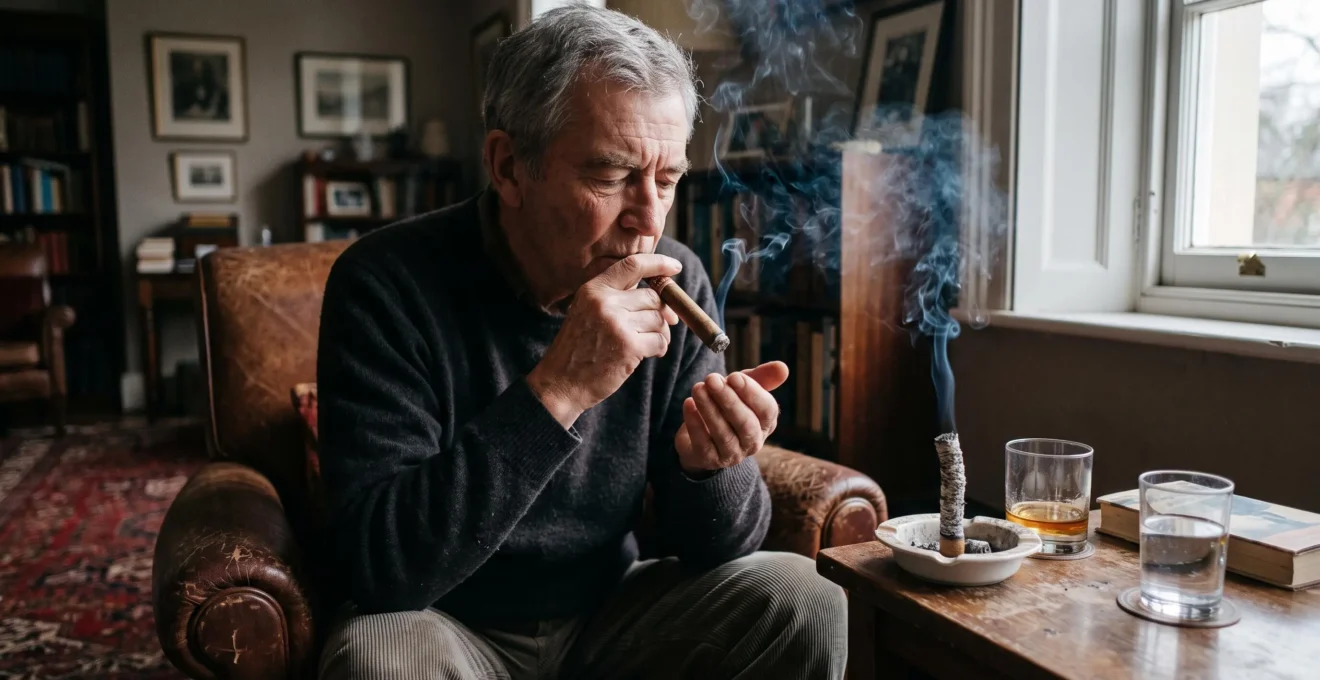
A faint impression of lavender, dried meadow grass or citrus blossom can make a botanical-forward cigar intriguing. Yet that impression may disappear after a sip of powerful whisky, a change in smoking pace or prolonged exposure to the same smoke. The cigar can continue producing smoke while its most delicate aromatic qualities become difficult to recognise.
The explanation lies partly in the distinction between aroma, taste and mouthfeel. Botanical descriptors generally refer to perceived aromatic qualities rather than specific substances that can be identified simply by tasting smoke on the tongue. Olfactory adaptation, competing smells, changing combustion conditions and irritation can all influence what a person notices.
A strong drink adds another layer of aromatic and sensory stimulation. Its alcohol sensation, persistent aroma and flavour intensity may compete with the subtler impressions associated with tobacco. That does not establish that the cigar has lost its botanical compounds.
The useful skill is learning to recognise whether a delicate note has faded because the smoke changed, because another sensation is masking it, or because the smoker has become accustomed to it. These explanations overlap, but they should not be treated as interchangeable.
Botanical cigar aromas: the essentials
- Strong spirits, environmental scents and accumulated smoke exposure can make delicate aromas harder to distinguish without necessarily eliminating them.
- Short breaks and comparisons with neutral air may help assess sensory adaptation, although no universal recovery time has been established.
- Smoking intensity and cigar progression affect smoke chemistry. Neither visible smoke volume nor a particular elapsed time reliably measures flavour perception.
- Why Are Botanical Notes the First to Vanish When the Smoke Gets Hotter ?
- How to Recover Delicate Botanical Notes With a 2-Minute Reset Without Putting the Cigar Out ?
- Indoors or Outdoors: Where Are Botanical Notes Easier to Taste Over 45 Minutes ?
- The Scent-Contamination Mistake That Makes Botanical Notes Impossible to Detect
- When Should You Smoke Botanical-Forward Cigars in a 2-Cigar Night ?
- Why Does Aroma Open Up After 20 Minutes Even if the Blend Is the Same ?
- Why Does Flavour Seem to Disappear Even When the Smoke Output Stays the Same ?
- Why Do Your Sensory Receptors Stop Noticing Flavour After 30 Minutes of Smoking ?
Why Are Botanical Notes the First to Vanish When the Smoke Gets Hotter ?
Botanical notes may become difficult to recognise when cigar smoke grows more intense because stronger bitter, acrid or irritating sensations compete for attention. Changes in smoking intensity also alter smoke composition. However, research has not established that floral and herbal cigar aromas disappear in a fixed order or at a particular combustion temperature.
Imagine a cigar initially suggesting chamomile, cut grass and a little cedar. Later, the smoke feels more abrasive, with bitterness becoming the dominant impression. The botanical qualities may have become less perceptible, but that observation alone cannot establish whether their associated aromatic compounds have diminished or simply become harder to distinguish.
Two explanations matter:
- A change in the smoke itself: combustion and condensation processes can modify the mixture of substances reaching the mouth and nose.
- Perceptual masking: intense bitterness, irritation or competing aromas can dominate the overall experience even when weaker aromatic stimuli remain present.
In experimental research on cigar burning and smoke emissions, researchers investigated how puff volume, puff frequency and smoking progression influenced nicotine, carbon monoxide and water emissions. They identified accumulation, condensation and evaporation effects. Their measurements establish that smoke chemistry changes during combustion, not that particular botanical aromas disappear first.
For an adult already smoking, a comparison between earlier and later impressions is more informative than treating a hotter sensation as proof that delicate aromatic compounds have disappeared. A series of long draws followed by a shorter one might seem to offer a diagnostic test, but it would also change smoke delivery and sensory exposure. There is no validated interpretation of that sequence.
The final portion of a cigar deserves particular caution. The experimental evidence demonstrates progression-dependent changes in emissions, including accumulation effects. It does not establish a universal increase in temperature at the cut end or prove that floral notes are necessarily the first qualities to be masked.
Persistent harshness should not be interpreted as a challenge to overcome. It is a reason to stop rather than intensify exposure in an attempt to retrieve a faint aroma.
Once these competing explanations are recognised, a break from continuous stimulation becomes a useful way to investigate the sensory contribution without assuming that it repairs changes in the tobacco smoke.
How to Recover Delicate Botanical Notes With a 2-Minute Reset Without Putting the Cigar Out ?
A two-minute break from smoke exposure may allow some olfactory sensitivity to recover, but two minutes is not a scientifically validated recovery period for cigar aromas. The relevant principle is interruption of a persistent stimulus. Breathing ordinary, relatively neutral air can provide a useful contrast, although nasal breathing itself has not been shown to outperform a simple pause.
When an aroma stays present, its apparent intensity can decline. This is known as olfactory adaptation. In ordinary situations, people may cease noticing a familiar room scent even though the underlying odour remains.
A human experimental study on olfactory desensitisation and recovery investigated this process in 20 participants with normal olfactory function. Researchers presented two different odorants under controlled conditions and found that longer recovery periods increased the perceived intensity of subsequent stimulation.
The experiment did not involve cigar smoke, whisky or botanical-forward tobacco. It therefore supports the general recovery principle, not a specific two-minute cigar protocol.
A simple observational approach is to stop exposure, move away from accumulated smoke and breathe normally in air without an obvious competing odour. After the break, notice whether surrounding smells seem clearer. This avoids forcing repeated smoke exposure merely to test sensitivity.
Two minutes can serve as a convenient interval for an informal comparison, but the outcome should not be treated as a pass-or-fail measurement. Recovery depends on the odorant, previous exposure and individual physiology.
Adaptation and masking require different interpretations. If the main problem is sensory adaptation, time away from the stimulus may alter perception. If a persistent bitter or irritating sensation dominates, an olfactory break cannot guarantee the restoration of a delicate flavour impression.
Nor is there a validated rule that sensitivity has recovered once someone can identify creaminess, dryness or roundness. Those descriptions concern texture and mouthfeel, which are not equivalent to olfactory sensitivity.
Repeatedly interrupting an experience may also make it harder to compare its progression. A single deliberate observation provides a more coherent record than chasing every momentary change.
Environmental odours also influence whether a break offers meaningful contrast, making the surrounding setting an important part of the next comparison.
Indoors or Outdoors: Where Are Botanical Notes Easier to Taste Over 45 Minutes ?
Neither indoor nor outdoor settings have been shown to provide universally better recognition of botanical cigar aromas over 45 minutes. Ambient smells, airflow and exposure to accumulated smoke may influence sensory conditions, but there is no established environmental formula for detecting floral notes. Health considerations also favour avoiding enclosed smoke exposure, particularly around other people.
From a sensory perspective, a location is not defined simply by whether it has walls. A terrace near a busy road can contain more competing odours than a quiet garden. Similarly, an indoor room containing perfume, cooking vapours or lingering smoke presents a different background from a clean, unscented environment.
Air movement introduces another variable. Wind can change the behaviour of a burning cigar and the distribution of its surrounding smoke, although the precise effect on perceived botanical notes has not been established. It would be misleading to claim that a particular wind level, or the appearance of a long ash column, identifies an optimal tasting environment.
The following comparison helps separate practical observations from unsupported claims about flavour enhancement.
| Factor | Indoor environment | Outdoor environment |
|---|---|---|
| Competing smells | Perfume, food and persistent room odours may be noticeable. | Traffic, vegetation, cooking and nearby activities may introduce competing scents. |
| Air movement | May be relatively stable, depending on ventilation. | More variable; gusts can affect smoke movement and burning conditions. |
| Smoke accumulation | Smoke can build up and contribute substantially to indoor air pollution. | Dispersion depends on conditions; exposure is not eliminated. |
| Botanical aroma detection | No demonstrated general advantage. | No demonstrated general advantage. |
The National Cancer Institute fact sheet on cigar smoking identifies cigar smoke as a potentially major source of indoor air pollution. It also explains that cigar smoke contains carcinogenic substances and that secondhand exposure is harmful.
Neutralising a room’s perfume does not make indoor cigar smoking safe. Ventilation, open windows and the absence of other occupants cannot be assumed to remove the associated risks.
For a 45-minute sensory comparison, consistency is more useful than declaring one location superior. Record obvious competing odours, changes in airflow and how long exposure has continued. Treat a change in perceived aroma as an observation, not proof that a particular setting improves cigar flavour.
Among these environmental variables, familiar fragrances on the body and nearby objects are especially easy to overlook because they may no longer attract conscious attention.
The Scent-Contamination Mistake That Makes Botanical Notes Impossible to Detect
A common sensory mistake is overlooking persistent fragrance from skin products, clothing, accessories or nearby drinks. Strong background odours can complicate the recognition of weaker aromatic impressions, while adaptation may make those familiar odours seem less noticeable. However, no evidence establishes that a particular fragrance makes botanical cigar notes completely impossible to detect.
Consider a fragranced hand cream. Its scent may be present whenever a hand approaches the face, even when the wearer no longer notices it continuously. Aftershave, scented fabric products and aromatic hair preparations can create similar background conditions.
The problem is not necessarily that one smell physically cancels another. Odour mixtures are perceptually complex: a stronger component may dominate identification, a familiar odour may become less noticeable through adaptation, and attention can shift towards whichever sensation seems most distinctive.
A simple pre-exposure inventory can identify potential confounders without involving tobacco smoke.
Five checks for a clearer aromatic baseline
- Check the wrist: notice any remaining fragrance from soap, lotion or aftershave. Record the dominant scent in one or two words.
- Check clothing and accessories: examine the scent of a scarf, collar or hat. Identify any persistent fabric perfume.
- Check the nearby drink: smell the glass without tasting it. Note whether a strong spirit, coffee or other beverage contributes a prominent aroma.
- Check the surroundings: identify obvious sources such as cooking, candles or traffic. Write down the strongest background odour.
- Establish a neutral comparison: move away from the competing scent and notice whether its absence changes the smell of the surrounding air. Record the difference without claiming it proves a change in cigar flavour.
Drink pairing deserves separate consideration because it involves more than smell alone. A powerful whisky can produce pronounced aromas along with alcohol-related sensations in the mouth and throat. Those sensations may remain noticeable after swallowing and affect subsequent flavour judgements.
Plain water can remove some beverage residue and provide a relatively neutral contrast, but its effectiveness as a specific technique for recovering botanical cigar flavours has not been established. Likewise, spacing sips may change the sequence of stimulation without guaranteeing a clearer perception of tobacco aromas.
A useful non-smoking exercise is to compare the aroma of water, a strongly scented beverage and a mild herbal infusion. This illustrates how a dominant odour can influence attention without requiring exposure to cigar smoke.
Once competing aromas have been identified, the order in which different intense sensory experiences occur becomes easier to interpret.
When Should You Smoke Botanical-Forward Cigars in a 2-Cigar Night ?
If comparing subtle and intense aroma profiles, assessing the delicate profile first is a reasonable sensory-order principle because earlier exposure to strong stimuli can influence later judgements. However, no controlled evidence in the supplied research validates an ideal two-cigar sequence. Smoking two cigars also increases tobacco-smoke exposure, so the sensory principle should not be mistaken for a recommendation to smoke both.
Order effects are familiar in sensory assessment. A highly intense smell can dominate attention and make the next, less intense stimulus harder to judge. Adaptation adds another complication: perception of a repeated odorant may decline, and recovery may take time.
For that reason, an informal comparison of botanical and robust aromas is more interpretable when the subtler sample is evaluated before the dominant one. This principle can be demonstrated with non-tobacco samples, such as a delicate herbal tea aroma followed by strong coffee.
The same logic explains why reversing the order may introduce uncertainty. If the first sample produces pronounced bitterness or irritation, subsequent judgements may reflect lingering sensations rather than the intrinsic character of the second sample.
There is no validated universal recovery interval. Water or plain bread may provide a familiar neutral comparison between foods or drinks, but neither has been shown to reset cigar-related olfactory adaptation or remove smoke-related irritation.
A second subtle botanical profile may also be difficult to distinguish after prolonged exposure to a similar aroma. In ordinary sensory comparisons, changing the aromatic family can make differences easier to describe. For example, comparing herbal tea with cocoa is conceptually different from comparing two closely related herbal infusions.
That does not establish that leather, cacao or spice-forward cigars are better second-cigars, nor that a long first cigar inevitably prevents detection of botanical notes later.
A safer and more informative approach is to compare unlit tobacco aromas or other non-combustible aromatic materials. This permits observations about order and intensity without creating an additional smoking session.
Order is only one influence on perception. Even during a single prolonged exposure, the apparent aromatic character can change as both the stimulus and the observer change.
Why Does Aroma Open Up After 20 Minutes Even if the Blend Is the Same ?
A cigar may seem to develop new aromas after 20 minutes because its combustion conditions change while the smoker’s sensory response also evolves. The blend remains physically the same, but the substances reaching the senses need not remain constant. Twenty minutes is not a scientifically established point at which botanical or other aromas reliably emerge.
It helps to separate two processes that can occur together.
First, cigar combustion is dynamic. The amount already consumed, the history of smoke passing through the tobacco and the pattern of puffing can affect subsequent emissions. Experimental cigar research demonstrates changing chemical yields as smoking progresses.
These results do not prove the common explanation that heat progressively releases particular essential oils from inner filler leaves at a predictable moment. Specific botanical aroma compounds were not measured in the referenced study.
Second, sensory responses change with exposure. An individual may become accustomed to a persistent dominant smell and notice differences in other sensations, or may become less sensitive to components of the same aroma mixture.
It is important not to equate this with a guaranteed improvement in aroma detection. Olfactory adaptation can reduce sensitivity; it does not necessarily uncover previously hidden notes.
For a purely observational exercise, someone can describe a fragrance at an initial encounter and again after prolonged exposure. Notes perceived at the second assessment may differ because of attention, adaptation, expectation or changes in the stimulus itself.
Similarly, a cigar described as woody at five minutes and floral at twenty minutes has not necessarily undergone a proven chemical transformation into a more botanical blend. Such descriptions remain subjective unless supported by chemical or controlled sensory measurements.
Keeping a record that distinguishes perceived aroma, bitterness, irritation and mouthfeel is more informative than assigning every change to the tobacco opening up.
There is also no scientific basis for assuming that an aromatic opening must inevitably be followed by botanical collapse at the beginning of the final third. That is a possible tasting narrative, not a demonstrated universal progression.
This distinction becomes particularly important when the volume of smoke remains substantial but the experience suddenly seems almost flavourless.
Why Does Flavour Seem to Disappear Even When the Smoke Output Stays the Same ?
Flavour can seem to disappear despite continuing smoke production because smoke volume and sensory intensity measure different things. The nose can adapt to sustained aromatic stimulation, and the relative prominence of bitterness or irritation may change. Consistent visible smoke therefore does not prove that the same aroma mixture is being produced or perceived at the same intensity.
Consider the difference between seeing smoke and recognising an aroma. A visible plume indicates the presence of aerosol and airborne substances. It does not directly quantify any particular floral, herbal or woody odorant, nor does it measure what the brain consciously recognises.
This matters because olfactory habituation is not equivalent to an absence of stimulus. An odour can continue to reach the sensory system while its subjective intensity decreases.
The human desensitisation study described earlier offers an important general explanation: prolonged exposure reduced perceived odour intensity, and recovery varied with the time allowed between stimuli.
Nevertheless, cigar flavour loss cannot automatically be attributed to receptors becoming less responsive. Smoke composition changes during consumption, and the complex mixture may also produce irritation or competing sensations.
A short absence from an odour, followed by a renewed perception of it, would be consistent with adaptation. It would not prove that the stimulus remained chemically unchanged. Nor would switching mouth position or attempting retro-nasal evaluation provide a validated diagnostic result for cigar smoke.
The distinction between loss of flavour intensity and loss of novelty is equally useful. A stable aroma may stop attracting attention even when it remains recognisable when deliberately assessed. Conversely, an evolving aroma mixture may seem more interesting because successive differences attract notice.
This does not mean that a consistently flavoured cigar objectively loses flavour faster than an evolving one. That proposition would require controlled comparisons rather than anecdotal impressions.
Increasing smoking frequency to seek stronger flavour is particularly unhelpful. Smoking conditions affect smoke emissions, and additional exposure carries health risks without offering an established solution to adaptation.
The remaining question is what actually changes in the sensory system during prolonged exposure and whether a fixed duration can predict the change.
Key takeaways before assessing sensory fatigue
- Separate changes in the aroma stimulus from changes in how that stimulus is perceived; both may occur at once.
- Use elapsed time as contextual information, not as a biological threshold for when floral or herbal sensations should disappear.
- Recognise that irritation and strong competing sensations can complicate aroma identification independently of olfactory adaptation.
Why Do Your Sensory Receptors Stop Noticing Flavour After 30 Minutes of Smoking ?
After prolonged exposure, olfactory adaptation can reduce the apparent intensity of familiar smells, while changes in attention, smoke chemistry and irritation may further alter flavour perception. Thirty minutes is not a universal physiological limit. The response varies between individuals and stimuli, and research has not demonstrated that botanical cigar notes systematically disappear before other flavour categories.
The phrase sensory receptors stop noticing flavour is a useful shorthand, but the biological picture is more complex. Olfactory adaptation involves changes in responses to sustained odour stimulation, while higher-level sensory processing and attention also influence conscious awareness.
Flavour itself is not handled by one receptor group. Smell, basic taste and oral sensations contribute different information to the combined experience.
A scientific review of orthonasal and retronasal flavour perception examines how odours are perceived through two distinct pathways. Orthonasal perception involves smelling through the nose, whereas retronasal perception involves volatile substances reaching the olfactory system from the mouth and pharyngeal region.
These pathways help explain why smelling an aromatic material directly and experiencing its flavour in the mouth are not identical activities.
They do not establish that switching between the two routes prevents adaptation, nor that floral cigar descriptors correspond to a special class of receptors that fatigue before receptors associated with wood or spice.
Similarly, bitter taste should not be described as a single sensory system that becomes permanently saturated during a smoking session. Persistent bitterness, dryness and irritation can affect the overall experience, but their mechanisms and recovery patterns are not interchangeable with olfactory adaptation.
The duration and severity of perceptual changes may be influenced by the nature of the stimulus, its concentration, the length of exposure and individual differences. Hydration may influence oral comfort, but the supplied research does not establish that drinking water prevents cigar-related olfactory adaptation.
A practical observation method is to distinguish three questions:
- Aroma: Is a recognisable odour still apparent, or has its subjective intensity declined?
- Mouthfeel: Are dryness, irritation or other physical sensations dominating attention?
- Context: Have competing fragrances, beverages or the duration of exposure changed?
These categories support clearer descriptions. They are not a clinical assessment and should not be used to justify prolonged smoke exposure to test whether sensitivity returns.
Rotating attention between aroma and mouthfeel may help someone describe the different components of a sensory experience. However, it has not been demonstrated to slow olfactory adaptation during cigar smoking. Deliberately directing smoke towards the throat or nose to examine this effect is unnecessary and can increase irritation.
For anyone interested in understanding sensory fatigue, controlled comparisons using non-tobacco aromas offer a more appropriate setting. They allow different intensities and recovery periods to be observed without the additional risks associated with burning tobacco.
A useful next step is to keep a short aroma journal using safe, non-combustible botanical samples, recording the initial impression, competing odours and changes after a break. This provides a practical way to learn the difference between adaptation, masking and genuine changes in an aromatic material.
Can a strong whisky permanently remove the floral notes from a cigar ?
There is no evidence that drinking whisky permanently removes floral compounds from a cigar. A powerful spirit can introduce strong aromas, alcohol sensations and lingering flavours that complicate the recognition of subtle impressions. The change in perception should not be confused with a demonstrated chemical change in the tobacco.
Is smelling a cigar different from tasting its smoke ?
Yes. Smelling an unlit cigar primarily involves orthonasal olfaction, while the flavour experience associated with smoke may involve retronasal olfaction alongside taste and oral sensations. These pathways differ in sensory processing. Smelling unlit tobacco can provide an aromatic observation without exposure to combustion smoke.
Does drinking water reset olfactory sensitivity ?
Water can provide a relatively neutral beverage comparison and may relieve ordinary mouth dryness, but it has not been established as a method for resetting olfactory adaptation caused by cigar smoke. Olfactory recovery depends on the stimulus and exposure conditions, not simply on rinsing the mouth.
Do floral aromas always disappear before woody or spicy aromas ?
No consistent disappearance order has been demonstrated for these cigar aroma categories. Floral, woody and spicy are sensory descriptors rather than fixed biological receptor groups. Their relative prominence depends on the aromatic mixture, perceptual interactions and the individual evaluating it.
Can someone train their nose to recognise botanical nuances without smoking ?
Non-combustible aroma comparisons provide a practical way to build descriptive familiarity. Dried herbs, floral infusions and other familiar aromatic materials can be assessed individually, then compared after exposure to a stronger scent. Keeping notes helps distinguish aroma identity, perceived intensity and familiarity without requiring tobacco-smoke exposure.