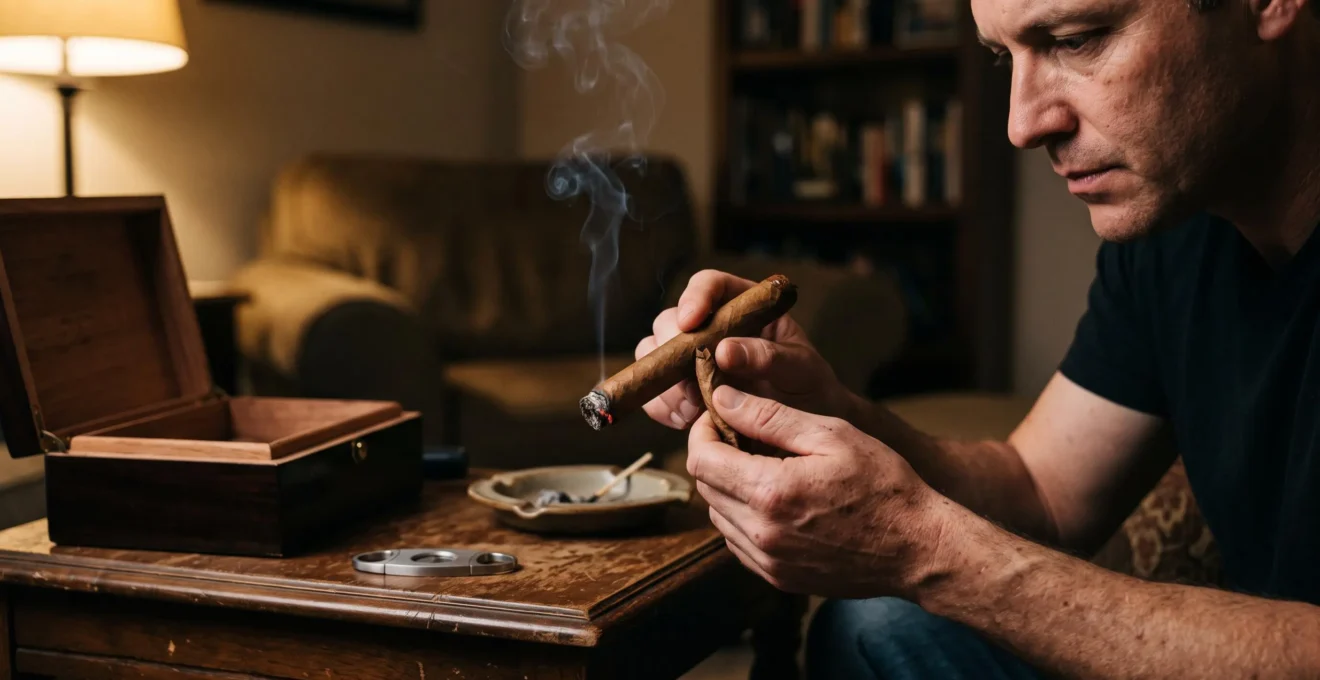
A cigar that tastes sharp on its first few draws is not necessarily destined to remain unpleasant. The opening can be affected by uneven ignition, puffing intensity and the way the tobacco begins burning. As the ember develops, its behaviour may change, sometimes revealing flavours that were difficult to distinguish initially.
That creates an expensive judgement problem for cigar enthusiasts in the UK: abandon a premium cigar too quickly and it may never get the opportunity to show its character. Persist with an unmistakably defective cigar, however, and the experience rarely improves simply through determination.
The useful approach is to treat the opening as an assessment rather than a verdict. Observe whether the sharpness decreases, whether the draw remains consistent and whether the burn responds to a gentler pace. These signals can help distinguish a temporary lighting or handling issue from a persistent construction problem.
No opening ritual can reliably predict every flavour a cigar will develop. It can, however, make the decision to continue, pause or stop considerably more informed.
What to remember about a cigar’s opening draws
- Early sharpness can reflect ignition and puffing conditions rather than the cigar’s established flavour character.
- Draw resistance, smoke temperature and burn consistency provide more useful early clues than a single flavour impression.
- A brief pause and a measured reassessment can help distinguish temporary harshness from a persistent problem.
- Why Are the First 5 Draws So Misleading for Judging a Cigar’s Real Profile?
- How to Run a 3-Minute Start Protocol That Prevents a Harsh First Impression?
- Keep Smoking or Pause: Which Early Signs Matter in the First 7 Minutes?
- The ‘Fix It With More Flame’ Mistake That Ruins the Cigar by Minute 10
- When Should You Take the First Retrohale to Avoid Nose Burn but Still Catch Aroma?
- How to Use Draw Resistance as a Clue to Filler Density in the First 15 Minutes?
- Why Does the Same Cigar Taste Like 3 Different Blends Over 60 Minutes?
- How Can You Describe an Overall Flavor Profile Without Using Vague Words Like ‘Smooth’?
Why Are the First 5 Draws So Misleading for Judging a Cigar’s Real Profile?
The first five draws can give a misleading impression because the cigar has only just been ignited, combustion may still be uneven, and the smoker has little sensory context for the flavours emerging. Initial sharpness may diminish as burning becomes more consistent, but there is no established rule that five draws are sufficient to identify a cigar’s eventual character.
During ignition, different parts of the foot may not begin burning simultaneously. The wrapper, binder and filler can therefore contribute unevenly to the initial smoke. A poorly established ember may produce an acrid impression, particularly if the smoker draws repeatedly to complete ignition.
Experimental evidence confirms that cigar smoke composition changes with smoking conditions. The 2017 study experimental research on cigar burning and smoke emissions, by Dethloff and colleagues, examined how puff frequency, puff volume and smoking progression affect emissions.
The researchers measured nicotine, carbon monoxide and water rather than flavour perceptions. Their findings establish that smoke emissions vary during a session, but they do not prove that an initially harsh cigar will become sweeter or smoother.
The distinction that matters is temporary versus persistent harshness.
- Potentially temporary: a sharp opening accompanied by uneven initial ignition, followed by a noticeable reduction in bite once combustion becomes steadier.
- Potentially persistent: continued bitterness, unpleasant heat or difficult airflow despite a stable burn and an unhurried pace.
- Uncertain: pronounced pepper or spice that remains consistent without an obvious combustion problem. This could be part of the blend’s character rather than a defect.
Body, strength and sweetness should also be considered separately. A cigar can produce a dense mouthfeel without strong perceived nicotine effects, or pronounced pepper without necessarily being full-bodied.
Palate adaptation complicates the interpretation. A sensation that becomes less noticeable may reflect a genuine change in the smoke, the smoker’s sensory adaptation, or both. These influences cannot be reliably separated through tasting alone.
Instead of attempting to identify the entire blend, note three observable characteristics during the opening: the intensity of the bite, the resistance of the draw and whether the smoke feels unusually warm.
Those opening observations become more meaningful when compared with a controlled lighting routine rather than an aggressive attempt to make the cigar taste better immediately.
How to Run a 3-Minute Start Protocol That Prevents a Harsh First Impression?
A three-minute start protocol can provide a practical framework for assessing a cigar without rushing its ignition. Check the unlit cigar, establish an even ember, then make a measured initial assessment. Three minutes is an organisational guide, not a scientifically validated settling period or a guarantee that harshness will disappear.
Before lighting, inspect the wrapper for obvious damage and assess the cold draw. Note whether air passes through with moderate resistance, feels unusually restricted or moves almost without resistance. The unlit aroma may also provide a reference point, although it does not reliably predict the finished flavour.
For ignition, Cigar Aficionado‘s cigar-lighting instructions recommend gradually heating the foot, rotating it and avoiding direct exposure of the tobacco to the flame. The objective is an even glowing ring rather than a blackened, overheated patch.
A practical three-minute observation sequence can be organised as follows:
- Before ignition: inspect the wrapper, note the cold-draw resistance and identify any obvious obstruction.
- During initial lighting: apply heat evenly, rotate the foot and avoid prolonged direct contact between flame and tobacco.
- After ignition: assess whether combustion appears established, allowing a short natural interval before evaluating the next draw.
These are flexible stages rather than rigid timed instructions. A cigar with a larger ring gauge, different moisture condition or uneven foot may behave differently.
Repeated hard draws are a poor substitute for controlled ignition. They change the rate at which air passes through the burning tobacco and can make it harder to determine whether an unpleasant sensation arises from the cigar itself or from how it is being handled.
Five observations to record at the start
- Inspect the wrapper and record any visible cracks, lifting edges or damage.
- Assess the cold draw and record it as firm, moderate or airy.
- Inspect the newly lit foot and record whether the glowing area is even or patchy.
- Note whether the first smoke impression is peppery, bitter, acrid or relatively neutral.
- After a natural pause, record whether the next impression is improving, unchanged or worsening.
The result is a short record that can be compared with later observations. It also prevents every unpleasant note from being attributed automatically to the blend.
A serious plug or torn wrapper will not necessarily improve through careful ignition. The protocol helps reveal these limitations rather than solve every construction defect.
Once combustion is established, the next question is whether the cigar is settling naturally or showing signs that justify pausing the assessment.
Keep Smoking or Pause: Which Early Signs Matter in the First 7 Minutes?
During the first seven minutes, the most useful signs are changes in harshness, airflow and burn consistency. A relatively even burn and an improving flavour impression suggest that the opening problem may have been temporary. Persistent bitterness, difficult airflow or obvious uneven burning justify reassessment. Seven minutes is a convenient checkpoint, not a validated quality threshold.
Experienced reviewers look for patterns rather than isolated imperfections. A slightly uneven ash edge is not automatically a serious problem, and ash colour alone cannot establish tobacco quality.
More useful information comes from whether the burning edge stays reasonably aligned and whether the cigar behaves consistently without repeated intervention.
The following comparison provides a practical decision framework.
| Observation | Possible meaning | Assessment |
|---|---|---|
| Initial sharpness gradually decreases | Ignition or early handling may have influenced the opening | Reassess after a natural pause |
| Burn line remains reasonably even | Combustion appears consistent | Note flavour changes without unnecessary intervention |
| One side burns substantially faster | Possible uneven ignition or canoeing | Check whether the irregularity persists |
| Internal filler burns ahead of the outer tobacco | Possible tunnelling or combustion imbalance | Consider a construction or burning problem |
| Draw remains heavily obstructed | Possible plug or excess resistance | Do not assume time will resolve it |
| Smoke becomes increasingly bitter and hot | Possible overheating or a less agreeable flavour profile | Stop rather than force the experience |
Setting the cigar down briefly provides an additional observation. The burning end can cool as puffing stops. If the next assessment is noticeably less sharp, excessive puffing or heat may have contributed to the previous impression.
This pause is informative but not conclusive. A temporarily milder sensation does not prove that overheating caused the original sharpness, just as persistent pepper does not automatically indicate defective tobacco.
Watch what happens repeatedly. A cigar that seems more balanced after a pause but becomes unpleasant whenever puffing accelerates may be sensitive to smoking intensity. A cigar that remains difficult even under consistent conditions may have a more fundamental problem.
There is also a psychological trap: once the opening has been labelled bad, every later note may be interpreted negatively. Conversely, the wish to justify an expensive purchase can encourage someone to overlook an experience that is clearly not improving.
Stopping remains reasonable whenever the smoke is unpleasant. There is no obligation to continue merely because the cigar might develop a different profile later.
In particular, avoid turning a minor issue into a bigger one through repeated lighting adjustments.
The ‘Fix It With More Flame’ Mistake That Ruins the Cigar by Minute 10
Applying more flame or puffing harder whenever a cigar tastes sharp can make the assessment less reliable. Aggressive interventions may alter combustion conditions and introduce further harshness instead of resolving the original issue. A lighter is appropriate for correcting genuine ignition problems, but repeated touch-ups should not become the automatic response to an unpleasant flavour.
Consider a common hypothetical scenario: a premium robusto opens with a pronounced pepper note. The smoker assumes that part of the foot is insufficiently lit and repeatedly applies the lighter while taking stronger draws.
Several minutes later, the smoke seems hotter and more bitter. At that point, the smoker cannot readily distinguish the blend’s natural character from the effects of repeated intervention.
The mechanism involves several interacting factors:
- More frequent or forceful puffing changes the supply of air to the burning tobacco.
- Repeated direct flame exposure can cause localised overheating.
- Smoke constituents are transported through the cigar, while condensation and evaporation affect emissions during smoking.
- An unevenly burning cigar can develop additional flavour irregularities independently of the tobacco blend.
The Dethloff experimental study discussed earlier supports the relationship between smoking intensity, progression and chemical emissions. It does not demonstrate that a mistake at minute two permanently damages flavour at minute ten.
Likewise, the movement and condensation of smoke constituents should not be reduced to a claim that all bitter substances accumulate in one predictable location. The process is more complex, and the supplied evidence does not establish a single cause of late-session bitterness.
A proportionate response depends on the observed problem.
- Leave minor burn irregularities alone initially and observe whether they persist.
- Allow a natural pause when the cigar seems excessively hot.
- For a genuine uneven ignition, consider a limited correction rather than prolonged flame contact.
- If the head becomes visibly obstructed, recognise that cutting away more tobacco is irreversible and may damage the cap.
- Stop if bitterness or airflow problems remain unacceptable rather than escalating the intervention.
Some experienced smokers use a reverse purge or carefully trim the head to address particular problems. These are specialist practices, not scientifically established fixes for bitter smoke, and neither guarantees an improvement.
With unnecessary adjustments avoided, aromatic evaluation becomes easier to interpret, including the question of when nasal assessment might add useful information.
When Should You Take the First Retrohale to Avoid Nose Burn but Still Catch Aroma?
There is no established safe or ideal minute for a first retrohale. Some cigar reviewers use nasal exhalation to identify aromas that are less noticeable in the mouth, but tobacco smoke irritates the nasal passages and carries health risks. Waiting for a less aggressive flavour impression cannot make the practice harmless or guarantee that nasal discomfort will be avoided.
Retrohaling, sometimes called nosing, involves allowing smoke already in the mouth to pass out through the nose rather than inhaling it into the lungs.
The specialist glossary entry Cigar Aficionado’s definition of nosing describes the practice as a way to evaluate smoke strength and detect additional flavour characteristics. It explicitly distinguishes this from inhaling smoke.
The source does not establish a recommended timing, a safe quantity of smoke or a predictable relationship between retrohaling and later flavour development.
From a sensory perspective, aroma and taste are closely connected. A cigar may present impressions reminiscent of cedar, dried fruit, roasted nuts or spice that an enthusiast describes more distinctly through smell than through mouthfeel alone.
However, these descriptions remain subjective. Recognising a floral or woody note does not prove that the cigar will become sweeter or that the same note will persist into the middle third.
For someone already experiencing nasal sensitivity, attempting to force a retrohale is particularly unhelpful. A strong burning sensation is a reason to stop exposure, not evidence that an especially complex aroma has been discovered.
A safer way to develop descriptive precision is to compare aromas without deliberately directing tobacco smoke through the nose. Unlit tobacco aromas, observations made between exposures and comparisons with familiar non-tobacco scents can help build vocabulary without increasing nasal smoke exposure.
For diagnostic purposes, the important distinction is between noticing additional aromatic characteristics and treating them as a reliable forecast. The former is an individual sensory observation; the latter requires evidence that is not available in the supplied source material.
More dependable early structural information can come from a characteristic that does not require detailed flavour identification: draw resistance.
How to Use Draw Resistance as a Clue to Filler Density in the First 15 Minutes?
Draw resistance can offer clues about cigar construction during the opening fifteen minutes. An unusually airy draw may suggest insufficient filler or an open airflow path, while excessive resistance may indicate a plug or tightly arranged tobacco. Neither sensation identifies the exact construction problem on its own, and fifteen minutes is a practical observation window rather than a validated diagnostic limit.
Air must pass through spaces within the tobacco bunch. Those passages depend not only on the amount of filler, but also on how the leaves are folded and arranged, their physical condition and the cigar’s dimensions.
According to Cigar Aficionado’s reference on cigar construction terminology, underfilled cigars can produce an airy draw and burn hotter. The same reference discusses how different bunching methods influence airflow.
That makes resistance a useful observation, but not a direct measurement of filler density.
| Draw sensation | Possible explanation | Interpretation limit |
|---|---|---|
| Moderately firm and consistent | Airflow remains restricted but functional | Does not prove ideal filler density |
| Exceptionally airy | Possible underfilling or open airflow channels | Does not identify the exact cause |
| Very tight from the outset | Possible plug, bunching issue or other restriction | May not identify where resistance originates |
| Resistance changes during smoking | Combustion and the remaining tobacco structure are changing | Does not guarantee future improvement |
Early comparisons are particularly useful when a cold draw already seems unusual. If resistance remains excessive after ignition, a construction issue becomes a reasonable possibility.
A slightly firm cigar may become easier to draw, but this should not be treated as inevitable. Equally, an airy cigar may produce a hotter smoking experience, although burn rate and perceived sharpness depend on more than filler density alone.
Some cigar enthusiasts attempt to correct tightness by gently manipulating the cigar or using a specialised draw tool. Such interventions can damage the tobacco and do not establish that a plug will be successfully corrected.
The strongest observation is consistency. A cigar that maintains usable airflow with a reasonably even burn offers a more stable basis for evaluating flavour changes than one requiring continual physical adjustment.
Once structural problems have been considered, the next challenge is understanding why flavour impressions may change even when the cigar is burning consistently.
Why Does the Same Cigar Taste Like 3 Different Blends Over 60 Minutes?
A cigar may seem like three different blends over an hour because its smoke composition, combustion conditions and the smoker’s perception can all change as it burns. The opening, middle and final thirds provide a convenient framework for describing these changes, but there is no universal progression from pepper to sweetness to greater strength.
Premium handmade cigars typically combine wrapper, binder and filler tobaccos. Filler leaves may include different tobacco grades selected for characteristics such as aroma, strength and combustion behaviour.
Terms such as ligero, seco and volado are associated with different leaf positions and characteristics. Their proportions and arrangement contribute to the intended blend.
However, it would be misleading to imagine that every cigar is constructed from three successive flavour layers that the flame encounters one after another. Filler arrangement varies, and the cigar does not necessarily burn through a simple sequence of individually isolated tobacco grades.
Three broader influences help explain perceived flavour development.
- Combustion progression: the quantity and arrangement of tobacco remaining ahead of the ember change throughout smoking.
- Smoke composition: emissions, condensation and evaporation vary over the course of the session.
- Sensory perception: repeated exposure, adaptation and individual expectations can alter how flavours are experienced and described.
A reviewer may describe an opening as bright and peppery, a middle third as rounder and more aromatic, and a final third as denser or sharper. This is a possible tasting narrative, not a fixed timeline that every cigar follows.
Hypothetical tasting example: one cigar, three impressions
During the opening, a smoker notes pepper, mild cedar and a moderately firm draw. In the middle third, the pepper appears less prominent while roasted-nut and cocoa-like impressions become easier to describe. Near the end, bitterness becomes more noticeable and the perceived warmth increases.
This imaginary tasting illustrates how a flavour record can change. It does not establish that the tobacco chemically becomes sweeter in the middle or that the final bitterness has one identifiable cause.
The distinction between intentional blending and handling effects is especially important. When flavour changes occur alongside increasingly uneven burning or repeated aggressive puffing, the reviewer should record those conditions rather than attributing every difference to the blender’s design.
By contrast, an evolving profile observed under relatively consistent conditions may reasonably be described as part of the cigar’s experienced character, without claiming certainty about its cause.
The final step is turning those observations into language precise enough to distinguish one cigar from another without relying on labels such as smooth, strong or good.
Key takeaways for evaluating the whole cigar
- Describe the opening as a set of observations rather than a prediction that must come true.
- Separate flavour changes from variations in airflow, combustion and sensory perception.
- Use the same vocabulary and recording method across sessions so differences become easier to identify.
How Can You Describe an Overall Flavor Profile Without Using Vague Words Like ‘Smooth’?
Describe a cigar’s overall profile using separate dimensions such as body, perceived strength, sweetness, spice, earthiness, creaminess and acidity. Record the dominant impressions in each third, alongside changes in harshness and draw resistance. This produces a more informative account than calling a cigar smooth, although flavour descriptions remain subjective rather than objectively measured properties.
The word smooth can refer to several different sensations. One smoker may mean that the smoke causes little noticeable irritation. Another may be describing a rounded mouthfeel, mild spice or an absence of pronounced bitterness.
Without clarification, these interpretations are difficult to compare.
A practical tasting vocabulary uses familiar sensory references rather than elaborate descriptions chosen for effect.
| Dimension | Useful descriptions | What to distinguish |
|---|---|---|
| Perceived strength | Mild, moderate, pronounced | Subjective intensity, not a nicotine measurement |
| Body | Light, medium, dense | Perceived weight or fullness of smoke |
| Sweetness | Honey-like, dried-fruit-like, caramel-like | A sensory resemblance, not necessarily sugar content |
| Spice | Black pepper, clove-like, warming | Distinct aromatic impressions versus irritation |
| Earthiness | Dry soil, wood, leather-like | Earthy impressions versus general bitterness |
| Creaminess | Rounded, buttery, soft-textured | Mouthfeel rather than literal cream content |
| Acidity | Bright, tangy, sour | Perceived sharpness versus a measured pH value |
For consistency, write one concise line for each third. Record the dominant aroma or taste impression, the harshness level and whether the draw remained comfortable or became more restricted.
For example, a hypothetical record might read:
- Opening: pronounced pepper, faint cedar sweetness, moderate bite, slightly firm draw.
- Middle: clearer cedar and cocoa-like notes, reduced bite, consistent resistance.
- Final: stronger roasted impressions, increasing bitterness, draw unchanged.
This record does not prove the cause of the changes. It does establish precisely what the smoker perceived and when.
Comparing two sessions with the same cigar format, or vitola, can make the method more revealing. If the first session feels peppery and the second seems predominantly woody, check whether the lighting, pacing, storage conditions and tasting context differed.
Those variables should be noted rather than assumed to explain every discrepancy. Personal perception can vary even when the cigar and surrounding conditions appear similar.
Most importantly, distinguish between an observable description and an expectation. The phrase « sharp opening with a detectable cedar-like sweetness » is more informative than « harsh cigar », but it still does not establish that sweetness will dominate later.
The practical next step is to compare an opening note with a complete three-part record from a previous cigar. Look for which early signals actually corresponded with later impressions, and which turned out to be misleading. That comparison is more valuable than forcing an unpleasant session to continue simply to confirm a prediction.
Does an expensive cigar always become smoother after the opening?
No. Price does not guarantee a predictable flavour progression. Some cigars remain peppery or intense throughout, while others develop a more rounded impression. Construction, combustion, individual perception and the blend itself all influence the experience.
Can a cigar taste harsh even when its burn line looks perfect?
Yes. An even burn suggests reasonably consistent combustion, but it does not guarantee a pleasant flavour. Pronounced spice, bitterness or irritation may remain noticeable even when the cigar shows no obvious construction problem.
Does a firm cold draw mean the cigar is plugged?
Not necessarily. Some resistance is normal, and cigar dimensions and bunching methods affect airflow. A plug becomes a stronger possibility when the restriction is unusually severe and remains problematic during the smoking session. Resistance alone cannot identify its precise cause.
Can the first few draws predict the flavours of the final third?
Only to a limited extent. Initial draws may reveal identifiable flavour impressions and structural characteristics, but there is no validated method for predicting the final third from those observations alone. Later changes in smoke composition, burning conditions and sensory perception complicate the forecast.
Should you continue a cigar that causes an unpleasant burning sensation?
No. A burning sensation or persistent discomfort is a sufficient reason to stop. Tobacco smoke exposure carries health risks, and neither a smoother flavour nor the possibility of later aromatic development makes continued exposure safe or necessary.