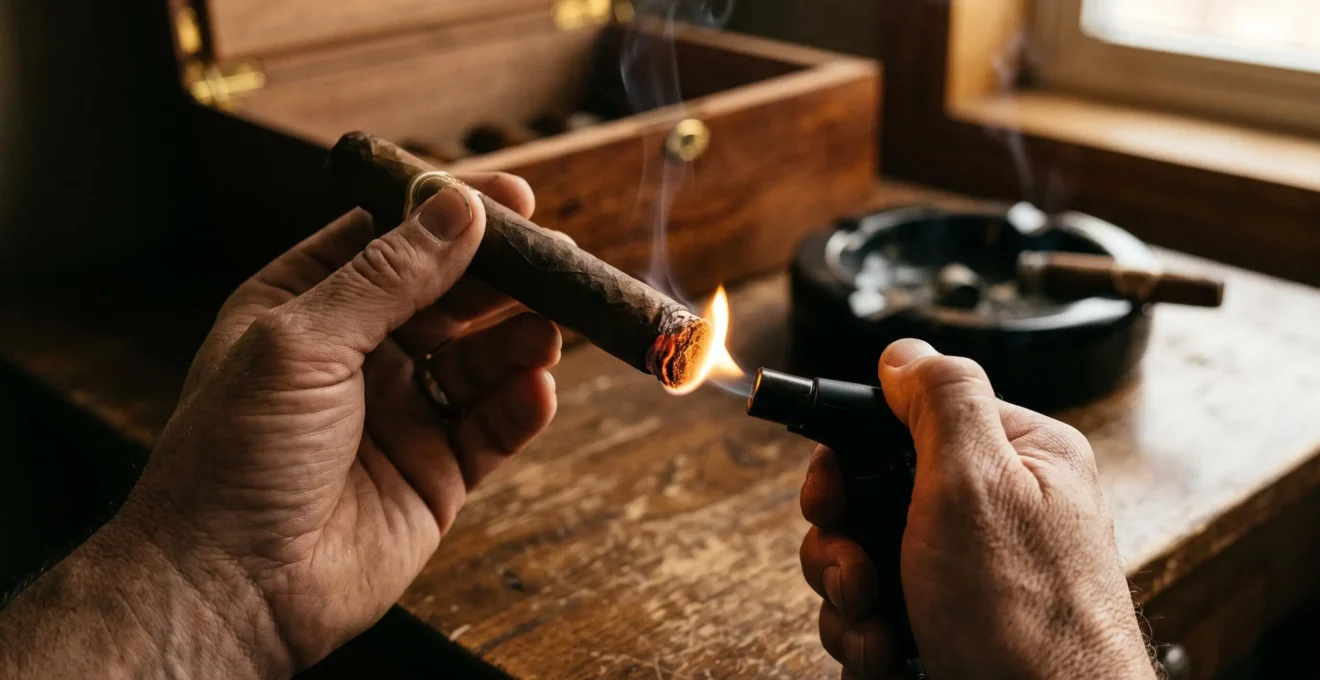
A cigar that begins burning unevenly can keep developing an awkward diagonal burn line long after the lighter has been put away. One side advances, the opposite edge remains dark, and repeated attempts to correct the imbalance may leave the tobacco tasting hot or bitter. This uneven pattern is commonly called canoeing.
The initial light matters because it establishes which parts of the cigar’s foot are actively burning. If the flame reaches one section more thoroughly than another, the slower section may struggle to catch up. Construction, moisture and environmental conditions can contribute too, so not every persistent burn problem begins with poor lighting technique.
For UK cigar smokers using a butane torch, ordinary matches or cedar spills, the practical aim is straightforward: heat the foot gradually, distribute the heat evenly, avoid aggressive initial draws and intervene only when an irregularity genuinely needs attention. These habits can improve consistency without promising that every cigar will burn perfectly.
The essentials of a controlled cigar light
- Toast the foot indirectly while rotating the cigar, rather than concentrating intense flame on one spot.
- Begin with gentle, measured puffs and inspect the ember before attempting corrections.
- Use a small, localised touch-up for a cigar that remains lit; remove loose ash and relight gently if it has gone out completely.
- Why Does a Bad Light Create Canoeing That Keeps Coming Back Even After Fixes?
- How to Light With a Torch in 60 Seconds Without Scorching the Wrapper?
- Torch, Soft Flame, or Cedar Spill: Which Lights More Evenly Outdoors in a Breeze?
- The « Big First Pull » Mistake That Makes the First Inch Taste Bitter
- When Should You Relight vs Touch Up During the First 10 Minutes?
- Why Does Holding the Torch Too Close Create Bitterness in Under 30 Seconds?
- Why Do Early Burn Imbalances Keep Reappearing Even After You Fix Them Once?
- Why Is the Early Combustion Stage Where Most Burn Problems Start in the First 8 Minutes?
Why Does a Bad Light Create Canoeing That Keeps Coming Back Even After Fixes?
A bad initial light can create recurring canoeing because one side of the cigar establishes a stronger ember than the other. The faster-burning section advances while the darker edge lags behind. A brief correction may improve the visible burn line without fully resolving the original imbalance, particularly when airflow, moisture or construction differences are also involved.
During ignition, the heat must reach the packed tobacco inside the foot as well as the exposed wrapper edge. If the lighter remains directed towards one side, combustion may become established there before the opposite section has ignited sufficiently. As smoking continues, the uneven line can become increasingly visible.
According to Holt’s advice on achieving an even cigar burn, an uneven initial light is one recognised cause of irregular combustion. Rotating the cigar, checking its ember and applying restrained corrections are practical ways to manage the problem. The guidance also identifies construction issues as potential causes.
The timing of the imbalance is a useful clue, not a definitive diagnosis. A diagonal burn appearing almost immediately suggests that ignition deserves attention. If the cigar initially burns evenly but subsequently develops a stubborn slow-burning section, uneven filler distribution, an air pocket or another construction issue becomes more plausible. However, these causes can overlap, and neither follows an exclusive timeline.
Excessively aggressive heating may also produce fragile ash along the faster-burning edge. When loose ash breaks away, exposed tobacco can make the burn line look more irregular. This is not proof that ash damage itself causes recurring canoeing; the underlying heating and tobacco distribution still matter more.
A practical diagnostic is to inspect the foot after several gentle puffs. If one section consistently remains dark, allow a minor difference time to settle before making a small correction. Continued resistance after careful correction suggests that repeated torching may not solve the underlying problem. There is no validated three-puff rule that separates lighting faults from construction defects.
The most effective preventive measure is to distribute heat evenly from the outset. That begins with controlling torch position, distance and movement rather than trying to rescue an already crooked burn line.
How to Light With a Torch in 60 Seconds Without Scorching the Wrapper?
A controlled torch light starts with the flame positioned away from direct contact with the tobacco. Hold the cigar at an angle, rotate its foot through the heat and allow a modest ember to form before taking gentle initial puffs. Sixty seconds is a useful practice framework, not a guaranteed lighting duration for every cigar or torch.
A butane torch offers directional heat, which is particularly useful outdoors. Its advantage is also its principal risk: holding the concentrated blue flame against a single point can char tobacco before the surrounding foot has warmed evenly.
In Cigar Aficionado‘s article on cigar lighters, Michael Frank describes holding the cigar at approximately 45 degrees above the flame and rotating it during ignition. The article also warns against immersing the tobacco directly in the flame because excessive charring can produce harsh smoke.
For a practical one-minute exercise, the following sequence provides a controlled starting point. The timings are illustrative, and the visible condition of the foot should determine when to continue.
- Seconds 0–10: Ignite the torch safely and position the cigar approximately 45 degrees above its flame. Begin with a visible gap between the hottest flame and the tobacco. A distance around 2–3 cm can serve as an initial visual reference, but it is not a scientifically established universal setting.
- Seconds 10–25: Rotate the cigar slowly so that the heat reaches the whole circumference of the foot. Move the cigar rather than allowing concentrated heat to remain on one section.
- Seconds 25–40: Continue toasting until the exposed tobacco begins glowing modestly and evenly. Avoid holding the foot deep within the blue flame or attempting to create an intensely incandescent surface.
- Seconds 40–50: Take gentle initial puffs, allowing the ember to develop without forcing a large volume of air through the cigar.
- Seconds 50–60: Briefly inspect the foot. A light blow can reveal glowing and dark sections. Make a restrained local correction only if an area clearly has not ignited.
The objective is an adequately established ember, including the centre of the foot, rather than an artificially bright ring achieved through prolonged heating. An insufficiently lit centre can produce its own combustion difficulties, while excessive toasting risks charring the tobacco.
Thin or delicate-looking wrappers, including some Connecticut-style wrappers, deserve careful handling. However, there is no established evidence in the supplied sources that Connecticut wrappers necessarily transfer heat faster than every other wrapper type. The reason to use restraint is the general risk of excessive local heating, not a verified wrapper-specific temperature threshold.
Five checks for a controlled torch light
- Set a visible gap between the torch flame and cigar foot; confirm that the tobacco is not immersed in the blue flame.
- Hold the cigar at an angle and rotate it; confirm that every section of the circumference has faced the heat.
- Toast the exposed foot gradually; look for modest, distributed glowing rather than a single intensely bright patch.
- Take gentle initial puffs; confirm that the cigar draws without requiring forceful inhalation.
- Blow lightly across the foot and inspect it; identify any remaining dark section before deciding whether a touch-up is necessary.
Once the basic technique becomes consistent, the next variable is the flame source itself. Outdoor airflow can make an otherwise careful lighting routine much harder to control.
Torch, Soft Flame, or Cedar Spill: Which Lights More Evenly Outdoors in a Breeze?
A torch is generally the most practical of these three options when lighting a cigar in a moderate breeze because its concentrated flame is less easily disrupted. A soft flame offers gentler heat in sheltered conditions, while a cedar spill allows gradual, traditional lighting but needs protection from airflow and falling embers. None guarantees a perfectly even burn.
Outdoor lighting presents two separate challenges: keeping the flame stable and distributing its heat around the cigar foot. A flame that remains lit in the wind is not automatically better at heating the tobacco evenly. Technique still matters.
Soft-flame lighters and matches provide broad, relatively gentle heat, but their flames may flicker, lean or extinguish in moving air. Torch lighters resist disruption more effectively but concentrate heat into a smaller region, increasing the importance of rotation and distance.
A cedar spill is a thin wooden strip that burns as a traditional cigar-lighting source. Holt’s explains the gradual process in its instructions for lighting a cigar with a cedar spill. The technique involves holding the burning strip at a slightly downward angle and toasting the cigar foot above the flame.
Cedar spills can introduce a perceived woody nuance, although this depends on the smoker and is not established by controlled sensory testing in the supplied material. Similarly, the assertion that a torch held too close necessarily deposits a detectable butane taste is not supported by chemical measurements. Excessive tobacco charring is a more clearly documented explanation for harshness during lighting.
The choice also depends on the cigar and the level of shelter available. A powerful double-flame torch may be unnecessarily aggressive for a small cigar with a delicate wrapper, while a cedar spill can become difficult to manage when gusts disturb its long flame or carry burning fragments.
| Criterion | Torch lighter | Soft flame or matches | Cedar spill |
|---|---|---|---|
| Moderate breeze | Usually the most stable choice | Flame can flicker or extinguish | Requires shielding |
| Heat distribution | Concentrated; rotation essential | Broader, less concentrated heat | Gradual heating with careful movement |
| Risk during use | Localised overheating | Flame instability | Falling ash and burning fragments |
| Practical setting | Moderately exposed terrace | Sheltered outdoor area or permitted indoor setting | Calm, sheltered location with safe ash disposal |
In a moderate breeze, a torch with deliberate rotation is a practical default. In still conditions, a soft flame allows more gradual control. A cedar spill can be enjoyable where the flame is sheltered and burning debris can be managed safely, but it is not a proven superior choice in strong wind.
If conditions are too windy to keep the lighting flame or burning fragments under control, moving to a more sheltered, permitted location is preferable to repeatedly fighting the wind. UK smoke-free restrictions and venue rules should also be respected.
Regardless of the lighter selected, the next opportunity to disturb an otherwise even start arrives with the first draw. A carefully toasted foot can still become overheated when the smoker tries to establish combustion too aggressively.
The « Big First Pull » Mistake That Makes the First Inch Taste Bitter
A forceful first pull can make a newly lit cigar taste harsh because drawing air rapidly through the tobacco intensifies combustion before the ember has settled. The resulting heat may exaggerate the flavour of charred tobacco. Several measured, gentle puffs are easier to control than one prolonged draw intended to ignite the entire foot at once.
At the start of smoking, different sections of the cigar may still be reaching stable combustion. A powerful draw increases airflow through the lit tobacco and can accelerate burning in areas that are already hotter than their neighbours.
That is especially unhelpful when a cigar has received an uneven initial toast. Rather than necessarily bringing every section into balance, the additional airflow may increase an existing difference and contribute to harsh smoke.
The natural impulse is to take a long first pull to check whether the cigar is properly lit. A better approach is to establish an adequate ember visually and then take measured puffs without rushing.
For a practical first-minute routine, allow the freshly lit foot a brief moment to settle, take two or three gentle puffs and check that the ember remains reasonably consistent. A short pause before resuming a comfortable pace can reduce the temptation to draw repeatedly. An approximately one-second puff and a 30-second pause may be used as personal pacing cues, but these figures are not proven universal settings.
Harshness does not have one exclusive cause. Excessive heat and charring can contribute, but the cigar’s tobacco blend, moisture condition and construction also influence the smoking experience. The supplied specialist sources do not establish that one powerful draw irreversibly destroys specific essential oils or guarantees bitterness over a measurable length of tobacco.
If the first puffs taste unpleasantly burnt, increasing the draw rate is unlikely to help. Allowing the cigar to cool slightly and avoiding further direct flame exposure is a more restrained response. If the foot remains unevenly lit, assess the visible ember before making a local correction.
A persistent unpleasant taste may remain despite improved pacing, especially where tobacco was heavily charred during ignition. However, the duration and reversibility of that flavour change cannot be predicted from the available evidence.
Once the cigar has started burning, restraint remains useful. The next decision is whether a darker section deserves a brief touch-up or whether the cigar has genuinely gone out and needs a fresh light.
When Should You Relight vs Touch Up During the First 10 Minutes?
Touch up a cigar when it is still lit but a clearly defined section is burning more slowly than the rest. Relight it when combustion has stopped completely. The distinction matters because a local correction targets one area, whereas a full relight requires removing loose ash and carefully re-establishing combustion across the foot.
A touch-up uses a small amount of heat on the slower-burning section. It is not the same as reheating the whole cigar. For a minor difference, allowing the ember to settle naturally may be preferable to intervening immediately.
A relight is appropriate when the cigar has extinguished. In that situation, applying flame through a layer of loose, spent ash may contribute to an unpleasant charred taste. Removing the loose ash before gently toasting the exposed tobacco is a more controlled approach.
These distinctions are described in Holt’s instructions for relighting and touching up cigars, which also explains that excessive moisture and construction problems can contribute to extinguishing or uneven combustion.
During the first ten minutes, make the decision according to the actual condition of the cigar rather than the elapsed time.
| Observed condition | Preferred response | Reason |
|---|---|---|
| Small uneven edge, ember still active | Observe briefly before intervening | Minor differences may settle naturally |
| Distinct slow-burning section, cigar still lit | Apply a restrained local touch-up | Targets the lagging section without reheating everything |
| Cigar completely extinguished | Remove loose ash and relight gently | Re-establishes combustion at the exposed foot |
| Same serious imbalance repeatedly returns | Reassess construction and moisture rather than adding more flame | Further heating may not resolve the cause |
A dark section occupying less than one-quarter of the circumference may look like a suitable candidate for a touch-up, but that fraction is not a validated threshold. Likewise, there is no reliable universal rule that a two-second flame exposure is sufficient or that two unsuccessful corrections automatically require a complete relight.
Repeated heating should not become the default response. Every application of a concentrated torch introduces more heat, and aggressive interventions can create fresh irregularities. A small correction followed by observation is usually more sensible than chasing a perfectly straight line every few seconds.
If the cigar repeatedly extinguishes or resists careful correction, consider its condition rather than assuming that more flame will restore normal performance.
Both procedures depend on the same principle: apply only the heat required. That becomes particularly important with high-intensity torches, where a small error in positioning can quickly affect the exposed tobacco.
Why Does Holding the Torch Too Close Create Bitterness in Under 30 Seconds?
Holding a torch too close can produce rapid harshness because its concentrated flame may char exposed tobacco rather than gradually establish an even ember. The closer the cigar sits to the hottest part of the flame, the greater the risk of localised overheating. Bitterness can develop quickly, although a precise 30-second threshold is not scientifically established.
A torch concentrates combustion heat into a narrow flame. When the cigar foot is placed directly inside that flame, the exposed tobacco may blacken and char before the entire surface is evenly ignited.
Charring differs from gently heating the tobacco towards ignition. Excessively intense exposure can produce an acrid sensation that is apparent during the first puffs. This is the practical reason specialists recommend indirect lighting and continuous rotation.
The effects of heat should also be distinguished from claims about fuel residues. Smokers sometimes describe a chemical-tasting first puff as evidence of butane contamination. However, the available sources do not establish a reliable sensory test that separates fuel-related taste from tobacco charring or other flavour causes.
It would therefore be misleading to diagnose two distinct chemical forms of bitterness purely from their taste or duration. A burnt, persistent character may suggest overheated tobacco, but taste alone does not prove the mechanism.
The simplest visual guide is to keep the exposed tobacco outside the concentrated blue region of the flame. Position the torch so heat reaches the foot indirectly, rotating the cigar rather than pressing the flame against one patch. If the foot is immersed in the torch flame, increase the gap.
This method is relevant for delicate wrappers as well as heavier ones. A light-coloured Connecticut wrapper may make visible scorching particularly unwelcome, but wrapper colour alone does not establish a quantified difference in thermal conductivity or flavour sensitivity.
If one section blackens rapidly while another remains relatively untouched, stop applying heat to the darkened area. Allow the remaining sections to warm gradually instead of trying to achieve uniformity through increasingly intense flame exposure.
Avoiding scorching is only part of the solution. If one side repeatedly falls behind even after restrained corrections, the underlying burn characteristics of the cigar deserve closer attention.
Why Do Early Burn Imbalances Keep Reappearing Even After You Fix Them Once?
Early burn imbalances can reappear because a touch-up corrects the visible ember without necessarily removing the condition that made one section burn more slowly. Uneven tobacco distribution, restricted airflow, inconsistent moisture or the original ignition pattern may still influence combustion. Repeated aggressive corrections can introduce additional heat without solving that underlying problem.
The phrase “burn memory” is sometimes used informally to describe this recurring behaviour. It is a useful metaphor for observing a repeated pattern, but it should not be treated as a proven physical mechanism in which previously underlit tobacco necessarily becomes denser or wetter.
Tobacco density is primarily a matter of how the cigar has been constructed. If filler or binder distribution creates a persistent difference in airflow, a short touch-up will not reorganise the tobacco inside the cigar.
Similarly, a cigar with excessive or uneven moisture may burn inconsistently despite technically competent ignition. A recurring problem is therefore not automatically evidence that the smoker has failed to apply enough heat.
Consider a hypothetical example: a cigar initially develops a diagonal burn line. A brief touch-up improves its appearance, but after several gentle puffs the same side begins lagging again. The smoker applies a stronger flame, only to discover that the opposite edge now advances too quickly.
In this scenario, the corrective action has changed the visible pattern without establishing a consistently even burn. Repeating the same aggressive intervention may make control harder, not easier.
A more restrained approach is to allow a small difference to develop naturally while keeping the cigar’s rotation and airflow conditions reasonably consistent. If desired, adjust the cigar’s orientation briefly and observe whether the slower section catches up. This is a practical observation technique rather than a proven method with guaranteed effects.
When a clearly unlit section persists, a modest, targeted touch-up is reasonable. Afterward, allow several gentle puffs before deciding whether further action is needed.
If the same substantial imbalance returns repeatedly despite correct lighting and measured corrections, consider construction or moisture as possible causes. The proposed rule of abandoning correction after exactly three recurrences is not scientifically validated; the relevant judgment is whether additional flame is helping or merely overheating the cigar.
This distinction changes how the first few minutes should be managed. Rather than constantly correcting the burn line, the aim is to establish an adequate ember, observe its development and intervene selectively.
Key takeaways before the first eight minutes
- A consistent initial ember reduces one avoidable cause of uneven burning, but cannot overcome every construction or moisture defect.
- Minor burn differences do not always require immediate correction; inspect the cigar before adding more heat.
- Wind, lighting technique and smoking pace should be considered together when judging whether the early burn is stable.
Why Is the Early Combustion Stage Where Most Burn Problems Start in the First 8 Minutes?
The first eight minutes are an important observation period because the initial ember develops into a continuing burn across the cigar’s foot. Uneven ignition, excessive heat and aggressive first draws can all influence its early behaviour. However, the available evidence does not establish that most later canoeing or flavour problems originate within this exact timeframe.
During the early stage, the cigar transitions from the externally heated foot to combustion sustained by intermittent draws. Sections that were poorly ignited may remain behind, while areas exposed to more intense initial heating can advance more quickly.
The developing ember is sometimes described as a combustion front or burning layer. Its behaviour depends on the tobacco available to burn, the cigar’s construction and the airflow created by each puff.
Although an early imbalance can persist, the first burn line does not permanently determine the path of combustion for the entire cigar. Later changes in tobacco density, moisture and smoking conditions can produce new irregularities independently of how the cigar was lit.
A useful early-stage routine combines controlled ignition with observation rather than treating every visible difference as an emergency.
- At ignition: Toast the foot indirectly, rotating the cigar until the exposed tobacco has developed a reasonably distributed ember.
- During the first minute: Begin with measured puffs. Observe whether the foot glows across its surface and whether any clearly unlit section needs attention.
- Over the following minutes: Maintain a comfortable smoking pace. Avoid prolonged, forceful draws intended to accelerate a slower edge.
- If canoeing begins: Decide whether the irregularity is minor enough to settle naturally or whether a restrained local touch-up is appropriate.
- By approximately eight minutes: Review the burn pattern and whether corrections have helped. If the same problem persists, consider the cigar’s construction or moisture rather than automatically repeating the lighting process.
The eight-minute period is a convenient practical checkpoint, not a validated biological or combustion threshold. It does not mean a problem appearing later must have been caused during these initial minutes.
Outdoor conditions complicate the assessment. A changing breeze may alter how an exposed cigar burns or make the lighting flame less stable. Ambient humidity and temperature can also influence the environment, although the supplied material does not quantify their effects on the rate at which the ember develops.
For a cigar lit on a breezy UK terrace, shielding the flame during ignition and avoiding repeated exposure to gusts are sensible precautions. If the burn line becomes uneven after a change in conditions, the environment should be considered alongside the initial technique.
The purpose of this early-stage routine is not to produce a mathematically straight ash line. It is to reduce avoidable overheating, recognise persistent faults and keep corrective action proportionate to the problem.
On the next cigar, begin by inspecting the foot during lighting, take measured first puffs and assess the burn after a few minutes. If a small uneven section resolves without intervention, leave it alone. If it persists, make one careful correction and judge the result before applying additional heat.
Can a cigar burn unevenly even when it was lit correctly?
Yes. Uneven filler distribution, air pockets and moisture problems can all contribute to irregular combustion. Correct lighting reduces an avoidable source of imbalance but cannot guarantee that a cigar with a construction problem will burn consistently.
Should the entire cigar foot glow before taking the first puff?
The aim is to establish an adequately even ember across the exposed foot, without overheating it. A modest, consistent glow is more useful than an intensely bright surface. Gentle initial puffs can help complete ignition, while a light blow reveals areas that remain dark.
Is a double-flame torch better than a single-flame lighter for preventing canoeing?
Not necessarily. A double-flame torch covers a broader area but can deliver substantial concentrated heat. A single-flame torch allows more precise positioning. Neither design eliminates the need to rotate the cigar and avoid direct contact with the hottest part of the flame.
Can a cedar spill make a cigar taste woody?
Some smokers report a subtle cedar character when using a burning cedar strip. This is a subjective sensory observation rather than a demonstrated, consistent chemical effect. The principal practical distinction is the gradual lighting method and the need to manage falling ash and burning fragments safely.
How can you tell whether a cigar is worth correcting again?
Observe whether a previous restrained correction produced a lasting improvement. A minor irregularity may settle naturally, while a recurring substantial imbalance can indicate construction or moisture problems. If repeated applications of flame are causing more heat and harshness without improving the burn, further correction is unlikely to be useful.