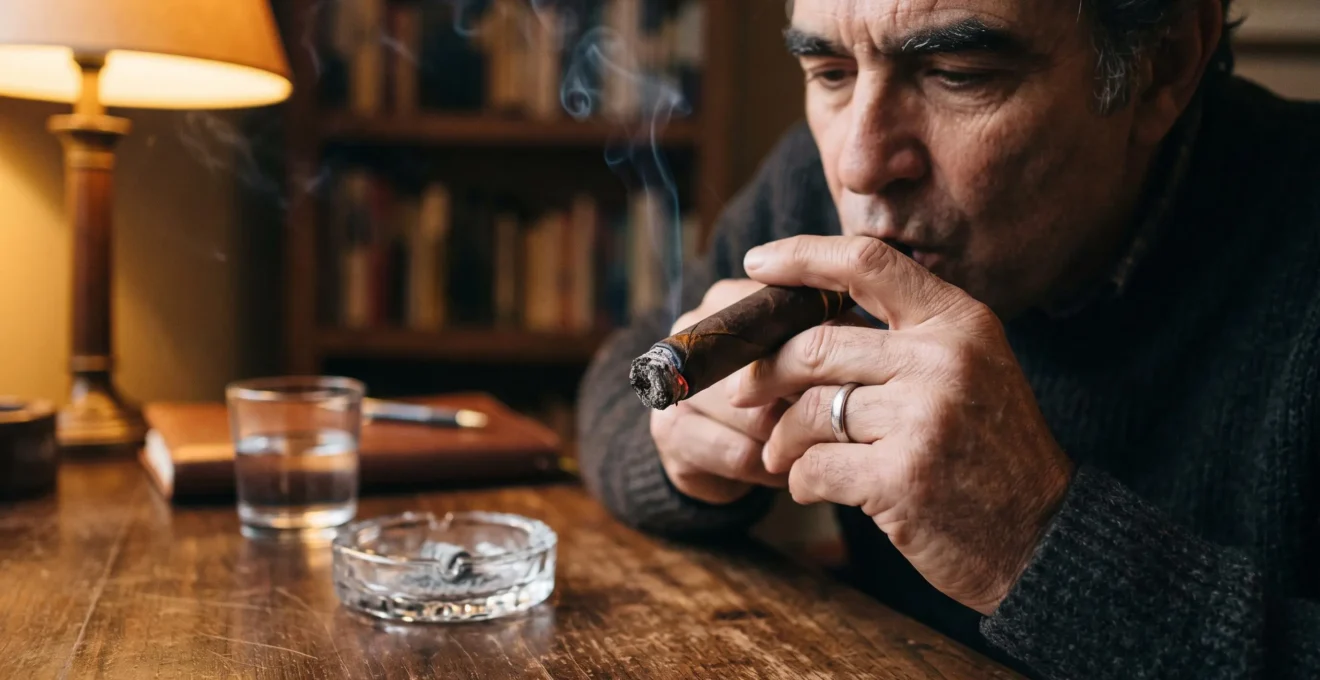
A cigar can develop a convincing caramel, honey or brown-sugar character without being infused with flavourings. The explanation lies partly in tobacco chemistry and partly in how the nose and brain interpret aromas produced when the leaf is heated.
After approximately 45 minutes, a cigar may reveal toasted, sweet-smelling notes that were barely apparent before lighting. Yet 45 minutes is not a chemical threshold. The timing depends on the blend, its construction, combustion conditions and individual perception. Some cigars display these characteristics much earlier; others never develop an obvious caramel impression.
Crucially, caramel-like aroma is not proof that actual sugar is reaching the tongue. Natural tobacco constituents can form compounds associated with sweetness during thermal decomposition, while added flavourings can produce similar sensory impressions.
Understanding that distinction helps explain why sweetness changes throughout a cigar, why a dark wrapper is not necessarily sweeter, and why tasting descriptions alone cannot establish whether a product contains additives. None of these sensory differences makes tobacco smoke harmless.
Natural cigar sweetness: the essentials
- Heat transforms tobacco constituents into aromatic compounds associated with caramel, toast and roasted nuts, even without added flavourings.
- Sweetness is often an olfactory impression rather than a measurable sugar taste; neither a cold draw nor a tasting session can conclusively identify additives.
- Blend composition, smoking conditions, coffee pairings and storage affect perceived sweetness, but there is no universal 45-minute or 60-day rule.
- Why Does Sweetness Show Up Mid-Smoke Instead of on the Cold Draw?
- How to Detect Natural Sweetness Using a 30-Second Palate Reset Between Puffs?
- Claro Sweetness or Maduro Sweetness: Which Works Better With an Espresso After Lunch?
- The « Naturally Sweet » Mistake That Tricks Buyers Into Ordering Infused Cigars
- How to Store Sweet-Leaning Cigars for 60 Days Without Losing the Bright Notes?
- Why Does Caramel Sweetness Appear Only After the Burn Line Settles?
- Why Does Cedar Shift From Sweet to Dry as the Cigar Heats Up?
- Why Does Caramel Sweetness Show Up Late and Then Disappear After 10 Minutes?
Why Does Sweetness Show Up Mid-Smoke Instead of on the Cold Draw?
Sweetness may become more noticeable halfway through a cigar because heating changes the tobacco’s aromatic chemistry. Compounds associated with toasted, caramel-like and nutty smells can form during thermal decomposition. Before lighting, those heat-generated aromas are absent or less prominent, although naturally occurring leaf aromas can already suggest fruit, honey or molasses.
The cold draw and the burning cigar present different chemical environments. Unlit tobacco releases volatile substances at ambient temperature, while a lit cigar undergoes complex processes involving heating, evaporation, pyrolysis and combustion.
A 2026 Frontiers in Chemistry study on cigar aroma formation compared aroma-active compounds in cigar tobacco leaves, their pyrolysis products and smoke. Researchers identified 69 aroma-active compounds in leaf samples, 63 in pyrolysis products and 69 in smoke samples.
The study found that thermal processing shifted the aroma profile towards toasted sweetness and roasted-nut characteristics associated with compounds including furans and pyrazines. This supports the possibility of natural caramel-like aromas developing after lighting, but does not establish a particular point in a cigar at which sweetness must emerge.
Sweet-smelling does not necessarily mean sugar-sweet. Cedar, dried fruit, honey and toasted nuts can evoke sweetness through smell, even when the tongue is not detecting a corresponding concentration of dissolved sugars.
A cold draw remains useful as a descriptive baseline. Raisin, hay, woody or syrup-like impressions before lighting can be noted and compared with the later smoke profile. They are not reliable predictions of how sweet the lit cigar will become.
Combustion conditions add another variable. Changes in puff frequency, airflow and temperature can influence the volatile compounds reaching the senses. However, there is insufficient evidence for a universal rule that faster smoking produces earlier but flatter sweetness.
For that interpretation to be meaningful, the next distinction is between an aroma remembered as sweet and a sweetness sensation that remains noticeable between observations.
How to Detect Natural Sweetness Using a 30-Second Palate Reset Between Puffs?
A brief water-based palate reset can help someone compare successive flavour impressions more consistently, but it cannot chemically verify natural sweetness. A 30-second interval is a convenient observation routine, not a scientifically validated recovery period. Taste, retronasal smell and lingering smoke sensations all contribute to what a smoker describes as sweet.
The WHO scientific review of flavour perception in tobacco products explains that flavour involves multiple sensory pathways, particularly taste and olfaction. Aromas reaching the nose from the mouth can create a convincing sweetness impression independently of direct sugar taste.
Residual aromas, oral coatings and sensory adaptation can complicate repeated assessments. A person may experience a flavour as increasingly sweet, less distinctive or unexpectedly bitter without a corresponding change in the tobacco’s composition.
A simple observation method can reduce some obvious sources of interference:
- Record the initial impression using precise descriptors such as honey aroma, dried fruit, caramel smell or sweetness on the tongue.
- Allow the previous impression to settle rather than immediately taking another puff.
- Sip plain, room-temperature water and note whether any flavour remains.
- After approximately 30 seconds, compare the next impression under similar conditions, without deliberately increasing inhalation or smoke exposure.
- Repeat the observation only if appropriate, recording changes rather than forcing a conclusion.
This method is a sensory exercise, not a health recommendation or laboratory test. In particular, deliberately drawing tobacco smoke through the nose is unnecessary for identifying additives and increases contact between smoke and sensitive tissues.
There is a significant limit to interpreting the results. Natural tobacco aromas may vary throughout smoking, but added flavourings can also change with heat and time. Likewise, relatively consistent sweetness does not prove infusion.
A useful record therefore distinguishes sensory observation from ingredient evidence. A description such as “caramel aroma became more prominent after the first third” is defensible; “therefore this cigar contains no flavourings” is not.
Strong coffee, flavoured mouthwash, chewing gum or a recent sugary dessert introduce additional variables. Avoid treating impressions collected under different conditions as directly comparable.
Once those distinctions are clear, coffee pairing becomes easier to interpret without assuming every apparent sweetness difference originates in the cigar.
Claro Sweetness or Maduro Sweetness: Which Works Better With an Espresso After Lunch?
Some Maduro cigars pair naturally with intense espresso because their cocoa, roasted and darker sweet-associated aromas can complement coffee’s flavour profile. A lighter Claro cigar may be easier to appreciate alongside a gentler coffee. Neither outcome is guaranteed: wrapper colour alone cannot establish sweetness, body or pairing quality.
Claro and Maduro describe broad wrapper characteristics rather than fixed flavour formulas. Tobacco variety, cultivation, fermentation, ageing and the composition of the binder and filler all influence what eventually reaches the palate.
Professional guidance from Tobacconist University material on cigar and beverage pairing emphasises the relationship between beverage intensity and cigar characteristics. Darker wrappers can contribute richness, but they are not automatically sweeter or stronger.
As a practical starting hypothesis, a cigar with delicate hay, floral or light honey-like aromas may be less distinguishable beside a strongly roasted espresso. A blend showing cocoa, toasted nuts or dark-fruit notes may offer more recognisable aromatic overlap.
| Coffee style | Possible Claro pairing | Possible Maduro pairing |
|---|---|---|
| Short, intense espresso | Subtle aromas may be difficult to distinguish. | Roasted, cocoa-like aromas may complement the coffee. |
| Longer, milder coffee | Delicate hay or honey-like notes may remain more apparent. | A rich blend may dominate the combination. |
| Milk-based coffee | A softer beverage profile may make lighter aromas easier to notice. | Cocoa-like impressions may provide a familiar contrast. |
| Sweetened coffee | Added sugar complicates judging natural leaf sweetness. | Dark sweetness may become difficult to separate from the drink. |
These are sensory expectations, not experimentally established pairing rules. The coffee’s bean, roast, extraction and temperature matter, as does the cigar’s complete blend.
Consider the distinction between aromatic similarity and genuine enhancement. Two products sharing roasted characteristics may feel harmonious, but that does not demonstrate that coffee has increased the cigar’s natural sugar content.
For someone assessing whether sweetness comes from tobacco or additives, unsweetened water offers a less complicated comparison than espresso and dessert.
The more important buying decision is not which wrapper appears sweetest, but whether the product is explicitly flavoured or simply described using sweet-associated tasting notes.
The « Naturally Sweet » Mistake That Tricks Buyers Into Ordering Infused Cigars
The mistake is treating the word “sweet” as an ingredient declaration. A traditional cigar described as having honey or caramel notes may contain no intentionally added honey or caramel flavouring. Conversely, a cigar marketed as natural tobacco can still require closer examination of its manufacturing claims before the absence of added flavourings can be established.
Tasting descriptions and ingredient information serve different purposes. “Notes of molasses” describes a sensory impression, while “honey-infused” describes a claimed treatment or manufacturing characteristic.
This distinction matters because naturally derived flavouring ingredients are still additives when deliberately introduced to alter a product’s flavour. The phrase “natural flavours” does not necessarily mean sweetness originates solely from fermented tobacco.
For UK readers, product descriptions, manufacturer information and packaging provide a stronger starting point than guessing from aroma alone. Descriptors such as “flavoured”, “infused”, “aromatised” or an explicit statement about treated wrappers deserve attention.
Price and humidor placement may provide context, but neither establishes what ingredients were used. An expensive cigar is not automatically unflavoured, and a cigar displayed beside traditional premium products may still contain added flavourings.
Five checks before classifying a sweet cigar
- Copy the product’s exact name and variant. Deliverable: an identifiable manufacturer and product line.
- Record the packaging claims. Deliverable: the exact wording concerning flavouring, infusion or sweetened components.
- Check the manufacturer’s product description. Deliverable: a recorded statement, or an explicit note that ingredient information was unavailable.
- Separate sensory notes from ingredient claims. Deliverable: two labelled columns distinguishing “caramel aroma” from “added caramel flavouring”.
- Mark the evidence level. Deliverable: a classification of declared flavoured, declared unflavoured or not established, without presenting uncertainty as proof.
A second reason to check product type is storage. Intentionally flavoured cigars can transfer aromatic characteristics to other cigars when stored together. Their presence in a shared humidor may alter the aromas of products that were originally unflavoured.
There is also a reverse mistake: rejecting a traditional Maduro cigar because its description mentions chocolate, brown sugar or dried fruit. Such notes may arise from the tobacco and its processing rather than an added flavouring.
Sweetness describes an impression; infusion describes a process. Product documentation is therefore more informative than attempting to identify additives through the intensity or consistency of a flavour.
Once the product category is understood, storing it correctly becomes important for maintaining a clear comparison between different blends.
How to Store Sweet-Leaning Cigars for 60 Days Without Losing the Bright Notes?
Sixty days is a reasonable observation period for comparing cigars under stable storage conditions, but it is not a guaranteed flavour-preservation window. Tobacco aromas may evolve during storage, while humidity fluctuations and the presence of strongly flavoured products can complicate comparisons. The aim is consistency, not preserving a particular honey or fruit note indefinitely.
Storage changes are difficult to interpret because perceived aroma depends on the condition of the leaf as well as the volatile compounds it contains. Excessive drying may affect combustion and flavour delivery; excessive moisture may introduce other performance and preservation problems.
However, available evidence does not establish a universal humidity setting that specifically protects natural caramel, honey or dried-fruit aromas, or prove that those notes disappear after a defined number of days.
Practical advice from Holt’s Cigar Company advice on arranging cigars in a humidor recommends keeping flavoured and unflavoured cigars separate because aromatic transfer can occur in shared storage.
That is a more defensible distinction than claiming ordinary Maduro cigars necessarily contaminate Claro cigars in the same way as deliberately infused products. Unflavoured cigars can have different aromatic intensities, but wrapper darkness alone does not determine a measurable transfer risk.
For an informal 60-day comparison, use cigars from the same blend and record their original condition. Keep storage circumstances as consistent as possible, then compare descriptions collected at the beginning, during and towards the end of the period.
A simple record can distinguish three outcomes: the sweet-associated aroma remains recognisable, changes into another character, or becomes less noticeable. Avoid automatically attributing any difference to the loss of a particular molecule without chemical analysis.
Even when someone describes fading honey notes as “generic brown sugar”, that remains a subjective impression rather than proof of a predictable degradation pathway.
Physical separation between deliberately flavoured and unflavoured products is particularly relevant when preserving the identity of a collection. Separate compartments can also help with organisation, although they do not guarantee complete isolation when air is shared.
Stable storage removes some uncertainty, but the way a cigar burns introduces an entirely different explanation for changing sweetness.
Why Does Caramel Sweetness Appear Only After the Burn Line Settles?
Caramel-like aromas may become more noticeable after a cigar develops a relatively even burn because the tobacco is then undergoing a more consistent heating process. Thermal decomposition generates aroma-active compounds, but research does not establish that an even burn line produces a specific caramelisation zone or guarantees the appearance of sweetness.
The burning end of a cigar contains several interacting regions. Tobacco is heated, volatile compounds are released, material undergoes thermal decomposition and combustion produces additional substances.
The resulting smoke composition depends on more than one visible feature. Airflow, tobacco density, moisture, construction and the way heat travels through the tobacco can all influence what reaches the smoker.
The early lighting stage may differ from later combustion because heat distribution is still changing. Nevertheless, it would be inaccurate to claim that natural sugars are necessarily caramelised incompletely in the first centimetres and fully caramelised only after the burn line becomes even.
Caramelisation and tobacco pyrolysis are not interchangeable explanations. Conventional sugar caramelisation describes particular heat-driven reactions, while cigar smoke chemistry involves multiple pathways involving sugars and other tobacco constituents.
The 2026 chemical research discussed earlier supports formation of toasted-sweet and nutty aromatic compounds during pyrolysis. It does not identify an exact distance from the cigar’s foot at which those aromas begin.
A practical observation log can nevertheless be useful. Instead of assuming the first third must be bland, note the cigar’s approximate burn position when caramel, toast or nut-like descriptions first become appropriate.
Compare that observation only with other samples of the same blend under broadly similar conditions. One cigar’s construction or condition may differ from another’s, so a single example cannot establish a blend-wide pattern.
Frequent relighting and aggressive puffing can also alter the sensory experience. However, an uneven burn is not proof of poor-quality tobacco, just as an even burn is not chemical evidence of natural sweetness.
The same caution applies when a pleasant woody aroma changes into a dry, almost papery impression as smoking progresses.
Why Does Cedar Shift From Sweet to Dry as the Cigar Heats Up?
Cedar can seem gently sweet early in a cigar and progressively drier later because the overall aroma mixture and sensory balance change with heating. The nose may initially associate woodiness with soft, sweet-smelling compounds, while later toasted, bitter or irritating sensations make dryness more prominent. This does not necessarily mean a single cedar compound has chemically transformed.
Woody descriptors are common in cigar tasting, but they are not precise identifiers of individual molecules. A cedar note may arise from multiple compounds, their combinations and the smoker’s learned associations with wood, boxes and tobacco.
When additional roasted, bitter or earthy notes appear, the original cedar character can become less obvious. What the smoker experiences as a change from sweet cedar to dry cedar may therefore reflect a change in relative aroma intensity rather than a complete replacement of one flavour.
Temperature can influence which volatile compounds are released and how strongly they are perceived. However, a simple claim that all cedar aromas become dry or bitter as heat rises would overstate the evidence.
Storage creates another interpretive problem. Cigars kept in cedar-lined packaging may carry a noticeable woody aroma before lighting. The extent to which packaging contributes to the eventual smoke profile is not established merely by smelling the wrapper or box.
Likewise, an unusually harsh, dry impression early in a cigar may raise questions about its condition, combustion or storage history, but it cannot by itself diagnose dehydration.
Dryness is a sensory description, not a humidity measurement. A well-maintained cigar can develop dry woody impressions, while an improperly stored cigar may exhibit several unrelated changes.
The relationship with sweetness is particularly interesting. A contrast between dry wood and toasted aromas can make a remaining honey-like or caramel-like impression stand out, even without an increase in the amount of sugar-related material present.
Such contrasts help explain why a cigar can appear to “open up” or become more complex after the early puffs. The language describes a changing sensory experience, not a proven sequence of reactions for every blend.
The final complication is time: an aroma may appear, intensify and fade within a relatively short period even when the underlying tobacco has not undergone a corresponding abrupt change.
What to remember before interpreting fading sweetness
- Separate the chemical formation of sweet-associated aromas from the brain’s changing ability to recognise them.
- Neither an even burn line nor a distinctive cedar progression proves the absence of flavour additives.
- Record time, burn position and sensory descriptors independently rather than treating a ten-minute interval as a fixed property of the cigar.
Why Does Caramel Sweetness Show Up Late and Then Disappear After 10 Minutes?
Caramel-like sweetness may appear late and become less noticeable ten minutes later because the smoke’s aromatic balance changes while perception also adapts. Later heating conditions, competing roasted or bitter sensations and lingering smoke residues may influence the experience. There is no established ten-minute disappearance rule, and fading sweetness does not prove that tobacco sugars have been exhausted.
Two processes must be distinguished: changes in the chemical mixture produced during smoking and changes in the sensory response to that mixture.
The chemical process involves tobacco constituents being heated and transformed as combustion advances. The composition of each puff can vary because different materials and heating conditions are involved.
The perceptual process involves smell, taste, irritation and contextual comparisons. Sensory adaptation may reduce the distinctiveness of a repeated aroma, while stronger competing sensations can make it harder to recognise.
These processes do not necessarily operate on the same timeline. An aroma might become less obvious even while related compounds remain present in the smoke, or it might fade because the volatile mixture has genuinely changed.
The distinction matters when describing caramel, honey or dried-fruit aromas. There is insufficient evidence to claim that the later thirds of every cigar contain a special concentration of sugars responsible for delayed sweetness. Tobacco positioning and blend construction vary, and wrapper, binder and filler can all contribute throughout smoking.
Similarly, accumulated smoke residues may affect mouthfeel and flavour perception, but their specific contribution to sweetness disappearing after exactly ten minutes has not been quantified by the supplied research.
Pausing and drinking water may change the perceived balance of flavours. If a previously noticed aroma becomes recognisable again, that is compatible with a perceptual contribution to its earlier disappearance. It is not proof of receptor recovery or of a particular chemical mechanism.
Approaching the final third, a cigar may develop stronger roasted, earthy, bitter or harsh impressions. Increased heat exposure and the changing smoke mixture can make a previously delicate caramel character less prominent, although the precise sequence differs between blends.
For a useful assessment, record three separate observations: when the aroma first became noticeable, how it was described at its clearest point, and what characteristics dominated when it faded. This provides a more informative account than stating that all natural sweetness disappears on a fixed schedule.
The practical next step is to review existing tasting notes alongside the manufacturer’s flavouring disclosures, distinguishing what was experienced from what can actually be verified about the tobacco. This offers a more reliable basis for understanding natural sweetness than using elapsed smoking time as evidence of ingredients.
Does a caramel flavour mean that a cigar contains added sugar?
No. Caramel-like aromas can arise from heat-driven reactions involving naturally occurring tobacco constituents. Smell can also create a sweetness impression without an equivalent sugar taste. A caramel descriptor alone cannot establish whether sugars or flavourings were deliberately added.
Can a cigar be described as naturally sweet if its wrapper has been sweetened?
The phrase requires clarification. A sweetened wrapper involves a deliberate manufacturing treatment, even if the sweetener itself comes from a natural source. Natural origin and absence of additives are different claims. Manufacturer information is needed to determine what treatment, if any, was used.
Why can two cigars from the same box have different sweetness profiles?
Individual cigars may differ in tobacco distribution, construction, moisture condition and combustion behaviour. Perception also varies with the surrounding environment and prior tastes or smells. A difference in sweetness does not automatically indicate inconsistent manufacturing or the presence of additives.
Does ageing always make a cigar sweeter?
No. Storage and ageing can alter a cigar’s aromatic characteristics, but there is no universal progression towards greater sweetness. Some aromas may become less noticeable, others may change, and a perceived improvement is not proof that sugar content has increased. Consistent storage and careful comparison are more informative than assuming ageing always improves flavour.
Can a cigar with no added flavourings still present health risks?
Yes. Unflavoured and naturally sweet-smelling cigars still produce harmful tobacco smoke and can expose users to nicotine and carcinogenic substances. Descriptions such as natural, additive-free or traditionally fermented concern product characteristics, not proof of reduced health risk.