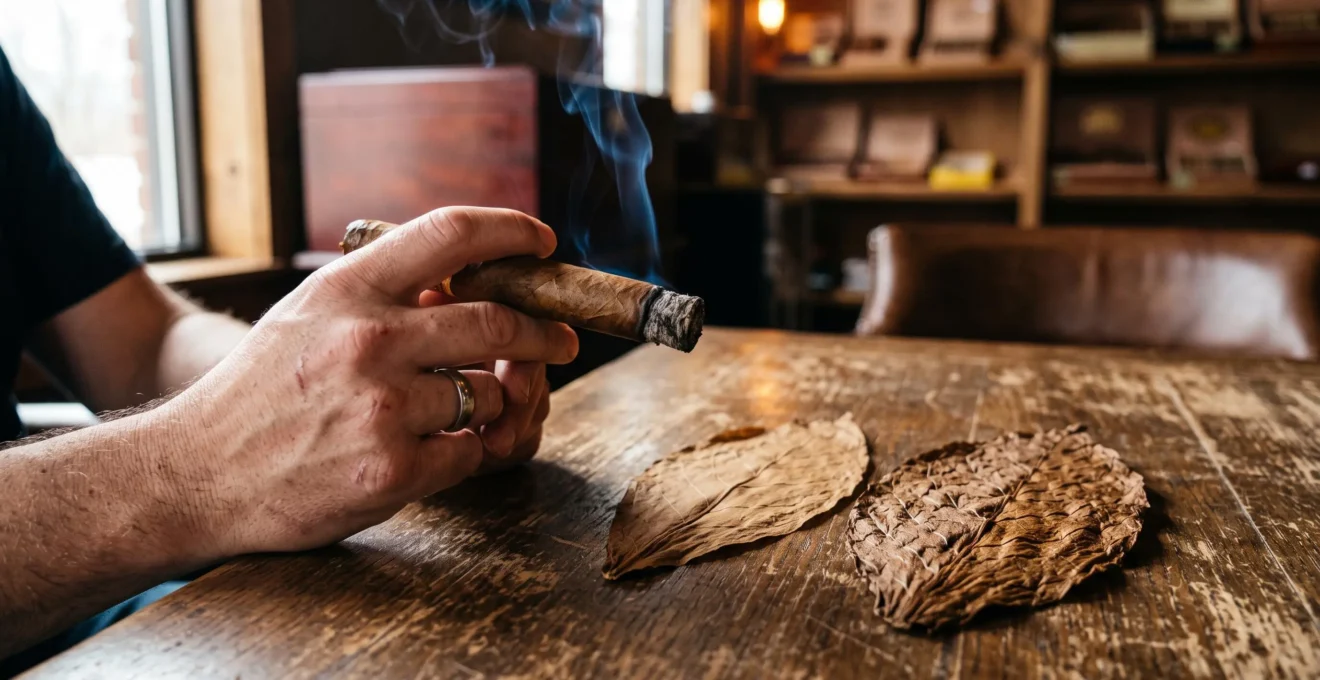
Two cigars bearing the same name, made from the same tobacco varieties and rolled to the same dimensions, can produce noticeably different experiences. One may burn evenly with a relatively soft texture, while another becomes sharper and warmer as combustion progresses. Growing-season weather is one possible contributor, but it is rarely the only explanation.
Temperature, rainfall and water availability influence how tobacco leaves develop. Subsequent curing, fermentation and storage further modify their physical and chemical properties. By the time a cigar is lit, the original climate signal has passed through several additional processes.
For UK smokers investigating batch variation, the useful question is therefore not simply whether a harvest was hot or wet. It is how the crop developed, how the tobacco was processed, and whether the finished cigar has been kept under stable conditions. Understanding these distinctions makes differences in draw, combustion and perceived intensity easier to interpret without attributing every change to origin or weather.
Climate, cigar structure and burn: the essentials
- Growing conditions can alter tobacco leaf anatomy, but drought does not consistently produce thicker leaves or stronger cigars.
- Changes in smoke temperature during combustion are documented, although there is no universal intensity peak at 20 or 25 minutes.
- Stable storage and gradual moisture equilibration are more dependable preservation principles than automatically changing humidity targets with every season.
- Why Can Two Crops From the Same Seed Produce 2 Completely Different Cigar Profiles?
- Why Does Heat Stress Often Produce Thicker Leaves That Feel More Intense After 25 Minutes?
- How to Adjust Your Puffing Rhythm When the Cigar Starts Running Hot by Minute 20?
- Dry Climate or Humid Climate Origins: Which Typically Deliver Creamier Texture?
- The Year-Round Storage Mistake That Makes Climate-Sensitive Cigars Crack in Winter
- Why Does Central Heating Cause Tight Draws and Cracked Wrappers in Winter?
- How Can You Store Cigars in a UK Flat Without Wild Humidity Swings?
- When Should You Move Your Humidor at Home to Avoid Seasonal Swings in Draw?
Why Can Two Crops From the Same Seed Produce 2 Completely Different Cigar Profiles?
Two tobacco crops grown from the same genetic variety can develop different leaf structures because sunlight, temperature and water availability affect plant growth. Their characteristics may diverge further during curing and fermentation. Consequently, genetic similarity does not guarantee identical tobacco chemistry, combustion behaviour or the sensory characteristics of finished cigars.
Genetics establishes a range of possible plant characteristics rather than a fixed outcome. During a growing season, tobacco plants respond to environmental conditions through changes in leaf expansion, internal tissue development and metabolism.
Water stress is particularly revealing. In a 2023 Journal of Plant Physiology study on drought and tobacco leaf thickness, researchers observed reduced leaf thickness during earlier drought exposure, followed by increased thickness after prolonged treatment. The response depended on the duration of stress rather than following a simple rule that drier conditions always create thicker foliage.
These findings concern living tobacco plants under experimental conditions. They demonstrate biological variability, not a direct relationship between drought and cigar strength.
The distinction between growing conditions and processing conditions is equally important. Field weather influences the developing plant, whereas humidity and temperature during curing affect harvested tobacco. Fermentation adds another source of variation before leaves are selected and incorporated into a blend.
An Industrial Crops and Products study on humidity during cigar tobacco curing compared relative humidity conditions of 60%, 70% and 80% during the browning stage. Researchers found measurable differences in leaf chemistry and appearance, with the 70% treatment producing the most favourable combination among the tested conditions.
This was a controlled curing experiment, not a recommendation to store finished cigars at 70% humidity.
Evidence: post-harvest humidity changes tobacco chemistry
The 2022 cigar-tobacco curing experiment compared three humidity treatments during leaf browning.
At 80% relative humidity, chlorogenic acid content decreased by 85.32% during the investigated stage. The result demonstrates substantial processing-related chemical changes, but it does not predict how a finished cigar will taste.
To investigate a suspected harvest difference, compare cigars of the same brand and vitola, with known batch information where possible. Record their condition, storage history and construction before considering variations in combustion speed, perceived smoke warmth and mouthfeel.
This is an observational comparison, not a controlled laboratory test. Without reliable batch and blend records, even a striking sensory difference cannot establish that growing-season weather caused it.
A manufacturer may also adjust tobacco proportions between production runs to maintain a recognisable house style. Conversely, different harvests may enter a familiar blend without any announced recipe change.
Crop climate creates possibilities for variation; curing, fermentation and blending determine how much of that variation survives into the finished cigar.
Why Does Heat Stress Often Produce Thicker Leaves That Feel More Intense After 25 Minutes?
Prolonged drought can increase tobacco leaf thickness under certain experimental conditions, but heat stress does not reliably produce thicker cigar leaves. Nor is there evidence that such leaves consistently create a stronger middle third after 25 minutes. Perceived intensity depends on several interacting factors, including tobacco composition, construction and changing combustion conditions.
Leaf thickness is a measurable anatomical characteristic. It reflects the arrangement and development of tissues, including palisade and spongy cells, rather than simply the amount of flavour-bearing material present.
A drought-stressed plant may initially restrict cell expansion and produce thinner foliage. With longer exposure, anatomical responses may change direction. This makes statements such as « hotter season equals thicker leaf » unreliable without measurements from the particular crop.
It is also important to separate a tobacco leaf’s thickness from the construction of a finished cigar. A cigar contains filler, binder and wrapper. Their arrangement, moisture content and physical characteristics influence airflow and the way combustion progresses.
A thicker individual leaf does not automatically mean that more combustible material is concentrated at the cigar’s core. Its contribution depends on how that leaf is selected and used.
Evidence on changes during smoking is stronger than evidence connecting those changes specifically to drought-induced thickness. The National Cancer Institute monograph chapter on cigar chemistry and toxicology summarises experiments showing that smoke temperature at the mouthpiece can rise during successive puffs.
25–30°C to 75°C
In one historical experiment cited by the National Cancer Institute, smoke temperature at the mouthpiece began around 25–30°C and reached approximately 75°C near the end of a cigar smoked down to 10 mm. These values depend on the experimental conditions and are not universal cigar temperatures.
National Cancer Institute, Smoking and Tobacco Control Monograph No. 9, Chemistry and Toxicology.
Temperature measured at the mouthpiece should not be confused with the much hotter combustion cone. Neither measurement provides a direct numerical measure of perceived flavour intensity.
The often-mentioned 25-minute threshold is therefore best understood as an illustrative moment in a particular smoking session, not as a predictable transition imposed by leaf anatomy.
For a qualitative comparison, note where an apparent change occurs relative to the cigar’s physical length rather than relying exclusively on elapsed minutes. Also record whether draw resistance, combustion regularity or puff frequency changed around the same point.
Two cigars reaching their middle third at different times are not necessarily experiencing the same thermal conditions. Ring gauge, tobacco packing and the way each cigar burns complicate the comparison.
Even the expectation that a denser leaf must burn hotter can be misleading: combustion behaviour is not determined by thickness alone, and a slower-burning cigar is not necessarily cooler at every measurement point.
A noticeable increase in warmth is an observation worth recording, but attributing it to heat-stressed leaves requires evidence that ordinary smoking experience cannot provide on its own.
How to Adjust Your Puffing Rhythm When the Cigar Starts Running Hot by Minute 20?
If a cigar feels unusually hot around the twentieth minute, the first diagnostic step is to determine whether its behaviour has changed alongside puff frequency, draw resistance or combustion irregularity. Faster puffing can alter thermal conditions, but the 20-minute mark has no established biological significance. An uncomfortable or harsh smoking experience is a reason to stop rather than pursue a particular flavour outcome.
The National Cancer Institute’s review illustrates why timing matters when interpreting cigar combustion. One historical smoking-machine protocol used a puff every 40 seconds, with a 20 ml puff volume and a 1.5-second duration.
These values describe an experimental method. They are not recommended smoking intervals or a safety threshold.
For someone examining an existing cigar-smoking observation, several variables deserve separate consideration:
- Puff frequency: repeated draws introduce air into the combustion zone and affect how burning progresses.
- Draw resistance: changes in airflow can reflect construction, moisture conditions or developing combustion irregularities.
- Burn-line appearance: an uneven line may indicate inconsistent burning, but it does not identify a unique cause.
- Smoke temperature: perceived warmth at the mouthpiece is different from temperature inside the burning tobacco.
A common interpretation is that accumulating oils and tars necessarily tighten the draw and produce a self-reinforcing overheating cycle. Tobacco-smoke constituents and combustion deposits certainly change during use, but the supplied evidence does not establish this as the universal cause of tightening draw resistance.
Initial packing density, moisture distribution and construction can also affect airflow. A cigar that was restrictive before lighting presents a different diagnostic situation from one whose resistance changed later.
| Observation | Possible explanation | Important limitation |
|---|---|---|
| Warmth increases alongside frequent draws | Combustion conditions may be affected by puff frequency | Frequency alone does not establish the cause |
| Draw feels restrictive from the beginning | Construction or moisture distribution may contribute | The cause cannot be identified from resistance alone |
| Burn line becomes uneven | Combustion is progressing inconsistently | Leaf origin and weather cannot be inferred |
| Harshness increases late in the cigar | Changing smoke temperature or chemistry may contribute | Harshness is subjective and is not a calibrated temperature reading |
Forceful reverse blowing or repeated attempts to manipulate combustion should not be treated as scientifically validated ways to restore a particular flavour profile. The available sources do not establish that such methods consistently improve burn quality.
Equally, relighting is not a diagnostic test of leaf density. It introduces another change in combustion conditions and makes comparisons less controlled.
The broader health context matters: cigar smoke contains toxic and carcinogenic substances, and an apparently cooler or smoother sensory experience does not make it safe.
Elapsed time is a weak explanation on its own. Without consistent conditions and direct measurements, a hotter middle section cannot be reliably traced to a particular growing season.
Dry Climate or Humid Climate Origins: Which Typically Deliver Creamier Texture?
Neither dry-climate nor humid-climate tobacco origins can be reliably classified as producing creamier cigars. Growing conditions influence plant development, but variety, curing, fermentation, blending and storage all intervene before the finished product is assessed. Creaminess is a subjective sensory description rather than a directly measured consequence of regional humidity.
Popular origin-based descriptions often compress complex agricultural and manufacturing differences into a memorable rule. Expressions such as « dry climate means strength » or « humid climate means smoothness » may sound intuitive, but they are not established by the research supplied here.
The growing environment can influence leaf anatomy and metabolism. Soil conditions, cultivar characteristics and agricultural management may also affect the harvested material. However, these factors cannot be translated directly into a predictable sensory ranking across entire tobacco-growing regions.
What enthusiasts call creaminess may combine several sensations: perceived smoke texture, aromatic associations, mouthfeel and the absence of pronounced harshness. These impressions are not equivalent to a laboratory measurement of leaf oil concentration.
Post-harvest conditions add a further complication. The documented curing experiment demonstrates that humidity during browning alters cigar-tobacco chemistry. It does not establish that the resulting finished cigars would be creamier, stronger or smoother.
For a reader investigating differences in texture, a more useful framework is to distinguish production-related factors from conditions that can be checked at home.
| Factor | Potential relevance | What can be established? |
|---|---|---|
| Growing-season climate | Influences plant growth and leaf anatomy | Crop records or measurements are needed |
| Wrapper variety and origin | Contributes to the cigar’s composition | Manufacturer information may identify it |
| Curing and fermentation | Modify tobacco chemistry after harvest | Processing records are rarely fully available |
| Storage moisture | Affects physical condition and combustion | A calibrated hygrometer can help assess conditions |
| Smoking conditions | Influence combustion and perceived warmth | Comparisons remain sensitive to behaviour |
This table is a diagnostic framework, not a scientifically established ranking of the factors by their impact on creaminess.
A hot or relatively dry production region may yield a cigar described as creamy because the final sensory profile depends on more than regional weather. Wrapper selection, processing choices and the complete blend may all matter.
Likewise, two cigars from a humid growing region may differ considerably despite sharing a broad geographical classification.
When comparing products, it is more defensible to record the actual sensory description alongside verifiable production characteristics than to assume climate alone explains the outcome.
Origin can be a useful starting point for investigating a cigar’s background, but creaminess cannot be predicted confidently from rainfall or atmospheric humidity alone.
The Year-Round Storage Mistake That Makes Climate-Sensitive Cigars Crack in Winter
The most consequential year-round storage mistake is allowing repeated or rapid changes in a cigar’s moisture environment. A fixed humidity target is not inherently wrong, even in winter. Problems arise when heating, temperature differences, poor container sealing or aggressive rehumidification cause the wrapper and filler to exchange moisture at different rates.
Tobacco is hygroscopic: it absorbs and releases moisture in response to its surroundings. The exposed wrapper and the filler near the open foot can respond to environmental changes before moisture has equilibrated throughout the cigar.
When the outer leaf dries quickly, it may become brittle and crack. Conversely, rapid rehumidification can create uneven expansion between different layers and damage the cigar’s construction.
The mechanism is therefore more complex than simply classifying a cigar as « too dry ». Both the direction and speed of moisture change matter.
According to Tobacconist University‘s cigar preservation guidance, stable conditions and gradual moisture corrections are central preservation principles. Its discussion includes the traditional 70% relative humidity and 70°F reference, while recognising that suitable storage conditions vary.
It also discusses 65–70% relative humidity as a commonly successful range, with some preferences extending towards 60–65%. These are practical preservation ranges, not universal laboratory thresholds for every cigar or container.
Relative humidity describes the amount of water vapour present relative to saturation at the prevailing temperature. Consequently, temperature changes can alter relative humidity even when the absolute amount of moisture remains unchanged.
A hygrometer reading must therefore be interpreted alongside temperature and the stability of the storage environment.
That does not mean a humidor should automatically be assigned a different humidity target every season. If its interior remains stable within a suitable range, unnecessary adjustments may introduce the fluctuations that preservation guidance seeks to avoid.
For a cigar that has already become unusually dry, increasing humidity aggressively is particularly unwise. Moisture needs time to move through the wrapper, binder and filler rather than being forced into the outer layers suddenly.
The same caution applies when a wooden humidor has dried out: conditions inside the enclosure should be stabilised without exposing stored tobacco to abrupt changes.
Winter preservation is best understood as a matter of controlling environmental variation, not chasing an exact number on every reading.
Before changing a seasonal storage target, establish whether the humidor is genuinely drifting, whether its readings are trustworthy and whether the tobacco shows physical signs of moisture imbalance.
Why Does Central Heating Cause Tight Draws and Cracked Wrappers in Winter?
Central heating can expose stored cigars to warmer, drier indoor conditions and repeated temperature fluctuations. Rapid moisture loss can make wrappers brittle and prone to cracking, while excessive moisture can swell tobacco and restrict airflow. A tight draw and a cracked wrapper may therefore have different causes rather than representing two inevitable effects of winter heating.
Radiators and underfloor heating alter the thermal environment of a room. If air is warmed without adding moisture, its relative humidity generally falls. That creates conditions in which exposed hygroscopic materials may lose moisture.
A cigar stored in a poorly sealed or frequently opened enclosure may consequently experience changes in moisture balance as the heating system operates.
Location also matters. A humidor placed on a shelf immediately above a radiator may face stronger local temperature changes than one situated away from direct heat.
Likewise, a container near a cold window may experience temperature differences between its surroundings and its interior, potentially complicating humidity management.
Cracked wrappers are consistent with excessive or rapid drying, although handling damage and other construction problems can also contribute.
Tight draws, by contrast, may occur when tobacco is overly moist and swollen. Restricted airflow can also result from construction characteristics unrelated to humidity.
This distinction is essential because treating every restrictive draw as evidence of dryness can lead to inappropriate moisture adjustments.
| Observation | Possible moisture-related explanation | Interpretation |
|---|---|---|
| Brittle wrapper with visible cracking | Rapid or excessive moisture loss | Check the storage history for drying and fluctuations |
| Soft tobacco with unusually restrictive airflow | Excess moisture and swelling | Check for persistently high humidity |
| Restrictive airflow without visible wrapper damage | Construction or uneven moisture distribution | Humidity alone cannot identify the cause |
| Changing readings near a heat source | Local temperature and humidity variation | Assess the humidor’s placement and measurement stability |
A further concern is repeated cycling between dry and humid conditions. This can place physical stress on tobacco layers and compromise preservation over time.
Claims that such cycles necessarily remove a measurable amount of aromatic oil over a single winter go beyond the supplied evidence. Chemical and sensory deterioration should not be quantified without corresponding measurements.
The practical implication is nevertheless clear: avoiding recurrent environmental extremes is preferable to repeatedly correcting their effects after damage becomes visible.
Central heating is an environmental risk factor rather than a diagnosis. The position of the humidor, its sealing characteristics and recorded internal conditions offer more useful evidence than the calendar alone.
How Can You Store Cigars in a UK Flat Without Wild Humidity Swings?
Stable cigar storage in a UK flat depends on choosing an appropriate enclosure, keeping it away from direct heat and sunlight, and monitoring its internal temperature and humidity. A well-maintained wooden humidor or suitably sealed container may work, provided changes are gradual and moisture remains balanced. The most expensive equipment is not necessarily the most appropriate.
UK homes can experience markedly different indoor conditions between heating season and warmer months. The extent of variation depends on the building, ventilation, heating arrangements, occupancy and room placement.
Older flats with single glazing or intermittent heating may experience significant temperature differences, but building age alone does not establish how stable a particular room will be.
The first task is to identify a location with relatively consistent conditions. An interior cupboard or shelf away from radiators, direct sunlight, windows and steam-producing areas can be a reasonable starting point.
Storage materials introduce different practical considerations. Wooden humidors can buffer some moisture changes, but their performance depends on construction, sealing and proper preparation. Airtight glass, acrylic or plastic containers can reduce exchange with the surrounding room, although their internal moisture must still be managed.
Professional preservation guidance recognises several possible enclosure materials rather than requiring one universal solution.
| Storage type | Potential advantage | Main consideration |
|---|---|---|
| Seasoned wooden humidor | Wood can provide some moisture buffering | Seasoning, sealing and environmental placement matter |
| Sealed glass or acrylic container | Limits exchange with room air when properly sealed | Moisture changes inside may persist until corrected |
| Airtight plastic container | Compact and comparatively simple | Material suitability, seal quality and internal humidity require attention |
A digital hygrometer can help distinguish actual storage fluctuations from impressions based on room comfort or the weather outside. Its reliability should be checked rather than assumed.
Observing temperature and humidity over approximately a fortnight can be a useful personal monitoring exercise, especially when the heating schedule varies. This is a practical diagnostic suggestion, not a scientifically validated minimum monitoring period.
A five-step flat-storage stability check
- Map potential locations. Identify two or three storage spots away from direct sunlight, radiators and steam; record the locations on a simple room sketch.
- Inspect the enclosure. Check whether the humidor or container closes properly and note its material, condition and humidification system in a storage record.
- Check measurement reliability. Verify the hygrometer according to its manufacturer’s instructions and record the result or known uncertainty.
- Monitor internal conditions. Log temperature and relative humidity across ordinary heating cycles; produce a dated record showing whether readings remain stable.
- Review before intervening. Compare the readings with the tobacco’s visible condition and document one justified adjustment, or record that no change is necessary.
At the autumn heating switch-on, it is sensible to review recorded conditions, inspect the enclosure and check whether its location has become unsuitable. A similar review when heating is reduced in spring can reveal a different seasonal pattern.
Routine handling or rotation of cigars is not automatically required simply because the season changes. Any intervention should follow an observed need and avoid introducing abrupt environmental changes.
A stable container in a moderately variable room may provide better preservation than a poorly positioned premium humidor subjected to repeated temperature extremes.
Once a reliable storage pattern has been established, preservation becomes a matter of checking for meaningful deviations rather than continually changing settings in response to outdoor weather.
Key decisions before relocating a humidor
- Move a humidor in response to demonstrated exposure to heat, sunlight, dampness or unstable temperatures—not merely because the season has changed.
- Use recorded internal conditions to distinguish environmental problems from differences in cigar construction.
- Prioritise gradual changes and a reliably stable location over frequent adjustments to humidity settings.
When Should You Move Your Humidor at Home to Avoid Seasonal Swings in Draw?
Move a humidor when its current position exposes it to repeated temperature changes, direct sunlight, heating equipment or other conditions that compromise internal moisture stability. Autumn heating changes, winter cold spots and summer solar exposure are sensible times to reassess placement. Seasonal relocation is not automatically necessary when storage conditions remain stable.
The decision should follow the conditions measured inside the container, not simply the date.
During autumn, switching on the central heating may reduce indoor relative humidity or create stronger temperature differences near radiators. A previously suitable shelf can become less stable as household heating patterns change.
In colder winter periods, positions close to poorly insulated windows or external walls may experience additional temperature variation. In summer, direct sunlight can heat a container well beyond the conditions in the shaded part of the room.
For a UK flat with limited storage space, the preferred location is generally one that avoids direct sources of heat and moisture while remaining reasonably stable throughout ordinary daily routines.
Draw resistance may offer an additional observation, but it is not a precise humidity measuring instrument. Tobacco that absorbs excessive moisture may swell and restrict airflow, while drying can create other structural changes or wrapper damage.
A change in draw between cigars obtained in different seasons cannot, by itself, demonstrate that the humidor needs moving. Construction differences, batch variation and prior storage history remain alternative explanations.
Consider three practical situations:
- Autumn heating starts: review the humidor’s readings and check whether nearby radiators or warm airflow have changed its immediate environment.
- Winter cold spells: inspect locations near windows and exterior walls for notable temperature changes rather than assuming the entire room is unsuitable.
- Summer sunlight: reassess shelves receiving direct sun, particularly where a container could experience localised heating.
In a small flat where no position is perfectly stable, an interior cabinet or a better-sealed enclosure may reduce environmental exposure. Adjusting the humidification system may be appropriate if measurements show a persistent problem, but corrections should remain gradual.
Repeatedly moving a humidor from one location to another can itself produce avoidable changes in its environment. Small variations are not necessarily harmful, and a stable overall pattern is more useful than constant intervention.
The most practical seasonal system is a short review of the container’s position, internal readings and physical condition whenever household heating or sunlight exposure changes substantially.
Review the current storage location against recorded conditions, and relocate the humidor only when there is a clear environmental reason. Keep a simple record of the change and subsequent readings so future seasonal decisions rest on observation rather than guesswork.
Does a thicker tobacco leaf always contain more nicotine?
No direct relationship of that kind is established by the supplied studies. Leaf thickness is an anatomical measurement, whereas nicotine content is a chemical characteristic. A thicker leaf cannot be assumed to contain more nicotine without an appropriate chemical analysis.
Can a cigar’s harvest year be identified from the way it burns?
Not reliably. Combustion reflects multiple influences, including tobacco composition, construction, moisture and the conditions under which it burns. Verified production records are needed to identify harvest material; sensory impressions alone cannot establish its year.
Should humidor humidity always be reduced during the British winter?
No. A seasonal reduction is not automatically necessary. The priority is maintaining suitable, stable internal conditions and avoiding abrupt changes. Temperature, enclosure performance and actual humidity readings should inform any adjustment.
Can a cracked cigar wrapper recover after rehumidification?
Gradual moisture equilibration may improve the condition of overly dry tobacco, but it cannot be assumed to reverse physical tears that have already formed. Rapid rehumidification may cause additional damage through uneven expansion.
Does a cooler or creamier cigar produce safer smoke?
No. Creaminess, mildness and perceived smoke temperature are sensory characteristics, not indicators of reduced health risk. Cigar smoke contains toxic and carcinogenic substances, and a smoother experience should not be interpreted as evidence that the smoke is safe.