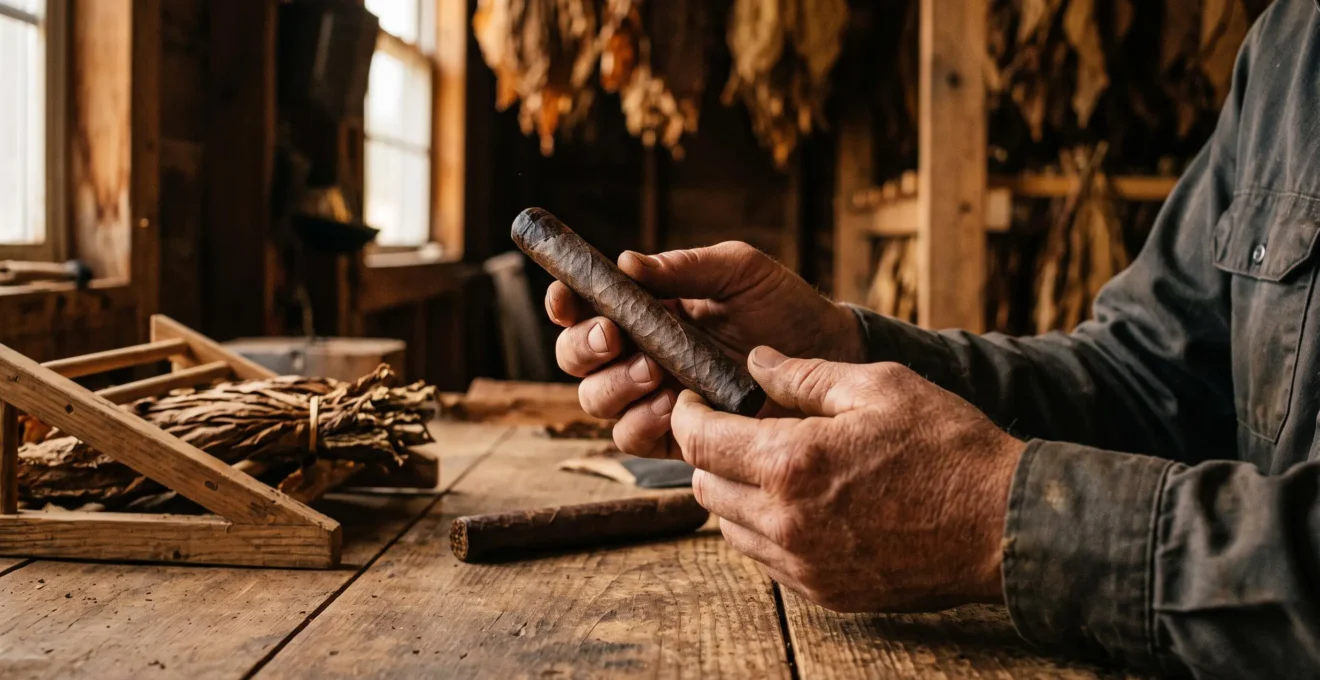
Air-dried tobacco can produce a cigar that tastes noticeably less sharp than its strength might suggest. The reason is not simply that the leaves have lost moisture. During air curing, pigments degrade, microorganisms participate in chemical transformations, and the compounds responsible for tobacco aroma change. Subsequent fermentation can further modify nicotine, nitrogen compounds and flavour precursors.
These changes help explain why a substantial cigar may develop a rounded, apparently cleaner character without becoming mild. However, 30 days is not a scientifically established threshold for removing ammonia from finished cigars. Much of the chemistry associated with curing and fermentation occurs before the cigar reaches its owner.
For UK cigar enthusiasts sensitive to sharp, ammonia-like impressions, the useful distinction is between leaf processing, post-shipping moisture equilibration and what happens during combustion. Understanding those separate mechanisms offers a more reliable way to interpret sweetness, harshness and the effects of storage than relying on an ageing countdown.
Air curing, sharpness and resting: the essentials
- Air curing transforms tobacco pigments and aroma precursors, but it does not guarantee that every cigar will become smoother after 30 days.
- Fermentation can change nicotine, nitrogen compounds and sugars; perceived strength and harshness are related but different characteristics.
- Stable storage and gradual moisture equilibration matter more than forcing a cigar to rest for an arbitrary number of days.
- Why Can Air-Dried Tobacco Taste Cleaner Even When the Cigar Is Full-Bodied?
- How to Calm « Green » Notes at Home in 10 Days Without Over-Humidifying
- Air-Dried Cleanliness or Heavy Fermentation: Which Is Gentler if Smoke Irritates Your Throat?
- The Storage Mistake That Brings Back Sour Notes in Air-Dried Profiles
- When Is the Sweet Spot to Smoke Air-Dried Cigars After Shipping: Day 3 or Day 14?
- Why Does Fermentation Heat Reduce Harshness Even When Nicotine Feels Strong?
- Why Do Early Combustion Volatiles Hit Hardest Before the Cigar Settles?
- Why Do Volatile Compounds Create a Sudden Ammonia-Like Spike in the First 10 Minutes?
Why Can Air-Dried Tobacco Taste Cleaner Even When the Cigar Is Full-Bodied?
Air-dried tobacco can taste cleaner because curing changes the leaf’s chemical composition, including pigments and aroma precursors, while subsequent fermentation can modify compounds associated with sharpness. A full-bodied cigar may therefore feel rich without displaying equally intense acrid notes. However, air curing alone does not establish either low ammonia content or a reliably smoother finished cigar.
During air curing, tobacco leaves hang in ventilated conditions and lose moisture gradually. Unlike flue curing, which uses externally controlled heat, traditional air curing relies primarily on ambient conditions and airflow. This does not mean that the process is chemically passive.
Research on aroma formation during cigar tobacco air-curing documents the degradation of chlorophyll and carotenoid pigments alongside microbial transformations. Chlorophyll degradation contributes to compounds such as neophytadiene, while carotenoid breakdown contributes to other aroma-related substances.
These transformations offer a plausible explanation for the development of a more mature aroma, but they do not prove that every air-cured cigar contains less ammonia than tobacco processed by another method.
Body and harshness should be assessed separately. Body describes the perceived weight and concentration of a cigar’s smoke and flavour. Strength commonly refers to nicotine impact, while harshness describes sensations such as acridity, sharpness or irritation. Nicotine contributes to strength, but none of these sensations can be predicted from nicotine concentration alone.
Connecticut Broadleaf illustrates why the distinction matters. Its air-cured production background does not prevent it from being used in substantial, dark and intensely flavoured cigars. The overall result also depends on the filler, binder, fermentation, blending and combustion conditions.
Sweetness requires similar care. Air curing changes aroma precursors, but there is insufficient evidence to claim that it consistently preserves more natural sugar than faster, heat-assisted curing. Perceived sweetness may also arise from aroma compounds rather than measurable sugar content alone.
Air curing therefore influences the ingredients of a clean-tasting profile; it does not create a guaranteed chemical outcome. Residual nitrogen-containing compounds may remain, and subsequent processing contributes significantly to the finished result.
The key expectation to abandon is that air drying automatically produces a mild cigar. The more useful question is whether its complete processing history has produced a balanced leaf, which leads directly to the problem of tobacco that still smells green.
How to Calm « Green » Notes at Home in 10 Days Without Over-Humidifying
Green notes in a finished cigar may become less noticeable as moisture equilibrates under stable storage conditions, but ten days cannot reliably correct incomplete curing or fermentation. The practical goal is to avoid excessive humidity, observe changes gradually and distinguish temporary conditioning problems from characteristics that home storage cannot remove.
A freshly delivered cigar may smell grassy, vegetal or unusually sharp. Those impressions can reflect its tobacco blend, processing history, moisture state or a combination of factors. A green aroma is not, by itself, proof of an elevated ammonia concentration.
Premium cigars are hygroscopic: they absorb and release moisture in response to their environment. The wrapper, binder and filler do not necessarily reach equilibrium at the same speed. This makes sudden changes in storage humidity a poor strategy for improving flavour.
According to Tobacconist University‘s cigar preservation guidance, approximately 70% relative humidity is a traditional reference point rather than a universal ideal. The organisation discusses successful storage around 65–70% RH and acknowledges preferences closer to 60–65% RH.
For a cigar showing signs of excess moisture, a stable environment towards the lower end of an appropriate storage range may help it reach a different moisture balance. However, lower humidity has not been demonstrated to accelerate ammonia removal from finished cigars.
Higher-RH humidity packs are not a shortcut to removing green notes. If the storage environment is already too humid, increasing moisture may impair the draw and combustion characteristics. It can also encourage undesirable storage conditions without resolving the cigar’s underlying flavour.
A practical assessment can be made without assuming that ten days will produce a particular result. A cold-foot aroma check and an unlit draw provide subjective observations, not validated chemical measurements. What matters is whether the cigar’s condition changes consistently without visible damage or instability.
A five-step cigar conditioning check
- Record the starting condition: note the arrival date, packaging condition and any unusually sharp or vegetal aroma. Deliverable: one baseline entry.
- Check the storage environment: use a functioning hygrometer to record relative humidity and temperature. Deliverable: a dated environmental reading.
- Allow stable equilibration: keep the cigar in suitable storage without repeatedly changing humidity settings. Deliverable: a short log showing whether conditions remained stable.
- Inspect for deterioration: check for visible mould, wrapper damage or pronounced mustiness. Deliverable: a condition assessment; isolate suspect cigars rather than attempting to salvage mouldy tobacco.
- Compare observations: after a period of stable storage, record the aroma and draw impressions again without assuming that improvement must occur. Deliverable: a before-and-after comparison.
This routine can reveal whether the cigar was simply adjusting to its surroundings. It cannot transform inadequately fermented tobacco into properly processed tobacco, and cold aroma does not directly measure ammonia.
If the sharpness remains despite appropriate storage, additional resting may accomplish little. That distinction matters particularly when someone interprets a harsh sensation as evidence that one curing method must be gentler than another.
Air-Dried Cleanliness or Heavy Fermentation: Which Is Gentler if Smoke Irritates Your Throat?
Neither air-cured nor heavily fermented tobacco can be considered reliably gentler on the throat. Processing changes the chemical composition and sensory profile of the leaf, but actual irritation also depends on combustion products and individual sensitivity. A cigar described as smooth can still produce irritating smoke and substantial nicotine exposure.
Air curing and fermentation are also not mutually exclusive categories. Many premium cigar tobaccos undergo air curing followed by fermentation. Comparing an air-cured cigar with a heavily fermented one therefore means comparing different processing histories and degrees of treatment, not necessarily two separate production methods.
Fermentation can change nitrogen-containing compounds, aroma precursors and nicotine characteristics. More extensive processing may reduce particular sharp impressions while creating darker, earthier or more bitter sensory qualities. Those descriptions are tendencies rather than dependable predictions for every tobacco.
The important distinction is between sensory smoothness and physiological irritation. Smoothness is a tasting description. It is not evidence that the smoke is less harmful or medically safer.
The comparison becomes clearer when the relevant characteristics are separated.
| Criterion | Air-curing contribution | Additional fermentation contribution |
|---|---|---|
| Principal processing role | Moisture loss and development of aroma precursors | Further microbial and chemical transformations |
| Ammonia-related chemistry | Not established as uniformly low after curing | Can change depending on process conditions and pH |
| Nicotine | Depends on tobacco and processing history | May decrease or change in chemical availability |
| Perceived sweetness | Depends on aroma composition and leaf characteristics | Can change as sugars and aromatic substances evolve |
| Throat irritation | No demonstrated universal advantage | No demonstrated universal advantage |
Timing may offer a clue about what a smoker experiences, but it cannot diagnose a specific compound. Immediate irritation could involve smoke temperature, volatile constituents, smoke concentration or individual sensitivity. Irritation that increases later may reflect changing combustion conditions, accumulated exposure or puffing behaviour.
It would be misleading to identify early irritation as ammonia with certainty or attribute later irritation specifically to nicotine. Both situations involve complex smoke mixtures.
Proper storage and sufficient moisture equilibration may improve consistency of combustion. They do not make cigar smoke harmless. Tobacco smoke contains substances that can irritate the airways and cause serious health effects regardless of curing style.
For someone who repeatedly experiences throat irritation, changing to a different tobacco-processing category is not a reliable protective measure. Avoiding smoke exposure is the dependable way to prevent smoke-related irritation.
The distinction also helps separate a cigar’s original processing from a later storage fault. A product that once tasted balanced but subsequently developed sour notes may have a conditioning problem rather than an inherently unsuitable curing profile.
The Storage Mistake That Brings Back Sour Notes in Air-Dried Profiles
Prolonged storage at excessive relative humidity can contribute to sour, muted or otherwise unpleasant cigar characteristics. Tobacco absorbs environmental moisture, and too much moisture can interfere with combustion and increase mould risk. However, sour flavour alone does not establish that stored tobacco has developed additional ammonia or undergone a specific acid-forming reaction.
A common mistake is to assume that a higher humidity setting always preserves flavour better. In reality, cigar conditioning depends on a suitable moisture balance, stable temperature and gradual equilibration.
Excess moisture can change the way a cigar burns. Poor combustion may alter flavour release, while an overly moist wrapper and filler can affect draw resistance and burn consistency. The resulting experience may be described as sour, acrid, dull or musty.
These descriptions are sensory observations, not chemical diagnoses. There is insufficient evidence to claim that the residual sugars of air-cured tobacco consistently convert into acidic compounds during ordinary humidification or that an ammonia-removal process reverses under high humidity.
The central storage problem is moisture imbalance. It can affect cigars from several curing backgrounds, so air-cured tobacco should not automatically be assigned a separate humidity requirement.
A useful diagnostic distinction is whether the unwanted character was present on arrival or emerged after storage:
- Sharp from arrival: processing history, blend composition or transport-related moisture imbalance may be relevant.
- Previously balanced, then sour: inspect the storage environment and signs of over-humidification before assuming a manufacturing defect.
- Musty with visible growth: suspect mould contamination and avoid smoking the affected cigar.
If excessive humidity is suspected, check the hygrometer, assess its accuracy and restore stable storage conditions within an appropriate range. Avoid abrupt drying, particularly where the wrapper could be damaged by rapid moisture changes.
A subsequent cold-draw assessment can help document subjective changes, but it cannot confirm whether the cigar’s chemical composition has improved. Some flavour defects will remain despite appropriate conditioning.
The distinction between a persistent processing-related sharpness and a new storage-related flavour is therefore more useful than assuming every unpleasant note comes from trapped ammonia.
Once storage is stable, the next question becomes how long a newly delivered cigar should remain undisturbed. That decision calls for observation rather than a universal three-day, fourteen-day or thirty-day rule.
When Is the Sweet Spot to Smoke Air-Dried Cigars After Shipping: Day 3 or Day 14?
Neither day 3 nor day 14 is a proven optimum for smoking an air-cured cigar after shipping. Transport can expose cigars to changing environmental conditions, and moisture equilibration takes time. A suitable resting period depends on the cigar’s condition and storage stability, not an established timetable for ammonia disappearance.
Shipping can introduce temperature changes and variations in environmental moisture. Packaging may moderate those changes, but the cigar can still reach its destination at a moisture state different from the one expected during long-term storage.
Resting allows moisture to redistribute through the wrapper, binder and filler. This physical process should not be confused with fermentation or with a proven reduction in ammonia concentration.
There is currently no evidence in the supplied research demonstrating that air-cured cigars universally retain a larger pool of removable volatile compounds after shipping than more heavily fermented cigars.
Consequently, a longer resting period should not be presented as a guaranteed chemical cleansing process.
For an individual cigar, the two proposed dates can instead be treated as optional observation points:
- Day 3: inspect the cigar’s physical condition, storage readings and unlit aroma after initial equilibration.
- Day 14: compare those observations if the cigar remains under appropriate storage and there is a reason to continue monitoring.
- Beyond day 14: continue only where the cigar’s condition or storage history justifies it; extra time does not guarantee improved flavour.
A cigar that already appears properly conditioned may not benefit from an extended wait. Conversely, a cigar exposed to substantial environmental fluctuations may need additional time to reach moisture equilibrium.
The cold-foot smell and unlit draw can serve as personal reference points, but they are not validated measurements of residual ammonia. Likewise, differences between cigars smoked on separate dates cannot automatically be attributed to storage time, because individual cigars may differ.
A comparison is most meaningful when the storage conditions remain stable and the observations are documented consistently. The purpose is to understand conditioning, not to manufacture a deadline for improvement.
Understanding why fermentation changes tobacco differently from household resting also prevents unrealistic expectations. Manufacturing processes can alter chemical composition in ways that ordinary humidor storage has not been shown to reproduce.
Why Does Fermentation Heat Reduce Harshness Even When Nicotine Feels Strong?
Fermentation can alter tobacco compounds associated with harshness through microbial and chemical reactions influenced by temperature, moisture and processing conditions. Nicotine may nevertheless remain present at substantial concentrations, so a cigar can taste comparatively smooth while delivering a strong nicotine effect. Importantly, fermentation can also reduce nicotine content rather than leaving it unchanged.
During fermentation, tobacco undergoes transformations involving microbial communities, nitrogen compounds, sugars and aromatic substances. Temperature is one process variable, but heat alone does not explain every chemical change.
A study of chemical and flavour changes during cigar tobacco fermentation examined leaves from Hainan and Sichuan and measured significant changes in nicotine and other constituents.
In the investigated Hainan samples, nicotine concentrations decreased from 4.24% ± 0.12% to 2.74% ± 0.21%, reported nicotine concentration reduction in the experimental Hainan tobacco samples during fermentation, a reported reduction of 35.38 %. The Sichuan samples showed a reported reduction of 35.61%.
35.38%
Reported nicotine concentration reduction in the experimental Hainan tobacco samples during fermentation. This result concerns the measured leaves and cannot be generalised to every cigar or fermentation method.
Si and colleagues, Bioresources and Bioprocessing, 2023.
These findings directly challenge the simplistic statement that fermentation removes harsh compounds while leaving nicotine largely intact. The outcome depends on the material and processing conditions.
The same experiment reported changes in total nitrogen and sugars. Total nitrogen decreased by 10.60% in Hainan samples and 4.93% in Sichuan samples, while total sugars initially increased at stages that differed between the investigated origins.
Therefore, heavier fermentation does not automatically mean less sweetness. Neither does air curing guarantee more residual sugar. Sweetness perception involves the interaction of chemical composition, aroma release, smoke characteristics and individual sensory interpretation.
Additional research published in 2026 examined acidic fermentation treatments applied to air-cured Dexue 1 tobacco. The findings linked changes in free nicotine and ammonia-related chemistry to reduced irritancy under controlled treatment conditions.
In particular, the experimental explanation involved pH-dependent behaviour: under more acidic conditions, ammonium ions are more stable and less likely to volatilise as ammonia during combustion. This does not mean that ordinary air curing or domestic storage produces the same effects.
The practical interpretation is that a cigar’s perceived smoothness reflects a broader processing history than simply the number of days spent drying. Its nicotine concentration and irritant-related chemistry can change through different mechanisms.
Even with well-processed tobacco, the sensations associated with combustion may vary across a cigar. That variation introduces a separate question: why the opening puffs sometimes seem unusually sharp.
Why Do Early Combustion Volatiles Hit Hardest Before the Cigar Settles?
The beginning of a cigar can feel unusually sharp because lighting establishes a changing combustion and heating environment that releases smoke constituents at varying rates. Puff intensity, tobacco moisture and the developing burn zone can influence the initial sensory experience. However, scientific evidence does not establish that the first portion always contains the highest ammonia concentration.
When tobacco begins burning, its constituents undergo thermal decomposition and other reactions. Smoke contains gases, vapours and particles whose composition depends on temperature, oxygen availability, tobacco chemistry and how combustion proceeds.
The early puffs may therefore differ from later ones as the burning region becomes established. The cigar’s moisture state can also influence combustion behaviour, although it is not possible to identify ammonia as the dominant contributor simply from a sharp taste.
A tempting explanation is that the exposed foot contains a uniquely concentrated reservoir of residual ammonia because the rest of the cigar has had less contact with air. The supplied research does not demonstrate this mechanism.
Nor does it establish that resting a finished cigar for 30 days preferentially removes volatile nitrogen compounds through its foot. Volatile behaviour during curing, fermentation and combustion must be distinguished from the moisture equilibration occurring in a humidor.
A harsh opening is not proof of inadequate resting. It may reflect the blend, the cigar’s construction, its moisture condition or combustion conditions, among other factors.
Some smokers report that smaller, less frequent puffs produce a cooler or less acrid experience. This is a sensory practice, not an established method for removing ammonia or preventing exposure to harmful smoke constituents.
Similarly, more extensive initial toasting should not be described as a scientifically validated way of burning off an ammonia-rich surface layer. There is no direct evidence supplied for such a claim.
For anyone who experiences throat discomfort, changing puff technique does not make smoke safe. Persistent coughing, burning or irritation is a reason to stop the exposure rather than attempt to compensate through smoking technique.
The main diagnostic mistake is treating the first third as a reliable chemical test of the cigar’s processing quality. Without measurements, the cause remains uncertain.
That distinction leads to the final chemical question: what ammonia-related compounds can actually contribute to irritation, and why does the often-cited first-ten-minute window remain unproven?
Key takeaways before interpreting an ammonia-like spike
- A sharp smell or sensation cannot identify ammonia without appropriate chemical measurement.
- Processing conditions, particularly pH and fermentation chemistry, influence how nitrogen-containing compounds behave.
- The first ten minutes and the first thirty days are observation windows, not scientifically validated periods of predictable ammonia removal.
Why Do Volatile Compounds Create a Sudden Ammonia-Like Spike in the First 10 Minutes?
Ammonia and other volatile nitrogen-containing compounds can contribute to the chemistry of tobacco smoke, and their behaviour depends partly on tobacco composition and processing conditions. However, a sudden ammonia spike during the first ten minutes of cigar smoking is not established as a universal phenomenon. Sharp sensations alone cannot demonstrate that such a spike has occurred.
Ammonia-related chemistry begins before combustion. Tobacco contains nitrogenous constituents that can change during curing and fermentation. These changes influence which compounds remain in the leaf and how they may behave when exposed to heat.
Ammonia exists in a chemical equilibrium with ammonium ions. This equilibrium is affected by pH: more acidic conditions favour the ammonium form, while less acidic conditions can favour un-ionised ammonia.
This distinction matters because the chemical form influences volatility. Nevertheless, the exact smoke composition emerging from a burning cigar also depends on complex thermal and combustion processes.
In experimental research on cigar tobacco irritancy during acidic fermentation, investigators used malic-acid treatments, including a treatment combined with glucose, to modify the chemical environment of air-cured tobacco.
The proportion of free nicotine decreased by 37.52% under one treatment and 46.98% under another, relative to the unfermented control. The researchers also discussed the importance of pH-dependent ammonia behaviour in explaining reduced irritancy under the tested conditions.
These are controlled fermentation findings. They do not establish that a commercially manufactured cigar releases most of its ammonia during its first ten minutes, nor that post-shipping rest reproduces the treatment’s chemistry.
The often-reported initial sharpness can have several possible explanations:
- Volatile smoke constituents: compounds released during heating may contribute to sharp odours or sensations, but their identities cannot be established by taste alone.
- Changing combustion conditions: the burn zone and smoke formation processes evolve after ignition.
- Moisture and tobacco composition: conditioning and leaf chemistry can influence combustion and sensory character.
- Individual sensitivity: smokers may perceive irritation differently even when exposed to similar smoke conditions.
It is also important to distinguish chemical sweetness from perceived sweetness. Aromatic compounds can create impressions described as sweet, even when the sensation is not directly determined by the leaf’s sugar content.
A dominant acrid note might mask subtler aromas perceptually, but this does not prove that a measurable ammonia decline reveals previously hidden sugars. Demonstrating that relationship would require controlled chemical and sensory data.
Neither a specific ten-minute decline nor a corresponding thirty-day storage improvement is documented in the research considered here.
Consequently, air curing should be understood as one contributor to flavour development, fermentation as a separate contributor to chemical transformation, and storage as a means of maintaining suitable physical conditioning.
For a practical next step, document the cigar’s processing information where available, check storage stability and avoid assuming that perceived sharpness identifies a particular chemical defect. If smoke causes irritation, stopping exposure is more reliable than seeking a supposedly cleaner cigar or extending its resting period.
Is air curing the same as ageing a finished cigar?
No. Air curing is a tobacco-leaf processing stage during which moisture levels change and chemical transformations contribute to aroma development. Ageing or resting a finished cigar occurs after manufacture and may involve gradual moisture equilibration. The two processes should not be assumed to produce equivalent chemical changes.
Does a dark cigar wrapper indicate heavy fermentation or high nicotine content?
Not reliably. Wrapper colour reflects tobacco variety and processing history, but it does not independently establish fermentation depth, nicotine concentration or the overall strength of the finished blend. The filler and binder also contribute to the cigar’s characteristics.
Can a cigar become too dry while waiting for sharp notes to fade?
Yes. Tobacco exchanges moisture with its environment, and excessively dry storage can compromise the wrapper and smoking characteristics. Lowering relative humidity without a clear conditioning reason is not a validated method for removing ammonia. Stable, appropriate storage is preferable to abrupt adjustments.
Does a sweet-smelling cigar necessarily contain more sugar?
No. Perceived sweetness depends on sensory interactions involving aroma compounds as well as the tobacco’s chemical composition. Fermentation research shows that sugar levels can change during processing, but neither sweetness of aroma nor flavour reliably reveals the amount of sugar remaining in an individual cigar.
Can resting a cigar make its smoke less harmful?
There is no evidence in the supplied research that resting a finished cigar for a particular number of days makes its smoke safe or substantially reduces the health risks of smoking. Storage can influence moisture balance and smoking characteristics, but harmful combustion products remain. A smoother sensory impression should not be interpreted as lower health risk.