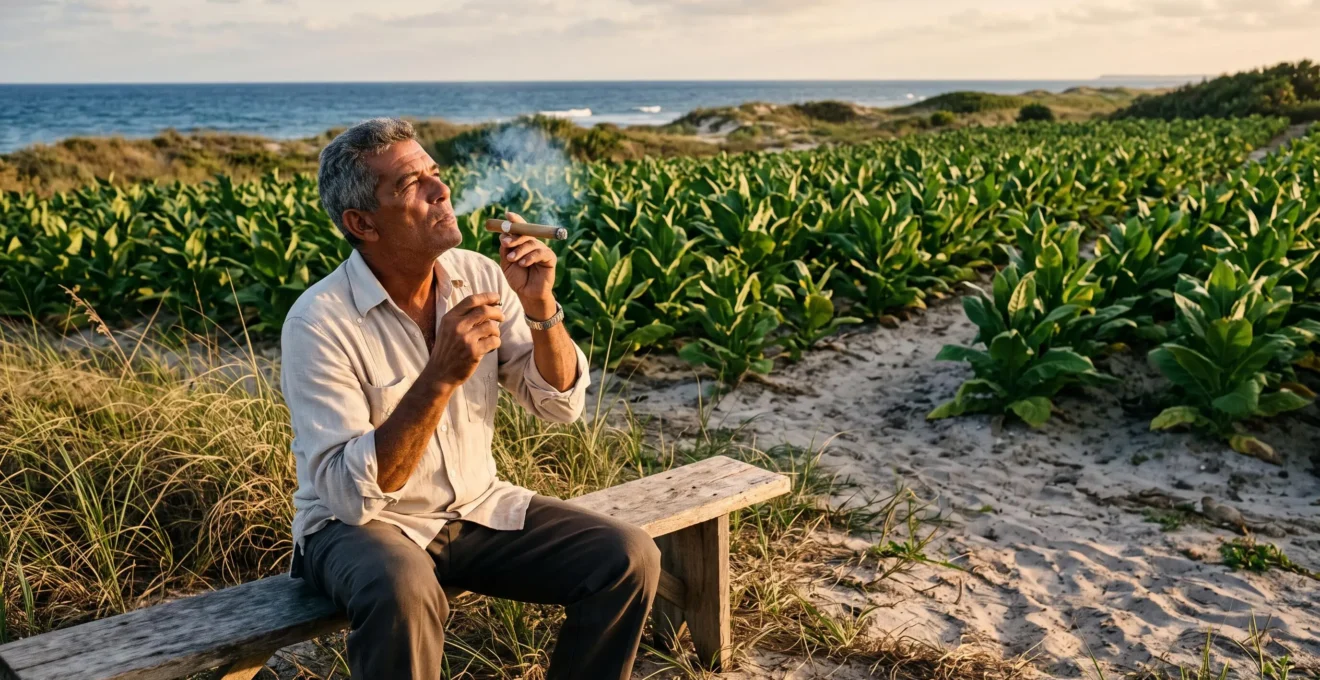
A cigar can seem remarkably gentle at first light yet develop impressions of cream, toasted grain or natural sweetness as the session progresses. Sandy coastal soils are sometimes credited with producing this approachable character, but the explanation is more complicated than the familiar idea that sand automatically creates sweeter tobacco.
Soil texture influences drainage, nutrient availability and plant growth. Those conditions can alter tobacco leaf chemistry, although fermentation, blending, wrapper selection and moisture conditioning also determine the finished cigar’s sensory profile. A relatively quiet aroma does not necessarily indicate an absence of flavour, just as a sweet impression does not establish a high concentration of residual sugars.
For UK enthusiasts comparing mild cigars, the practical question is therefore not simply where the tobacco grew. It is whether a particular blend offers the balance, texture and flavour development they appreciate without relying on pronounced pepper or intensity.
The following distinctions help make sense of coastal-style cigars while separating plausible agricultural influences from marketing claims that research has not established. Tobacco smoke remains harmful regardless of strength, smoothness or perceived sweetness; a mild taste does not indicate reduced health risks.
What matters most about coastal-style cigar sweetness
- Sandy soils influence tobacco-growing conditions, but there is no established universal rule that coastal sand produces sweeter premium cigars.
- Wrapper character, fermentation, blend composition and moisture can matter more to the finished flavour than soil origin alone.
- A clean burn and understated first-light aroma are useful observations, not proof of either sweetness or particular growing conditions.
- Why Do Sandy Soils Often Produce a Cleaner Burn With Fewer Relights?
- How to Pick a Coastal-Profile Cigar for Beginners Without Ending Up Bored at Minute 20?
- Coastal Mildness or Volcanic Spice: Which Feels Better After a High-Stress Day?
- The Over-Toasting Error That Makes Mild Coastal Cigars Taste Like Hot Paper
- Best Humidity Range for Mild Coastal Cigars to Keep Sweetness Over 30 Days
- Why Does Well-Drained Soil Often Produce Brighter Flavours Than Heavy Clay?
- Connecticut or Claro: Which Mild Wrapper Gives More Noticeable Sweetness?
- Why Does a Connecticut Wrapper Taste Bland Unless You Smoke It Differently?
Why Do Sandy Soils Often Produce a Cleaner Burn With Fewer Relights?
Sandy soils can influence the chemical composition of tobacco leaves through their drainage and nutrient-retention characteristics. However, there is insufficient evidence that tobacco grown in coastal sand consistently produces cigars with cleaner combustion or fewer relights. Finished-cigar moisture, rolling consistency and tobacco preparation provide more immediate explanations for uneven burning.
Sand generally drains more readily than finer-textured soils and may retain fewer nutrients. This changes the growing environment, particularly the availability of water and minerals such as potassium, which can affect tobacco development.
In a Frontiers in Plant Science field study on tobacco soil texture, researchers compared tobacco production under sandy and loamy conditions in China’s Hunan Province. They found differences in nutrient retention, fertiliser performance and aspects of leaf composition.
Importantly, the experiment involved flue-cured tobacco rather than finished premium cigars. It did not measure cigar burn lines, ash stability or relighting frequency. Its results cannot establish a direct combustion advantage for coastal tobacco.
A cigar’s burning behaviour also depends on how its filler, binder and wrapper work together. Uneven filler density can create differences in airflow. Unequally conditioned tobacco can cause sections to burn at different rates. Excessive moisture may make combustion difficult to sustain.
Three observations can help describe a cigar’s performance without incorrectly assigning the cause to soil:
- Ash firmness: note whether the ash holds together, while recognising that this does not reveal soil origin reliably.
- Burn-line stability: observe whether one side advances persistently ahead of the other.
- Relights in the first third: record repeated extinguishing alongside draw resistance and storage conditions.
For example, if several cigars from the same box behave inconsistently despite similar conditioning, variation in construction becomes a reasonable possibility. If multiple otherwise well-made cigars are unusually difficult to keep lit, excessive moisture is another possibility worth checking.
Neither observation independently identifies a soil-related problem.
A cigar with a straight burn may still taste flat, harsh or unbalanced. Combustion quality is one characteristic of the experience; flavour richness is another.
The more meaningful question for a mild coastal-style blend is whether its restrained flavour remains interesting throughout the session. That requires looking beyond the burn line to the blend itself.
How to Pick a Coastal-Profile Cigar for Beginners Without Ending Up Bored at Minute 20?
The most useful way to assess a beginner-oriented coastal-style cigar is to look for a balanced blend with recognisable flavour development rather than simply the lowest strength rating. Wrapper descriptions, filler composition, physical dimensions and credible tasting notes offer better purchasing information than an unsupported claim of sandy-soil sweetness.
Mildness does not have to mean monotony. Some understated blends present a fairly constant creamy or woody character, while others develop roasted, nutty or gently spicy impressions. Such differences depend on the tobacco and blending decisions rather than following a guaranteed coastal pattern.
A practical comparison of the main characteristics can help separate genuinely useful product information from evocative descriptions.
| Selection clue | What it can indicate | Important limitation |
|---|---|---|
| Light wrapper colour | Possibly delicate, creamy or grassy flavour characteristics | Colour does not establish strength or sweetness |
| Connecticut Shade designation | A recognised wrapper category often associated with restrained flavours | The filler can produce a substantially fuller experience |
| Coastal origin description | Information about agricultural geography or brand positioning | It does not prove a particular flavour profile |
| Ring gauge | A different physical proportion of filler, binder and wrapper | Thickness alone does not predict flavour intensity |
| Mild strength label | A manufacturer’s or reviewer’s relative strength assessment | Strength, body and flavour complexity are distinct |
For someone evaluating a mild cigar for the first time, a useful product description should explain what changes between the beginning, middle and final portion. A cigar described only as smooth may offer less decision-making value than one whose individual flavour characteristics are identified.
Perceived boredom after the opening portion may reflect a genuinely linear blend, adaptation to repeated aromas or expectations shaped by stronger products. It is not necessarily evidence of poor tobacco.
The idea that sandy-soil cigars characteristically develop more flavour during their second third remains unproven. A changing flavour profile may be interesting, but it cannot be inferred from soil texture.
Environmental context also influences sensory judgement. Strong food aromas, fragranced surroundings and residual tastes from coffee or sweet drinks can complicate comparisons. Beverages may change perceived sweetness through contrast or adaptation, but pairing effects are individual rather than universal.
Five checks for an informed mild-cigar comparison
- Record the wrapper designation and its stated origin; retain a clear product description.
- Identify the filler and binder origins where disclosed; create a short blend profile.
- Separate the stated strength from the described flavour notes; write down both categories.
- Check whether independent reviews describe changes across the cigar’s thirds; produce a simple flavour-development summary.
- Compare claims about soil origin against actual producer information; mark unsupported flavour promises as unverified.
For beginners, the strongest basis for comparison is clear information about strength, construction and flavour, combined with an understanding that a mild smoking experience is not a safer one.
Coastal Mildness or Volcanic Spice: Which Feels Better After a High-Stress Day?
A coastal-style mild cigar and a spicy, volcanic-origin cigar may offer very different sensory experiences, but neither is established as a better way to recover from stress. For someone comparing flavours, the relevant distinction is between understated creaminess and pronounced pepper or earth notes, not a proven relaxing effect of growing soil.
Descriptors such as coastal mildness and volcanic spice are convenient tasting shorthand. They are not scientifically standardised cigar categories.
A coastal blend may be marketed around soft wood, mild cream or cereal-like impressions. A blend associated with volcanic growing regions may be described in terms of pepper, mineral character or richer earthiness.
However, geography does not guarantee these differences. Tobacco varieties, growing methods, curing, fermentation and final blending can reverse expectations.
Volcanic soils also vary considerably. Their mineral composition, drainage properties and agricultural characteristics cannot be reduced to a universal spicy flavour signature.
| Sensory dimension | Coastal-style mild profile | Volcanic-style spicy profile |
|---|---|---|
| Typical marketing language | Creamy, soft, restrained | Peppery, earthy, assertive |
| Flavour emphasis | Subtle transitions and texture | More obvious contrasts and spice |
| Potential appeal | Preference for understated flavours | Preference for pronounced flavour intensity |
| Evidence limitation | Not a universal soil-driven category | Not a universal soil-driven category |
A person’s sensory impressions may also change with fatigue, attention and surroundings. Someone distracted or tired might report fewer delicate flavour details than when concentrating on the same aroma under different conditions. That is a plausible sensory observation, not an established effect specific to coastal cigars.
Importantly, smoking should not be characterised as a reliable stress-management method. Nicotine can reinforce dependence, while tobacco smoke exposes users to harmful substances even when the flavour seems gentle.
The practical comparison is therefore about sensory preferences rather than therapeutic benefits. A cigar described as mild may seem understated to one reviewer and sufficiently complex to another.
This distinction also clarifies why an initially quiet cigar can still offer noticeable flavour: intensity and complexity are not interchangeable. Its combustion and temperature, however, can influence whether those nuances remain perceptible.
The Over-Toasting Error That Makes Mild Coastal Cigars Taste Like Hot Paper
An overly heated cigar can develop unpleasant hot, bitter or papery impressions that overwhelm its more subtle flavours. Mild blends may make those changes particularly noticeable because they have fewer intense competing notes. Nevertheless, research does not show that coastal tobacco contains a special reserve of delicate sugars uniquely destroyed by over-toasting.
The common description of hot paper refers to a sensory impression rather than a precisely identified chemical condition. Heat changes the compounds produced during combustion and can alter the balance between pleasant and unpleasant smoke characteristics.
In a restrained blend, an increase in acrid or harsh notes may become particularly conspicuous. A more powerful blend may contain other pronounced flavours, but that does not mean overheating leaves it unaffected.
The mechanism should not be simplified to the idea that coastal leaf sugars burn away first. Premium cigar tobacco undergoes extensive processing before smoking, and its finished sweetness cannot be explained through residual sugar concentration alone.
A useful distinction is between three possible explanations for a papery or harsh character:
- Excessive heat: harshness develops or intensifies alongside conspicuous changes in combustion behaviour.
- Insufficient conditioning: the cigar feels unusually dry, and the wrapper may be fragile or prone to cracking.
- Intrinsic blend characteristics: the same impression appears consistently across similarly stored cigars, suggesting a flavour characteristic rather than an isolated handling issue.
These are diagnostic possibilities, not a validated test capable of determining a single cause. Poor construction, storage variation and individual perception can overlap.
There is also no established first-third sweetness window specific to sandy-coastal cigars. Flavour may change across a cigar, but the nature and timing of that development depend on the particular blend.
Descriptions of smoking cadence should not be confused with health protection. Changing puff duration or frequency does not make tobacco smoke safe, nor does it remove the exposure associated with smoking.
Where a cigar repeatedly tastes harsh, investigating its storage history and construction is more meaningful than automatically blaming its agricultural origin.
Because moisture strongly influences combustion, examining storage conditions provides a more useful next step than relying on an unsupported theory about coastal tobacco sugars.
Best Humidity Range for Mild Coastal Cigars to Keep Sweetness Over 30 Days
A relative humidity of approximately 65–70% is a commonly accepted starting range for preserving premium cigars, including mild styles. However, no controlled evidence establishes a unique humidity target that protects sandy-coastal sweetness for exactly 30 days. Consistency, temperature, initial cigar condition and moisture equilibration are more important than a promised flavour-retention deadline.
Premium cigars are hygroscopic: they exchange moisture with their surroundings. Changes in environmental humidity do not affect the wrapper, binder and filler instantaneously or equally.
According to Tobacconist University‘s cigar preservation guidance, many premium cigars can be maintained around 65–70% relative humidity, while some enthusiasts prefer conditions closer to 60–65%.
The institution emphasises that stable conditions within an appropriate range generally matter more than repeatedly chasing an exact humidity reading.
Excessive moisture can make cigars harder to keep lit and mute their flavour. Excessive dryness may leave wrappers fragile and prone to cracking. Rapid environmental changes can also damage construction.
These principles apply broadly to premium cigars. There is no demonstrated reason to assume Connecticut-wrapped coastal blends have a uniquely narrow moisture tolerance.
The 30-day period is best understood as an observation window rather than a scientifically established point at which sweetness either survives or disappears.
For a meaningful month-long storage assessment, begin with a properly functioning hygrometer and record both relative humidity and temperature. Maintain a consistent environment instead of making frequent adjustments in response to every minor reading.
Check the instrument against an appropriate calibration or accuracy-verification procedure for its particular model. A misleading hygrometer reading can encourage unnecessary adjustments.
Seasonal changes may affect the humidor’s surroundings, especially where indoor heating alters ambient moisture. Such changes justify observation, but not automatic daily corrections.
Wrapper flexibility provides a supplementary physical clue. A slight springiness may be consistent with appropriate conditioning, while brittleness may indicate dryness. Neither sensation reliably measures internal moisture throughout a cigar. The apparent coolness of the cigar’s foot is even less dependable as a humidity indicator.
Excess moisture may produce subdued or unpleasant flavour impressions, but a sour note alone cannot establish over-humidification. Fermentation, contamination, construction and the particular blend may also contribute.
65–70% RH
A commonly used storage range for many premium cigars, not a scientifically proven sweetness-preservation optimum for sandy-coastal tobacco.
Tobacconist University, Cigar Preservation.
Once storage is reasonably consistent, attention can return to the agricultural question: how much of the cigar’s apparent brightness can genuinely be attributed to the soil?
Why Does Well-Drained Soil Often Produce Brighter Flavours Than Heavy Clay?
Well-drained soils can affect tobacco growth through water availability, aeration and nutrient movement, potentially changing leaf chemistry. However, brighter flavour in finished cigars is not a proven universal consequence of sandy drainage. Soil conditions interact with climate, fertilisation, tobacco genetics and fermentation, making simple comparisons with heavy clay unreliable.
Soil texture describes the relative proportions of sand, silt and clay. These particles influence how water enters, moves through and remains within the soil.
Sandy soils generally allow faster drainage but may also lose nutrients through leaching. Clay-rich soils often retain more moisture and nutrients, although drainage and aeration depend on soil structure, compaction and management.
Neither soil type automatically provides ideal conditions. Sandy tobacco fields can experience water or nutrient stress, while clay-rich fields may perform well when carefully managed.
Research comparing tobacco cultivation across different soil textures demonstrates that agricultural outcomes depend on fertilisation as well as the soil environment. This does not support describing clay-grown tobacco as inherently muddy or sand-grown tobacco as inherently clean-tasting.
There is an additional complication: the chemical composition of the harvested leaf is not the same as the final sensory character of a cigar.
A Springer Nature study of cigar tobacco fermentation and aroma formation examined tobacco from China’s Hainan and Sichuan provinces. The researchers recorded significant changes in sugars and aroma-related compounds during fermentation.
After 28 days of fermentation, total and reducing sugars decreased significantly in the studied material. In the Sichuan samples, total sugars fell by 62.69 % and reducing sugars by 84.85% under the observed conditions.
These figures describe particular samples and processes, not a universal reduction across cigar production. Crucially, they demonstrate why residual leaf sugars cannot simply be treated as a direct measurement of sweetness in finished cigar smoke.
What fermentation research reveals about sweetness
Researchers analysed chemical composition, bacterial succession and aroma-related compounds in cigar tobacco from Hainan and Sichuan.
Significant changes in sugar concentrations and aromatic substances occurred during fermentation. The experiment supports the importance of processing in flavour development but does not establish that sandy soils generate sweeter finished cigars.
A practical tasting vocabulary can still help describe differences without inventing agricultural explanations:
- Brightness: a fresh, lively or clearly defined sensory impression.
- Clean sweetness: a restrained perception reminiscent of cream, cereal or mild caramel.
- Earthy depth: deeper impressions associated with soil, wood or roasted materials.
- Heaviness: an overall dense or lingering flavour character rather than a specific aroma compound.
These descriptors are subjective. They are useful for communicating experiences but cannot independently identify sandy, clay-rich or volcanic soils.
Year-to-year changes add another limitation. Rainfall, temperature, crop management and processing can influence the same farm’s output across seasons, so a supposed soil signature should never be treated as immutable.
For the consumer, the wrapper and the complete blend provide more accessible information than speculative soil chemistry. That makes the distinction between Connecticut Shade and Claro especially useful.
Connecticut or Claro: Which Mild Wrapper Gives More Noticeable Sweetness?
Connecticut Shade wrappers are commonly associated with creamy, nutty and relatively restrained flavour impressions, while Claro describes a light wrapper-colour category rather than one particular tobacco variety. Neither designation guarantees greater sweetness. Differences in cultivar, curing, fermentation and the complete blend can matter more than the label alone.
The comparison is frequently misunderstood because Connecticut and Claro do not describe exactly the same type of characteristic.
Connecticut Shade traditionally refers to a shade-grown wrapper tradition associated with the Connecticut River Valley, although related commercial designations are also used for tobacco grown elsewhere.
Claro is a colour designation for relatively light wrapper leaf. A Connecticut Shade wrapper may itself be described as Claro, meaning the two labels can overlap rather than represent mutually exclusive options.
When reviews describe Connecticut wrappers as creamy or nutty, they communicate a common sensory association, not a fixed chemical profile.
Likewise, a light Claro wrapper may be described as grassy, delicate or mildly sweet, depending on its variety and processing. Its colour alone cannot establish that it produces a particular flavour.
| Characteristic | Connecticut Shade | Claro |
|---|---|---|
| Primary meaning | Wrapper-growing tradition or tobacco designation | Wrapper-colour classification |
| Common tasting descriptions | Cream, nuts, soft wood | Variable; may include grass, cream or light wood |
| Sweetness guarantee | None | None |
| Relationship | May have a Claro appearance | May include Connecticut Shade tobacco |
| Main limitation | Origin and processing differ | Colour does not identify cultivar |
The wrapper is an important contributor to cigar flavour, but its influence cannot be expressed as a universal percentage. Wrapper-to-filler proportions, ring gauge, fermentation and blend composition all affect the result.
A narrow cigar may present a different balance between wrapper and filler than a thick cigar made with similar tobaccos. That does not establish that smaller cigars are universally sweeter or more complex.
To distinguish wrapper effects convincingly, a comparison would ideally control the filler, binder, dimensions and conditioning while changing only the wrapper. Simply comparing two finished cigars back to back cannot isolate wrapper influence because their blends may differ in several respects.
Perceived sweetness also deserves careful interpretation. A creamy or gently nutty impression is not the same as sugar-like sweetness, and naturally sweet flavour language should not be interpreted as evidence of added sweeteners.
The remaining question is why one Connecticut-wrapped cigar can seem flavourful while another appears almost empty. Sensory perception explains part of that difference, but technique alone cannot account for every disappointing blend.
Key takeaways before assessing Connecticut flavour
- Connecticut Shade and Claro can overlap: one refers chiefly to a wrapper tradition, the other to colour.
- Apparent sweetness reflects aroma, texture, processing and blend composition rather than residual sugar alone.
- A subtle cigar may offer genuine complexity, but no sensory technique can guarantee that a particular blend will taste satisfying.
Why Does a Connecticut Wrapper Taste Bland Unless You Smoke It Differently?
A Connecticut-wrapped cigar may seem bland because its subtle aromatic characteristics are difficult to distinguish, particularly when expectations have been shaped by stronger blends. However, blandness is not necessarily a technique problem. Wrapper quality, fermentation, blending, conditioning and individual sensory sensitivity can all influence the experience.
Flavour perception combines several sensory inputs. The tongue detects basic tastes, while the olfactory system contributes substantially to the recognition of complex aromas.
Retronasal olfaction occurs when volatile compounds travel from the oral cavity towards the olfactory receptors. This pathway helps explain why aroma and taste interact in the overall perception of flavour.
As described in a systematic review of retronasal olfaction testing, retronasal perception is an established physiological phenomenon. The review examined methods used to assess this pathway in human participants.
It did not investigate cigar smoking or demonstrate that passing tobacco smoke through the nose makes Connecticut cigars sweeter.
This distinction matters because the familiar recommendation to retrohale cigar smoke is often presented as though it were a scientifically validated method for revealing hidden sweetness. The available research on human olfaction does not justify that specific claim, and nasal exposure to tobacco smoke should not be portrayed as harmless.
A more defensible approach to evaluating subtle flavour descriptions is to compare the language used in independent reviews, including the distinction between creamy texture, nut-like aromas, faint sweetness and overall strength.
Consider a hypothetical example: two reviewers assess the same mild blend. One describes cream and toasted grain, while the other calls it flat. Their disagreement may reflect individual sensory thresholds, expectations or environmental differences, rather than proving that one person used the wrong technique.
Likewise, an unsatisfying result cannot automatically be blamed on an overheated cigar or careless smoking. Some blends simply offer less flavour development than others, and consumer preferences differ.
Rather than assuming subtlety is always a virtue, a useful assessment asks whether the flavour is identifiable, balanced and consistent with the product’s description.
This also resolves the original puzzle of sweetness with little aroma at first light. A soft opening aroma and an eventual sweet impression are compatible sensory observations, but they do not prove that coastal sand created the effect. Aroma perception, tobacco processing and blending remain essential parts of the explanation.
A sensible next step is to compare producer information and independent descriptions of Connecticut-wrapped cigars, noting where their claims are supported and where they rely on subjective tasting language. That provides a sounder basis for understanding mild flavour profiles than assuming sweetness, safety or satisfaction can be predicted from soil alone.
Does a sweeter-tasting cigar contain more sugar?
Not necessarily. Perceived sweetness can arise from combinations of aromatic characteristics and sensory associations rather than a directly measurable sweetness from residual leaf sugars. Research on cigar tobacco fermentation documents significant changes in sugars and aroma-related compounds, so sweetness cannot be predicted from soil texture or initial sugar content alone.
Are naturally mild cigars less harmful than strong cigars?
No. Mildness describes a sensory impression or relative strength category, not the absence of harmful tobacco-smoke constituents. A smooth, lightly aromatic cigar can still expose users to nicotine and carcinogenic substances. Neither sandy-soil cultivation nor a light wrapper establishes a health advantage.
Can ash colour reveal whether tobacco was grown in sandy soil?
No reliable consumer test establishes growing-soil texture from cigar ash colour or firmness. Mineral composition, tobacco processing, combustion conditions and construction may all influence ash characteristics. Claims that white or firm ash proves superior soil quality should be treated cautiously.
Does coastal tobacco always contain less nicotine?
No. Nicotine content depends on multiple factors, including tobacco genetics, cultivation, leaf position and processing. Sandy coastal origin alone is insufficient to determine nicotine content. A cigar’s perceived mildness is not a dependable measurement of nicotine exposure.
Does keeping a cigar in a humidor for 30 days improve sweetness?
Not as a general rule. Consistent humidity can help preserve cigar condition, but there is no demonstrated universal 30-day period that increases or preserves sweetness in coastal tobacco. The outcome depends on the cigar’s original condition, its construction and the stability of the storage environment.