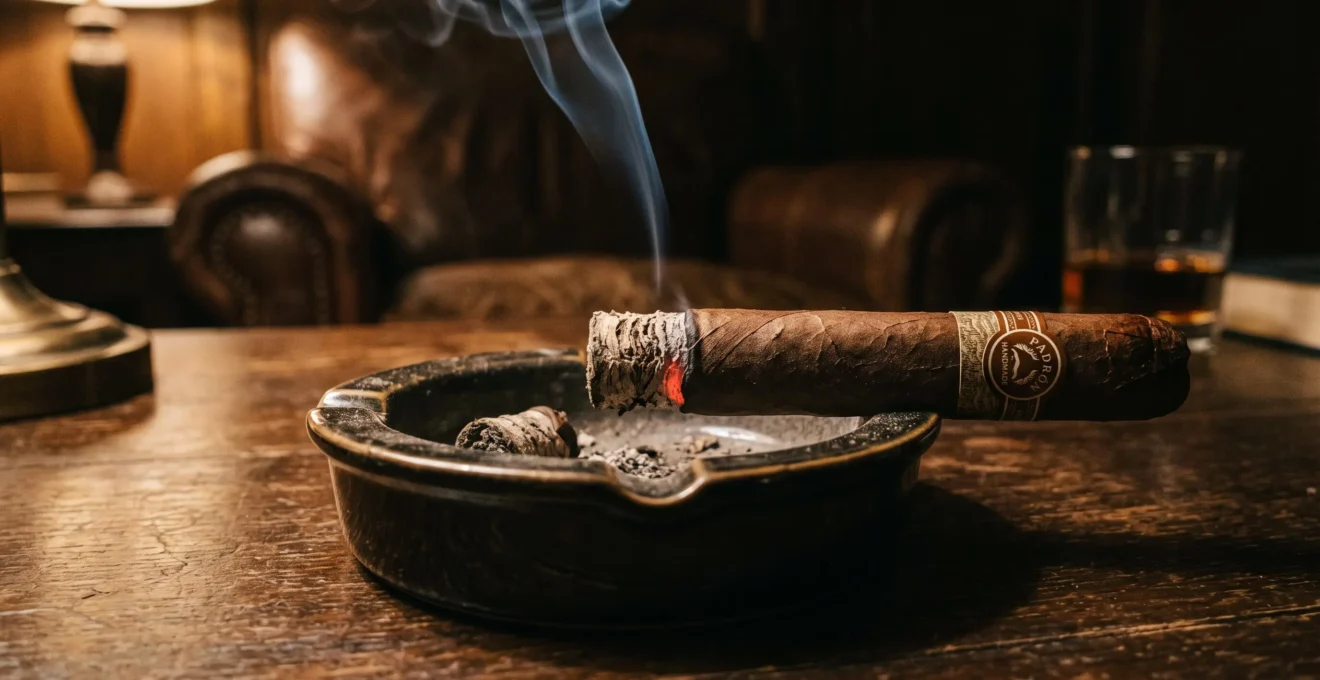
A cigar can begin with a convincing combination of cedar, roasted nuts and spice, only to become strangely empty halfway through. The wrapper still looks immaculate. The burn may even appear reasonably straight. Yet the flavour has lost its weight, leaving warmth and smoke without the depth promised by the opening draws.
Filler tobacco is central to this change because it forms the cigar’s internal structure and supplies much of the material consumed throughout the smoke. Its leaf varieties, density, distribution and moisture condition influence how combustion develops. The wrapper contributes to the sensory experience, but its appearance cannot reveal those internal characteristics.
Not every quiet middle third indicates poor blending. A deliberate transition towards milder tobacco, excess humidity, an irregular bunch or smoking too quickly can produce superficially similar sensations. Distinguishing these possibilities requires observing the draw, temperature, burn line and flavour together.
Understanding those signals makes it easier to judge whether a cigar’s middle third is behaving as designed or revealing a correctable problem.
What determines the character of a cigar’s middle third?
- Filler composition matters: ligero, viso, seco and volado contribute different combinations of body, aroma and combustion characteristics.
- Construction and moisture matter: a loose bunch, concentrated plug or poorly conditioned filler can change airflow and obscure flavour.
- Diagnosis comes before correction: compare repeated smoking experiences, draw resistance and burn behaviour before changing storage or using a draw tool.
- Why Does the Middle Third Change So Much When the Wrapper Looks the Same?
- How to Use Draw Resistance as a Clue to Filler Density in the First 15 Minutes?
- Blend Design or Storage: Which Usually Causes a Hollow Middle Third?
- The Draw-Tool Mistake That Disturbs Filler and Creates Hot Spots
- When Should You Dry-Box a Cigar for 2 Hours to Improve Filler Combustion?
- Why Does Binder Porosity Decide Whether the Cigar Tunnels or Canoes?
- Which Matters More for Smoothness: Lower Primings or Upper Primings When You Smoke After Dinner?
- Why Do Cultivated Tobacco Leaves From the Same Farm Taste Different After 12 Months of Storage?
Why Does the Middle Third Change So Much When the Wrapper Looks the Same?
The middle third changes because the burning conditions inside a cigar evolve even when its wrapper remains visually unchanged. Filler leaves determine much of the internal airflow, combustible material and blend composition. As the ember advances, differences in tobacco distribution, accumulated moisture and smoking temperature can alter flavour intensity without producing an obvious external change.
A premium handmade cigar usually contains three structural components: a wrapper, a binder and a filler bunch. The wrapper is the outermost leaf and contributes aroma and flavour. The binder contains the bunch, while the filler provides the principal internal mass of tobacco.
The construction process matters because leaves vary naturally in thickness, moisture, elasticity and density. According to Tobacconist University‘s explanation of cigar bunching, manufacturers use tobacco weight and blend proportions to help control consistency. Excess material can restrict the draw, while insufficient material can leave the bunch underfilled.
Inside a long-filler cigar, tobacco leaves generally extend lengthwise. The burning region advances along these leaves rather than encountering a completely new, separate mixture at every centimetre. However, leaf placement, irregularities within individual leaves and changing thermal conditions mean the composition burning at any moment is not necessarily identical.
Blenders can also design flavour development intentionally. Cigar Aficionado‘s discussion of construction and flavour transitions describes how cigar construction can influence which tobaccos contribute throughout the smoke.
That supports the possibility of deliberate transitions, but not a universal rule that every blend becomes stronger in its middle third.
Consider two hypothetical cigars with indistinguishable wrappers. One contains a consistently distributed combination of aromatic and fuller-bodied tobaccos. The other has an unevenly compressed bunch with a relatively open internal channel. The first might develop gradually; the second might burn faster through part of its filler and lose balance.
The middle third often exposes such differences because the smoker is no longer experiencing the initial lighting conditions. Heat transfer, condensation and the established burning pattern can influence the result. It would nevertheless be inaccurate to assume that maximum heat or moisture always occurs at this precise point.
The practical question is whether the change arrives gradually with balanced combustion or coincides with an unexpected shift in resistance, temperature or burn shape. Those observations lead naturally to the draw.
How to Use Draw Resistance as a Clue to Filler Density in the First 15 Minutes?
Draw resistance offers an early clue to how tightly the filler has been bunched, although it cannot measure density directly. An unusually open draw can suggest loose packing or an internal air channel; excessive resistance may indicate compressed tobacco or moisture-related swelling. The first 15 minutes provide a convenient observation period, not a scientifically established diagnostic deadline.
Start before lighting. Hold the cigar gently and move your fingers along its length, applying only enough pressure to detect obvious changes in firmness. A well-constructed cigar need not feel perfectly uniform, but conspicuous soft areas or hard concentrations are worth remembering.
Do not squeeze forcefully or twist the cigar to investigate a suspected plug. That can damage the wrapper or disturb a bunch that was initially sound.
Once the cigar has been cut, a gentle pre-light draw provides a useful baseline. After lighting, observe how much effort produces a comfortable amount of smoke.
| Draw sensation | Possible filler condition | What to check next |
|---|---|---|
| Very open | Loose bunching, an oversized cut or an internal channel | Fast combustion, unusually warm smoke and soft spots |
| Balanced | Reasonably consistent airflow through the bunch | Flavour delivery and whether the burn remains regular |
| Firm | Dense bunching, a narrow cut or elevated moisture | Smoke output, persistent hard spots and difficulty keeping the ember established |
A firm draw is not automatically defective. Some formats naturally offer more resistance, while a larger opening at the head can make the same cigar feel considerably easier to smoke.
The most informative observation combines several clues. An exceptionally easy draw, a noticeably soft section and a rapidly advancing burn line together strengthen the suspicion of an underfilled area. None of those observations alone proves the cause.
Early assessment is useful because the original bunch has not yet been extensively altered by heat, ash formation or attempts to correct the burn. Nevertheless, density-related problems can emerge later, so a cigar that performs well initially has not automatically passed every construction test.
A five-step filler assessment
- Inspect the unlit barrel: note any visible swelling, cracking or unusual deformation. Record one short description.
- Check firmness gently: identify any distinct soft or hard section. Record its approximate position.
- Establish a draw baseline: classify the resistance as open, balanced or tight after cutting. Record the classification.
- Observe the initial burn: note whether the burn line stays broadly even during the first part of the smoke. Record any deviation.
- Compare with the middle third: document changes in draw, warmth and flavour. Produce a brief comparison of initial and later performance.
If the same cigar format repeatedly feels balanced at the beginning but becomes flat halfway through, the next step is to distinguish a characteristic of the blend from the condition in which the cigar has been stored.
Blend Design or Storage: Which Usually Causes a Hollow Middle Third?
Neither blend design nor storage can be called the usual cause of a hollow middle third without examining the cigar and the consistency of the problem. A repeated, similar transition across properly conditioned examples suggests an inherent blend characteristic. An isolated failure, particularly with abnormal draw or combustion, makes storage and individual construction more plausible explanations.
The first diagnostic distinction is between repeatability and variation. If several cigars of the same vitola from one box produce a similar quiet middle, the pattern may reflect the intended balance of tobaccos. It may also reflect shared storage conditions or a batch-level construction issue.
By contrast, one cigar that suddenly loses flavour while its companions perform normally deserves closer examination for localised density or moisture problems.
Humidity offers several plausible mechanisms. Tobacco exchanges moisture with its surroundings, and its outer and inner layers do not necessarily condition at identical rates. Tobacconist University’s cigar preservation recommendations explain that excess moisture can swell the tobacco, interfere with airflow, mute flavour and contribute to uneven combustion.
Too much moisture can therefore produce a middle third that feels sour, difficult to keep alight or unexpectedly restricted. Repeated relighting may further disturb the flavour.
Insufficient moisture creates a different risk. Dry tobacco and a brittle wrapper can alter how readily the cigar burns. A cigar that becomes unusually warm while offering little perceived flavour may have a conditioning problem, although that sensory combination is not a definitive test of under-humidification.
| Observation | More plausible explanation | Important limitation |
|---|---|---|
| Similar, gradual middle-third transition across several cigars | Blend character or a shared production characteristic | Shared storage can produce a repeated problem |
| Muted flavour, repeated relights and restricted draw | Excess moisture or dense construction | Resistance alone cannot separate the causes |
| Sudden warmth, fast combustion and irregular ash | Dryness, loose filler or smoking cadence | Several causes can occur together |
| One cigar differs markedly from others in the box | Individual construction or conditioning variation | One observation cannot identify the exact fault |
Time introduces another variable. A recently rolled cigar may change during post-production conditioning as moisture redistributes and the blend settles. Additional rest can sometimes improve integration, but it is not a reliable cure for a fundamentally unbalanced recipe.
For a fair comparison, assess another cigar of the same format after stable storage, keeping the cut and smoking pace reasonably consistent. If the same pattern remains, repeated corrective interventions are less likely to be useful.
Once an individual obstruction is suspected, however, it is tempting to reach immediately for a draw tool. That intervention can create another variable and complicate the diagnosis.
The Draw-Tool Mistake That Disturbs Filler and Creates Hot Spots
The principal draw-tool mistake is forcing a piercer deeply into the cigar or twisting it aggressively through the filler. Instead of merely relieving an obstruction, this can displace leaves, compress adjacent tobacco and create an artificial airflow channel. The resulting uneven resistance and combustion may turn a previously firm draw into a hot, irregular middle third.
A handmade filler bunch relies on the relationship between individual leaves and the spaces separating them. Air needs a route through the cigar, but creating a large open passage is not equivalent to improving the original construction.
If a tool pushes tobacco outward, it may leave a relatively open centre surrounded by compressed material. During smoking, the disturbed areas can burn differently, potentially encouraging tunnelling or localised overheating.
That is a mechanical explanation rather than proof that every use of a draw tool produces hot spots. Outcomes depend on the construction, the location of the restriction and how extensively the filler is disturbed.
Before intervening, distinguish a genuinely obstructed draw from a merely firm one. A cigar that produces adequate smoke and consistent flavour with moderate resistance may not need correction. A severe obstruction produces little smoke despite reasonable drawing effort.
For an unlit cigar, first check whether the cut is excessively narrow and whether the cigar appears over-humidified. Those possibilities should be considered before physically altering the bunch.
If assistance is still appropriate, minimal, shallow intervention presents less opportunity for disruption than repeatedly pushing and twisting a tool deep inside. Check resistance gently after each adjustment and stop when a usable draw returns.
Once the cigar is burning, inserting a tool becomes less predictable. It can disturb heated material and ash, while continuing to pull hard on the cigar may intensify combustion. A more conservative response is to reduce puff frequency and observe whether the burn stabilises.
Heat cannot be relied upon to restore displaced leaves to their original arrangement. If the internal damage is substantial, the cigar may remain uneven despite a slower cadence.
A cigar that feels heavy and damp rather than mechanically obstructed raises a different question: whether temporary moisture adjustment is more appropriate than altering its structure.
When Should You Dry-Box a Cigar for 2 Hours to Improve Filler Combustion?
Dry-boxing may be worth considering when a cigar appears over-humidified, draws with difficulty, repeatedly goes out or produces muted, unpleasant flavours. Two hours is only an illustrative starting point, not a validated treatment duration. The result depends on ambient relative humidity, cigar dimensions and initial conditioning, while the inner filler may change much more slowly than the wrapper.
Dry-boxing means temporarily placing a cigar away from its normal humidified storage environment, typically in a suitable unhumidified container. Its purpose is to allow some moisture to escape before smoking.
That process can change surface conditions and may help a cigar light or burn more readily. It does not rearrange tightly packed filler, remove a physical plug or correct an unbalanced tobacco recipe.
The earlier storage guidance establishes an important constraint: moisture moves between the environment and tobacco surfaces before the internal leaves fully equilibrate. Consequently, a short dry-box session should not be described as a reliable method for drying the entire filler bunch evenly.
The practical decision depends on symptoms.
- Consider a brief conditioning adjustment when the cigar feels excessively moist, struggles to stay lit and exhibits muted flavour with heavy resistance.
- Avoid using dry-boxing as a default remedy when the cigar already burns cleanly, draws freely and simply delivers a mild middle third.
- Reassess the approach if the wrapper begins feeling brittle or shows signs of cracking.
For example, a smoker might take an unusually damp-feeling cigar from a humidor and assess its condition after a short period in a clean, dry container. This is a hypothetical diagnostic scenario, not an experimentally validated two-hour protocol.
At the two-hour point, environmental conditions could produce very different results. A cigar exposed to relatively dry indoor air may lose surface moisture faster than one resting in a humid room. Neither observation provides an exact measurement of moisture in the centre of the bunch.
Rapid moisture loss also carries a cost. A wrapper can become fragile before the internal filler has adjusted sufficiently. Cracking, splitting and an increasingly hot burn are reasons to avoid extending the process indiscriminately.
For regular storage, stable conditions and adequate equilibration are more dependable principles than repeated last-minute adjustments. The practical humidity ranges discussed by Tobacconist University are guidance rather than universal requirements for every blend.
If moisture adjustment leaves the cigar burning irregularly, the interaction between filler packing and the binder deserves closer attention.
Why Does Binder Porosity Decide Whether the Cigar Tunnels or Canoes?
Binder porosity can influence how air, moisture and heat interact with a cigar’s filler, but it does not independently decide whether tunnelling or canoeing occurs. Tunnelling develops when the inner tobacco burns ahead of the surrounding material. Canoeing occurs when one side advances faster than the other. Filler density, leaf arrangement, moisture and lighting conditions also contribute.
The binder is the tobacco leaf enclosing the filler bunch beneath the wrapper. Its primary construction function is to hold that bunch together in a stable shape, helping preserve the intended relationship between the internal leaves.
Like other tobacco leaves, binder material varies in thickness, elasticity, vein structure and physical characteristics. Those differences can influence the cigar’s structure and combustion, although a precise causal relationship between binder porosity and individual burn defects cannot be inferred merely from observing a finished cigar.
Tunnelling typically appears as a hollow or recessed burning core, with surrounding material lagging behind. Smoke can become hotter or less balanced because the exposed burning surface no longer behaves as intended.
Canoeing produces a different appearance: a sloping burn line, with one flank consuming tobacco more quickly. Uneven ignition, localised moisture differences or construction irregularities can all contribute.
A hypothetical cigar illustrates why both layers matter. Imagine a tightly packed filler bunch surrounded by a binder containing a relatively permeable region. If local airflow favours one passage, uneven combustion might develop. Yet the same visible defect could arise from a density gap in the filler itself.
That uncertainty matters when choosing a correction. A modestly uneven burn may settle without intervention. Repeatedly applying flame can overheat the surrounding tobacco and make the sensory imbalance worse.
When correction is needed, gently warming the slower-burning external area may help an uneven edge catch up. For canoeing, direct attention towards the lagging side rather than repeatedly heating the already advanced side.
With tunnelling, cautious re-lighting around an under-burned outer edge may sometimes restore a more even front. However, a deep internal channel or severely damaged bunch may not respond reliably.
Excessive moisture and persistent structural defects should not be treated by ever more aggressive flame application. When repeated corrections achieve little, the cigar itself may be the limiting factor.
Even in a cigar that burns evenly, the composition of the filler still shapes perceived strength. This becomes particularly noticeable when choosing between aromatic lower primings and fuller-bodied upper leaves.
Which Matters More for Smoothness: Lower Primings or Upper Primings When You Smoke After Dinner?
Neither lower nor upper tobacco primings guarantee a smoother after-dinner cigar. Lower leaves generally contribute milder characteristics and dependable combustion, while upper primings such as ligero tend to supply more strength and body. Smoothness depends on the balance, fermentation and placement of these tobaccos, rather than their position on the plant alone.
Priming refers to the position and harvesting of leaves from different levels of a tobacco plant. Leaf position influences sunlight exposure, thickness and chemical development, which in turn affect how blenders select tobacco for different purposes.
The traditional categories do not represent rigid or universally identical classifications across every growing region.
| Priming | Typical characteristics | Contribution to the blend |
|---|---|---|
| Volado | Lower leaves, relatively mild | Combustion support and lighter tobacco character |
| Seco | Lower-region leaves, often thinner and aromatic | Aroma, balance and dependable burning |
| Viso | Intermediate position and characteristics | Body, flavour, aroma and combustion balance |
| Ligero | Upper leaves, generally thicker and stronger | Strength, body and richer tobacco character |
These distinctions are explained in Tobacconist University’s explanation of tobacco primings, which identifies complementary functions for ligero, viso, seco and volado.
The after-dinner setting adds an individual sensory variable. A rich meal or accompanying drink may change how a smoker perceives subtle aromas, but the available sources do not establish that eating makes seco-driven cigars objectively thin or that ligero-heavy blends necessarily become smoother.
Some experienced smokers may prefer a more substantial cigar after a meal. That preference should be distinguished from a demonstrable change in tobacco chemistry or combustion.
Ligero also presents a construction challenge. Its thicker leaf generally burns less readily than lighter combustion-oriented tobaccos, so its placement within the bunch matters. A high proportion of ligero without complementary leaves can compromise the balance between draw, burn and flavour.
For someone who values a flavourful middle third, balanced richness is a more useful selection criterion than maximum advertised strength. Descriptions mentioning well-integrated body, aromatic complexity and carefully matured tobacco can provide clues, but these remain qualitative assessments.
Aged ligero may be described as mellow or refined, yet age alone cannot guarantee smoothness. Fermentation quality, storage and the complete blend remain important.
That leads to an easily overlooked point: two leaves with the same priming designation can still behave differently after processing and storage, even when they come from the same farm.
Key takeaways before judging an aged filler blend
- Record the cigar’s original flavour and burn pattern before assuming that later storage has changed it.
- Distinguish tobacco maturation from humidity adjustment: they involve different processes and do not produce interchangeable results.
- Judge whether ageing has improved integration, rather than expecting it to correct missing body or an uneven bunch.
Why Do Cultivated Tobacco Leaves From the Same Farm Taste Different After 12 Months of Storage?
Tobacco leaves from the same farm can taste different after 12 months because they may have started with different primings, field conditions, harvest dates and fermentation histories. Storage then changes their condition and sensory character according to moisture, temperature and prior processing. Twelve months is not a fixed maturation threshold, and leaves do not necessarily develop at the same rate.
A farm is not a uniform growing environment. Soil characteristics, drainage, exposure and plant development can differ across individual fields. Leaves harvested from the upper part of a plant also begin with different physical characteristics from those taken lower down.
Harvesting and curing introduce further differences. Two leaves classified within the same broad priming group may have experienced different ripeness, handling or curing conditions before entering fermentation.
Fermentation is particularly relevant to flavour development. It helps transform raw cured tobacco and reduce undesirable characteristics before the leaves are incorporated into a premium cigar. The eventual result depends on the starting material and how processing is managed.
Subsequent ageing and storage can further influence perceived harshness, aroma and integration. However, it would be misleading to claim that every bale undergoes a predictable reduction in specific compounds over precisely 12 months without analytical measurements.
Moisture distribution is another important distinction. A tightly packed bale and a finished cigar have different physical structures, so their conditioning behaviour cannot be assumed to be identical.
A cigar stored for several months may smoke differently from an example assessed shortly after purchase. Such changes might reflect genuine maturation, improved moisture equilibrium or simply variation between individual cigars.
The distinction can be explored through a hypothetical comparison. Suppose two cigars of the same vitola initially share a slightly sharp opening and a muted middle. One is assessed immediately, while the other is stored under stable conditions before a later assessment. If the rested cigar seems more integrated, that observation suggests a change in its smoking character, but does not identify which internal chemical or moisture process caused it.
Ageing can refine a blend without redesigning it. It cannot add tobacco leaves that were never included, change their priming proportions or repair an existing physical channel through the bunch.
Consequently, a consistently mild middle third may remain mild after further rest, even if its flavour becomes less rough. There is no guarantee that waiting will turn it into a richer or stronger experience.
For the next cigar, make a simple comparison between the opening and middle third: note draw resistance, burn regularity, temperature and flavour character, then compare those observations with another properly conditioned example. Consistent notes are more informative than an isolated disappointing smoke, particularly when deciding whether the blend itself suits your preferences.
Can a cigar have a perfect burn line but still taste hollow?
Yes. A straight burn line indicates reasonably even external combustion, but it does not demonstrate that the filler offers the flavour intensity a smoker expects. A deliberately mild blend, personal sensory perception or differences in tobacco composition may produce a quiet middle third without an obvious burn defect.
Does a larger ring gauge automatically produce a richer middle third?
No. A larger ring gauge gives a blender space to incorporate and arrange different tobaccos, but it does not guarantee stronger flavour. Leaf selection, proportions, construction and smoking conditions remain important. Ring gauge also changes airflow and the physical amount of tobacco being consumed.
Should a cigar be relit immediately when its middle third becomes bland?
Not when the cigar is still burning normally. Relighting is a response to an extinguished or inadequately burning ember, not a guaranteed remedy for weak flavour. If the cigar remains alight, observe the draw and burn behaviour before attempting any correction. Unnecessary heating may introduce additional harshness.
Can two cigars from the same box have different filler density?
Yes. Handmade cigar production involves natural variations in leaf thickness, dimensions and moisture. Although bunching and weight controls aim to improve consistency, individual cigars can differ in internal compression and airflow. Differences between sticks should not automatically be attributed to the blend recipe.
Will keeping a hollow-tasting cigar in a humidor for another year make it stronger?
Not necessarily. Additional rest may alter perceived smoothness and flavour integration, but it cannot increase the original proportion of ligero or repair an underfilled bunch. A consistently mild middle third may remain mild. Since tobacco smoke carries serious health risks, perceived smoothness should not be confused with reduced harm.