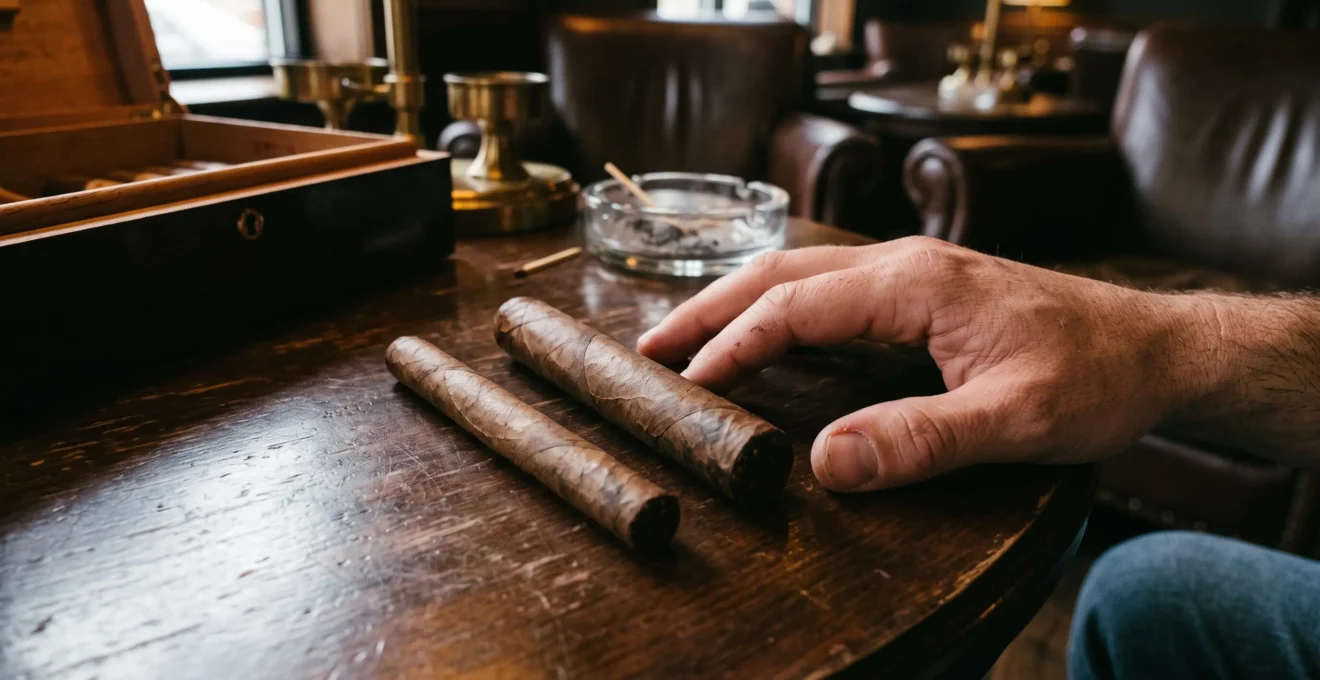
A 56-ring-gauge cigar can seem noticeably smoother than a slender cigar from the same range, even when both carry the same blend name. That difference does not necessarily mean the thicker cigar contains weaker tobacco. Ring gauge changes the physical construction of a cigar, the balance between its wrapper and filler, and potentially the way smoke moves through it.
For UK cigar buyers comparing vitolas, the distinction matters because flavour intensity, nicotine exposure and smoking duration are not interchangeable measurements. A thick cigar may produce substantial smoke without delivering the sharp initial sensations associated with a thinner format. Equally, a slim cigar can taste peppery without necessarily containing more nicotine.
The most useful comparison considers diameter, length, tobacco composition, draw, conditioning and smoking behaviour together. These variables help explain why two cigars marketed under one blend can deliver different experiences, and why judging either format during its opening minutes can be misleading.
Thick versus slim cigar ring gauges: the essentials
- Ring gauge changes flavour balance: thicker formats generally contain more filler relative to wrapper, while slimmer cigars can emphasise wrapper characteristics.
- Milder taste does not mean lower nicotine exposure: perceived smoothness cannot establish chemical strength or total smoke emissions.
- Match the format to the session: compare length alongside diameter, preserve a clean draw and avoid increasing puff frequency to hurry a large cigar.
- Why Does a Thick Ring Gauge Spread Flavour Out Instead of Hitting Hard Early On?
- How to Cut a 56 Ring Gauge Cleanly Without Creating a Tight Draw?
- Thick or Slim Vitola: Which Is Better if You Only Have 40 Minutes?
- The « Feels Cool So Puff Faster » Mistake That Ruins Thick Cigars After 35 Minutes
- Where Should You Place Thick Cigars in Your Humidor for Even Conditioning Over 30 Days?
- Why Do Slim Cigars Concentrate Pepper on the Tongue Faster?
- How to Cut in One Motion to Avoid Wrapper Splits on 52 to 60 Ring Gauges?
- Why Do Slender Cigar Shapes Hit Harder in the First 10 Minutes Than Robustos?
Why Does a Thick Ring Gauge Spread Flavour Out Instead of Hitting Hard Early On?
A thick ring gauge can taste milder because increasing the cigar’s diameter changes the proportion of wrapper tobacco to filler and can alter airflow and smoke delivery. The resulting flavour balance may feel rounder or less sharply defined. However, there is no established rule that wider cigars produce cooler smoke, lower nicotine exposure or weaker flavour.
Ring gauge measures cigar diameter in sixty-fourths of an inch. A 56-ring-gauge cigar is therefore wider than a 42-ring-gauge cigar, regardless of their lengths. This geometric difference changes how much tobacco can fit into a cross-section and how the manufacturer distributes wrapper, binder and filler leaves.
The distinction matters because a cigar’s wrapper and filler need not contribute the same flavour characteristics. As explained in Cigar Aficionado’s explanation of wrapper, binder and filler flavour, larger formats generally give the filler blend greater relative influence, whereas the wrapper can have greater proportional influence in slimmer vitolas.
This means that two sizes carrying the same blend name do not necessarily contain identical tobacco quantities or exactly the same proportions of each component. Manufacturers may adjust the internal construction to preserve a recognisable flavour profile across formats.
Airflow adds another variable. Draw resistance depends on more than diameter: bunch density, leaf arrangement, moisture and the opening at the head also matter. A larger cigar is not automatically easier to draw.
The idea that smoke becomes milder simply because the same aromatic compounds are distributed over a larger area of the palate is not established by the available evidence. Nor is the claim that a wider ember must burn at a lower temperature per unit of surface.
Perceived intensity is not a nicotine measurement. A smooth-tasting cigar may still produce substantial nicotine and other harmful emissions. Scientific research on cigar combustion has found that smoke emissions change as a cigar burns, making early flavour impressions an unreliable guide to the entire session.
The practical distinction is between tobacco composition, physical construction and subjective sensation. All three influence the experience, but none can be reduced to a simple thick-equals-mild formula.
How to Cut a 56 Ring Gauge Cleanly Without Creating a Tight Draw?
To cut a rounded 56-ring-gauge cigar cleanly, identify the shoulder, position a sharp cutter near the closed end and make a controlled cut without removing the entire cap. A double-bladed guillotine is a practical option. The objective is to create a sufficiently open passage while preserving the wrapper’s structural support.
The shoulder is the transition between the rounded head and the straight sides of the cigar. Cutting beyond this boundary can compromise the cap holding the wrapper in place.
For most conventional rounded heads, approximately 2 mm from the end is a useful starting reference, although the correct position depends on the shape of the cap. It is not a universal measurement for every 56-ring-gauge cigar.
The distinction is especially important with prominent shoulders or unusually shaped heads, where the physical cutting line may differ from that of a conventional robusto.
According to Cigar Aficionado’s cutting and lighting instructions, the aim is to provide an ample, smooth opening without damaging cigar construction. The guidance also explains why a sharp double-bladed cutter can help reduce wrapper tearing.
Once cut, the cigar can be checked for airflow before lighting. If resistance seems unusually high, examine whether the opening is restricted or the cigar itself feels excessively firm. A further small adjustment may be appropriate when enough cap remains, but repeatedly removing tobacco risks damaging the wrapper.
There is also no categorical reason to avoid a V-cutter on a thick cigar. A properly designed V-cut can create a substantial opening and sometimes an exceptionally open draw. A punch creates a different opening geometry, but its suitability depends on the punch diameter and cigar construction.
Importantly, a difficult draw is not necessarily a cutting problem. Tightly packed filler, uneven bunching and excessive moisture can all contribute. Cutting deeper cannot reliably correct these conditions.
A correctly positioned cut protects the cigar’s structure; it does not guarantee unrestricted airflow through an incorrectly constructed or poorly conditioned cigar.
Thick or Slim Vitola: Which Is Better if You Only Have 40 Minutes?
For a 40-minute session, a shorter or slimmer vitola is often a more practical candidate than a long, thick cigar, but length matters as much as ring gauge. A 42–46-ring-gauge format may suit the available time, provided its dimensions are appropriate. Diameter alone cannot reliably predict how long any cigar will last.
A wider cigar contains a larger cross-sectional area of tobacco, assuming comparable internal construction. However, a short, thick cigar may still require less time than a long, slender one. Tobacco density, moisture, combustion characteristics and smoking behaviour further complicate duration estimates.
Consider this format comparison as a shopping guide rather than a laboratory prediction.
| Decision factor | Slim vitola, around 42–46 | Thick vitola, around 52–60 |
|---|---|---|
| Typical construction | Lower filler-to-wrapper proportion | Greater filler contribution relative to wrapper |
| Flavour character | Wrapper characteristics may stand out more | Filler characteristics may dominate more |
| Time suitability | Short examples may suit limited sessions | Short examples may also fit; check length |
| Draw | Depends on construction and opening | Depends on construction and opening |
| Interrupted session | Relighting can change flavour | Relighting can change flavour |
A common mistake is to select a large cigar and then increase puff frequency in an attempt to finish it within a fixed period. Smoking more intensively changes combustion conditions rather than simply making the experience proportionally shorter.
An experimental study of cigar smoking intensity and emissions investigated the effects of different puff frequencies, puff volumes and stages of consumption. Its findings included increasing nicotine and water emissions as cigars progressed, alongside effects associated with condensation and evaporation.
The research does not establish a preferred smoking duration for any particular ring gauge. It does show why smoking behaviour and consumption stage must be considered when assessing exposure.
Relighting deserves similar caution. Leaving a cigar extinguished for an extended period can result in stale or harsh flavours, but the available sources do not establish that thicker cigars universally suffer more than slender ones.
The best fit is a format whose expected duration suits the available time without pressuring the smoker to accelerate consumption. If the session must end early, there is no need to finish the cigar.
The « Feels Cool So Puff Faster » Mistake That Ruins Thick Cigars After 35 Minutes
A thick cigar that initially feels soft or smooth can become harsh when smoking intensity increases. More frequent or larger puffs change the burning conditions and may alter the smoke’s sensory character. The supposed turning point at 35 minutes is not universal: the effect depends on cigar construction, consumption stage and smoking behaviour.
The problem begins when smoothness is mistaken for insufficient strength. A smoker may respond by drawing more often, expecting the fuller flavour associated with a stronger blend.
However, sensory mildness is not a reliable measure of combustion intensity. A cigar can taste relatively restrained while still producing considerable smoke and nicotine emissions.
The experimental research discussed earlier provides an important distinction. Under its investigated conditions, smoke emissions changed with smoking intensity and with the proportion of cigar consumed. Nicotine and water emissions increased nonlinearly during consumption.
This does not establish that every cigar necessarily becomes bitter after 30–40 minutes. It also does not identify a scientifically validated puffing interval that prevents harshness.
Nevertheless, a change from balanced flavour to dryness, sharpness or bitterness is a useful observation. Before attributing it entirely to the blend, consider whether smoking behaviour has changed, the cigar is approaching its final portion, or its draw and combustion have become uneven.
Visible changes in the burning end may also indicate inconsistent combustion, although no single ash shape or ember profile provides a reliable diagnosis of smoke chemistry.
Some experienced smokers purge a cigar by gently expelling air through it. That technique may affect the immediate sensory experience, but the supplied research does not demonstrate that purging reverses overheating or removes accumulated toxic emissions.
Most importantly, deliberately drawing harder to compensate for a milder sensation is not a dependable way to assess a cigar’s strength. It changes the conditions being compared.
A reliable format comparison requires consistent observation across the session, not an attempt to force a thicker cigar to deliver the same initial intensity as a slimmer one.
Where Should You Place Thick Cigars in Your Humidor for Even Conditioning Over 30 Days?
Place thick cigars where humidor temperature and relative humidity remain stable, without direct contact with a humidification device or visibly damp surfaces. A central position may be practical in some humidors, but it is not universally superior. Thirty days can serve as an observation period, not a scientifically established conditioning requirement for a particular ring gauge.
A thick cigar contains a substantial quantity of tobacco within its larger cross-section. It is physically plausible that moisture equilibration may differ from that of a slimmer cigar, but the available manufacturer guidance does not quantify the difference or establish a fixed resting time.
For Cuban cigars, the official Habanos cigar storage recommendations specify 16–18 °C and 65–70% relative humidity.
These are manufacturer recommendations for Habanos, not universal specifications independently validated for every premium cigar produced worldwide.
Excessive humidity can interfere with smoking performance, while drying can make cigar flavour harsher. Maintaining stable storage conditions is therefore more defensible than intentionally reducing humidity to make a blend taste stronger.
A gentle examination of a cigar’s firmness may identify an obvious hard spot, softness or physical irregularity. However, touch cannot reliably measure moisture distribution between its surface and centre. A firm core and softer exterior are not definitive proof of uneven humidity.
For a cigar recently transferred between storage environments, monitor the humidor rather than relying on an arbitrary countdown. Note whether humidity and temperature readings remain stable and whether wrappers show visible signs of excessive dryness or moisture.
Five checks for a 30-day humidor conditioning review
- Record the starting conditions: note the date, humidor temperature and relative humidity to establish a baseline.
- Inspect the storage position: confirm that the cigars are not touching the humidification element or a visibly damp surface; record any repositioning.
- Monitor stability: keep a dated log of temperature and humidity readings during the observation period.
- Check physical condition: note any visible wrapper cracks, unusual dampness or obvious irregularities without excessive handling.
- Review after 30 days: compare observations with the starting record and identify whether storage conditions have remained stable, without assuming that internal moisture equilibration is complete.
The purpose of this review is to identify storage problems and changes over time. It is not a laboratory test of internal tobacco moisture or a guarantee of improved flavour.
Consistent humidity and temperature provide a sounder basis for comparing formats than trying to intensify a cigar by deliberately drying its wrapper.
Why Do Slim Cigars Concentrate Pepper on the Tongue Faster?
Slim cigars can seem more peppery because their wrapper contributes a relatively greater share of the tobacco construction, potentially emphasising spicy characteristics. Draw behaviour and the specific leaves used may also influence perception. However, there is no direct evidence in the supplied sources that slender cigars deposit the same quantity of pepper-related compounds onto a smaller area of the tongue.
The most useful starting point is construction. A slender vitola has less room for filler tobacco relative to its outer leaf than a substantially thicker format. If the wrapper carries prominent pepper, cedar or earthy characteristics, those notes may become more noticeable.
This is not a guarantee of increased spice. A mild wrapper can give a slender cigar a very different profile from one made with a stronger, more assertive leaf.
Another consideration is the internal arrangement of tobacco. A smaller diameter does not necessarily mean that the identical filler blend is compressed into a narrower cylinder. Manufacturers may select different leaf proportions or bunching methods to achieve their intended flavour and draw characteristics.
The proposed explanation involving flavour compounds being deposited over a smaller surface of the tongue remains speculative. The available evidence does not quantify such deposition or demonstrate that narrow smoke passages consistently produce higher smoke temperatures.
Therefore, a slim cigar’s pronounced pepper note should not automatically be interpreted as increased nicotine strength, faster nicotine uptake or hotter combustion.
When two vitolas from the same cigar line taste different, compare their wrapper characteristics and any available manufacturer information about internal construction. The named blend is relevant, but it does not prove identical leaf proportions.
Consumer tasting impressions can help describe the difference, provided they are recognised as subjective rather than precise measurements of chemical exposure.
This distinction also explains why choosing a thicker format to avoid pepper may change the overall flavour balance without necessarily reducing the cigar’s underlying nicotine content.
How to Cut in One Motion to Avoid Wrapper Splits on 52 to 60 Ring Gauges?
To reduce the risk of wrapper splits on a 52–60-ring-gauge cigar, use a sharp cutter appropriately sized for the head, position it squarely near the shoulder and make one smooth, decisive cut. The blade should sever the cap rather than crush the tobacco. Correct positioning and blade condition matter more than ring gauge alone.
A premium cigar wrapper is a delicate tobacco leaf held under tension around the bunch. Damage may occur when the cutter is blunt, poorly aligned or positioned too far beyond the cap.
A wide head creates a practical equipment consideration: the cutter must open sufficiently to accommodate the full diameter without squeezing the cigar before the blades engage.
It does not follow that thick cigars intrinsically split more frequently than slender ones. The available sources do not establish comparative wrapper-failure rates by ring gauge.
For a rounded head, first identify the shoulder and confirm that the blades will remove only the required portion of the cap. A double-bladed guillotine can provide balanced cutting action, provided both blades are sharp and the cutter is suitably sized.
Align the tool, stabilise the cigar gently and complete the cut with continuous, even pressure. An uncertain movement or repeated squeezing can increase the opportunity for leaf distortion.
Cigar scissors offer another option, especially when their design comfortably accommodates a large head. Their suitability depends on blade quality, accurate alignment and controlled handling. There is no established rule that scissors become preferable at 58 ring gauge.
If a wrapper appears unusually dry or brittle, inspect its condition before cutting. Stable humidor storage is preferable to attempting to compensate for dryness through greater cutting force.
When the cap has been removed, examine whether the remaining wrapper is secure. If the leaf begins to lift, cutting progressively deeper is unlikely to restore the original construction.
Protecting the wrapper matters because the cutting process should preserve the cigar’s intended construction rather than introduce a new reason for uneven airflow or mechanical damage.
Key takeaways before choosing your next vitola
- Compare the complete cigar: diameter, length, wrapper characteristics and filler composition together provide more useful information than ring gauge alone.
- Do not equate sharp flavour with nicotine strength: a peppery early impression and total chemical exposure are different considerations.
- Judge the full experience: the opening minutes cannot reliably predict how smoke emissions or perceived flavour will evolve later.
Why Do Slender Cigar Shapes Hit Harder in the First 10 Minutes Than Robustos?
Slender cigars may feel stronger during their opening minutes because wrapper characteristics can be more prominent and their flavour balance differs from that of thicker robustos. However, the first 10 minutes are not a scientifically established period of accelerated nicotine delivery for slim cigars. Apparent intensity depends on tobacco composition, dimensions, construction and individual perception.
A thin cigar may deliver an immediate impression of pepper, earth or other pronounced characteristics. If those notes are associated with strength by the smoker, the cigar may seem more powerful than a larger example from the same range.
The distinction between flavour intensity and nicotine exposure is essential. A pronounced sensation does not prove that nicotine enters the body faster or that the cigar contains a stronger blend.
Nor does a larger ring gauge guarantee a slow progression of nicotine delivery. Tobacco quantity and the physical characteristics of the cigar vary across formats. The smoking-intensity study discussed earlier demonstrates that emissions can change as smoking progresses, but it does not provide a direct controlled comparison of nicotine uptake between lanceros and robustos.
Length further complicates the comparison. A slender but long cigar may have a different combustion progression from a short, thick robusto. Comparing their flavour after an identical number of minutes does not mean that the same proportion of each cigar has been consumed.
A practical buying decision can therefore start with three questions:
- Which flavour characteristics matter? Wrapper-forward spice and filler-led complexity are different potential preferences, not fixed outcomes of diameter.
- How much time is available? Check cigar length as well as ring gauge, rather than estimating duration from thickness.
- What information is available about the blend? A common product-line name does not establish identical leaf proportions or total nicotine content.
For a smoker who finds slim formats sharper than robustos, it is reasonable to investigate differences in wrapper influence and construction. For someone who finds large formats too restrained at first, selecting a more nicotine-rich blend solely to increase early intensity could lead to an unwanted experience later.
Neither flavour softness nor smoke temperature should be used as a proxy for safety. Cigar smoke contains harmful substances, and a smoother sensory experience is not evidence of reduced health risk.
When comparing vitolas before a purchase, check their dimensions and construction, consider the full intended session, and avoid treating the first few minutes of flavour as proof of nicotine strength. The most useful choice is an informed format comparison, not a search for a supposedly safer or weaker cigar based on diameter.
Does a higher ring gauge mean a stronger cigar?
No. A higher ring gauge describes a larger diameter, not a fixed nicotine concentration or flavour intensity. A wider cigar may contain more total tobacco when other dimensions and construction are comparable, but strength depends on the tobacco used and cannot be established from diameter alone.
Can two cigars from the same blend have different flavour profiles?
Yes. Manufacturers may adjust the proportions and arrangements of tobacco leaves across vitolas. The relative influence of wrapper, binder and filler also changes with format, meaning a shared blend name does not guarantee an identical sensory experience.
Is a 56-ring-gauge cigar always easier to draw than a 42?
No. Although diameter affects available space within the cigar, actual draw resistance also depends on tobacco packing, leaf arrangement, moisture, construction quality and the size of the opening at the head. A poorly constructed wide cigar can still have a restrictive draw.
Will storing a thick cigar for 30 days make it taste smoother?
Not necessarily. Thirty days is not a proven universal conditioning period for thick cigars. Appropriate temperature and humidity can help maintain cigar condition, but the available manufacturer guidance does not establish that every large-ring-gauge cigar becomes smoother after a particular number of days.
Does smoother cigar smoke contain less nicotine?
No such conclusion can be drawn from taste alone. Perceived smoothness reflects sensory characteristics, whereas nicotine exposure depends on tobacco composition, smoke emissions and smoking behaviour. Smooth smoke is not necessarily lower in nicotine or less harmful.