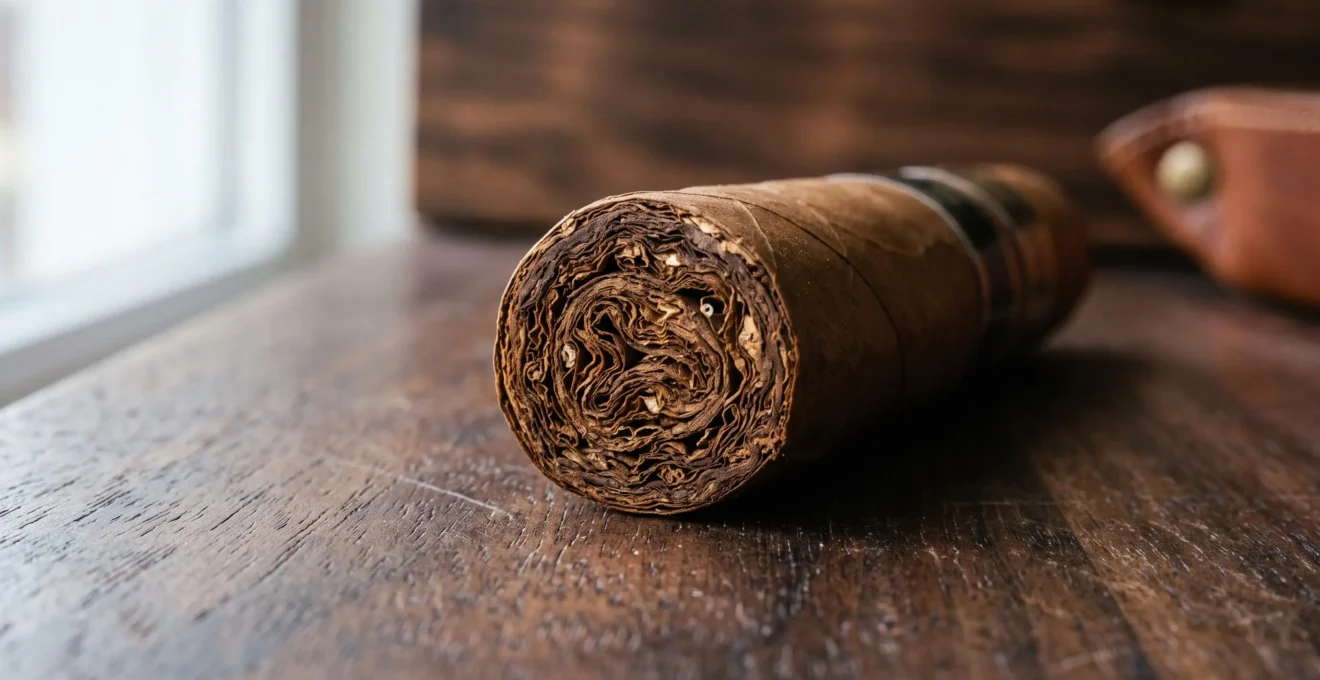
A cigar can have a flawless, silky wrapper and still develop a crooked burn line, a hollow tunnel through its centre or unexpectedly sharp flavours halfway through smoking. The cause may lie beneath the attractive outer leaf, where the binder holds the filler together and contributes to combustion.
Known as the capote, the binder is the structural tobacco leaf between the filler and wrapper. Its elasticity, thickness, arrangement and burning characteristics influence how the assembled cigar performs. Yet uneven burning is rarely explained by one layer alone. Filler density, moisture, initial lighting and puffing behaviour can produce similar symptoms.
For smokers troubleshooting an expensive cigar, the useful question is not simply whether the binder is defective. It is whether the observed combination of draw resistance, burn shape and flavour changes makes a binder-related problem more plausible than competing explanations.
Understanding those distinctions helps avoid unnecessary relights, premature changes to humidor settings and attempts to correct problems that cannot reliably be fixed once the cigar is lit.
Binder tobacco and uneven cigar burns: the essentials
- Construction matters beneath the wrapper: binder and filler arrangement affect combustion even when the exterior appears flawless.
- Burn patterns provide clues, not proof: canoeing, tunneling and changing draw resistance may result from several interacting causes.
- Diagnose before correcting: inspect firmness and airflow, consider storage conditions, and avoid repeatedly applying flame to a defect that will not improve.
- Why Does Binder Porosity Decide Whether the Cigar Tunnels or Canoes?
- How to Spot Binder-Driven Problems From the Cold Draw in Under 30 Seconds?
- Humidity Issue or Binder Issue: Which Is More Likely When One Side Won’t Catch?
- The Over-Touch-Up Mistake That Makes Binder Issues Worse and Flavour Bitter
- When Should You Rotate Boxed Cigars to Prevent Binder Moisture Gradients Over 30 Days?
- How to Do a 90-Second Pre-Light Check That Predicts Burn Problems Before You Commit?
- How to Use Draw Resistance as a Clue to Filler Density in the First 15 Minutes?
- Why Does Filler Tobacco Decide Whether the Middle Third Feels Rich or Hollow?
Why Does Binder Porosity Decide Whether the Cigar Tunnels or Canoes?
Binder porosity may influence how readily gases move through the tobacco surrounding the filler, but it does not independently decide whether a cigar tunnels or canoes. Both defects depend on the interaction between binder combustion, filler arrangement, moisture and smoking technique. A flawless wrapper cannot reveal whether those internal conditions are balanced.
The binder performs two important functions. It holds the filler bunch in shape before the wrapper is applied, and it becomes part of the burning tobacco structure. Its mechanical strength, elasticity and combustion characteristics therefore matter independently of appearance.
As explained in Tobacconist University‘s cigar bunching resource, the assembled bunch directly influences density, airflow, draw and combustion.
Leaf thickness, veins, overlapping sections and differences in tobacco structure may create non-uniform conditions around the filler. However, direct measurements establishing how a particular binder’s microscopic porosity determines a specific burn defect are not provided by the available professional sources. Porosity is consequently best treated as a possible contributing property rather than a definitive diagnosis.
Tunneling occurs when the cigar’s internal filler burns ahead of the surrounding binder and wrapper. The centre recedes while the outer tobacco remains comparatively unburned. Poor binder combustion can contribute, but infrequent puffing and other construction differences may also be involved.
Canoeing describes the opposite pattern of spatial imbalance: one side progresses faster than the other, leaving an angled burn line. Air pockets, uneven tobacco distribution or lighting technique can produce this appearance. A locally irregular binder may be involved, but the burn line does not establish which layer is responsible.
These patterns matter because uneven combustion can change which parts of the tobacco blend contribute to the smoke at a given moment. A cigar that initially tastes rounded may become sharper or less balanced later, although a flavour change alone does not identify the binder as the cause.
A thicker, more rustic-looking binder is not automatically inferior to a smooth-looking one. Strength and suitable combustion characteristics can matter more than visual refinement. Equally, thickness should not be assumed to improve the burn without evidence about the specific leaf and construction.
The practical distinction is between observing a pattern and proving its mechanism. A cold draw offers the next opportunity to gather clues, although it cannot reveal every combustion problem.
How to Spot Binder-Driven Problems From the Cold Draw in Under 30 Seconds?
A quick cold-draw inspection can identify excessive resistance, unusual looseness and uneven firmness before lighting, but it cannot reliably confirm a binder defect. The most useful approach combines a gentle draw with tactile and visual checks. Suspicious findings should guide closer observation rather than trigger an automatic judgment about the cigar’s construction.
The following 30-second routine is a practical screening method, not a scientifically validated binder test.
- First 10 seconds — assess the cold draw. After cutting the head, take a gentle, unlit draw. Air should pass comfortably without feeling severely restricted or unusually loose. Excessive resistance suggests an airflow restriction somewhere in the cigar, not necessarily in the binder.
- Next 10 seconds — check firmness. Lightly press along the barrel between thumb and fingers. Compare adjacent sections for unusually hard or soft areas without crushing the tobacco. A firm patch may suggest uneven bunching; a soft area may indicate a less densely packed region.
- Final 10 seconds — inspect the foot. Look at the exposed filler and surrounding tobacco. Notice conspicuous asymmetry, apparent gaps or concentrated bunching. Do not assume that a visible vein or ordinary binder overlap constitutes a defect.
A potentially useful clue is localisation. If a cigar feels consistently tight throughout, the overall bunching or moisture condition may deserve attention. If one short section feels distinctly different, a local construction irregularity becomes more plausible.
A rotation-dependent change in draw sensation might encourage closer inspection, but it is not a validated indication of a thick binder vein. The filler and other construction features can also influence resistance.
A good cold draw does not guarantee an even burn. Tobacco that permits comfortable airflow before lighting can still burn inconsistently because combustion introduces heat, changing moisture conditions and a moving ember front.
Tobacconist University’s tasting guidance supports inspecting appearance, firmness and pre-light resistance while treating those observations separately from performance after ignition.
The decision should therefore be proportionate. Comfortable airflow and consistent firmness provide no obvious reason for further intervention. A mild irregularity calls for observation. A severe obstruction may justify checking the cut or setting the cigar aside, but changing storage conditions should be based on evidence of a moisture problem rather than draw resistance alone.
If the cigar subsequently develops a one-sided burn, compare those observations with its moisture history before deciding whether the binder or storage conditions are more likely involved.
Humidity Issue or Binder Issue: Which Is More Likely When One Side Won’t Catch?
When one side of a cigar repeatedly fails to ignite, local construction becomes a reasonable possibility, but moisture cannot be ruled out from the burn pattern alone. Widespread tightness, poor ignition and difficulty sustaining combustion make conditioning worth investigating. Recurrent asymmetry after careful lighting makes a local structural irregularity more plausible, without proving a binder fault.
The distinction matters because adjusting an entire humidor to correct one problematic cigar may introduce new moisture imbalances without resolving the original defect.
For a practical comparison, consider three observations: how the cigar feels before lighting, how consistently its burn line deviates and whether other cigars stored under similar conditions behave the same way.
| Observation | Moisture-related possibility | Construction-related possibility |
|---|---|---|
| Difficulty keeping the entire foot alight | Excess moisture may hinder combustion. | Dense or uneven bunching may also interfere with burning. |
| One side repeatedly lags behind | Uneven conditioning remains possible. | Local binder or filler distribution deserves consideration. |
| Tight draw before ignition | Swollen, over-conditioned tobacco may contribute. | Excessively dense filler may restrict airflow. |
| Several cigars from the same box behave poorly | A shared storage condition is possible. | A shared production or construction issue is possible. |
| Problem improves after stable conditioning | Suggests moisture may have contributed. | Does not exclude an underlying construction difference. |
Premium cigars absorb and release moisture according to their environment. Their different layers do not necessarily reach a new equilibrium simultaneously, so a wrapper can feel properly conditioned while internal tobacco is still adjusting.
The Tobacconist University cigar preservation resource explains this gradual movement of moisture and the combustion difficulties associated with excessive conditioning.
Imagine, hypothetically, that several cigars in a recently delivered box burn inconsistently while previously stored cigars from the same humidor behave normally. That comparison would justify investigating acclimatisation and construction before changing the humidor’s settings.
Conversely, a single cigar that continues developing an angled burn despite a careful initial light may have a local structural irregularity. Neither repeated relighting nor the direction of the burn alone identifies a specific binder vein as the cause.
A comparison with another cigar from the same batch can add information, but it is not a controlled experiment. Several defective cigars could reflect shared manufacturing characteristics, transport conditions or storage history. There is no sound basis for equating the same-sided failure across a box with definitive proof of binder damage.
When testing another cigar, record whether the difficulty involves ignition, airflow or a repeating angled burn. A description of the actual symptom is more informative than immediately labelling the entire box defective.
Once a one-sided burn appears, the next decision concerns whether correction will improve the experience or simply introduce additional heat and harshness.
The Over-Touch-Up Mistake That Makes Binder Issues Worse and Flavour Bitter
Repeatedly touching up an uneven cigar can make the smoking experience harsher by repeatedly exposing lagging tobacco to concentrated heat. Although a small flame correction may restore the burn line, constant intervention cannot repair uneven internal construction. When the cigar repeatedly develops the same defect, further corrections may offer diminishing benefits.
Touching up means carefully applying flame to the tobacco that has fallen behind the advancing burn. It is different from relighting an entirely extinguished cigar.
One common mistake is treating every small deviation as an emergency. Minor irregularities can sometimes correct themselves as the ember progresses. Immediate intervention may therefore be unnecessary.
A second mistake is applying flame indiscriminately across the burning end. This can overheat tobacco that was already burning adequately, potentially changing flavour and increasing harshness without addressing the original imbalance.
According to Holt’s explanation of uneven cigar burns, canoeing and tunneling can arise from several causes, including construction, lighting and puffing habits. Its practical guidance favours limited, precise correction rather than indiscriminate heating.
It would be too strong to claim that every additional touch-up produces a measurable accumulation of tar that migrates into the draw. The supplied evidence does not demonstrate that specific mechanism. The observable concern is repeated heating, possible flavour deterioration and failure to correct the underlying problem.
A restrained correction hierarchy is more useful:
- Observe before intervening. Allow a minor deviation an opportunity to settle, while avoiding unusually rapid or aggressive puffing.
- Make one careful correction if necessary. If the slower side remains substantially unburned, apply flame precisely to that area rather than heating the entire foot.
- Reassess the result. If the same uneven pattern continues, recognise that further flame may not overcome the construction or conditioning issue.
- Stop trying to rescue an unrecoverable burn. Accept a modest cosmetic irregularity or discontinue the cigar if the draw and flavour remain unpleasant.
The trade-off is straightforward: restoring visual symmetry is not necessarily the same as improving flavour. A cigar with a slightly uneven burn but acceptable airflow may require less intervention than one repeatedly extinguishing.
It is also important not to force a rapid series of puffs in an attempt to keep the ember active. Aggressive puffing can itself contribute to uneven combustion.
If several cigars require similar intervention, examine their conditioning history before treating every burn line as an isolated manufacturing fault.
When Should You Rotate Boxed Cigars to Prevent Binder Moisture Gradients Over 30 Days?
There is no established universal requirement to rotate boxed cigars at a particular point during a 30-day period. Rotation may be worth considering when storage conditions are uneven, but stable humidity and gradual moisture equilibration matter more than following an arbitrary calendar. The binder’s moisture state cannot be determined reliably from wrapper softness alone.
Cigars are hygroscopic: tobacco exchanges moisture with its surroundings. Moisture enters and leaves through exposed surfaces, and changes take time to reach the inner layers.
This creates a practical complication after transport, rapid humidity changes or the introduction of cigars into a different storage environment. The wrapper can respond before all the internal tobacco has settled into a similar moisture condition.
It does not follow, however, that every binder is denser than its wrapper or that it consistently retains moisture for longer. Those relationships depend on the actual tobaccos and have not been quantified by the supplied preservation guidance.
Nor is it established that a moisture gradient specifically triggers canoeing in the middle third. Uneven internal conditioning is a plausible factor worth considering when combustion is inconsistent, not a confirmed explanation for a particular burn pattern.
Rather than rotating automatically, assess the box’s circumstances:
- Storage stability: Is the humidor maintaining a reasonably consistent environment?
- Recent movement: Have the cigars recently arrived from different storage or transport conditions?
- Box arrangement: Are some cigars positioned where airflow or moisture exposure might differ?
- Conditioning consistency: Do cigars from different positions show noticeable differences in firmness or cold-draw resistance?
For many premium cigars, professional guidance describes relative humidity around 65–70% as a commonly successful range, although preferences and tobacco characteristics vary. Some smokers use lower levels. These figures are not a guarantee of correct conditioning for every cigar.
Importantly, the time required to correct an internal moisture imbalance may range from days to weeks or longer, depending on its severity. Thirty days is therefore a convenient observation period rather than a guaranteed equilibration deadline.
Hypothetical example: examining a recently delivered box
Suppose a box arrives after exposure to different storage conditions. Cigars near its edges feel slightly different from those in its centre, while the outer wrappers all appear healthy.
Instead of immediately rotating every cigar, the owner monitors the humidor’s stability, compares a few positions and allows gradual conditioning. If differences persist, repositioning the cigars becomes a reasonable practical experiment. This scenario illustrates a decision process, not a validated rotation schedule.
Frequent handling is not necessarily beneficial. Excessive pressure and abrupt environmental changes can create additional problems, especially when wrappers are delicate.
The most useful outcome of storage monitoring is better information before lighting. That same principle can be condensed into a consistent pre-light inspection.
How to Do a 90-Second Pre-Light Check That Predicts Burn Problems Before You Commit?
A 90-second pre-light check can reveal obvious construction and airflow concerns before ignition, although it cannot predict every future burn problem. Examine the cigar’s shape and foot, compare firmness along its body, assess the cold draw and record any significant irregularities. The result is a practical risk assessment, not a guarantee of performance.
This routine extends the quicker cold-draw assessment by gathering several observations together. Its purpose is to distinguish ordinary cosmetic variation from findings that may materially affect airflow or combustion.
Begin with the head and foot. A generally consistent shape is reassuring, while a visibly irregular cut, pronounced deformation or obvious gap in the exposed tobacco deserves attention. A natural wrapper vein or visible binder seam, by contrast, is not sufficient evidence of faulty construction.
Next, gently examine the barrel. The goal is not to compress the tobacco into a different shape but to recognise large differences in firmness. A conspicuously hard section or unusually soft pocket may suggest uneven internal distribution.
Finally, assess the cold draw after cutting. Air should move through the cigar comfortably. Excessive restriction or unusual looseness can justify closer inspection, although neither automatically identifies the binder.
Your five-step, 90-second pre-light checklist
- Inspect overall shape — 15 seconds. Record one outcome: symmetrical, slightly irregular or visibly deformed.
- Examine the foot — 15 seconds. Note whether the exposed tobacco appears broadly consistent or shows an obvious gap or concentrated area.
- Check firmness — 20 seconds. Identify any distinct hard or soft section and record its approximate location.
- Assess the cold draw — 20 seconds. Classify resistance as comfortable, noticeably tight or unusually loose.
- Make a decision — 20 seconds. Record whether to proceed without concern, observe a specific irregularity or set aside a cigar with a serious unresolved problem.
These time allocations are an organisational aid, not research-established diagnostic thresholds. An experienced observer may notice concerns more quickly, while an unfamiliar construction may warrant more careful examination.
The inspection also has an important limitation: combustion changes the tobacco. A cigar that looks and feels consistent before lighting may still develop uneven burning later because of internal variations that cannot be detected through touch or a cold draw.
The right distinction is between higher confidence and certainty. A satisfactory inspection lowers concern about obvious problems but does not prove that the cigar will remain balanced into its middle third.
Once the cigar is lit, observing how resistance develops adds information that a static inspection cannot capture.
How to Use Draw Resistance as a Clue to Filler Density in the First 15 Minutes?
Draw resistance during the first 15 minutes can reveal whether airflow remains comfortable as the cigar begins burning, but it cannot measure filler density directly. Persistent tightness, sudden restriction or an unusually loose draw may reflect bunching, moisture or other construction factors. The burn pattern provides additional context for interpreting those sensations.
The filler is assembled into a bunch, and its arrangement influences the channels through which air and smoke can travel. If tobacco is packed too tightly in a particular region, the draw may become restrictive. Less compact arrangements or internal gaps can contribute to an unusually open draw.
These are qualitative relationships rather than measurable thresholds available to a smoker without specialised equipment.
Long-filler construction uses extended tobacco leaves within the bunch, while short-filler construction uses smaller tobacco pieces. Their physical arrangements differ, but there is no reliable basis for concluding that one specific draw change within the first 15 minutes identifies which type or density is responsible.
The most informative approach is to observe the interaction between resistance and combustion.
| Observation | Possible interpretation | Diagnostic limitation |
|---|---|---|
| Tight draw with a reasonably even burn | Dense bunching or moisture-related restriction may be involved. | Does not isolate filler density. |
| Comfortable draw with one-sided burning | A local combustion or construction irregularity is possible. | Lighting technique and moisture also matter. |
| Loose draw with unusually rapid burning | Airflow may be passing through a comparatively open tobacco structure. | Cannot identify an internal gap without further evidence. |
| Increasing resistance as smoking continues | Airflow conditions may be changing as the cigar burns. | No specific filler-density diagnosis follows automatically. |
Flavour can offer additional clues, but these should be interpreted cautiously. A hot, harsh experience may accompany rapid smoking or combustion irregularities, while a weak or disappointing flavour profile may reflect the blend itself rather than excessive airflow.
If resistance increases, avoid assuming that stronger puffing will resolve it. A modest change in pace may be worth observing, but unusually forceful draws can heat the tobacco and affect the burn.
Some construction guidance describes gentle massage as a possible way to loosen tightly packed filler. Any such handling must be restrained: squeezing or rolling an already lit cigar risks damaging its structure and is not a dependable repair for a serious plug.
When a substantial restriction persists, accepting that the cigar cannot be satisfactorily corrected is more reasonable than repeatedly compressing it.
For note-taking, record three things: initial resistance, any change during the first part of smoking and the corresponding burn appearance. The observations become more useful when compared across cigars rather than interpreted in isolation.
Those mechanical observations also provide context for the sensory changes that become apparent as the cigar reaches its middle third.
Key takeaways before evaluating the middle third
- Compare construction and flavour separately: a disappointing flavour transition does not automatically establish a mechanical fault.
- Look for repeated patterns: similar experiences across comparable cigars carry more diagnostic value than one isolated smoke.
- Record the conditions: draw, burn shape and conditioning history help contextualise flavour changes without assuming an unproven cause.
Why Does Filler Tobacco Decide Whether the Middle Third Feels Rich or Hollow?
Filler tobacco strongly influences the middle third because its blend, arrangement and combustion contribute to the smoke’s flavour, body and balance. A cigar may develop greater complexity as smoking progresses or seem comparatively flat despite an attractive wrapper. However, a hollow-tasting middle third does not automatically prove that the filler was poorly packed.
The filler consists of the tobacco assembled inside the binder. Different leaves may contribute distinct sensory characteristics to the intended blend, while their physical arrangement also affects the cigar’s internal structure.
The binder secures that tobacco before the wrapper is applied. Consequently, a cigar’s smoking behaviour depends on the combined construction rather than on the visual quality of its exterior.
Two different explanations should be considered when a cigar loses its apparent richness halfway through.
The first is the intended blend profile. Some cigars naturally evolve, with changes in perceived intensity, balance or individual flavour characteristics. A middle third that feels less pronounced than the opening may simply reflect the blend’s sensory progression or the smoker’s perception.
The second is inconsistent combustion or airflow. A cigar that becomes difficult to draw, repeatedly burns unevenly or requires frequent relighting may deliver a less balanced experience. Construction could contribute, but there is insufficient evidence to attribute a particular flavour transition to a specific filler leaf igniting at a different moment.
Uneven bunching may create variations in density along the cigar, making construction a plausible factor to examine when sensory changes coincide with noticeable resistance or combustion problems.
Still, it would be inaccurate to claim that a visually beautiful wrapper necessarily delivers a fixed proportion of the flavour or that a particular core arrangement guarantees richness. Wrapper, binder and filler all contribute to the final experience, and no single visible component establishes how that experience will develop.
A useful evaluation framework is to compare repeated observations across cigars of the same brand, blend and vitola.
- First third: note the opening flavour, perceived body, draw comfort and general burn consistency.
- Middle third: record whether richness increases, remains stable or decreases, and whether the draw or burn changes at the same time.
- Final third: observe whether the flavour continues evolving or becomes dominated by harshness, heat or repeated combustion difficulties.
- Across the box: distinguish an isolated irregularity from a sensory pattern that recurs among comparable cigars.
If multiple cigars show a similar flavour progression while maintaining comfortable airflow and reasonably consistent combustion, the blend is a plausible explanation. If one cigar tastes markedly different while displaying an obvious construction problem, that individual cigar may be the more relevant concern.
Neither observation is a controlled test. Storage history, smoking behaviour and individual sensory perception remain possible influences.
These notes are most useful when they describe what actually happened rather than starting with the conclusion that the binder or filler must have failed.
For future comparisons, keep a simple record of draw resistance, burn pattern and flavour progression across several cigars. Consistent observations can make the difference between a characteristic blend profile and a possible construction problem easier to recognise, even when the wrapper looks perfect.
Can a cigar have a perfect cold draw and still tunnel?
Yes. A comfortable cold draw indicates that air can pass through the unlit cigar without obvious restriction. It does not establish how the binder and filler will combust once heated. Tunneling may involve binder combustion, construction differences or smoking technique, even when pre-light resistance feels satisfactory.
Does an uneven ash line prove that the binder is defective?
No. An angled burn or uneven ash may reflect the binder, filler distribution, initial lighting, moisture condition or puffing habits. The pattern can justify closer observation, but it cannot identify an individual tobacco layer as defective without additional evidence.
Can changing humidor humidity repair a badly constructed binder?
Stable conditioning may improve the combustion of a cigar affected by excess or insufficient moisture. It cannot be relied upon to correct an improperly assembled bunch or a significant structural irregularity. Humidor adjustments should therefore address demonstrated storage conditions, not one isolated uneven burn.
Are visible binder seams or thick veins always warning signs?
No. The binder is a working structural leaf, and its appearance does not have to meet the same cosmetic standards as the wrapper. A visible seam or vein alone is not proof of poor combustion. Its relevance depends on the tobacco’s actual construction and burning behaviour.
Should a cigar with repeated canoeing be discarded?
Not necessarily. Minor uneven burning may correct itself, and a limited flame adjustment can sometimes help. However, persistent canoeing accompanied by poor draw or unpleasant flavour may make further correction unproductive. There is no requirement to keep relighting a cigar whose performance remains unsatisfactory.