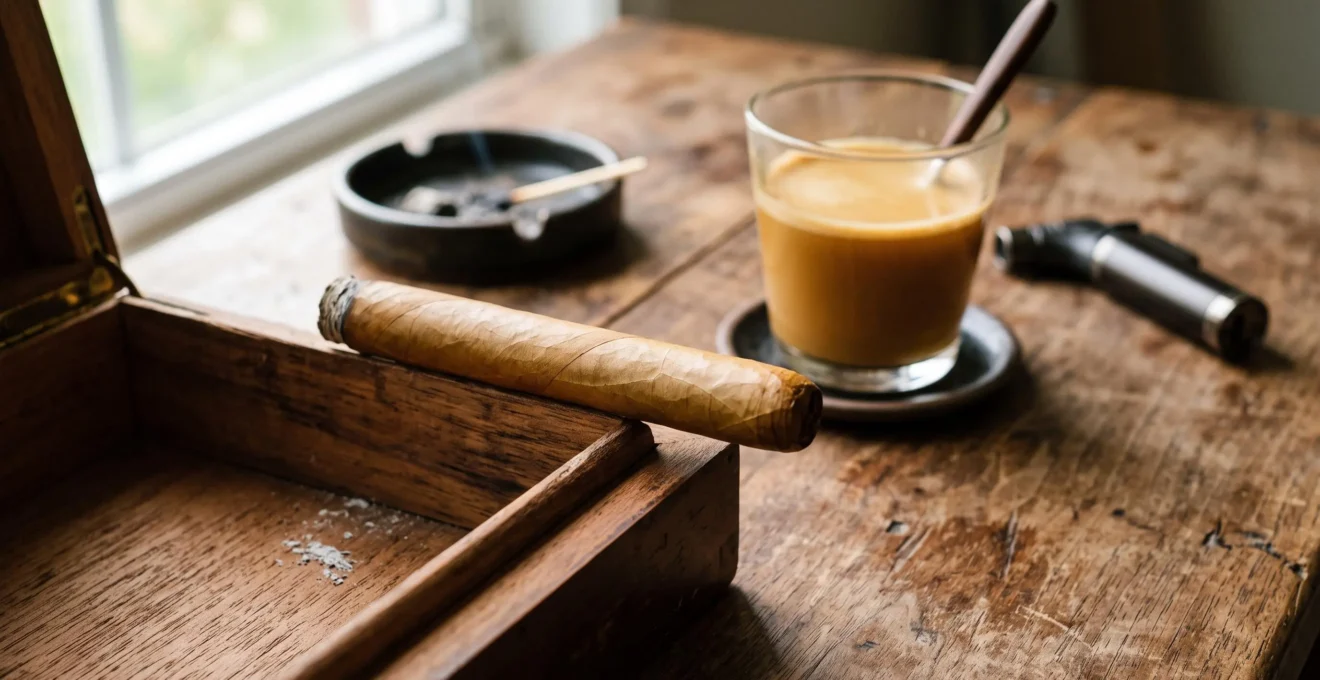
A golden brown cigar wrapper can look delicate without producing a shallow tasting experience. Claro wrappers are commonly associated with lighter colour and smoother flavours, but the tobacco beneath the outer leaf determines much of the cigar’s overall character. A relatively restrained opening can therefore develop into a more substantial impression as the different elements of the blend become noticeable.
That change is sometimes described as a cigar becoming richer around the 30-minute mark. It is a useful tasting observation, not a predictable chemical milestone. Cigar size, blend composition, moisture condition and smoking pace all influence how flavours develop. Some cigars remain consistently mild; others reveal increasingly prominent woody, creamy or nutty impressions.
There is another important distinction: Claro is primarily a wrapper colour classification, whereas Connecticut Shade identifies a particular tobacco type and growing tradition. A golden brown appearance alone cannot identify the leaf’s origin, fermentation history or likely strength.
Understanding these differences helps buyers judge what the wrapper can reasonably suggest without mistaking colour for a complete flavour profile. Tobacco smoke carries serious health risks regardless of wrapper colour or perceived mildness.
What a golden brown Claro wrapper really tells you
- Light colour does not guarantee a weak blend. The filler and binder can provide substantial body beneath a comparatively smooth wrapper.
- Flavour development is not governed by a 30-minute rule. Creaminess, grassiness and sweetness vary with the tobacco, construction and conditions.
- Storage and combustion matter. Moisture instability, uneven lighting and overheating can obscure delicate flavours or damage the wrapper.
- Why Do Claro Wrappers Show Grassy Notes Early but Turn Creamier Mid-Smoke?
- How to Choose a Claro-Wrapped Cigar That Still Has a Satisfying Finish?
- Claro or Connecticut-Style Mildness: Which Works Better With a Morning Coffee?
- The Too-Close Torch Mistake That Scorches Claro Wrappers in Under 20 Seconds
- Best Humidity Target for Claro Wrappers to Avoid Splits During Winter Heating
- Why Does a Thin Wrapper Create Brighter Flavour but Show Burn Flaws Faster?
- Connecticut or Claro: Which Mild Wrapper Gives More Noticeable Sweetness?
- Why Does a Connecticut Wrapper Taste Bland Unless You Smoke It Differently?
Why Do Claro Wrappers Show Grassy Notes Early but Turn Creamier Mid-Smoke?
Some Claro-wrapped cigars begin with vegetal or hay-like impressions and develop creamier, nuttier flavours as the smoking experience progresses. This is a possible sensory progression rather than an established characteristic of every Claro wrapper. The changing balance between wrapper, binder and filler flavours can make a cigar seem richer even when its overall strength has not increased.
A lighter-coloured wrapper does not necessarily produce the fresh, leafy intensity sometimes associated with very pale cigars. Scandinavian Tobacco Group’s cigar and wrapper classifications distinguish light-tan Claro from greenish Claro Claro, also known as Candela, and the darker Colorado Claro category. The manufacturer associates especially fresh, leafy characteristics with Candela rather than standard Claro.
This matters when interpreting an initial grassy impression. It may reflect the particular tobacco variety, curing and fermentation characteristics, or the interaction of several leaves in the blend. It should not automatically be attributed to residual vegetal compounds in the wrapper.
As smoking continues, the relative prominence of individual flavours may change. A smoother wrapper impression can become less noticeable against the richer aromas of the filler and binder. Alternatively, increasing heat can introduce bitterness, making the later experience harsher rather than creamier.
Thirty minutes is a reference point, not a flavour threshold. A short cigar may be approaching its final portion at that time, while a larger format may still be developing. Comparing the first, middle and final thirds provides a more meaningful framework than relying on elapsed minutes.
If grassiness remains prominent throughout, the explanation might simply be the blend’s natural character. Excessive dryness, uneven combustion or a poorly established ember are other possibilities, but the flavour alone cannot diagnose them. Nor does an early vegetal note establish a defective wrapper.
Aggressive relighting can further complicate interpretation by introducing additional charred flavours. It is therefore difficult to separate changes caused by the tobacco itself from those associated with inconsistent combustion.
For buyers, the practical lesson is to treat the opening impression as one part of the blend’s character rather than a reliable prediction of the entire cigar. That distinction also makes the finish more important than wrapper colour alone.
How to Choose a Claro-Wrapped Cigar That Still Has a Satisfying Finish?
A satisfying finish in a Claro-wrapped cigar depends on the complete blend, its construction and its preservation, not simply the wrapper’s light appearance. A smooth wrapper can accompany a substantial filler, while a darker wrapper can surround a comparatively gentle blend. Visual inspection helps identify condition and obvious defects, but it cannot reliably predict flavour persistence.
The finish describes the flavours and sensations that remain after a draw, or after the smoking experience ends. It is distinct from strength, which may include the perceived intensity and physiological effects of nicotine. A cigar can feel mild while leaving noticeable woody or nutty impressions.
Specialist editorial discussion in Cigar Aficionado’s analysis of wrapper, binder and filler influence explains why the outer leaf is only one component of flavour. The filler contributes substantially to overall strength, and the binder and filler can materially shape the cigar’s character.
When inspecting a Claro wrapper, several visible characteristics are worth separating:
- Surface sheen: A modest natural sheen may be normal, but a matte appearance does not prove that a wrapper has lost its flavour-producing oils.
- Vein structure: Fine or prominent veins reveal features of the leaf, although vein density alone cannot establish finish length or quality.
- Wrapper integrity: Splits, lifting seams and obvious dryness deserve attention because they may indicate handling or preservation problems.
- Foot construction: The exposed tobacco can reveal obvious gaps or irregularities, but appearance cannot establish filler density or predict draw resistance precisely.
The intended occasion provides another useful distinction. The following comparisons are selection considerations, not demonstrated performance rankings.
| Selection criterion | Short morning session | Longer relaxed session |
|---|---|---|
| Format | Smaller cigar suited to limited time | Larger format with more room for flavour development |
| Blend character | Clearly identifiable opening flavours | Balanced wrapper, binder and filler character |
| Finish expectation | Noticeable flavour without requiring prolonged development | Potential for changes across several stages |
| Retailer question | Is this blend consistent from the opening? | How does the flavour typically evolve? |
Dense construction is not automatically superior. An excessively tight cigar may have draw problems, while a correctly made, relatively open construction can still produce a satisfying experience. Filler composition and manufacturing consistency are more informative than a simple density label.
Storage history also matters. Rapid humidity fluctuations can damage leaf structure and interfere with combustion. However, the claim that humidity cycling specifically strips flavour-carrying oils from Claro wrappers is not established by the supplied evidence.
Fermentation and ageing influence tobacco characteristics, but neither fermentation duration nor wrapper colour independently determines how long the finish will last.
Five checks for evaluating a Claro-wrapped cigar
- Identify the actual wrapper designation and record whether the product is described as Claro, Colorado Claro or a specific Connecticut tobacco variety.
- Inspect the outer leaf for visible splitting, lifting seams or other damage, and note any observable defects.
- Record the binder and filler origins when the manufacturer provides them, creating a basic blend profile rather than relying on wrapper colour.
- Ask the retailer about storage consistency and document the conditions or history they can substantiate.
- Write down the desired format, flavour characteristics and finish in a short selection brief that can be compared with the manufacturer’s description.
This avoids treating lightness as a synonym for blandness while recognising the limits of what visual inspection can reveal. The same distinction becomes particularly relevant when considering flavour alongside morning coffee.
Claro or Connecticut-Style Mildness: Which Works Better With a Morning Coffee?
Neither Claro nor Connecticut-style wrappers are universally better companions for morning coffee. Claro describes a colour range, while Connecticut generally refers to tobacco varieties or growing traditions, so the categories can overlap. A relatively delicate cigar may be more noticeable beside a lighter coffee, but the pairing depends on the actual blend and roast rather than a dependable wrapper-specific rule.
The comparison becomes clearer when coffee itself is considered. Roast level, acidity, bitterness and texture all influence how neighbouring flavours are perceived. A bright coffee can accentuate contrasts with woody or herbal notes, while a roast with pronounced bitterness may obscure subtle sweetness.
Some tasters describe Claro-associated impressions as hay-like, grassy or gently sweet. Connecticut Shade blends are often discussed in terms of smoothness, bread, cream or toasted notes. These are useful tasting descriptors, not guaranteed signatures.
Connecticut-style wrappers are not compositionally identical. Traditional Connecticut Shade and Ecuadorian Connecticut may differ in leaf thickness, colour and flavour characteristics. In particular, Ecuadorian Connecticut can produce relatively creamy or nutty impressions and may be incorporated into stronger blends.
That variability prevents a universal conclusion that Claro is better with light-roast coffee or Connecticut requires a darker roast.
A comparative tasting can nevertheless reveal individual preferences. For example, a hypothetical taster might notice hay-like flavours alongside a lightly roasted coffee but perceive fewer distinct cigar flavours after switching to a particularly bitter roast. That observation would describe a personal pairing, not establish a general rule about all Claro wrappers.
Time is another factor. During a brief session, the opening portion represents a larger share of the overall experience. A cigar known for changing considerably during the middle third may therefore be a less predictable choice for someone primarily interested in its later flavours.
For a longer occasion, there may be more opportunity to notice transitions, although neither wrapper designation guarantees them.
UK buyers should also remember that flavour mildness does not mean reduced exposure to harmful tobacco smoke. Coffee pairing changes the sensory context, not the health risks.
Once that preference is understood, proper handling becomes relevant: delicate flavours can be obscured by uneven combustion or a badly charred wrapper, regardless of how carefully the cigar was selected.
The Too-Close Torch Mistake That Scorches Claro Wrappers in Under 20 Seconds
A torch lighter held too close can char the foot or outer wrapper of a cigar, potentially introducing harsh flavours and creating an uneven initial burn. The risk depends on flame intensity, distance, exposure and handling. There is no established universal 20-second scorching threshold, and Claro colour alone does not prove that the leaf is more thermally fragile than darker wrappers.
A visible burn mark can be particularly noticeable against a light-tan leaf. That difference in visibility, however, should not be confused with evidence of a lower thermal damage threshold.
Wrapper thickness, moisture condition and physical construction may affect how a cigar responds to heat. Yet colour is an insufficient proxy for any one of those characteristics. Some Connecticut Shade leaves are thin and elastic, while other relatively light-looking tobacco leaves may have different physical properties.
The central issue is the difference between establishing an even ember at the foot and unnecessarily charring tobacco around its outside edge.
Tobacconist University’s cigar-lighting instructions recommend rotating the cigar, maintaining separation between flame and tobacco, and avoiding direct charring of the exterior wrapper. Its guidance distinguishes ordinary flames from torches because their heat characteristics differ.
The professional guidance favours even lighting rather than prolonged direct flame contact. Rotating the foot helps distribute the initial heat, while keeping the flame away from the exterior reduces the chance of visibly burning the wrapper.
The published recommendations include different approximate separation distances for conventional flames and torch lighters. Those distances are handling guidelines, not experimentally established limits that guarantee protection with every lighter or tobacco construction.
It is also misleading to assume that a double-jet torch inevitably damages Claro leaves more than a single-jet lighter. Flame geometry, intensity and handling all matter, and the available evidence does not support a universal comparison.
An unusually bitter opening may reflect scorching, but bitterness alone is not a reliable diagnostic test. The tobacco blend, moisture condition and combustion pattern can also influence the initial flavour.
Visible external charring provides a clearer reason to suspect direct flame damage. Even then, it does not establish how deeply the damage has extended into the cigar.
There is no supported procedure demonstrating that cutting away a burnt portion or relighting automatically restores the original flavour. Removing damaged material may also disturb the construction, so recovery should not be assumed.
The broader lesson is that combustion problems can alter sensory impressions before the underlying blend has been fairly assessed. Storage-related moisture problems introduce a different set of variables, especially during winter.
Best Humidity Target for Claro Wrappers to Avoid Splits During Winter Heating
A stable relative-humidity range of approximately 65–70% is a commonly used starting point for preserving premium cigars, including those with Claro wrappers. It is not a scientifically established Claro-specific target. Winter heating can increase moisture loss, while excessive humidification can cause uneven expansion, poor combustion and construction damage. Stability generally matters more than chasing one exact number.
Tobacco is hygroscopic, meaning it exchanges moisture with the surrounding air. When a cigar experiences rapid drying, its wrapper can contract and become brittle. If the outer leaf and internal tobacco layers change moisture content at different rates, physical stress may develop.
According to Tobacconist University’s cigar preservation guidance, rapid dehydration can contribute to cracking, separation and unravelling. Rapid rehydration can also create damaging differences in expansion between tobacco layers.
There is no reliable evidence in that guidance that Claro wrappers consistently lose elasticity before every darker wrapper. Leaf composition, construction and moisture history provide more credible explanations than colour alone.
The traditional 70% relative humidity at 70°F benchmark is familiar in cigar preservation, but it is not a universal prescription. The professional reference describes successful storage across different humidity ranges and acknowledges that some cigars may be maintained at lower settings.
65–70% RH
A commonly used premium-cigar storage range, not a specially validated requirement for Claro wrappers. Tobacco composition, construction and moisture stability affect the appropriate conditions.
Tobacconist University, Cigar Preservation.
During winter, the surrounding environment deserves attention. Radiators, heating vents and repeated exposure to dry indoor air can create moisture fluctuations. A humidor positioned near a heat source may experience less stable conditions than one kept away from direct heating.
Visual inspection can help identify damage, but it is imperfect. Fine wrinkles, unusual firmness or splitting may justify checking preservation conditions; none can independently reveal the moisture content of every internal tobacco layer. A cigar may appear normal externally while its filler has a different moisture state.
Humidity adjustments also need restraint. Increasing moisture too quickly can produce uneven expansion between the wrapper, binder and filler. Excessive moisture may interfere with combustion, mute flavours and increase mould risk.
Gradual equilibration is therefore more defensible than repeated large adjustments. The available professional evidence does not establish that moving a cigar briefly to a cooler room immediately before smoking prevents wrapper splitting.
Ring gauge, tobacco properties and how often a humidor is opened can all influence practical preservation decisions. No single visual cue or hygrometer reading eliminates the need to consider the cigar’s condition over time.
This also explains why wrapper appearance alone is a poor indicator of smoking performance. Moisture and construction affect how the entire cigar burns, regardless of whether its outer leaf appears thin or substantial.
Why Does a Thin Wrapper Create Brighter Flavour but Show Burn Flaws Faster?
A thin cigar wrapper can make certain flavour characteristics seem more distinct, but thinness does not automatically create brighter flavours or cause faster burn defects. The wrapper is one component of a combustion system involving the binder, filler, moisture condition and cigar construction. Uneven burning may be more visually apparent on some delicate leaves without thickness being the underlying cause.
The wrapper forms the cigar’s exposed outer layer, while the binder holds the filler together. Each component participates in combustion and can contribute to flavour. The proportion of wrapper tobacco relative to filler also varies with the cigar’s dimensions.
A narrow cigar generally contains a greater wrapper proportion relative to its filler than a substantially wider cigar, although actual construction and blend design still matter. This helps explain why the same wrapper variety need not have an identical sensory influence across formats.
It does not establish that a thin wrapper necessarily allows oxygen to reach the ember more evenly. Airflow depends on the cigar’s internal structure, packing, draw resistance and burning conditions. Wrapper thickness alone cannot explain that process.
Burn irregularities are sometimes described using terms such as canoeing, where one side advances faster, and tunnelling, where internal tobacco burns ahead of the surrounding layers.
Several conditions may contribute to these patterns:
- Uneven distribution or packing of the filler.
- Differences in moisture content between tobacco layers.
- An uneven initial light or subsequent relighting.
- Variations in leaf properties and construction.
- External airflow or inconsistent combustion conditions.
A thin or delicate wrapper may make visible changes at the burn line especially noticeable. However, thicker wrappers can also burn unevenly, and the supplied references do not demonstrate that thin wrappers consistently develop canoeing or tunnelling sooner.
The distinction between flavour brightness and body is similarly important. Brightness is a sensory descriptor: it can refer to prominent herbal, fresh or sharply defined impressions. Body describes the overall weight or intensity of the smoking experience.
A cigar may present a relatively delicate wrapper character alongside a substantial filler blend. That combination can account for a lighter initial impression and a fuller overall experience without requiring a change in wrapper thickness or an increase in strength at a particular minute.
Observing whether uneven burning is confined to the outside or accompanied by changes in draw and flavour can help describe the problem. It cannot, on its own, prove which manufacturing or environmental variable caused it.
Once body and brightness are treated separately, another frequently confused characteristic becomes easier to evaluate: whether a lighter wrapper actually produces more noticeable sweetness.
Connecticut or Claro: Which Mild Wrapper Gives More Noticeable Sweetness?
Neither Connecticut nor Claro consistently produces more noticeable sweetness. Claro is a colour classification, while Connecticut identifies a tobacco tradition, so the two terms can describe overlapping products. Some cigars show hay-like or cedar-associated sweetness; others suggest bread, toast or cream. Fermentation, ageing, filler composition and individual perception prevent a reliable sweetness ranking based on either label alone.
Sweetness in tobacco tasting is not equivalent to measuring dissolved sugar in a drink. It describes a sensory impression formed by multiple aromas and their interaction with the overall flavour profile.
For instance, a cigar with prominent woody and herbal characteristics may make a subtle sweet impression easier to identify through contrast. Another cigar with uniformly creamy or toasted flavours may seem broadly rounded without presenting sweetness as a distinct note.
These observations can help explain why two smokers disagree about which wrapper tastes sweeter, but they do not demonstrate that Claro systematically produces greater flavour contrast than Connecticut.
There is also a terminology problem. A traditionally pale Connecticut Shade cigar may fit within a light wrapper colour category. Comparing Connecticut and Claro as though they were mutually exclusive tobacco varieties can therefore create a misleading test.
A more meaningful comparison records the actual wrapper tobacco, the wider blend and the flavours noticed at different stages.
The following descriptors are illustrative rather than universal specifications.
| Characteristic | Hay-like or herbal profile | Toasted or creamy profile |
|---|---|---|
| Common tasting language | Hay, cedar, light floral impressions | Bread, toast, cream, nuts |
| How sweetness may register | As a distinct contrast against herbal notes | As part of a rounded overall impression |
| What the description establishes | An individual sensory interpretation | An individual sensory interpretation |
| What it does not establish | That all Claro wrappers are sweeter | That all Connecticut wrappers are sweeter |
Fermentation and ageing can influence the characteristics of tobacco, as can leaf origin, seed variety and position on the plant. Nevertheless, no controlled comparison in the supplied sources establishes which of these factors consistently produces greater perceived sweetness in one wrapper category.
An individual comparison can be documented at the opening, middle and finish, using the same beverage context and recording both the tobacco specification and the perceived flavours. Such notes may help a person identify patterns in their own palate, but they cannot establish general product superiority.
This matters because sweetness is often confused with mildness. A smooth cigar is not necessarily sweet, and a relatively strong blend can still contain recognisably sweet aromatic impressions.
That distinction also exposes a problem with the familiar claim that Connecticut wrappers are inherently bland. Their reputation often reflects expectations about subtlety rather than an objective absence of flavour.
Key takeaways before assessing Connecticut mildness
- Connecticut and Claro are not opposite wrapper categories: one refers to tobacco identity or growing tradition, the other primarily to colour.
- Subtle flavours can be difficult to distinguish from general smoothness, but that does not prove the tobacco lacks aromatic character.
- Smoking conditions, moisture and blend composition complicate judgements about blandness; no single tasting technique can guarantee a different result.
Why Does a Connecticut Wrapper Taste Bland Unless You Smoke It Differently?
A Connecticut-wrapped cigar can seem bland when its subtle flavours are overshadowed by the rest of the blend, competing tastes or combustion-related harshness. However, there is no evidence that Connecticut wrappers require one special smoking technique to release their flavours. The tobacco variety, fermentation, ageing, filler and construction can all influence whether the experience feels delicate, balanced or genuinely unremarkable.
Connecticut Shade is often associated with a relatively smooth profile, but the Connecticut designation covers more than one growing environment and leaf characteristic. Traditional Connecticut Shade and Ecuadorian Connecticut can differ in thickness, appearance and flavour intensity.
Some Ecuadorian Connecticut wrappers are described as creamy or slightly nutty, and they may be combined with sufficiently bold fillers to create medium- or full-bodied cigars. The idea that every Connecticut cigar must be extremely mild therefore overlooks an important part of contemporary blend construction.
The perception of blandness also depends on what a smoker expects to detect. Someone accustomed to pronounced pepper, earth or heavily roasted impressions may initially struggle to distinguish restrained woody, bread-like or nutty flavours.
That difference in perception does not mean the wrapper is flavourless. Equally, a subtle reputation cannot prove that a disappointing cigar contains hidden complexity.
Smoking pace is sometimes proposed as the explanation. Excessive heat and poor combustion can affect taste, so avoiding repeated overheating is a reasonable handling consideration. Yet the supplied sources do not demonstrate that longer intervals between draws or smaller draws reliably reveal sweetness unique to Connecticut tobacco.
Retrohaling is another technique sometimes discussed in cigar tasting. Passing smoke through the nasal passages exposes sensitive tissues to tobacco smoke, and there is no evidence in the supplied material that it is necessary to identify Connecticut flavour characteristics. It should not be presented as a requirement for appreciating a cigar.
When a product tastes consistently flat, several interpretations remain possible. Its blend may genuinely be restrained, its storage may have affected its condition, or its flavour may simply not match the individual’s preferences.
Over-ageing or excessive fermentation cannot be diagnosed from blandness alone. While tobacco processing affects flavour, the available material does not establish a reliable sensory test that identifies either cause in a finished cigar.
This provides a useful comparison with the golden brown Claro expectation. A Claro wrapper may be associated with a smooth, light-tan appearance, yet the filler can provide substantial richness. A Connecticut-style wrapper may create a similarly restrained visual impression while surrounding a more assertive blend.
Neither wrapper name independently predicts the overall strength, sweetness or finish. Manufacturer descriptions of the complete blend and evidence of sound preservation are more defensible than broad assumptions drawn from colour.
For a practical next step, compare complete blend specifications, wrapper classifications and storage information before deciding which flavour characteristics matter most. Treat any expectation of a richer 30-minute finish as a possibility to assess, not a promise attached to a golden brown leaf.
Is a golden brown cigar wrapper always classified as Claro?
No. Wrapper colour categories include Claro and Colorado Claro, among others. Claro is generally light tan, while Colorado Claro extends towards somewhat darker brown shades. Lighting, natural leaf variation and manufacturer terminology can make visual identification uncertain. The product’s actual tobacco specification is more informative than appearance alone.
Can a light-coloured cigar contain strong tobacco?
Yes. A comparatively smooth or pale wrapper can surround a binder and filler blend that produces substantial strength and body. The complete tobacco composition matters more than the colour of the outer leaf. Light appearance does not imply reduced nicotine exposure or lower health risks.
Does a cracked Claro wrapper mean the cigar has been stored too dry?
Excessive drying and rapid moisture loss can contribute to brittle, cracked wrappers, but they are not the only possible causes. Handling damage and uneven moisture changes may also affect construction. A crack alone cannot establish the cigar’s complete storage history or its internal moisture condition.
Is Claro the same thing as Candela?
No. Standard Claro is usually described as light tan, while Candela is also known as Claro Claro and is typically associated with a distinctly greenish appearance. Candela is especially associated with fresh leafy characteristics, which should not automatically be attributed to every conventional Claro wrapper.
Does a cigar becoming creamier mean its nicotine strength has increased?
No. Creaminess is a sensory description, whereas nicotine strength concerns the tobacco’s pharmacological properties and exposure. A change in perceived richness does not establish a corresponding increase in nicotine concentration or delivery. The supplied sources do not demonstrate a predictable strength change at the 30-minute point.