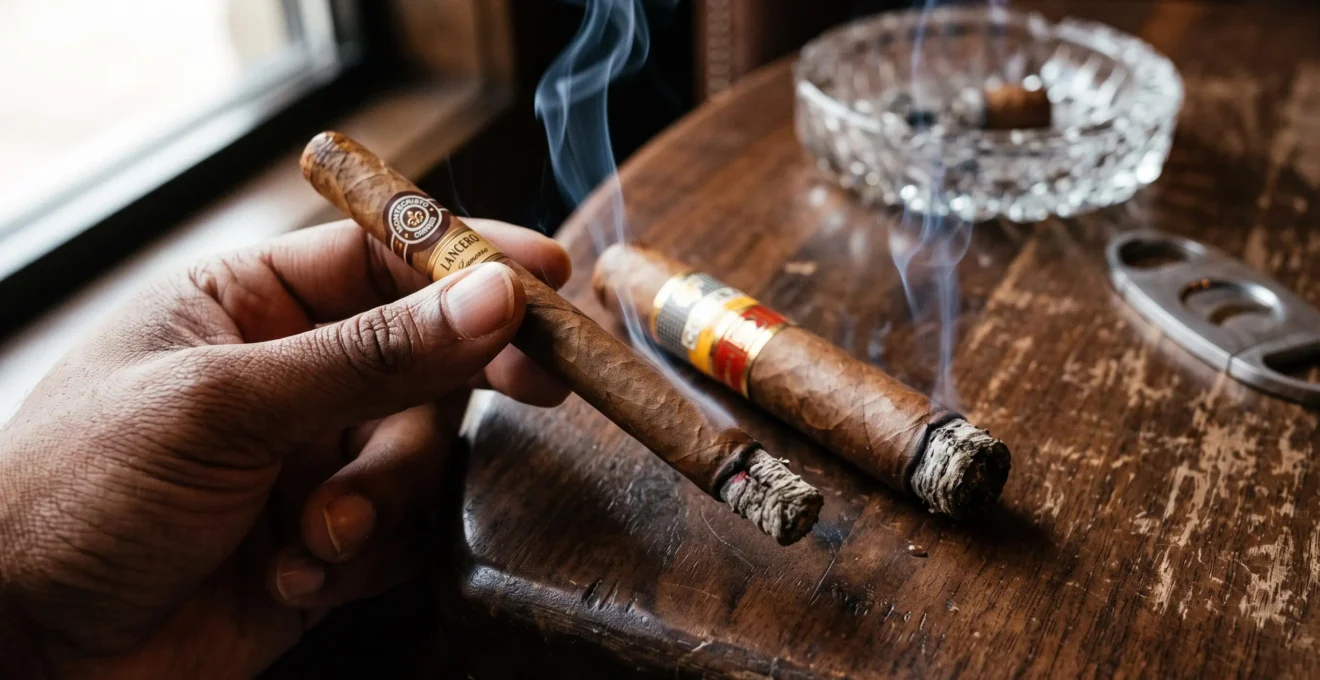
A slender lancero can seem unexpectedly forceful during its opening ten minutes, particularly when compared with a robusto from the same cigar range. Pepper may appear sooner, the smoke may seem sharper, and subtle changes in drawing technique can become more noticeable. Yet a smaller ring gauge does not automatically mean stronger tobacco or greater nicotine delivery.
The distinction begins with cigar construction. A narrow format contains proportionally more wrapper relative to its filler, potentially making wrapper-derived flavours more prominent. Airflow, moisture, tobacco composition and individual puffing behaviour can further alter the experience. Some smokers interpret this combination as greater intensity, even when the actual nicotine strength remains uncertain.
Understanding these differences means separating three characteristics often confused in cigar reviews: flavour intensity, perceived heat and nicotine exposure. Comparing them individually makes a lancero-versus-robusto tasting more informative than relying on ring gauge alone. It also helps explain why a wider cigar can taste gentler at first without necessarily being a milder product.
Slender Cigars vs Robustos: The Essentials
- Wrapper influence: Slim cigars have a higher wrapper-to-filler proportion, which can make certain spicy or aromatic notes more noticeable.
- Smoking behaviour: Puff frequency, volume and draw resistance influence combustion and emissions; faster smoking can complicate flavour comparisons.
- Nicotine strength: Neither a narrow nor a thick ring gauge reliably predicts nicotine exposure or establishes a safer cigar.
- Why Do Slim Cigars Concentrate Pepper on the Tongue Faster ?
- How to Smoke a Slim Vitola Without Overheating It in the First 15 Minutes ?
- Slim Lancero or Thick Toro: Which Is Safer if You’re Nicotine-Sensitive ?
- The Aggressive-Light Mistake That Ruins Slim Cigars Before Minute 5
- When Should You Slow Down on a Lancero to Keep the Final Third From Turning Sharp ?
- Why Does a Thick Ring Gauge Spread Flavour Out Instead of Hitting Hard Early On ?
- Slim or Thick Ring Gauge: Which Makes White Pepper Feel Less Sharp Over 45 Minutes ?
- Why Do Thicker Ring Gauges Sometimes Taste Milder Even When They’re the Same Blend ?
Why Do Slim Cigars Concentrate Pepper on the Tongue Faster ?
Slender cigars can deliver a more immediately noticeable pepper sensation because their construction gives the wrapper a relatively greater contribution to the overall tobacco mixture. Airflow and smoking pace may also influence perceived sharpness. However, there is no established rule that a narrower ring gauge produces hotter smoke or stronger pepper during the first ten minutes.
Ring gauge measures cigar diameter in sixty-fourths of an inch. A lancero commonly has a substantially narrower diameter than a robusto, although dimensions vary between manufacturers.
This difference changes the relative quantities of wrapper, binder and filler. According to Cigar Aficionado’s explanation of wrapper and filler contributions, wider cigars have a greater filler-to-wrapper ratio than slender formats.
Consequently, when a wrapper contributes distinctly spicy characteristics, those notes may stand out more clearly in a narrow cigar. This is a change in tobacco proportions, not evidence that smoke physically concentrates on a smaller area of the tongue.
Two different sensations can also be confused during tasting:
- Blend-derived pepper: A prickling, aromatic sensation described as white pepper, black pepper or spice, associated with the particular tobaccos and their balance.
- Combustion-related harshness: An acrid, bitter or irritating sensation that may change with smoking intensity and burn conditions.
Cigar pepper descriptors are sensory comparisons, not proof that tobacco smoke contains the same capsaicin responsible for chilli heat. Likewise, ligero tobacco may contribute strength and intensity, but its presence does not guarantee a specific pepper flavour.
Draw resistance complicates the comparison further. A tightly packed slender cigar may require additional effort to draw, whereas a well-constructed lancero can have relatively easy airflow. Neither outcome follows from diameter alone.
A useful personal comparison involves evaluating two vitolas sold under the same blend name, preferably with similar storage conditions. Record the first impressions, distinguishing aromatic spice from throat irritation and excessive warmth. Because manufacturers may adjust leaf proportions between sizes, the comparison should be treated as a sensory observation rather than a controlled scientific experiment.
The strongest first impression is not necessarily the strongest tobacco. This matters particularly when the next variable—how the cigar burns—starts influencing flavour perception.
How to Smoke a Slim Vitola Without Overheating It in the First 15 Minutes ?
The opening fifteen minutes of a slender cigar are best evaluated without repeatedly forcing the draw or maintaining an unnecessarily intense burn. Smoking intensity influences combustion and smoke emissions, but no scientifically validated puff interval specifically prevents lancero overheating. The relevant principle is to recognise changes in smoke harshness rather than assume a fixed smoking rhythm guarantees a cooler experience.
A lancero contains less tobacco across its diameter than a substantially wider cigar. This may make certain changes in airflow and combustion more apparent, although construction, moisture and tobacco composition remain important.
Experimental research offers a useful distinction between observation and tasting folklore. An experimental study of cigar burning and smoke emissions examined how puffing intensity and the progression of combustion affected measured emissions, including nicotine and carbon monoxide.
The findings show that smoke output is dynamic. They do not establish that a particular puffing schedule makes slender cigars safe, nor do they demonstrate that rapid puffing always causes ammonia or tar to accumulate progressively in a lancero.
For sensory analysis, several changes are worth recording:
- Sudden bitterness: A previously balanced flavour becomes acrid or unpleasant.
- Increased irritation: The sensation shifts from aromatic spice towards an uncomfortable throat response.
- Uneven combustion: One section of the foot advances noticeably faster than another.
- Unstable ash: Ash becomes irregular, although this alone cannot diagnose combustion temperature.
Touching the burning foot is not an appropriate temperature test. Similarly, visible smoke thickness is not a reliable measure of nicotine concentration or toxicant exposure.
If a cigar repeatedly goes out, its moisture, construction or draw resistance may be contributing factors. Relighting can alter the initial flavour impression, but the available evidence does not establish that every delayed relight produces a harsh opening.
The distinction between taking a longer break and producing a cleaner smoke should also remain clear. A cigar that tastes smoother is not necessarily producing fewer harmful substances or delivering less nicotine.
For someone comparing vitolas, the most useful record is descriptive: note when bitterness emerges, whether the burn becomes irregular and whether similar changes occur in a wider format.
Flavour stability and exposure are different questions. That distinction becomes essential when comparing formats for someone who reacts strongly to nicotine.
Slim Lancero or Thick Toro: Which Is Safer if You’re Nicotine-Sensitive ?
Neither a slim lancero nor a thick toro can be considered safer for a nicotine-sensitive person on the basis of ring gauge. Tobacco composition, smoking behaviour, smoke volume and individual exposure all matter. A smaller cigar does not guarantee a lower nicotine dose, while a larger one does not reliably dilute nicotine. Avoiding tobacco smoke is the safer choice.
Nicotine strength is often confused with perceived flavour intensity. A cigar described as peppery or full-flavoured does not necessarily deliver more nicotine than one perceived as creamy or mild.
The National Academies review of cigar characteristics describes how tobacco type, cigar size, shape and smoking behaviour can influence exposure. Its findings do not establish that one particular premium cigar format is safer than another.
A comparison must therefore distinguish the characteristics of the product from the smoker’s behaviour.
| Factor | Slim Lancero | Thick Toro |
|---|---|---|
| Tobacco quantity | Generally less tobacco across its diameter | Generally more tobacco across its diameter |
| Nicotine concentration | Depends on tobacco composition | Depends on tobacco composition |
| Session exposure | Depends on smoking behaviour and duration | Depends on smoking behaviour and duration |
| Perceived intensity | May emphasise wrapper characteristics | May emphasise filler characteristics |
| Safety conclusion | Not established as safer | Not established as safer |
Strength labels such as mild, medium and full are also imperfect guides. They commonly describe a manufacturer’s or reviewer’s assessment of flavour and body rather than a standardised measurement of nicotine exposure.
Choosing a thick cigar because its flavour seems softer can therefore be misleading. Its greater tobacco quantity and potentially longer smoking duration may increase opportunities for exposure, although the actual result depends on how it is smoked.
Conversely, a slender cigar may have a distinctly intense sensory opening without delivering a predictably higher nicotine dose during that period.
For nicotine-sensitive people, warning signs such as nausea, dizziness, sweating or palpitations should not be interpreted as a reason to adjust cigar size or continue experimenting. Stop tobacco exposure if symptoms occur and seek medical advice when appropriate. Severe symptoms or suspected nicotine poisoning require urgent medical assessment.
Smoking less frequently, smoking a smaller format or avoiding inhalation does not eliminate the risks associated with cigar use. No cigar smoking pattern is established as risk-free.
Once safety claims are separated from tasting claims, the comparison can return to construction and combustion without mistakenly treating a smoother flavour as a healthier outcome.
The Aggressive-Light Mistake That Ruins Slim Cigars Before Minute 5
An aggressive initial light can create a charred, unevenly burning foot that makes the opening flavour unpleasant. A slender cigar’s smaller diameter may make an uneven burn especially conspicuous, but evidence does not establish that it is uniquely vulnerable. Direct flame contact and excessive heating are avoidable construction and combustion problems, not proof that the entire cigar is permanently ruined.
The common mistake is treating lighting as a contest to establish the largest possible ember immediately. Holding a powerful flame directly against the tobacco can create excessive local heating and an uneven burning surface.
With a narrow foot, there is comparatively little surface across which to distribute that initial heating. An irregular burn can consequently become a noticeable part of the opening experience.
However, a burnt taste after lighting does not by itself demonstrate tunnelling, canoeing or damage to the complete filler structure. Those problems have multiple possible causes, including construction, airflow and moisture.
Traditional cigar-lighting guidance, including Cigar Aficionado’s practical instructions, describes holding the cigar near rather than directly in the flame, rotating the foot and checking that the initial ember is reasonably even.
This is a specialist technique for managing the initial burn, not a scientifically validated way to reduce health risks.
Five Checks for Documenting an Uneven Initial Burn
- Inspect the unlit foot: Record whether the visible tobacco surface appears even. Deliverable: one pre-light observation.
- Record flame contact: Note whether the flame touched the tobacco directly or remained separated. Deliverable: a clear lighting-condition note.
- Inspect the initial ember: Record whether combustion appeared uniform across the foot. Deliverable: an even/uneven classification.
- Document the opening flavour: Distinguish aromatic spice from burnt or acrid notes. Deliverable: two separate sensory descriptors.
- Check subsequent burn behaviour: Record whether an uneven edge persisted or corrected itself. Deliverable: a short observation of burn progression.
If excessive charring has already occurred, further aggressive heating is not a reliable remedy. Allowing the burning end to settle rather than repeatedly exposing it to direct flame may avoid compounding the problem.
Removing charred wrapper or cutting into the burning end is not an established general recovery procedure and may damage the cigar further.
The opening burn is only one part of the session. Even a cigar that begins evenly may change character considerably as its remaining length decreases.
When Should You Slow Down on a Lancero to Keep the Final Third From Turning Sharp ?
A lancero may seem sharper in its final third as combustion advances and smoke composition changes, but there is no universal minute or remaining length at which this happens. The practical signal is a noticeable shift towards bitterness, irritation or heavier flavour. These observations do not prove that the final third contains more nicotine or becomes chemically stronger than a robusto.
Traditional tasting descriptions divide cigars into thirds because flavour can evolve as tobacco burns. This organisation is useful, provided it is not mistaken for a fixed chemical sequence.
One frequently repeated explanation suggests that strong ligero tobacco becomes concentrated at the mouth end of a slender cigar. That is not an inherent feature of lancero construction. Long-filler leaves can extend through the cigar, and the arrangement depends on the manufacturer’s blend and rolling method.
Nor is the final third necessarily dominated by accumulated tar. Condensation, evaporation, tobacco composition and changing combustion conditions can all affect emissions, with different constituents following different patterns.
For a comparative sensory record, three changes deserve attention:
- Flavour darkening: A transition from lighter aromatic impressions towards more roasted, bitter or earthy notes.
- Increased throat irritation: A stronger uncomfortable sensation that should not be mistaken for proof of higher nicotine content.
- Loss of balance: One harsh characteristic begins overwhelming previously distinguishable flavours.
A robusto may exhibit similar changes, although the point at which they occur can differ because of its construction, length, tobacco blend and the individual’s smoking behaviour.
Its greater filler volume does not provide a scientifically established protective buffer against harshness, and it cannot be assumed to maintain a lower combustion temperature throughout the session.
For a tasting comparison, the decision to stop should be based on whether the experience remains acceptable rather than on a requirement to finish the entire cigar. There is no sensory or health benefit in continuing when the smoke becomes unpleasant.
Ending before the final third is also a valid way to avoid prolonged exposure. It does not make the earlier exposure harmless.
This changing flavour profile highlights why comparing a lancero with a larger ring gauge requires more than examining the first few minutes.
Why Does a Thick Ring Gauge Spread Flavour Out Instead of Hitting Hard Early On ?
A thicker cigar may feel less immediately sharp because its larger filler-to-wrapper ratio changes the balance of tobacco flavours. The filler can have a greater relative influence, potentially making wrapper-derived pepper less prominent. However, thickness does not literally distribute flavour across a larger area of the palate, and it does not guarantee slower flavour development or cooler combustion.
Imagine two cigars belonging to the same product range: a narrow lancero and a considerably wider toro.
Both contain wrapper, binder and filler. The difference is their relative proportions and potentially the way the filler blend has been adjusted for each vitola.
In the slender format, wrapper characteristics may have a stronger relative influence. In the wider cigar, the additional filler can change the balance of spice, sweetness, earthiness and other perceived flavours.
This is one reason a cigar described as sharply peppery in a narrow format may feel rounder in a larger one. The difference is not necessarily a reduction in the intrinsic strength of the tobacco.
Thicker cigars also provide more room for combinations of filler leaves, although the existence of multiple filler components does not establish that flavours are released in a predetermined sequence.
A manufacturer may deliberately arrange or rebalance tobacco to create a particular experience. That blending decision can matter more than the diameter itself.
Consider the counter-example of a wide cigar built with a particularly assertive filler blend. Despite its large ring gauge, it may deliver intense flavours immediately. A narrow cigar using comparatively gentle tobaccos may be perceived as much softer.
Time introduces another complication. A wide toro may support a longer smoking session simply because it contains more tobacco, but its actual duration depends on length, construction and smoking behaviour. A longer duration does not necessarily make its flavour more gradual.
The useful distinction is therefore between structural potential and observed sensory performance. Ring gauge changes the material proportions available to the blender; it does not dictate the outcome independently.
To evaluate that difference fairly, pepper intensity should be compared over comparable stages of a session rather than using the opening alone as the verdict.
Slim or Thick Ring Gauge: Which Makes White Pepper Feel Less Sharp Over 45 Minutes ?
A thicker ring gauge may make white-pepper notes seem less prominent when the same wrapper has less relative influence over the overall blend. Yet neither size consistently produces a smoother 45-minute tasting. The actual result depends on tobacco composition, construction, smoking behaviour and personal perception. No controlled evidence establishes a universal pepper-intensity curve for lanceros versus robustos or toros.
White pepper is a tasting descriptor commonly used for a light, prickling, high-toned spice sensation. Black pepper generally suggests a darker or more forceful spicy impression.
Neither term identifies a specific measured chemical concentration in the smoke. They describe subjective sensory qualities, which may vary considerably between tasters.
White pepper should also be distinguished from irritation caused by smoke temperature or combustion products. A prickly flavour and an uncomfortable burning sensation may occur together, but they are not interchangeable.
For a 45-minute comparative tasting exercise, the most informative approach is to divide observations into opening, middle and late stages.
| Tasting stage | Slim vitola | Thick vitola |
|---|---|---|
| Opening | Record initial white-pepper prominence and any separate harshness | Record initial white-pepper prominence and any separate harshness |
| Midpoint | Record whether pepper increases, decreases or remains stable | Record whether pepper increases, decreases or remains stable |
| Final third | Record remaining spice, bitterness and irritation independently | Record remaining spice, bitterness and irritation independently |
| Overall impression | Summarise the perceived progression | Summarise the perceived progression |
This grid is a hypothetical observation framework, not an experimental dataset. It does not assume the slim cigar begins more peppery or the thick cigar becomes progressively stronger.
The same distinction applies to pacing. Comparing one cigar smoked rapidly with another smoked slowly introduces an additional variable, making it difficult to attribute differences to ring gauge.
Even at similar observed puffing frequencies, the comparison is not fully controlled. Puff volume, draw resistance, blend composition and individual sensory adaptation may differ.
A 45-minute window is convenient for organising notes, not a validated duration for these formats. Some cigars may not reach the same consumption stage within that period.
Comparisons are most informative when the smoker records both elapsed time and the approximate stage reached. This prevents the final third of one cigar from being compared inadvertently with the midpoint of another.
These observations lead to the broader issue behind the entire comparison: why two cigars marketed under the same blend name may perform so differently.
Key Takeaways Before Comparing the Same Blend
- A shared blend name does not guarantee identical leaf proportions across different vitolas.
- Wrapper-to-filler balance can explain perceived differences without proving that one format burns cooler.
- Storage, tobacco condition and airflow must be considered before attributing every flavour difference to diameter.
Why Do Thicker Ring Gauges Sometimes Taste Milder Even When They’re the Same Blend ?
Thicker cigars can taste milder than slender versions of the same named blend because their wrapper-to-filler proportions differ and manufacturers may adjust tobacco composition between sizes. These changes can alter the prominence of pepper, sweetness and other flavour notes. However, larger ring gauge does not consistently mean cooler smoke, lower nicotine exposure or less intense tobacco.
The apparent paradox begins with the phrase “same blend”. In cigar manufacturing, a product range can preserve an overall flavour identity while changing the proportions or arrangement of its tobacco components to accommodate different sizes.
A narrow lancero and a thick toro cannot necessarily reproduce precisely the same internal architecture. Their available space and relative wrapper contribution differ.
The wrapper surrounds the cigar, while the filler occupies its interior. As diameter increases, the relative quantity of filler generally grows compared with the wrapper.
Consequently, a wrapper carrying a noticeable spicy character may have less relative influence in a larger cigar. Filler-derived flavours may become more prominent, making the experience seem rounder or less pepper-forward.
That distinction is not equivalent to tobacco dilution. The additional filler has its own chemical composition and sensory characteristics, and it may be stronger rather than milder.
Combustion temperature is another commonly proposed explanation. Wider cigars are sometimes described as inherently cooler-burning, but diameter alone cannot reliably establish this.
Actual combustion behaviour depends on airflow, tobacco moisture, packing density and smoking intensity. Lower perceived sharpness should therefore not be treated as proof of lower combustion temperature.
Other variables can explain differences even when the cigars are nominally identical:
- Storage conditions: Differences in moisture can influence airflow and combustion.
- Age and tobacco condition: Sensory characteristics may change during storage, although the direction and magnitude are not universal.
- Draw quality: Resistance and packing can affect how a cigar behaves during smoking.
- Blend adjustments: Different proportions of ligero, seco and volado may alter the intended balance between vitolas.
- Individual perception: Previous exposure, sensory sensitivity and tasting context influence reported intensity.
A controlled comparison would need to account for these factors rather than simply place two differently sized cigars side by side. Without manufacturer-level blend details and measured smoking conditions, the outcome remains a sensory comparison rather than proof of a particular physical mechanism.
The practical conclusion is that flavour intensity is not a direct measurement of tobacco strength. A thicker cigar may appear smoother while still containing substantial amounts of nicotine and producing harmful smoke.
When comparing a lancero with a robusto or toro, record flavour, irritation and burn behaviour separately, then consider the blend’s construction and the limits of the evidence. If nicotine sensitivity or health risk is the concern, choosing a different ring gauge is not a reliable protective measure; avoiding cigar smoke remains the safer decision.
Does a smaller ring gauge always mean a stronger cigar?
No. Ring gauge affects the relative proportions of wrapper and filler, but tobacco composition and smoking behaviour also matter. A slender cigar can have a sharper flavour without necessarily delivering more nicotine or being objectively stronger than a larger cigar.
Can two cigars with the same blend name contain different tobacco proportions?
Yes. Manufacturers may adjust the proportions or arrangement of tobacco leaves to accommodate different dimensions and maintain a desired flavour profile. A shared blend name does not guarantee an identical internal recipe in every vitola.
Does a smoother-tasting robusto contain less nicotine?
Not necessarily. Perceived smoothness, sweetness or low pepper intensity cannot reliably establish nicotine concentration or absorbed dose. Tobacco composition, puffing behaviour and exposure conditions must also be considered.
Can cigar ash colour reveal whether a lancero is burning too hot?
No reliable universal relationship establishes ash colour as a thermometer for cigar combustion. Ash appearance may reflect several factors, including tobacco composition and burning conditions. It should not be used to infer nicotine delivery, smoke toxicity or a precise burning temperature.
Does retrohaling make a slim cigar’s pepper notes easier to identify?
Passing smoke through the nasal passages may change how aromatic and irritating sensations are perceived, but it also exposes sensitive tissues to tobacco smoke. It is not necessary for identifying cigar differences, and there is no evidence that gentler retrohaling makes cigar use safe. A smoker can document flavour impressions without deliberately increasing nasal exposure.