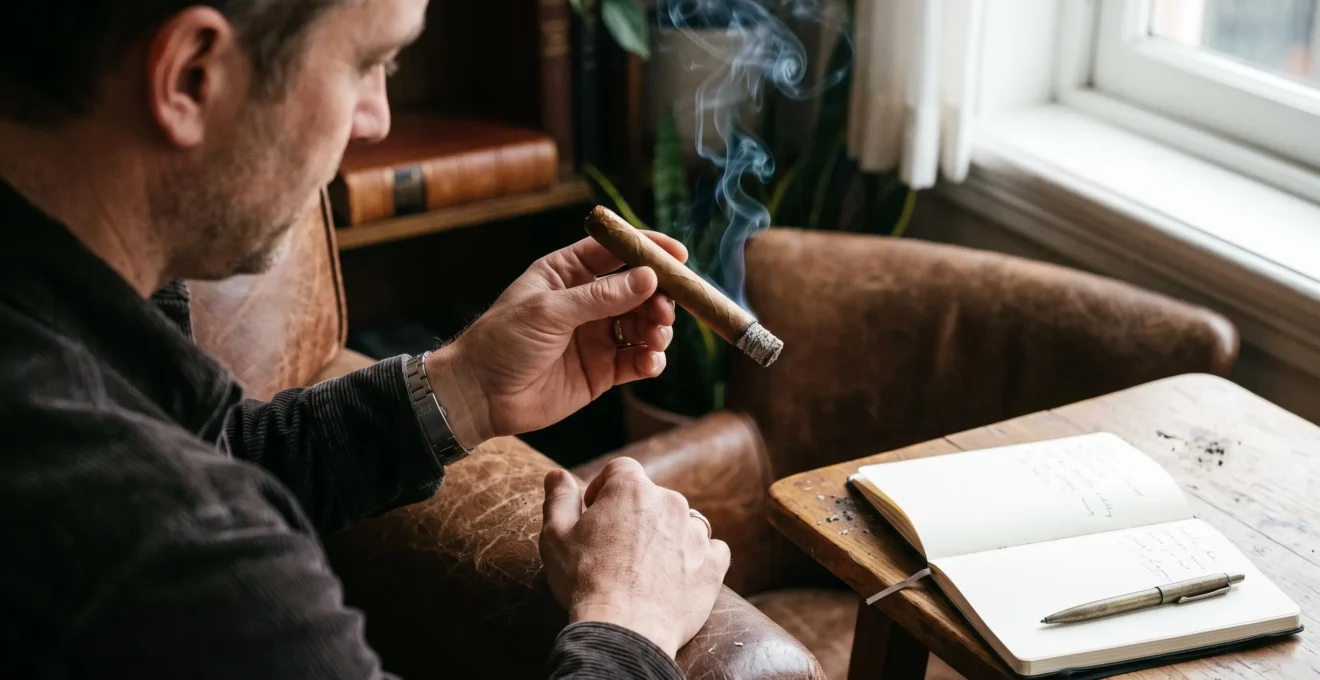
Two cigars can contain similarly strong tobacco yet burn at noticeably different rates. One produces a relatively steady ember and changing aromas; the other needs frequent attention, develops an uneven burn line or becomes sharp before reaching its midpoint. The distinction is not necessarily nicotine strength. Leaf processing, physical construction, moisture and puffing behaviour can all influence what happens.
Tobacco curing changes the leaf’s chemistry and physical condition before blending begins. Temperature, moisture and time affect carbohydrate transformations, colour development and the way leaves become suitable for subsequent processing. Fermentation, which is a separate stage, can further modify chemical constituents associated with irritation.
However, the claim that curing style determines burn speed more strongly than blend strength needs qualification. No single curing label reliably predicts a finished cigar’s combustion rate. Leaf thickness, packing density, storage humidity and smoking intensity remain important variables.
For cigar enthusiasts comparing apparently similar blends, the useful approach is to understand what curing changes, recognise what it cannot explain and avoid mistaking a hurried burn for a leaf-processing defect.
Tobacco curing and cigar burn: the essentials
- Curing influences leaf chemistry and physical properties, but construction, humidity and puffing also affect burn speed.
- Harshness and perceived strength are different sensations; fermentation and combustion conditions can influence irritation independently of a cigar’s strength description.
- Compare lighting, burn consistency and flavour progression before attributing differences between cigars to curing.
- Why Does Proper Curing Reduce Harsh Edges Even When the Cigar Burns Faster?
- How to Spot Curing-Driven Flavours in the First 10 Minutes Without Overthinking Notes?
- Lighter Curing or Heavier Curing: Which Suits a Morning Smoke With Coffee?
- The Misdiagnosis That Blames Curing When the Real Issue Is a Bad Light
- In What Order Should You Assess Curing Influence Across the 3 Thirds for Clearer Notes?
- Why Does Better Barn Ventilation Often Lead to Sweeter Smoke Without Adding Sugar?
- Why Does a Fast Burn Increase Harshness Even When the Cigar Isn’t Strong?
- Why Does Fast Combustion Speed Make Flavours Feel Thin After 15 Minutes?
Why Does Proper Curing Reduce Harsh Edges Even When the Cigar Burns Faster?
Proper curing can help reduce undesirable green-leaf characteristics by allowing controlled chemical and physical changes before tobacco is processed further. Subsequent fermentation may also reduce constituents associated with irritation. Consequently, a relatively fast-burning cigar can sometimes feel smoother than a slower-burning one, although curing alone cannot predict smoothness or combustion speed.
Fresh tobacco contains water, chlorophyll, carbohydrates and numerous other compounds that change during curing. As the leaf loses moisture under controlled conditions, enzymatic processes alter its composition. A cure that ends before appropriate transformations occur can leave undesirable green characteristics, although not every sharp flavour indicates incomplete curing.
Curing and fermentation should not be confused. Curing prepares harvested leaves through controlled drying and associated biochemical changes. Fermentation involves further processing in which chemical reactions and microbial activity can alter tobacco composition.
A 2026 experimental study, Mechanisms for reducing cigar tobacco leaf irritancy during acidic fermentation, examined air-cured Dexue 1 leaves under specified acidic fermentation treatments. Researchers observed changes in free nicotine, ammonia-related chemistry and measured leaf irritancy. These findings support fermentation’s influence on certain chemical properties, but do not demonstrate that ordinary curing makes all cigars smoother.
What an acidic fermentation experiment actually demonstrated
In the 2026 AMB Express study, researchers compared experimental acidic fermentation treatments involving malic acid, including a treatment combining malic acid and glucose, with unfermented tobacco.
The proportion of free nicotine decreased by 37.52% in treatment T2 and 46.98% in treatment T3 relative to the control. These results concern specific experimental conditions, not standard cigar curing or a general reduction in nicotine exposure.
A separate source of harshness is combustion behaviour. Frequent drawing, uneven burning or an excessively dry cigar may produce a sharp sensation without establishing any problem with the original curing process.
As a practical observation, sharpness that changes markedly with puffing behaviour warrants consideration of combustion conditions. Persistent irritation does not, by itself, prove inadequate curing or fermentation: blend composition, storage and individual sensitivity can also contribute.
Another distinction concerns perceived strength. A mild cigar can seem forceful because its smoke irritates the throat, while a nicotine-rich blend can deliver a comparatively smooth sensory impression. Neither experience establishes the cigar’s actual nicotine delivery.
This distinction makes the first few minutes more informative, provided sensory impressions are treated as observations rather than proof of a particular production method. Smoothness is also not a measure of reduced health risk.
How to Spot Curing-Driven Flavours in the First 10 Minutes Without Overthinking Notes?
Use the opening ten minutes to establish a simple sensory baseline: perceived sweetness, smoke texture and any sharpness at the back of the throat. These observations help describe how a cigar begins, but they cannot conclusively identify its curing method. Blend composition, fermentation, storage and lighting can produce overlapping flavour characteristics.
The most useful first impression is often a broad description rather than an elaborate list of aromas. A cigar may feel rounded, dry, grassy, earthy, sweet or distinctly sharp. The question is whether those characteristics remain stable as combustion becomes established.
Three observations can organise an initial comparison:
- Perceived sweetness: Is there a mild sweet impression, or is the flavour primarily dry and earthy? Sweetness is a sensory quality, not proof of elevated sugar content or slow barn curing.
- Sharpness: Is there a pronounced throat sensation, and does it change during the opening period? Such changes may reflect combustion as well as leaf chemistry.
- Smoke texture: Does the smoke seem full, light, dry or coarse? These descriptions help compare experiences without pretending to identify their biochemical causes.
Grassy or hay-like aromas deserve particular caution. They can occur in a range of tobacco profiles and are not definitive evidence of rapid drying. Improper yellowing can leave green characteristics in tobacco leaves, but taste alone cannot establish that a particular cigar experienced this defect.
Similarly, sweetness should not automatically be credited to patient curing. A scientific review of tobacco carbohydrates reports that reducing sugar concentrations can rise during yellowing and subsequently decline as curing progresses. Leaf variety and processing conditions also matter.
For a repeatable comparison, focus on texture, sweetness and sharpness rather than trying to name every fleeting aroma. Record whether the initial impression becomes more balanced, remains consistent or changes abruptly.
A change during these opening minutes is useful information, but assigning it to curing requires corroborating production details. Without those details, the interpretation remains provisional.
The opening profile creates a reference point for later observations, particularly when comparing how two cigars respond to their burn rate. It is also relevant when considering how tobacco aromas interact with coffee.
Lighter Curing or Heavier Curing: Which Suits a Morning Smoke With Coffee?
A cigar with a relatively delicate flavour profile may complement coffee without dominating it, whereas one with darker, more substantial aromas may remain noticeable alongside an intense brew. However, lighter and heavier curing are not precise universal cigar categories, and they do not reliably determine burn speed. Pairing decisions should consider actual flavour, construction and moisture condition.
In cigar discussions, descriptions such as light curing, dark curing or heavily cured tobacco can refer loosely to leaf colour, processing duration or perceived intensity. These characteristics are not interchangeable. Darker tobacco is not necessarily stronger, and longer curing does not automatically produce a richer cigar.
For a morning coffee, the more practical distinction is between complementary and competing flavour profiles. A cigar with restrained aromatic intensity may allow the coffee’s acidity or delicate notes to remain noticeable. A more pronounced tobacco profile may instead become the main sensory focus.
The following comparison describes hypothetical pairing preferences, not scientifically established effects of particular curing methods.
| Decision criterion | Delicate tobacco profile | Fuller tobacco profile |
|---|---|---|
| Coffee character | Subtle or relatively bright flavours | Pronounced roast or fuller-bodied flavours |
| Likely pairing intention | Keep the coffee perceptible | Give the tobacco more sensory presence |
| Potential drawback | Tobacco flavours may be difficult to distinguish beside intense coffee | Tobacco aromas may overshadow delicate coffee notes |
| Burn behaviour | Must be assessed independently | Must be assessed independently |
| What to verify | Actual blend, condition and draw | Actual blend, condition and draw |
A quick espresso and a long mug also represent different drinking rhythms. It may be tempting to assume that a fast-burning cigar naturally suits one and a slower-burning cigar the other. However, burn duration is affected by cigar size, packing, humidity and puffing behaviour; curing colour alone is an unreliable guide.
Choosing exclusively by a manufacturer’s strength label creates a similar problem. Strength generally communicates an intended intensity, often associated with nicotine impact, but it does not specify the leaf’s curing history or predict whether the smoke will become sharp.
For comparison purposes, keep the coffee preparation consistent and note whether the cigar’s perceived sweetness, bitterness or texture changes alongside it. Coffee temperature and flavour intensity can alter perception, independently of tobacco curing.
Differences between apparently similar cigars can also originate before the first sustained draw, especially when lighting creates uneven combustion. That possibility should be considered before assigning a disappointing pairing to curing.
The Misdiagnosis That Blames Curing When the Real Issue Is a Bad Light
An uneven or excessively aggressive initial light can create an irregular burn line and an unpleasant opening flavour that may be mistaken for a curing problem. If combustion begins unevenly, the resulting experience does not provide a clean basis for evaluating leaf processing. Storage condition and cigar construction must also be considered before drawing conclusions.
The first sign is often physical rather than aromatic: part of the cigar foot burns while another portion remains relatively unlit. The smoker then experiences inconsistent combustion, sometimes with one side advancing more quickly.
A noticeably charred area at the foot may indicate excessive local heating. An abrupt change after the earliest section has burned can also suggest that the opening light influenced the initial impression. Neither observation proves the tobacco was cured incorrectly.
A poorly established light is a confounding variable. Before drawing inferences about leaf quality, distinguish between an irregular burn that appears immediately and a recurring pattern observed under otherwise similar conditions.
For an observational comparison, examine how the burn develops beyond the opening portion instead of judging the cigar solely by its first few puffs. If the initial irregularity disappears and the subsequent burn is consistent, the original light is a plausible explanation.
If the same problem persists through the first third, examine other possibilities rather than assigning an automatic curing diagnosis. An uneven bunch, an obstructed draw, wrapper damage or uneven moisture distribution may contribute to the outcome.
Storage deserves particular attention. An overly dry cigar may burn differently from one maintained in an appropriate condition, while uneven moisture can complicate combustion. No single sensation establishes that moisture is the cause, so storage history is more useful than guessing from flavour alone.
Five checks before attributing a burn problem to curing
- Record storage conditions: note the known storage history and any measured humidity information. Deliverable: one short condition note.
- Inspect the cigar: look for visible wrapper damage or obvious irregularities. Deliverable: a recorded condition observation.
- Document the initial burn: note whether the cigar foot begins evenly or displays an obvious asymmetry. Deliverable: an opening-burn description.
- Compare early and later behaviour: record whether the unevenness continues or settles during the first third. Deliverable: a two-stage comparison.
- Separate observation from explanation: classify the result as a possible lighting, storage, construction or unresolved issue. Deliverable: a provisional conclusion that identifies uncertainty.
The same diagnostic discipline protects against two opposite errors: rejecting a well-processed cigar because its opening light was inconsistent, and overlooking genuine product variation because every defect is blamed on technique.
A longer observation across the cigar’s thirds offers a clearer comparison than the opening alone, although it still cannot reveal the full curing history without production information.
In What Order Should You Assess Curing Influence Across the 3 Thirds for Clearer Notes?
Begin with the opening third to establish texture and sweetness, use the middle third to observe how these characteristics evolve, and treat the final third as a check for accumulated combustion effects. This sequence provides a consistent tasting record, but none of the three stages independently identifies curing quality or fermentation history.
Dividing a cigar into thirds is a convenient observational convention. It is not a laboratory-validated method for diagnosing curing defects. Its value comes from comparing the progression of the same product instead of treating individual flavours as isolated events.
The first third establishes a baseline. Describe whether the initial sensory impression seems dry, rounded, sweet, sharp or muted. Avoid assuming that a relatively thin opening demonstrates incomplete curing or that sweetness appearing later proves slow maturation.
In the second third, note whether the original characteristics remain recognisable, become more prominent or diminish. Changes can arise from smoke chemistry, increasing combustion progression, moisture movement and the cigar’s physical design.
The final third introduces further complications. The shorter remaining tobacco column and altered combustion conditions can change smoke delivery and sensory experience. Sharpness appearing late should not automatically be attributed to either heat or curing without additional evidence.
Experimental cigar research has examined smoke emissions at successive portions of cigar consumption. Its measurements demonstrate that smoke composition changes as a cigar burns, but they do not validate the traditional three-thirds tasting framework.
A useful record therefore concentrates on comparable descriptors rather than unsupported causal diagnoses.
| Stage | What to observe | What not to assume |
|---|---|---|
| First third | Initial sweetness, texture, sharpness and burn regularity | Opening flavour directly identifies the curing method |
| Second third | Whether the flavour becomes fuller, flatter or remains consistent | A change in intensity proves a particular fermentation outcome |
| Final third | Changes in sharpness, texture and combustion consistency | Late harshness conclusively identifies immature tobacco |
For each third, write one line describing perceived sweetness and smoke texture. A consistent trajectory makes two cigars easier to compare, while abrupt changes prompt closer consideration of lighting, moisture, construction and smoking behaviour.
The next comparison can be made with another cigar of the same blend and format. Even then, differences between individual cigars, storage conditions and production batches may remain.
Following the cigar’s progression is particularly useful when evaluating claims about barn curing conditions, because processing explanations must account for chemistry rather than rely solely on impressions of sweetness or burn speed.
Why Does Better Barn Ventilation Often Lead to Sweeter Smoke Without Adding Sugar?
Controlled barn ventilation helps maintain the temperature and humidity conditions needed for appropriate tobacco curing. Those conditions influence carbohydrate breakdown and other chemical transformations associated with aroma development. However, better ventilation does not necessarily produce sweeter smoke, and perceived sweetness cannot reliably establish whether sugar was added or how the leaf was cured.
During air-curing, leaves gradually lose moisture while their biochemical composition changes. Air movement helps producers manage drying conditions and avoid excessive moisture accumulation. Yet ventilation must be balanced with ambient humidity and temperature: stronger airflow is not always better.
Excessive drying can interfere with desirable processing stages, while prolonged excessive humidity can damage leaf quality. Curing therefore involves regulating several interacting variables rather than simply allowing the greatest possible airflow.
The underlying chemistry is more complicated than the phrase « slow curing preserves sugar » suggests. The scientific review of tobacco carbohydrates and aroma formation, published in Molecules in 2020, explains that sugar concentrations depend on tobacco variety, harvesting and curing conditions, including temperature, time and moisture.
During curing, complex carbohydrates can break down while concentrations of simpler sugars change. Reducing sugars may increase during yellowing before declining later. Air-cured tobacco generally has lower residual sugar levels than tobacco subjected to some higher-temperature curing processes.
Perceived sweetness is not equivalent to measured residual sugar. Aromatic compounds, tobacco composition and sensory interactions can contribute to a sweet impression even when the finished leaf contains relatively little sugar. The same review also notes that carbohydrate chemistry can contribute to harmful compounds during combustion.
Agronomic defects demonstrate why environmental control matters. The INRAE reference on defects in air-cured tobacco identifies inadequate yellowing, low relative humidity and cold temperatures among possible causes of persistent greenish leaf tissue. Excessive humidity during another curing stage can cause barn scald.
These observations concern the condition of tobacco leaves. They do not demonstrate that a cigar with a particular flavour received more or less barn ventilation.
Marketing language creates an additional ambiguity. Descriptions such as naturally sweet, carefully cured or traditionally aged may refer to sensory characteristics or production practices, but they are not standardised measurements of curing duration, residual sugars or combustion performance.
For a useful comparison, request concrete production information where available: curing method, handling conditions, fermentation approach and leaf origin. Even detailed production information does not replace the influence of bunching, storage moisture and smoking behaviour on the finished cigar.
Curing can shape the material that eventually burns, but the moment-to-moment behaviour of the burning cigar introduces another set of variables. That is where a mild blend can still produce an unexpectedly harsh impression.
Why Does a Fast Burn Increase Harshness Even When the Cigar Isn’t Strong?
A rapidly burning cigar can feel harsh even when its blend is described as mild because strength and combustion conditions are different variables. Puff frequency, puff volume and the cigar’s physical characteristics influence smoke production and emissions. A sharp sensation may accompany unfavourable combustion conditions without establishing that the underlying tobacco contains more nicotine.
Blend strength is commonly discussed in terms of perceived impact and nicotine-related intensity, but manufacturers’ strength descriptions are not a standardised chemical measurement. Sensory harshness, meanwhile, refers to irritation or sharpness and can vary independently of the intended strength category.
Combustion complicates that distinction. Draw behaviour affects the supply of air to the burning tobacco, while moisture, leaf characteristics and construction also influence the burning system. A faster visible burn does not, by itself, establish a particular combustion temperature or chemical exposure.
In experimental research on cigar burning and smoking intensity, Dethloff and colleagues examined differing puff frequencies and volumes and measured smoke emissions as cigars burned. Their findings showed that smoking intensity and progression through the cigar affect emissions, including nicotine, carbon monoxide and water.
The study supports the importance of smoking behaviour when comparing combustion outcomes. It does not directly establish that a faster burn always feels harsher or that a specific puffing pattern guarantees a smoother experience.
Moisture condition provides another possible explanation. A cigar that has become unusually dry may behave differently from one maintained under suitable storage conditions. However, dry storage cannot be diagnosed from harshness alone, and an irregular burn may originate in construction or lighting.
There is also a potential behavioural feedback loop: someone experiencing an uneven or unsatisfactory burn may draw more frequently to maintain combustion. That changes smoking intensity and makes the resulting experience less suitable for comparing the original blends.
The most important distinction is between product characteristics and smoking conditions. Describing a cigar as mild does not promise low emissions, while describing it as smooth does not imply that its smoke is safe.
Once this distinction is established, the remaining question is why a cigar’s flavour can seem less complex as the session continues, even when the blend itself has not changed.
Key takeaways before assessing flavour loss
- A cigar’s flavour can evolve during combustion without any change to its original blend composition.
- Smoking intensity and progression through the cigar affect measured emissions, but subjective flavour changes require separate evidence.
- Comparing identical cigars under different conditions can reveal variation, though it cannot isolate curing as the cause without controlling other factors.
Why Does Fast Combustion Speed Make Flavours Feel Thin After 15 Minutes?
A cigar may seem less aromatic after its opening minutes because combustion conditions, smoke composition and sensory perception change as smoking progresses. Frequent drawing and uneven burning can contribute to an inconsistent experience. However, there is no established universal fifteen-minute threshold at which fast combustion makes flavours thin, nor proof that curing style alone controls how long flavours persist.
The sensation of thinness generally describes a loss of perceived depth or aromatic variety rather than a measured reduction in one chemical compound. It may reflect a changing balance of aroma, smoke texture and irritation.
Tobacco smoke contains numerous compounds formed or transferred during heating and combustion. Their delivery is not constant throughout a cigar. Research measuring emissions over successive portions of cigar consumption has documented changes in nicotine, water and carbon monoxide delivery, influenced by smoking intensity and the progression of combustion.
Those findings cannot be translated directly into named flavours or subjective complexity. A change in measured smoke composition does not necessarily correspond to an identifiable change in perceived sweetness, body or aromatic depth.
Likewise, the explanation that rapid combustion destroys delicate aromatics and leaves only blunt smoke notes is a plausible sensory hypothesis, not a demonstrated general rule for cigars. Different flavour compounds have different formation and transfer mechanisms, and no simple curing-to-flavour-duration equation has been established.
Consider a hypothetical comparison involving two cigars from the same production line. One appears vivid during the opening period but becomes less distinctive later; the other maintains a more consistent sensory profile. Even if their burn rates differ, the observation does not prove that curing caused the difference.
Physical variation between the individual cigars, packing density, moisture distribution, initial lighting and differences in puffing behaviour remain alternative explanations. Repeating observations across multiple examples would strengthen a comparison, although it would still not constitute a controlled experiment.
Hypothetical comparison: two sessions with the same cigar model
Imagine recording two separate sessions using cigars of the same model and comparable storage history. In the first, the observer notes rapid apparent flavour changes and irregular combustion. In the second, the recorded flavour trajectory is more consistent and the burn appears steadier.
The appropriate conclusion is that the two experiences differed under their respective conditions. The observation provides a reason to examine lighting, construction, moisture and puffing patterns, but does not establish that either cigar was cured differently. No numerical effect or guaranteed improvement can be inferred.
Available smoking time is another practical consideration, but cigar dimensions and construction are better starting points for estimating a session’s duration than vaguely defined light or heavy curing labels. A comparatively short smoking session also should not be assumed to preserve more flavour simply because the cigar burns faster.
Curing influences the starting material; combustion governs how that material is consumed. Fermentation further affects tobacco chemistry, while physical construction and smoking intensity help determine the evolving smoke. Blend strength describes a different dimension of the product.
The central question therefore has a conditional answer. Curing can materially influence tobacco properties relevant to flavour and burning, but the supplied scientific evidence does not establish that curing style changes cigar burn speed more than blend strength does. Neither variable alone adequately predicts a cigar’s performance over time.
When comparing cigars, keep a concise record of their known production characteristics, storage conditions, burn consistency and flavour progression. Use the observations to ask more precise questions about the product rather than treating smoothness or burn speed as proof of curing quality. Tobacco smoke remains harmful regardless of how smooth, mild or evenly burning a cigar appears.
Is air-cured tobacco always slower-burning than flue-cured tobacco?
No. Air-curing and flue-curing produce different processing conditions and can result in different leaf chemistry, but they do not establish a universal burn-speed ranking for finished cigars. Leaf properties, blend composition, construction and moisture all influence combustion. The tobacco carbohydrate research discussed above supports chemical differences between curing methods, not a guaranteed difference in finished cigar burn rate.
Can the colour of a cigar wrapper reveal how long its tobacco was cured?
Not reliably. Wrapper colour can reflect tobacco variety, growing conditions, harvesting, curing and subsequent processing. A darker wrapper does not establish a longer curing period, greater nicotine strength or slower burn. Production information is needed to make a defensible statement about the leaf’s processing history.
Does fermentation continue the same process as curing?
No. Although both can alter tobacco chemistry, they are distinct processing stages. Curing involves controlled drying and associated biochemical changes in harvested leaves. Subsequent fermentation can involve further chemical and microbial transformations. The 2026 acidic fermentation experiment demonstrates treatment-specific chemical changes but does not establish equivalent results for conventional curing.
Does an evenly burning cigar prove that its tobacco was properly cured?
No. Even combustion may be associated with suitable construction, consistent moisture and a well-established initial light. It is not a definitive test of leaf curing or fermentation. A cigar can burn evenly while retaining undesirable sensory characteristics, and one made from appropriately processed tobacco can burn irregularly because of physical or storage-related factors.
Does smoother cigar smoke mean that it contains fewer harmful substances?
No. Perceived smoothness is a sensory characteristic, not a reliable indicator of toxicant emissions or health risk. Experimental changes in leaf irritancy do not establish that finished cigar smoke is safe. Tobacco combustion produces harmful substances, and reduced throat irritation should never be interpreted as evidence of reduced harm.