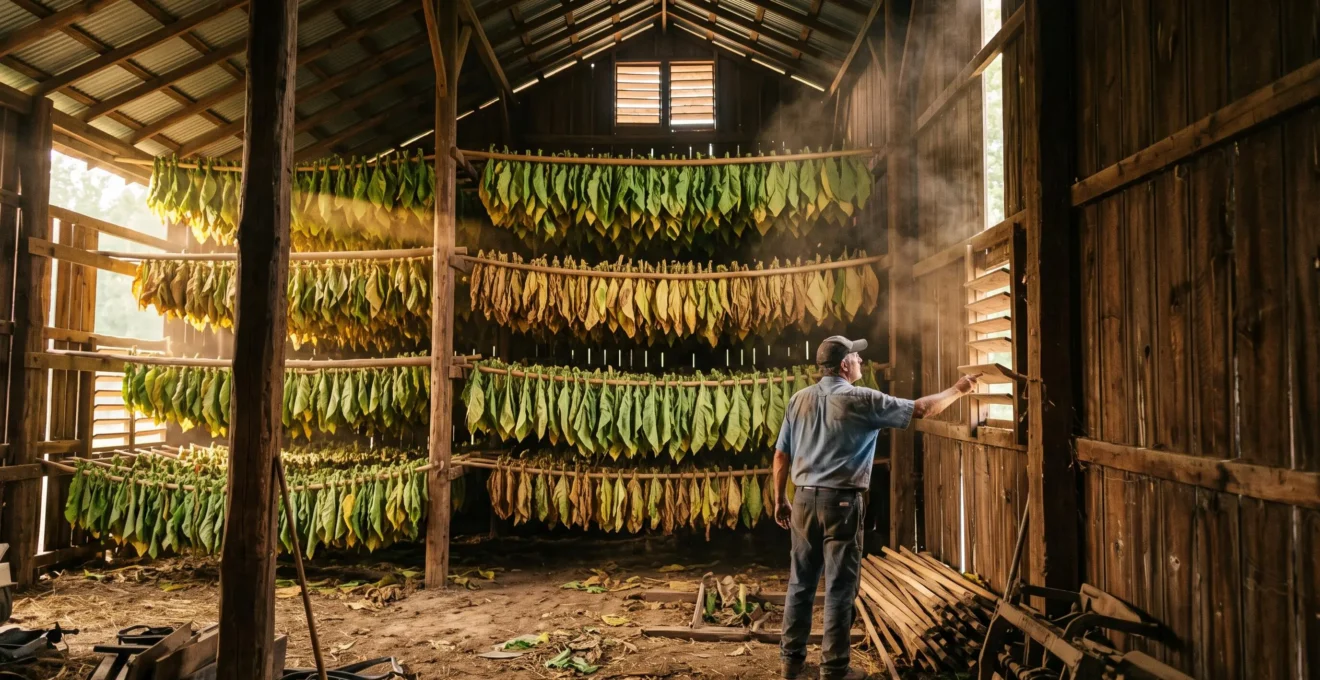
A tobacco curing barn does considerably more than dry harvested leaves. Its openings, ventilation patterns, temperature and humidity influence the biochemical transformations that prepare tobacco for fermentation. Those transformations help determine which aromatic compounds may eventually contribute to the character of a finished cigar.
For a UK cigar enthusiast, the important distinction is between aroma development and perceived strength. A cigar can have recognisable notes of wood, earth, coffee or leather while retaining a substantial nicotine impact. Conversely, a cigar described as mellow can still deliver muddled or irritating smoke.
The 90-day reference in the title should not be treated as a universal curing threshold. Traditional air-curing frequently takes substantially less time, and producers may subsequently ferment or age tobacco for much longer. Research supports the importance of curing conditions for aroma chemistry, but does not establish that airflow necessarily changes aroma more than nicotine-related strength after exactly 90 days.
Understanding the sequence—from barn ventilation to fermentation, rolling and storage—makes the expression “barn-cured” much more useful when reading cigar descriptions.
What barn curing actually tells you
- Controlled airflow supports gradual moisture loss and chemical transformations that influence tobacco aroma; more ventilation is not automatically better.
- Perceived smoothness, aromatic clarity and nicotine strength are different characteristics, so a full-bodied cigar need not taste harsh.
- Curing claims cannot guarantee sweetness, even combustion or a particular result after 14, 60 or 90 days. Fermentation, construction and storage also matter.
- Why Does Better Barn Ventilation Often Lead to Sweeter Smoke Without Adding Sugar?
- How to Decode « Barn-Cured » Notes on a Website When Details Are Vague?
- Wrapper Type or Curing Method: What Should You Prioritise Under £15?
- The « Slow-Cured Burns Perfectly » Mistake That Leads to Constant Touch-Ups
- When Should You Rest Barn-Cured Cigars for 14 Days to Get a Clearer Aroma?
- Why Can Air-Dried Tobacco Taste Cleaner Even When the Cigar Is Full-Bodied?
- Why Does Fermentation Heat Reduce Harshness Even When Nicotine Feels Strong?
- Why Does Tobacco Fermentation Change Sweetness After 60 Days but Not After 10?
Why Does Better Barn Ventilation Often Lead to Sweeter Smoke Without Adding Sugar?
Better-managed barn ventilation can contribute to tobacco that eventually produces smoother, more clearly defined aromas without adding sugar. The benefit comes from controlling moisture loss and allowing biochemical transformations to progress, rather than simply exposing leaves to more air. Sweetness perceived in finished cigar smoke does not necessarily mean that the cured tobacco contains more residual sugar.
Fresh tobacco contains moisture, pigments and numerous chemical precursors. As harvested leaves hang in a curing barn, they lose water while enzymes and microorganisms participate in changes affecting their composition. Chlorophyll breaks down, leaf colour changes and some compounds associated with later aroma development are transformed.
The distinction between controlled and excessive ventilation matters. Insufficient airflow can leave tightly packed leaves damp for too long, whereas strong dry currents may remove moisture faster than the desired transformations can proceed.
itemprop= »name »>Tobacconist University’s explanation of air-curing describes how traditional curing barns use ventilation openings to manage humidity and temperature. It also identifies approximately 40–60 days as a traditional curing reference, rather than a fixed requirement for every tobacco crop.
Two meanings of sweetness should be distinguished. Residual sweetness concerns naturally occurring compounds remaining in the tobacco. Perceived sweetness describes a sensory impression that may become more apparent when irritating or competing notes are less prominent. Neither can be inferred from ventilation alone.
A 2026 study in Frontiers in Microbiology investigated how microbial communities and pigment-derived precursors change during cigar tobacco air-curing. The researchers demonstrated that selected bacterial strains could convert beta-carotene into aroma-related compounds, including linalool and tabanone 2.
The 2026 Frontiers in Microbiology study on aroma formation during air-curing, corrected in September 2026, provides a plausible biochemical explanation for why curing influences later aromatic potential. It does not establish that greater ventilation always makes smoke sweeter.
For sensory interpretation, it can be useful to note whether sweetness is perceived at the beginning, middle or end of a cigar. Such observations describe the smoking experience, however, not the original airflow conditions. Tobacco blending, combustion temperature and moisture also influence when particular aromas become noticeable.
Even neighbouring barns can produce differences if their temperature, humidity and airflow vary. Without production records, those differences cannot reliably be reconstructed from smoke flavour alone.
How to Decode « Barn-Cured » Notes on a Website When Details Are Vague?
“Barn-cured” is a useful starting description, but it is not a precise flavour classification. To interpret it, identify the actual curing method, the tobacco’s origin and any details about the drying environment or duration. If a seller provides none of these, treat the term as an incomplete manufacturing description rather than evidence of superior aroma.
Air-curing is especially relevant to premium cigar tobacco. Harvested leaves hang in ventilated structures while moisture decreases and the leaf undergoes chemical changes. Traditional Cuban curing houses, known as casas de tabaco, use arrangements such as wooden hanging poles or laths called cujes.
Other curing methods should not be conflated with this process. Sun-curing relies on solar exposure and is associated with certain tobacco traditions, including some Oriental tobaccos. Fire-curing exposes leaves to smoke from controlled fires and can introduce a distinctive smoky character. These are different processes, not interchangeable versions of “barn-cured”.
Descriptions involving cedar require particular care. Cedar storage, cedar-lined packaging and cedar-like tasting notes do not independently demonstrate how harvested tobacco was cured.
The following distinction helps separate useful production information from language that merely sounds specific.
| Website description | What it reasonably indicates | What remains unknown |
|---|---|---|
| Barn-cured | Tobacco was reportedly cured in a barn or comparable structure. | Method, duration, ventilation and fermentation. |
| Air-cured | Leaves were dried through an air-curing process. | Exact temperature, humidity and final sensory outcome. |
| Slow-cured | A producer claims a relatively gradual process. | The comparison standard and measurable duration. |
| Traditionally cured | A claim about production heritage or practice. | Which operations were actually performed. |
Country of origin can help contextualise the claim, but national or regional tobacco categories should not be mistaken for universal, standardised ventilation specifications. A Cuban or Dominican origin alone cannot verify a particular barn treatment.
Five checks for a vague barn-curing product description
- Record the exact curing phrase from the product listing. Deliverable: a verbatim note that distinguishes a specific method from general marketing language.
- Identify the stated origin of the wrapper, binder and filler. Deliverable: a component-by-component origin record, including any undisclosed information.
- Check whether the seller names air-, sun- or fire-curing. Deliverable: a confirmed method or an explicit “not specified” entry.
- Ask the retailer about curing duration, ventilation conditions and subsequent fermentation. Deliverable: a written response or a record of unanswered questions.
- Compare the retailer’s reply with the original description. Deliverable: a short assessment identifying verified details, unsupported claims and remaining uncertainty.
Specific answers do not guarantee a particular tasting result, but they make it easier to distinguish traceable production details from unsupported assumptions. That distinction becomes particularly useful when comparing cigars within a limited budget.
Wrapper Type or Curing Method: What Should You Prioritise Under £15?
Under £15, prioritise information that matches the question you want answered rather than assuming either wrapper type or curing method always matters more. Curing and fermentation can influence the aroma of the tobacco blend, while wrapper characteristics, filler construction and moisture also affect the smoking experience. No reliable evidence establishes one component as universally dominant within this price range.
For someone specifically interested in the meaning of “barn-cured”, useful information about the filler and its processing is more relevant than a wrapper colour description alone. The filler forms a substantial part of many handmade cigars, although the relative contribution of each component depends on the blend and format.
A wrapper can also have an important sensory influence. Its variety, growing conditions and processing affect its characteristics, and its condition can influence combustion. It would therefore be misleading to suggest that wrapper choice concerns only appearance.
Smaller ring-gauge cigars may expose the smoker to a different proportion of wrapper tobacco than larger formats, but the sensory contribution cannot be calculated from dimensions alone.
| Comparison priority | More useful information | Main limitation |
|---|---|---|
| Understanding barn-curing aroma | Filler origin, curing method and fermentation description. | Production details do not predict exact tasting notes. |
| Understanding wrapper character | Wrapper variety, origin and processing. | Colour alone is an unreliable flavour guide. |
| Understanding combustion | Construction quality, moisture condition and storage history. | Neither curing nor wrapper labels guarantee an even burn. |
| Comparing value under £15 | Transparent specifications, format and retailer information. | Price does not independently establish production quality. |
Consider a hypothetical comparison between two cigars advertised at the same price. One lists a visually attractive wrapper but says little about its filler. The other identifies its tobacco origins and curing method. The second offers more information for studying curing, but that does not prove it tastes better or is better constructed.
A smooth opening followed by rougher smoke later in the session should not automatically be blamed on poorly cured filler. Puffing rate, smoking temperature, moisture and blend composition provide competing explanations.
Once the distinction is clear, another common misunderstanding becomes easier to avoid: assuming that slower curing necessarily produces more consistent combustion.
The « Slow-Cured Burns Perfectly » Mistake That Leads to Constant Touch-Ups
Slow curing does not guarantee a perfectly even cigar burn. Curing influences the condition and composition of tobacco leaves, but combustion also depends on how the cigar is blended and rolled, its moisture content and the way it is smoked. Repeated lighter touch-ups may indicate construction or storage issues rather than a defect in the original drying process.
Air-curing can contribute to tobacco combustibility, yet the finished cigar is a complex assembly. Leaves with different physical properties are combined inside a binder and wrapper, creating variations in density and airflow.
When moisture is excessive or the internal construction is uneven, a cigar may burn inconsistently despite having undergone careful curing and fermentation.
Frequent corrections can make interpretation harder. Repeated direct heating may overheat a portion of the cigar, potentially introducing scorched or bitter impressions that obscure its underlying blend.
A practical assessment begins with the burn pattern and draw rather than another application of flame. A persistently resistant draw may suggest excessive packing or moisture; an uneven burn on one side may have several explanations, including differences in construction or environmental conditions. Neither observation is diagnostic by itself.
The difference between tobacco transformation and cigar construction is therefore fundamental. Curing prepares leaves for later processing; fermentation changes their chemical characteristics; rolling determines how those leaves are physically arranged. Storage can subsequently alter their moisture condition.
A product description that says “slow-cured” provides no direct evidence about rolling consistency, draw resistance or the moisture of the cigar when purchased.
Nor should one imperfect burn be treated as proof of defective manufacturing. An isolated observation is less informative than recurring behaviour across comparable cigars stored under comparable conditions.
Before attributing inconsistent smoke to curing, it is worth considering another variable that changes after manufacture: how the finished cigar has been stored and transported.
When Should You Rest Barn-Cured Cigars for 14 Days to Get a Clearer Aroma?
A 14-day rest can be a reasonable observation period for cigars that have recently experienced changing storage conditions, but it is not a universal requirement. The purpose is to allow moisture distribution to become more consistent after transport or environmental changes. Whether the resulting aroma becomes clearer depends on the cigar’s initial condition, construction and storage history.
A finished cigar contains leaves with different structures and moisture-retention characteristics. Changes in surrounding humidity do not necessarily affect every layer at the same rate.
After transport or a change of storage environment, the wrapper, binder and filler may need time to approach a more stable moisture balance. The required period can vary with cigar diameter, packaging, previous storage conditions and the magnitude of the environmental change.
It is important to separate two different processes:
- Stabilisation rest: allowing a finished cigar’s moisture condition to settle after environmental changes.
- Longer-term ageing: storing cigars for an extended period during which additional chemical and sensory changes may occur.
These processes should not be confused with the original barn-curing stage. A cigar stored for two weeks does not undergo the same transformations as freshly harvested leaves hanging in a curing house.
An enthusiast comparing storage outcomes can record the initial cold aroma, storage history and observed physical condition, then repeat the assessment after a rest period. This is a personal comparison, not a validated test of curing quality.
If a cigar seems unusually hot, bitter or indistinct, moisture imbalance is one possible explanation. However, blend characteristics, smoking technique and construction may also account for those impressions. Additional rest is not guaranteed to correct them.
The scientific literature discussed here does not establish 14 days as an optimal consumer resting period. Avoid treating the number as a quality threshold.
Once storage effects are considered separately, it becomes easier to interpret one of the most confusing tasting combinations: substantial body alongside relatively clean, distinct aromas.
Why Can Air-Dried Tobacco Taste Cleaner Even When the Cigar Is Full-Bodied?
Air-dried tobacco can contribute to a full-bodied cigar with clearly distinguishable aromas because perceived strength and aromatic clarity are not the same characteristic. Nicotine-related impact, smoke concentration and flavour intensity can remain substantial even when processing reduces some undesirable sensations. Air-curing may support aromatic development, but it does not guarantee a clean or smooth finished cigar.
Descriptions such as “full-bodied”, “strong” and “harsh” are often used interchangeably, although they refer to different experiences.
Strength commonly describes perceived physiological impact, including nicotine effects. Body refers more broadly to the perceived weight and intensity of smoke. Aromatic clarity describes how distinctly individual notes can be recognised rather than obscured by competing sensations.
For example, two hypothetical cigars might both be described as full-bodied. One may present distinguishable impressions resembling dry wood, roasted coffee and leather. The other may seem dominated by bitterness, stale or musty notes, or an indistinct smoky character.
Those impressions cannot, on their own, reveal whether either cigar was correctly air-cured. Fermentation, blending, combustion and storage remain relevant.
Research published in 2023 examined enzyme activity and microbial communities during cigar tobacco air-curing and fermentation. It found substantial changes in metabolic enzyme activity during curing, with microbial populations differing between the two processing stages.
The PubMed record of the 2023 study on cigar tobacco curing and fermentation supports the conclusion that these are connected but distinct phases of transformation. It does not establish a universal relationship between curing conditions and perceived smoking strength.
Environmental control also has limits. Inadequate drying or persistently damp conditions can create spoilage risks. Visible mould is not evidence of desirable ageing or successful curing.
Consequently, “air-dried” is best understood as a process description, not an automatic synonym for cleanliness, sweetness or quality.
To understand that distinction more fully, the next stage to examine is fermentation, where temperature and microbial activity influence tobacco chemistry after curing.
Why Does Fermentation Heat Reduce Harshness Even When Nicotine Feels Strong?
Heat generated during controlled tobacco fermentation can accompany chemical and microbial transformations that reduce certain undesirable characteristics of cured leaves. A cigar may consequently seem less harsh without necessarily feeling weak. However, fermentation does not leave nicotine universally unchanged, and a smoother sensory profile should not be interpreted as proof of lower nicotine exposure or reduced health risk.
After curing, tobacco may be gathered into fermentation piles. Moisture, biological activity, pile size and surrounding conditions affect how temperature develops within the tobacco mass.
As fermentation progresses, chemical constituents and microbial communities change. The process may reduce or transform some compounds associated with undesirable odours and sensations while modifying the precursors that contribute to the finished tobacco’s aroma.
The central distinction is between physiological strength and sensory harshness. A strong nicotine impression can coexist with a relatively smooth smoke because those outcomes do not arise from precisely the same variables.
Leaf variety, growing conditions and position on the plant help determine its original composition. Curing and fermentation subsequently alter that material, while blending and smoking conditions influence what is perceived in the finished cigar.
Fermentation is not simply a matter of heating tobacco as much as possible. Excessive or poorly controlled conditions can damage the material and undermine quality. Producers must manage the process according to the properties and condition of the tobacco being treated.
Another misconception concerns the development of strength during a smoking session. A cigar that seems progressively stronger is not necessarily proof of successful fermentation. Changes in smoke concentration, combustion and the smoker’s experience can affect perception independently of the original fermentation process.
Likewise, unusually aggressive smoke at the beginning of a cigar may warrant questions about processing, but it cannot diagnose incomplete fermentation without further evidence.
The 2023 microbiological research described earlier supports the existence of different enzymatic and microbial changes across curing and fermentation. It does not establish an exact nicotine-retention rule or a sensory test that definitively measures fermentation success.
Temperature alone also cannot explain how far fermentation has progressed. Duration matters, but only in conjunction with the biological material and the conditions maintained throughout processing.
Key takeaways before comparing fermentation durations
- Do not treat fermentation time as a substitute for information about temperature, moisture and tobacco type.
- Early reduction of undesirable odours and later aromatic development may occur at different stages, without following a universal timetable.
- Use descriptions of sweetness or smoothness as sensory observations, not as proof of fermentation duration or reduced nicotine exposure.
Why Does Tobacco Fermentation Change Sweetness After 60 Days but Not After 10?
Tobacco fermentation may produce more noticeable aromatic changes over 60 days than over 10 because biochemical transformations require time and depend on the conditions maintained during processing. Yet neither duration guarantees a particular sweetness outcome. Different tobaccos, pile sizes, moisture levels and temperatures can produce different rates of transformation, making a fixed comparison unreliable.
Fermentation is a continuing process rather than a single event. During its earlier stages, changes in volatile compounds and other constituents may alter odour and reduce some undesirable characteristics. Other transformations may continue across subsequent fermentation cycles.
In traditional pile fermentation, the condition of the tobacco mass is monitored and the material may be rearranged as part of process management. Such handling can help address differences in temperature and moisture within the pile, although the appropriate approach depends on the tobacco and production system.
A 2024 experiment in Frontiers in Microbiology examined finished handmade cigars kept under different oxygen conditions for 60 days. Researchers compared microbial communities, chemical constituents and sensory characteristics.
Research example: oxygen conditions during 60 days of cigar ageing
The researchers studied handmade cigars from the same batch under experimental oxygen conditions reported as 0.1%, 6–12% and 15% of atmospheric oxygen concentration. They measured differences in microbial communities and tobacco chemistry during the 60-day period.
Within the tested conditions, the cigars treated at the reported 15% oxygen level received the most favourable quality evaluation, particularly for flavour richness and sweetness. This was a study of finished cigars during post-rolling treatment, not an experiment on airflow through a traditional barn or on freshly harvested leaves.
The 2024 Frontiers in Microbiology experiment on oxygen and cigar aging offers evidence that processing atmosphere can affect microbial communities and measured quality characteristics. It does not provide recommended ventilation settings for curing barns or establish that 60 days is universally preferable to 10.
Oxygen concentration, airflow rate and humidity are different variables. An experimental oxygen treatment must not be converted directly into advice about opening barn vents or altering commercial fermentation piles.
There is also no fixed guarantee that fermentation produces progressively sweeter smoke. Chemical changes may support compounds associated with desirable aroma, while the final sensory outcome remains dependent on blending, subsequent processing and smoking conditions.
For an enthusiast studying production descriptions, a practical interpretation is to look for evidence of controlled processing rather than a headline duration alone. Information about the original curing method, the distinction between curing and fermentation, and the existence of subsequent ageing stages is more informative than a claim that all tobacco reaches an optimal flavour after a specific number of days.
Cold aroma and the absence of an obvious ammonia-like note may offer descriptive observations, but neither provides a scientifically validated measurement of fermentation completion. Burn regularity is even less specific because construction and storage can strongly affect it.
The most useful next step when evaluating a barn-curing claim is to distinguish what the producer actually discloses—curing conditions, fermentation practices and storage history—from what a tasting description merely suggests. That approach connects production with sensory experience without treating sweetness, strength or a particular number of days as proof of quality.
Is barn curing the same as fermentation?
No. Barn curing generally refers to the initial treatment of harvested tobacco leaves, often involving gradual moisture loss and biochemical changes during air-curing. Fermentation is a subsequent processing stage involving additional chemical and microbial transformations. Both can influence aroma, but they should not be described as the same operation.
Does a longer curing period always create more complex aromas?
No. Curing duration must be interpreted alongside leaf characteristics, climate, humidity and ventilation. Longer exposure to unsuitable conditions may damage rather than improve tobacco. Available research does not establish a universal relationship between additional curing days and greater aromatic complexity in finished cigars.
Can a producer verify that a cigar was traditionally barn-cured?
A producer may provide information about the curing facility, method, tobacco origin and approximate processing period. Such documentation can substantiate the manufacturing claim, although it cannot guarantee a specific flavour. A retailer’s inability to provide those details leaves the claim less informative, but does not independently prove it false.
Does sweeter-tasting cigar smoke contain less nicotine?
Not necessarily. Perceived sweetness is a sensory characteristic, whereas nicotine content depends on the tobacco and its processing. A smoother or sweeter flavour cannot reliably establish lower nicotine exposure. Cigar smoke also presents health risks regardless of perceived mildness or smoothness.
Can the age of a finished cigar reveal how long its tobacco was cured?
No. The storage age of a finished cigar is separate from the time its harvested leaves spent curing and fermenting. A cigar aged for several months may contain tobacco processed over very different periods. Curing duration requires production information rather than inference from the cigar’s age or taste.