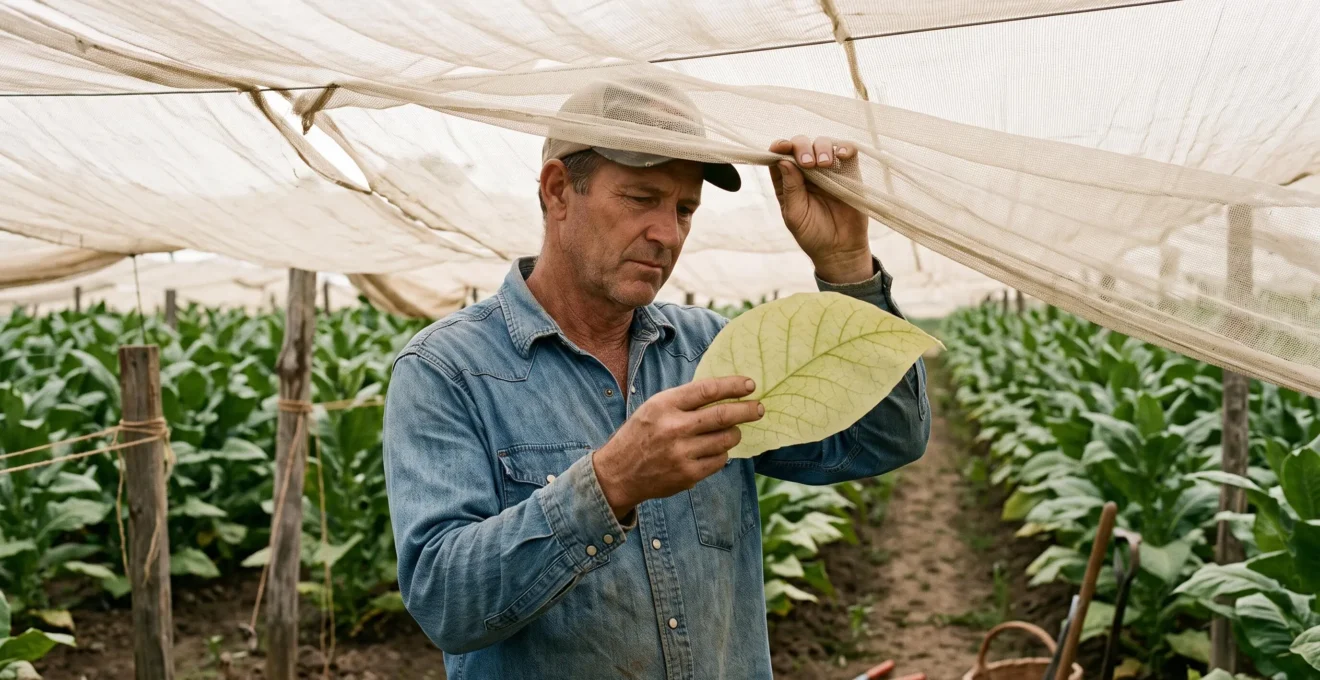
Shade-grown cigar wrappers are cultivated beneath protective fabric that filters direct sunlight and changes the growing conditions around the tobacco plants. The resulting leaves have historically been prized for their thin structure, smooth surface and fine veins. These qualities help explain why shade-grown wrappers often look delicate and contribute restrained sensory notes.
Yet a pale, silky wrapper does not guarantee a mild cigar or a perfectly straight burn. The binder and filler influence the blend’s overall strength, while tobacco moisture, construction and lighting technique affect combustion. Shade cultivation creates particular leaf characteristics; it does not remove those other variables.
For enthusiasts encountering terms such as Connecticut Shade, Claro or Sun-Grown on cigar descriptions, the useful distinction is between what cultivation can genuinely predict and what remains dependent on blending and handling. Understanding that distinction makes it easier to interpret wrapper colour, assess texture and recognise why an otherwise elegant cigar may occasionally burn unevenly.
Shade-grown cigar wrappers: the essentials
- Shade cultivation encourages thinner, smoother leaves with finer veins, but wrapper appearance does not reliably indicate the strength of the complete blend.
- Delicate flavour and an even burn are different characteristics. Consistent combustion also depends on construction, moisture balance and lighting.
- Colour and texture provide useful clues, but no single tactile or visual test can conclusively identify how a wrapper was grown.
- Why Do Shade-Grown Wrappers Often Feel Smoother Even When the Blend Isn’t Mild?
- How to Read a Shade-Grown Wrapper by Touch Without Damaging the Leaf
- Shade-Grown or Sun-Grown Wrapper: Which Holds Interest Better in a 45-Minute Smoke?
- The Humidity Mistake That Makes Shade Wrappers Lift and Canoe
- When Should You Stop Toasting a Shade Wrapper to Avoid Scorch Marks?
- Why Does a Thin Wrapper Create Brighter Flavour but Show Burn Flaws Faster?
- Why Do Claro Wrappers Show Grassy Notes Early but Turn Creamier Mid-Smoke?
- Why Does the Wrapper Leaf Decide the First 20 Minutes More Than the Filler Does?
Why Do Shade-Grown Wrappers Often Feel Smoother Even When the Blend Isn’t Mild?
Shade-grown wrappers often feel smoother because covered cultivation can produce thinner leaves with finer veins and a more uniform surface. These physical characteristics say little about the strength of the completed cigar. A delicate Connecticut Shade wrapper can surround a substantial filler blend, creating a cigar whose gentle exterior contrasts with its fuller smoking character.
Traditional Connecticut shade cultivation uses a cheesecloth canopy supported above tobacco plants. The canopy modifies more than the amount of sunlight reaching the leaves: it also affects airflow, humidity and evaporation.
Historical research documented these combined environmental conditions and identified finer veins, thinner tissue and smoother surfaces as desirable outcomes for wrapper production. The Connecticut Agricultural Experiment Station’s Tobacco Culture in Connecticut bulletin, published in 1934, provides an agricultural account of this cultivation system.
The important distinction is that the canopy changes the growing environment rather than simply slowing every aspect of leaf development. The historical evidence supports the resulting leaf characteristics but does not demonstrate that reduced sunlight slows expansion or produces smaller oil pockets.
“The object of growing tobacco under cheese cloth is to produce thinner, smoother leaves with smaller veins, thus more suitable for fine cigar wrappers.”
On a finished cigar, the fingers may notice a relatively smooth surface interrupted by fine, shallow veins. That physical refinement is separate from the sensory impression of strength. Wrapper tobacco contributes to flavour, but the filler and binder account for much of the material smoked and can produce considerable body regardless of the wrapper’s appearance.
Shade-grown wrappers are frequently described as less oily or less assertive than some sun-grown varieties. However, surface oil varies with seed, growing conditions and processing. It is not established that all shade-grown leaves contain less oil or that this alone explains reduced spice.
Consider a hypothetical cigar containing a pale Connecticut Shade wrapper around a ligero-rich filler blend. Its opening might suggest light bread or cream, while subsequent draws reveal a firmer body and stronger tobacco character. The wrapper’s delicate presentation would not contradict that outcome.
The practical lesson is to treat cultivation as a clue to leaf structure and possible aromatic character, not as a shortcut for predicting nicotine delivery or blend strength. That distinction also matters when examining a wrapper by touch.
How to Read a Shade-Grown Wrapper by Touch Without Damaging the Leaf
A shade-grown wrapper can sometimes be recognised by its smooth surface, relatively fine veins and delicate feel, but touch cannot establish cultivation method with certainty. The safest inspection is primarily visual, followed by minimal handling if necessary. Avoid squeezing the cigar, repeatedly rubbing the wrapper or pressing along a seam.
Begin under indirect light. Rotate the cigar slowly and observe the veins, surface uniformity and any visible damage. A well-finished shade-grown wrapper may appear fine-textured and comparatively smooth, although fermentation, sorting and craftsmanship also affect its finished appearance.
If tactile inspection is appropriate, use clean, dry fingers and make brief, gentle contact near the foot rather than applying concentrated pressure along the body. The purpose is to assess surface condition, not to compress the filler or bend the wrapper.
A very slight sense of flexibility may indicate that the outer tobacco is not excessively dry. Conversely, a brittle or visibly lifting edge deserves caution. These are general condition clues, not validated methods for identifying shade cultivation or measuring cigar moisture.
A faint cracking sensation is not a reliable standalone dryness test. Equally, a wrapper that feels supple is not proof that the binder and filler have reached the same moisture equilibrium. The cigar’s internal components can respond to environmental changes at different rates.
Colour is an equally imperfect identifier. Pale wrappers are commonly associated with shade-grown tobacco, but their final appearance also depends on variety, maturity, curing and fermentation. Darker wrappers are not necessarily sun-grown, and pale wrappers are not automatically shade-grown.
Even the term Claro describes a colour classification rather than providing a complete agricultural history. Candela, meanwhile, refers to a green wrapper appearance associated with particular curing practices; it should not be confused with every light-coloured Claro wrapper.
For reliable identification, the producer’s wrapper information remains more useful than any isolated visual or tactile cue.
Handling should preserve the leaf rather than attempt to prove its origin. Once the surface has been inspected, the next question is how its character may influence the experience over a full smoking session.
Shade-Grown or Sun-Grown Wrapper: Which Holds Interest Better in a 45-Minute Smoke?
Neither shade-grown nor sun-grown wrappers are inherently more interesting throughout a 45-minute cigar. Shade-grown varieties are often associated with restrained, creamy or lightly aromatic impressions, while some sun-grown varieties contribute stronger spice or earthiness. The complete flavour progression depends on filler composition, wrapper variety, cigar dimensions and combustion rather than sunlight exposure alone.
A shade-grown cigar might initially suggest bread, toasted cereal, light wood or floral nuances. A sun-grown alternative might open with pepper, roasted notes or a more pronounced tobacco character. These are possible tasting descriptions, not guaranteed chemical signatures of either cultivation method.
Importantly, no established universal rule says shade-grown aromas disappear rapidly while sun-grown spice steadily intensifies. Flavour changes as the smoking experience develops, but that evolution is shaped by blending, temperature, draw and individual perception.
For a 45-minute comparison, consider three useful dimensions:
| Criterion | Shade-grown wrapper | Sun-grown wrapper |
|---|---|---|
| Common sensory expectation | Often delicate, creamy or lightly aromatic | Sometimes more assertive, earthy or spicy |
| Opening impression | May emphasise subtle secondary notes | May introduce more prominent wrapper character |
| Middle progression | Depends strongly on the underlying blend | Equally dependent on filler and binder |
| Perceived strength | Not reliably predictable from the wrapper | Not reliably predictable from the wrapper |
| Interest over 45 minutes | Depends on balance, complexity and personal preference | Depends on balance, complexity and personal preference |
Size adds another variable. A narrow cigar may have a relatively greater wrapper-to-filler proportion than a large-ring-gauge format. Consequently, wrapper character may become more noticeable in certain slender formats, although the actual blend remains decisive.
For a purely hypothetical comparison, two cigars might share similar fillers but use different wrapper tobaccos. The shade-grown version could emphasise soft cereal notes, while the sun-grown version could introduce a stronger pepper impression. A different filler recipe could reverse which cigar feels stronger or more complex.
When choosing between them, a preference for subtlety may favour a shade-grown wrapper, while an interest in pronounced wrapper-driven spice may point towards particular sun-grown varieties. Neither preference determines how long a session should last.
Ultimately, sustained interest comes from how the components work together. Even the most appealing wrapper cannot compensate for poor moisture balance, which may disrupt combustion before the intended flavour progression becomes apparent.
The Humidity Mistake That Makes Shade Wrappers Lift and Canoe
Rapid humidity changes can cause a cigar’s outer wrapper and inner tobacco to expand or contract at different rates. This may lead to lifting seams, brittleness or cracking, while excessive moisture can interfere with ignition and combustion. Canoeing can also result from uneven lighting or construction, so a crooked burn is not proof of over-humidification.
Cigar tobacco is hygroscopic: it absorbs and releases moisture in response to its environment. The wrapper is exposed along the cigar’s exterior, while the filler also exchanges moisture through the open foot. Because moisture does not instantly distribute through the whole cigar, the outer and inner layers can temporarily occupy different conditions.
The distinction matters for delicate wrappers. Rapid drying can make the exterior contract and become brittle, potentially separating it from the binder. Conversely, sudden rehumidification of a very dry cigar may expand the outer tobacco before the interior has equilibrated.
Tobacconist University‘s cigar preservation guidance explains these moisture-related problems and notes that there is no universally ideal humidity reading for every cigar.
The traditional reference of 70% relative humidity at 70°F (approximately 21°C) is familiar in cigar preservation, but the same professional guidance recognises successful storage at approximately 65–70% relative humidity, with some preferences extending towards 60–65%. These are general practices, not shade-wrapper-specific thresholds.
When assessing a suspected moisture problem, several observations are useful:
- Tight draw: potentially associated with excess moisture, construction or internal obstruction.
- Lifting wrapper seam: possibly linked to moisture changes or imperfect adhesion.
- Cracking or brittle edges: consistent with excessive drying or physical damage.
- Uneven burn: possible evidence of lighting, moisture or construction problems rather than one identifiable cause.
For an unlit cigar suspected of being too moist, allowing its condition to stabilise in a suitable environment may be preferable to forcing immediate combustion. Some enthusiasts use temporary storage in a drier container, commonly called dry-boxing, but the available evidence does not establish an exact corrective duration for shade-grown wrappers.
Once burning has begun, an uneven edge may sometimes be corrected by careful, limited attention to the unlit area. A severely split wrapper, however, cannot necessarily be restored through lighting technique.
Avoid aggressive correction. Rapidly lowering the entire humidor’s humidity can create the opposite problem, particularly for cigars whose outer leaves have already become dry.
The more reliable principle is gradual moisture equilibrium rather than chasing an exact reading or reacting to every crooked burn. Once preservation is stable, careful ignition becomes the next controllable factor.
When Should You Stop Toasting a Shade Wrapper to Avoid Scorch Marks?
Stop applying direct heat once the cigar’s foot has been evenly warmed and ignition can be completed without repeatedly scorching the exposed tobacco. Rotate the cigar and keep the flame close rather than holding it against one point. A fixed number of seconds, grey ring or particular aroma is not a reliable shade-wrapper-specific stopping rule.
Toasting prepares the cigar’s open foot for ignition. The objective is reasonably uniform heat distribution across the exposed tobacco, not to burn the outer wrapper aggressively or hold a concentrated flame against the side of the cigar.
Delicate wrappers deserve particular attention because visible scorching can damage their surface. However, thinner tissue has not been shown to imply a universal lower ignition temperature across all shade-grown varieties. Torch intensity, distance, exposure and moisture condition also influence the outcome.
The technique described in Tobacconist University’s cigar lighting instructions emphasises even ignition, careful rotation and avoiding unnecessary contact between flame and tobacco. Concentrated torch flames generally require greater separation than softer flames.
An incomplete initial light can contribute to a crooked burn. At the same time, repeated aggressive heating may scorch tobacco and temporarily produce harsh or bitter flavours. The aim is therefore controlled, even ignition rather than prolonged exposure.
Five checks for a controlled, even cigar light
- Inspect the exposed foot. Confirm that the tobacco is accessible and note any visible damage before applying heat.
- Position the flame carefully. Keep it near the foot rather than directly against the outer wrapper; verify that the side remains uncharred.
- Rotate while warming. Turn the cigar gently and check that no single edge receives continuous concentrated heat.
- Establish ignition evenly. Use a gentle draw where appropriate and check the foot for clearly unlit patches.
- Correct only what needs correction. If a small area remains unlit, apply brief localised heat and reassess rather than reheating the entire circumference.
When a runner appears, the appropriate response depends on its cause. A small unlit area may respond to brief local correction; a split or severely damaged wrapper may not. Cutting past a scorch mark should not be treated as a universal repair method, particularly because removing tobacco can damage the wrapper further.
Similarly, a faint grey ring and an early sweet aroma may be observations made during lighting, but neither has been validated as a precise signal that shade-grown tobacco has reached an ideal temperature.
Consistent lighting can help a delicate wrapper perform well, but it cannot guarantee a straight burn. The balance between thinness, flavour contribution and visible combustion faults deserves separate consideration.
Why Does a Thin Wrapper Create Brighter Flavour but Show Burn Flaws Faster?
A thin wrapper may allow the filler blend’s character to remain prominent because the wrapper represents a smaller proportion of the cigar’s tobacco than it would if the outer leaf were thicker. However, perceived brightness is a sensory interpretation, not a proven consequence of thinness alone. Visible burn flaws depend on moisture, construction and ignition as well as wrapper structure.
Shade cultivation has historically been used to produce thin, smooth wrapper leaves. Their appeal lies partly in the fine surface and relatively unobtrusive physical structure, qualities suited to wrapping a finished cigar.
Thickness nevertheless should not be confused with a measured flavour intensity or guaranteed combustion behaviour. A wrapper contributes tobacco to the burning system, while the binder and filler supply much of the cigar’s mass. Changing the wrapper may alter flavour, but the result depends on its particular variety and preparation.
Cigar Aficionado‘s analysis of wrapper, binder and filler influence explains that wrapper contribution varies with tobacco type, seed origin and blending decisions. It also highlights the importance of filler in determining overall strength.
The relationship between thinness and burn faults is more nuanced than a simple lack of thermal reserve. A fine wrapper may make cracks, lifting edges or dark scorch marks conspicuous, but no universal rule establishes that every thin wrapper burns less evenly than every thick one.
Several practical factors can change the result:
- Moisture distribution: unequal conditions between wrapper and filler can affect structural stability.
- Initial ignition: an incompletely lit foot may encourage an uneven burn.
- Construction: differences in packing or leaf arrangement may affect airflow and combustion.
- Wrapper characteristics: tobacco variety, thickness and processing influence the material surrounding the cigar.
A smoker might describe a cigar as having a brighter opening when its wrapper contributes less obvious heavy spice or earthiness. That does not prove its filler flavours arrive sooner; it describes the balance perceived in that particular cigar.
This distinction prevents a common misunderstanding: thin shade-grown tobacco can be desirable for its refinement without being either inherently defective or mechanically guaranteed to burn evenly.
The colour of the wrapper adds another interpretive layer, particularly when pale Claro shades are associated with grassy or creamy tasting descriptions.
Why Do Claro Wrappers Show Grassy Notes Early but Turn Creamier Mid-Smoke?
Some Claro-wrapped cigars are described as grassy, hay-like or lightly vegetal at first, with creamier or nuttier impressions emerging later. This progression is possible but not inevitable. Claro primarily identifies a light wrapper colour, while the cigar’s flavour depends on tobacco variety, curing, fermentation, filler composition and the changing conditions of combustion.
A useful distinction is between Claro and Candela. Claro generally refers to a light tan or brown wrapper appearance. Candela wrappers retain a recognisably green colour associated with particular curing methods and may exhibit more obviously vegetal character.
It would therefore be misleading to explain the typical pale-brown Claro colour simply as chlorophyll retained by shade cultivation. The relationship between chlorophyll, curing and green tobacco appearance is more relevant to Candela, and even there, sensory outcomes depend on more than a single pigment.
Light wrappers may invite descriptors such as fresh hay, cereal, cream or mild wood. Those terms belong to sensory interpretation. Without controlled chemical and sensory evidence for a specific tobacco, attributing an early grassy impression directly to residual chlorophyll would overstate what the available sources establish.
Likewise, a creamy mid-smoke impression cannot automatically be explained by caramelised sugars taking over after early volatile compounds disappear. Tobacco combustion involves complex chemical processes, and the supplied evidence does not verify that particular sequence.
In a hypothetical tasting exercise, a correctly stored Claro-wrapped cigar might open with a light hay impression before the smoker notices more toasted or nutty notes. Another cigar of similar colour could remain woody throughout or become distinctly peppery because of its filler blend.
What can reasonably be observed is the relationship between sensory change and the cigar’s condition. An unexpectedly hot, harsh or unevenly burning cigar may be affected by moisture or lighting. But a sharp flavour alone cannot diagnose under-humidification.
Nor should creaminess be treated as a marker of correct storage. A cigar may burn consistently without developing creamy notes, just as a well-balanced blend may retain its vegetal character throughout.
Colour is most useful as one descriptive characteristic among several. The broader question is how much of the perceived evolution can actually be attributed to the wrapper rather than the filler.
Key takeaways before judging the finished blend
- Wrapper cultivation and appearance help describe the outer leaf, but cannot independently predict the cigar’s overall strength or flavour progression.
- Burn quality is better interpreted through the combined effects of moisture, construction and ignition than through shade-grown labelling alone.
- To assess wrapper influence, compare similar cigar formats and blends rather than treating the first few draws as proof that one component dominates.
Why Does the Wrapper Leaf Decide the First 20 Minutes More Than the Filler Does?
The wrapper can influence a cigar’s opening flavour, but there is no established rule that it dominates the first 20 minutes more than the filler. Wrapper tobacco, binder and filler all contribute during combustion. Their relative sensory importance depends on the blend, the cigar’s dimensions and the particular tobacco used, rather than a fixed chronological sequence.
The wrapper is visually prominent and can contribute distinctive secondary notes. However, it is not the only tobacco whose combustion products reach the smoker. Smoke passes through the cigar’s tobacco structure, and aroma perception involves compounds originating from multiple components.
Consequently, describing the wrapper as the only leaf responsible for initial retronasal perception is inaccurate. The tongue and olfactory system respond to the combined sensory experience, not an isolated outer layer whose influence automatically disappears after a predetermined interval.
The distinction becomes particularly relevant with shade-grown wrappers. A light, fine-textured outer leaf may suggest a restrained opening, but the filler may already be contributing prominent flavour and strength from the first draw.
Likewise, a wrapper that contributes subtle floral or cereal notes does not become irrelevant once the cigar has burned for several minutes. As long as the wrapper remains part of the burning cigar, it can contribute to the overall profile.
The 20-minute threshold is therefore better understood as a convenient tasting interval than as a demonstrated point at which filler influence overtakes wrapper influence.
A more useful assessment combines three categories:
| Observation | What it can suggest | What it cannot establish |
|---|---|---|
| Growing method | Likely differences in leaf structure and some sensory tendencies | Overall blend strength or guaranteed combustion quality |
| Colour and texture | Visible finish, vein structure and possible condition concerns | Exact cultivation method, flavour chemistry or nicotine delivery |
| Burn and flavour progression | How the complete cigar behaves during smoking | A fixed minute when wrapper influence ends and filler influence begins |
For a meaningful comparison, an enthusiast can record the stated wrapper origin, cigar format, storage conditions and impressions at successive points during the experience. Such notes help identify personal sensory patterns, though they cannot isolate the wrapper’s contribution unless the underlying blends are carefully controlled.
This approach also gives shade-grown tobacco proper credit. Its fine structure and potentially restrained aromatic contribution may be important qualities, but they should not be turned into unsupported rules about burn uniformity or chronological flavour dominance.
When evaluating a shade-grown cigar, begin with verified information about the wrapper and blend, inspect its condition and interpret flavour and burn as properties of the complete construction. That provides a more useful prediction than colour, tactile smoothness or a fixed twenty-minute tasting rule alone.
Does shade-grown automatically mean Connecticut Shade?
No. Connecticut Shade refers to a recognised wrapper tradition associated with particular tobacco and growing practices. Shade cultivation is a broader agricultural technique. The producer’s description is needed to establish a specific wrapper’s origin and identity.
Are shade-grown cigar wrappers always lighter than sun-grown wrappers?
No. Light colours are frequently associated with certain shade-grown varieties, but seed type, maturity, curing and fermentation all affect finished appearance. Colour alone cannot reliably identify whether tobacco was grown beneath a canopy.
Does an even ash line prove that a wrapper was shade-grown?
No. A relatively even burn may reflect appropriate moisture balance, construction and ignition. Both shade-grown and sun-grown wrappers can burn evenly or unevenly. The burn line cannot establish the wrapper’s cultivation method.
Can humidity damage be mistaken for poor wrapper quality?
Yes. Rapid moisture loss or absorption can affect the wrapper’s appearance and stability, producing cracking, separation or swelling. Such problems may occur without indicating that the original leaf was inferior. Construction and handling history also need consideration.
Does a mild-tasting shade wrapper mean the cigar contains less nicotine?
No. Perceived smoothness, flavour intensity and nicotine content are different characteristics. A subtle wrapper can surround a stronger filler blend. Wrapper colour or sensory softness cannot establish nicotine delivery, and smoking cigars carries significant health risks regardless of wrapper type.