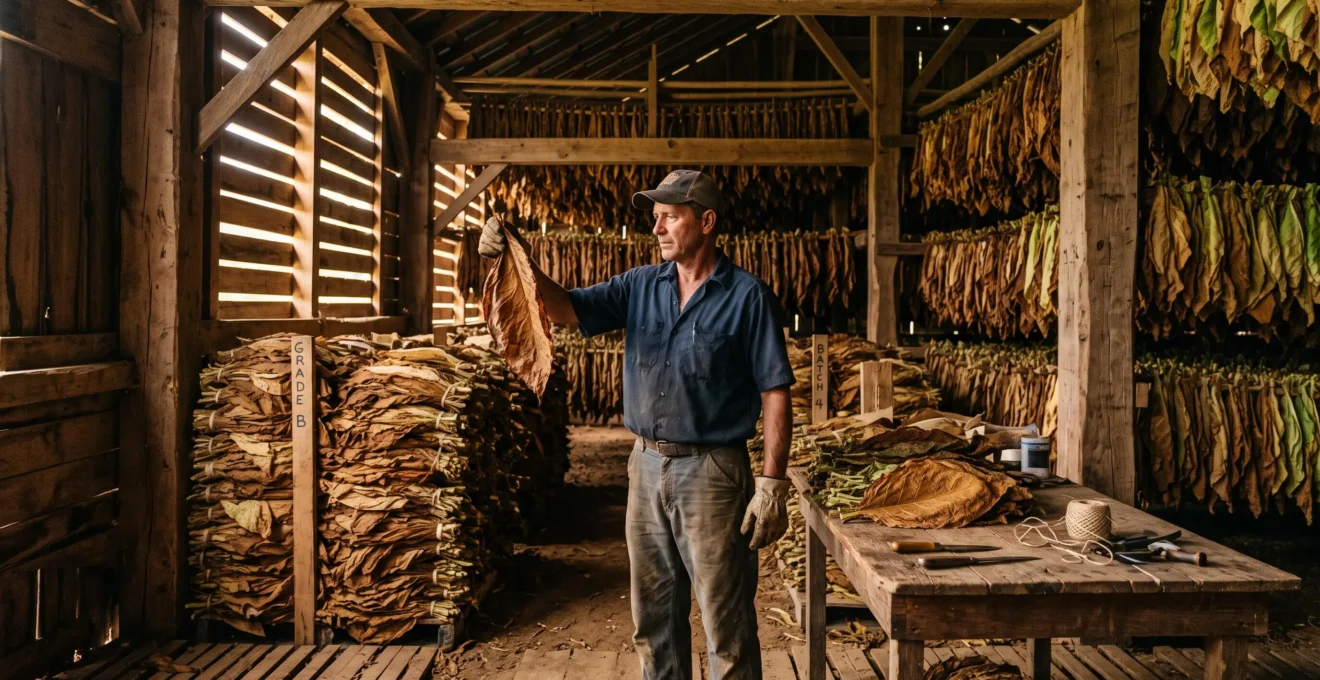
Two cigars can carry the same farm designation, share an apparently identical wrapper and follow the same blending recipe, yet develop noticeably different aromatic profiles after a year in storage. One may offer rounded, woody notes; another may seem muted, sharp or unexpectedly powerful.
The difference begins long before either cigar reaches a humidor. Growing conditions influence leaf chemistry, harvesting determines maturity, fermentation transforms flavour precursors, and subsequent ageing changes the balance of volatile aromatic compounds. Even neighbouring plants can produce materially different tobacco.
For UK enthusiasts comparing online listings, the useful question is not simply whether a cigar is old or comes from a celebrated origin. It is whether the seller can identify the harvest, leaf selection, processing history and storage conditions behind the particular batch.
None of these characteristics establishes a cigar’s health risk or makes tobacco smoke safe. They are quality and composition indicators, not evidence of reduced harm.
What explains cigar leaf variation?
- Seed variety and farm origin do not fix nicotine concentration, combustion behaviour or final aromatic composition.
- Leaf position, harvest maturity and fermentation history help explain differences that wrapper colour cannot reliably reveal.
- Twelve months of controlled storage can alter aroma chemistry, but ageing does not guarantee better flavour or correct poor manufacturing.
- Why Can Two Crops From the Same Seed Produce 2 Completely Different Cigar Profiles?
- How to Spot High-Quality Leaf Cues From Online Photos in Under 3 Minutes?
- Which Matters More for Smoothness: Lower Primings or Upper Primings When You Smoke After Dinner?
- The Colour-Only Mistake That Makes a « Premium » Cigar Taste Harsh by the Second Third
- Leaf Tastes Flat on Day 1: Why Do Cultivated Tobacco Leaves From the Same Farm Taste Different After 12 Months of Storage?
- Fermented or Aged: Which One Usually Drives Creaminess in a 45-Minute Smoke?
- Why Do Top-Priming Leaves Often Feel Stronger Within the First 10 Minutes?
- Why Can Harvest Timing Change Nicotine Hit Even When the Blend Recipe Stays the Same?
Why Can Two Crops From the Same Seed Produce 2 Completely Different Cigar Profiles?
Two crops grown from the same tobacco seed can develop different profiles because genetic identity does not guarantee identical leaf chemistry. Soil conditions, plant nutrition, weather, stalk position and harvesting maturity influence the material entering fermentation. Subsequent processing and storage can increase those differences, even when the resulting cigars share an origin and blending specification.
Think of a tobacco variety as a range of biological possibilities rather than a fixed flavour recipe. Plants respond to the availability of nutrients, water and sunlight. Differences in soil drainage or exposure within a single field can affect growth and maturity, although their precise sensory consequences cannot be predicted from location alone.
Growing under shade or in direct sunlight also changes the conditions under which leaves develop. These methods are associated with different leaf characteristics, but a shade-grown wrapper is not automatically milder or better fermented than a sun-grown alternative.
Leaf position adds variation within the same plant. Lower leaves and upper leaves develop under different conditions and commonly differ in thickness, chemical composition and intended blending function.
An agricultural investigation of Madura tobacco variety Prancak 95 reported average nicotine concentrations of 1.64% in lower leaves, 1.86% in middle leaves and 2.43% in upper leaves. These findings concern one experimental variety and cannot be transferred directly to every cigar tobacco cultivar.
2.43% versus 1.64%
Average nicotine concentration in upper versus lower leaves in the experimental Madura tobacco study. These values describe plant material, not nicotine delivered during cigar smoking.
Universitas Brawijaya study on nicotine accumulation by leaf position
There is also an important distinction between field variation and processing variation. Weather and soil influence the crop before harvest. Curing, fermentation, sorting and storage introduce further differences through decisions made after harvesting.
For an online buyer, the same farm is not necessarily the same leaf lot. Harvest year, priming selection and processing batch are more informative when available than origin alone.
Once that distinction is clear, wrapper photographs become useful as limited visual evidence rather than a substitute for knowing where and how the leaf was produced.
How to Spot High-Quality Leaf Cues From Online Photos in Under 3 Minutes?
Three minutes is enough to identify some visible wrapper characteristics, but not to establish cigar leaf quality. Compare colour consistency, surface texture, veins and cap construction, then assess whether the photographs accurately represent the product offered. Moisture, fermentation depth, nicotine concentration and internal construction cannot be determined reliably from images alone.
Begin by checking whether the listing shows the actual cigar or a generic promotional photograph. A studio image with strong colour correction may conceal natural variation. Multiple views under consistent lighting are more useful than a single dramatic photograph.
Next, look at the wrapper:
- Colour consistency: Notice pronounced variations or unusual patches, without assuming that every uneven shade represents defective fermentation.
- Veins: Assess their size and prominence. Visible veins are not inherently a defect, and vein size alone cannot identify the leaf’s position on the stalk.
- Surface texture: Recognise that some wrappers naturally have a pronounced tooth or grain. Texture must be judged against the characteristics of that tobacco type.
- Sheen: A subtle reflective surface can indicate visible oils, but photography and lighting strongly affect its appearance.
- Cap construction: Examine whether the cap appears neatly fitted, without pretending a photograph can establish draw quality.
A greenish cast or an unexplained dark patch warrants closer inspection, but neither proves incomplete curing or mould. If a mark appears suspicious, ask the retailer for a fresh photograph and clarification rather than diagnosing contamination remotely.
Compare unfamiliar listings with consistent photographs of the same wrapper variety or product line. A different cigar from another producer may provide a visual reference, but not a definitive quality standard.
A five-step online cigar listing check
- Identify whether the image is a stock photograph or the actual product; record the answer beside the listing.
- Inspect wrapper colour and visible patches; note any feature requiring clarification.
- Compare veins, grain and sheen against a comparable wrapper type; save the reference image or product name.
- Check the cap and overall appearance from every available angle; document any missing view.
- Request harvest or batch information and storage details; retain the retailer’s response before deciding.
Visual inspection should lead to better questions, not stronger assumptions. A beautiful wrapper may cover poorly selected filler, while a naturally mottled wrapper may have no meaningful manufacturing defect.
Where the listing offers little information, a knowledgeable retailer’s batch-specific explanation is more useful than trying to infer invisible processing conditions from colour.
Which Matters More for Smoothness: Lower Primings or Upper Primings When You Smoke After Dinner?
Lower primings are commonly associated with lighter-bodied blending components, while upper primings often contribute greater intensity. However, priming position cannot reliably predict whether a finished cigar will feel smooth after dinner. Fermentation, leaf maturity, blend proportions, moisture and construction all influence the experience, making processing quality as important as stalk position.
Leaves near the bottom of the tobacco plant generally develop differently from those at the top. Their physical characteristics can affect combustion, while differences in nicotine concentration may contribute to the intended strength of a blend.
The terms volado, seco and ligero are useful in some cigar-producing traditions, but their application is not universally interchangeable across origins or manufacturers. Treat them as producer-specific blending descriptions, not standardised chemical grades.
Fermentation and ageing complicate any simple ranking. An upper-priming leaf that has been carefully processed may contribute a more integrated aromatic profile than a poorly processed lower-priming leaf.
The following comparison is a practical interpretation framework, not a validated formula for sensory smoothness.
| Leaf selection | Processing history | Practical interpretation |
|---|---|---|
| Lower primings | Documented, consistent processing | Potentially useful for lighter-bodied blends; smoothness remains unverified. |
| Lower primings | Unclear processing | Stalk position offers little assurance against unpleasant flavour or poor combustion. |
| Upper primings | Documented, consistent processing | May contribute greater intensity without necessarily producing a rough sensory profile. |
| Upper primings | Unclear processing | Strength and smoothness are especially difficult to predict from the description alone. |
A substantial meal does not establish a predictable increase in nicotine absorption or sensitivity. Individual physiology, previous nicotine exposure and smoking behaviour matter, and eating does not make nicotine exposure harmless.
For someone comparing two after-dinner options, descriptions of body, combustion consistency and processing history are more informative together than priming terminology on its own.
This explains why wrapper shade is an unreliable shortcut: visible darkness cannot reveal the whole blend or guarantee a particular sensory outcome.
The Colour-Only Mistake That Makes a « Premium » Cigar Taste Harsh by the Second Third
The colour-only mistake is assuming that an attractive wrapper guarantees a smooth smoking experience. Wrapper shade cannot establish filler fermentation, moisture balance, draw resistance or combustion behaviour. A cigar that becomes unpleasant during its second third may reflect several interacting factors, so harshness cannot reliably be attributed to wrapper colour or a single processing fault.
Darker wrappers are often associated with maduro classifications and lighter wrappers with claro classifications. These terms describe appearance and aspects of production, but they are not universal measurements of nicotine concentration, flavour intensity or manufacturing quality.
A dark wrapper may surround a relatively intense filler blend. Conversely, a lighter wrapper can be used with strong tobacco components. The visible outer leaf is only one part of the construction.
The second third is not a definitive fermentation test. As a cigar burns, combustion conditions, heat accumulation, puffing behaviour and the distribution of tobacco within the bunch can all affect perceived harshness.
There is no general rule that under-fermented filler sits closer to the head or that the smoke must become harsh at a specific point. Some cigars are blended to evolve during smoking, but their internal leaf arrangement cannot usually be inferred from the wrapper.
When examining a cigar in person, gentle pressure may reveal obvious irregularities in firmness. Yet a rock-hard or unusually soft feel is not a laboratory measurement of moisture, rolling quality or airflow.
For online purchases, look for descriptions of construction, blend composition and quality control. Customer reports of repeated draw problems across the same product batch can be relevant, although anecdotal reviews cannot establish the cause.
A more useful distinction is between appearance and performance. Wrapper colour is observable; internal tobacco selection and combustion consistency require additional evidence.
A cigar that looks exceptionally uniform may still contain leaves with a different chemical and processing history from those used in an earlier production run. Storage adds another layer of variation.
Leaf Tastes Flat on Day 1: Why Do Cultivated Tobacco Leaves From the Same Farm Taste Different After 12 Months of Storage?
Tobacco leaves from the same farm can taste different after twelve months because they do not begin storage with identical chemistry or processing histories. Ageing changes the mixture of volatile aroma compounds, while humidity, temperature and storage format influence the conditions of maturation. Twelve months is therefore a period of potential change, not a guaranteed improvement interval.
Curing and fermentation establish much of the leaf’s initial chemical character. Ageing follows those stages, allowing additional transformations in the compounds associated with aroma.
Some volatile substances may diminish, and the relative balance of other aromatic compounds can shift. These changes are more complex than simply allowing ammonia to escape or converting oils into sweeter flavours.
A 2025 study published in Frontiers in Plant Science investigated finished cigars of a fixed commercial blend stored under controlled conditions. Researchers collected samples at 0, 1, 2, 4, 17 and 18 months and identified changes in aroma-associated compounds over time.
The reported chemical trends included shifts towards compounds associated with fruity, floral, honey-like, woody and sweet aromas, alongside changes in compounds associated with roasted, hay-like, burnt and spicy notes.
These measurements demonstrate aromatic evolution, not guaranteed sensory improvement. The study did not establish twelve months as the ideal ageing period for every cigar.
Controlled cigar-ageing research: what changed?
Researchers analysed finished cigars aged in Spanish cedar cabinets at 20°C ± 2°C and 60% ± 2% relative humidity, sampling six cigars at each collection point.
The analytical investigation identified 1,836 volatile compounds and 21 key aroma-active compounds associated with ageing-related changes. Its observations concern a particular blend and storage environment, not a universal recommendation for loose tobacco leaves.
Study: Frontiers in Plant Science study of aroma changes during cigar aging.
The distinction between storage formats matters. Unprocessed or partially processed tobacco in bulk, fermented leaf in bales, and finished cigars have different physical arrangements and processing histories. The controlled finished-cigar results cannot establish how quickly every loose leaf will change.
Storage introduces both opportunities and risks. Excessive moisture can encourage mould, while very dry conditions may damage the physical condition of cigars and alter their aromatic presentation. Temperature fluctuations further complicate control.
However, the cited experiment’s 60% relative humidity is a research condition, not a universal target for every tobacco product or consumer humidor.
What about a cigar that seems flat immediately after purchase? A restrained aroma may reflect the original blend, its condition, storage or individual perception. It is not proof that the cigar needs more ageing.
A strong ammonia-like smell can warrant concern and further investigation, but smell alone cannot identify the full processing history. If mould is suspected, the product should not be used.
Similarly, pronounced dryness cannot be assumed reversible through lengthy storage. Some physical properties may recover with careful conditioning, but the evidence does not support promising restoration of lost aromatic character.
Buyers should establish when the cigar was manufactured, how it was stored and whether the stated age refers to loose tobacco, fermented leaf or the finished cigar.
Ageing is best understood as a continuation of the leaf’s processing history. To interpret creamy or rounded flavour descriptions, fermentation must be considered separately.
Fermented or Aged: Which One Usually Drives Creaminess in a 45-Minute Smoke?
Neither fermentation nor ageing can be identified as the universal cause of creaminess in a forty-five-minute cigar. Fermentation changes tobacco’s chemical composition through biological and biochemical activity, while subsequent ageing alters aromatic profiles over time. Both can contribute to sensory character, but creaminess is a subjective descriptor rather than a measured outcome guaranteed by either process.
Fermentation is more active than ordinary maturation. Microorganisms participate in the transformation of carbon- and nitrogen-containing substances and influence the compounds that contribute to the final tobacco aroma.
A 2025 investigation published in Microbiology Spectrum examined microbial communities and metabolite changes during cigar tobacco fermentation. It connected microbial metabolism with the development of volatile compounds and flavour precursors.
The findings help explain why fermentation history matters. They do not demonstrate that longer fermentation automatically creates buttery, creamy or nutty sensations.
In particular, processing requirements differ according to tobacco variety, moisture and producer methods. A fixed number of fermentation days cannot serve as a reliable quality guarantee across all leaf types.
Ageing is a distinct process. The finished-cigar research described earlier demonstrated changes in aroma chemistry during controlled maturation. It did not prove that fermentation always dominates perceived creaminess or that ageing merely amplifies an existing flavour.
| Criterion | Fermentation | Ageing |
|---|---|---|
| Principal stage | Producer processing of tobacco leaf | Subsequent maturation of leaf or finished product |
| Relevant mechanisms | Microbial and biochemical transformations | Continuing changes in aromatic chemistry |
| Research-supported outcome | Changes in metabolites and flavour precursors | Changes in volatile aroma profiles |
| What remains uncertain | Specific sensory creaminess | Individual perception and optimal duration |
A cigar’s approximate smoking duration is primarily a practical characteristic, not evidence of fermentation depth. A forty-five-minute product cannot be expected to show a particular aromatic profile simply because of its size or advertised age.
Descriptors such as cream, butter, roasted nuts or sweetness may help compare tasting notes between batches, provided they are treated as subjective experiences rather than laboratory findings.
For a buyer, the valuable information is whether the producer explains its processing and maturation practices consistently. Stronger-tasting primings can influence the overall profile, but they raise a separate question about nicotine concentration.
Why Do Top-Priming Leaves Often Feel Stronger Within the First 10 Minutes?
Upper-priming tobacco leaves can contain higher nicotine concentrations than lower leaves, making them relevant to the perceived strength of some cigar blends. However, the sensation experienced during the first ten minutes cannot be predicted from priming position alone. Product design, smoking behaviour, individual nicotine exposure and leaf processing all affect the result.
Upper leaves develop at a different position on the plant, often experiencing different light exposure and maturity conditions. These factors can contribute to differences in leaf structure and chemical composition.
The Madura tobacco experiment discussed earlier found higher average nicotine concentrations in upper leaves than in middle or lower leaves. It also recorded increasing nicotine concentration across the plant ages studied.
These measurements provide evidence of biological variation by stalk position. They do not establish a universal rule that upper leaves deliver a precisely measurable nicotine effect during the opening minutes of a cigar.
Blenders select leaves for multiple functions, including flavour contribution, combustion and construction. Their selections determine the proportions and arrangement of different tobacco materials within a finished product.
Some cigars are intended to develop changing sensory characteristics during smoking, but the precise placement of stronger material inside a particular cigar should not be assumed without information from its manufacturer.
Combustion can further complicate the experience. Dense packing, moisture differences and inconsistent airflow may affect draw resistance and burning behaviour, while puffing patterns alter the conditions under which smoke is produced.
The first ten minutes therefore cannot isolate the effect of upper primings from that of construction or user behaviour.
It is also important to distinguish nicotine content in the leaf from nicotine absorbed by a person. Laboratory measurements of unburned tobacco do not directly quantify exposure during cigar use.
Harvest maturity introduces further differences, meaning even an unchanged blending specification may contain leaves with different concentrations in successive production years.
Key takeaways before comparing harvests
- Ask whether a repeat purchase comes from the same agricultural harvest, not merely the same farm or brand.
- Separate measured nicotine concentration from subjective strength and actual nicotine exposure.
- Treat sudden differences between batches as reasons to examine both leaf sourcing and production conditions rather than assuming a single cause.
Why Can Harvest Timing Change Nicotine Hit Even When the Blend Recipe Stays the Same?
Harvest timing can change tobacco nicotine concentration because leaf chemistry develops throughout plant growth. A blending recipe may specify the same varieties, origins and stalk positions across production years without guaranteeing identical chemical composition. Nevertheless, a perceived change in nicotine impact cannot be attributed to harvest timing alone without further evidence about the product and its use.
Nicotine accumulation is influenced by plant genetics and agricultural conditions. Leaf maturity, fertilisation, growing practices and other environmental factors can contribute to variation.
The Madura tobacco experiment provides a concrete example. Across the plant ages studied, reported nicotine concentration increased from 1.24% at 25 days after transplanting to 2.72% at 85 days.
Those observations concern a specific variety and experimental setting. They do not justify applying the same developmental pattern or percentages to every cigar-growing region.
An Oxford University Press chapter on nicotine content in tobacco also identifies variation associated with tobacco type, agricultural practices, leaf position, processing, storage and production year.
That broader scientific synthesis helps explain why the phrase same blend recipe should not be confused with identical tobacco chemistry.
Consider a hypothetical example. A producer makes two annual releases using the same named tobacco varieties and the same intended proportions of upper and middle primings. The second harvest differs in maturity and agricultural conditions. Even if the finished cigars look similar, their constituent tobacco may not have identical nicotine concentrations or aroma precursors.
Yet laboratory variation does not automatically translate into a predictable sensory difference. A smoker reporting that the second release feels stronger may also be responding to construction, moisture, smoking behaviour or personal circumstances.
Neither a faster burn nor darker perceived flavour is a validated standalone indicator of higher nicotine concentration. Similarly, a change in the experience of a familiar brand is not proof of counterfeit production.
The wine-vintage analogy is helpful within limits. Just as agricultural conditions can affect grapes from one year to another, tobacco harvests can differ despite a consistent geographical designation. Tobacco processing, however, involves distinct chemistry and cannot be assessed using wine quality rules.
For buyers researching repeat purchases, the strongest available comparison combines harvest identification, production or batch details, processing history and documented storage conditions. Missing information should remain an uncertainty rather than being filled with assumptions.
Before ordering another batch, compare the manufacturer’s stated composition, available harvest information and retailer storage records. This provides a more defensible basis for evaluating consistency than farm reputation, wrapper colour or ageing claims in isolation.
Does a cigar’s manufacture date reveal the age of its tobacco leaves?
No. The manufacture date identifies a stage in finished-product production, while the component leaves may have been harvested, fermented and stored earlier. To establish the full timeline, ask the producer or retailer which dates their ageing claims actually describe.
Can two cigars with the same wrapper origin contain different filler tobacco?
Yes. Wrapper origin describes only one component of a cigar. Filler and binder materials may have different geographical origins, harvest dates and processing histories. Even a nominally unchanged blend can incorporate different agricultural lots across production runs.
Can twelve months of storage fix an improperly fermented cigar?
There is no reliable evidence that twelve months of ordinary storage will correct inadequate fermentation. Ageing can change aromatic compounds, but it is not equivalent to the controlled biological and biochemical transformations that occur during fermentation. Improvement is not guaranteed.
Should a cigar retailer be able to identify its exact harvest year?
Harvest information is useful for evaluating batch consistency, but it may not be available for every component of a multi-origin blend. A retailer may reasonably provide a manufacturing batch or production date instead. The important point is distinguishing verifiable information from unsupported claims of vintage quality.
Does a smoother or creamier cigar contain less nicotine?
Not necessarily. Smoothness and creaminess are sensory descriptions, whereas nicotine concentration is a measurable chemical characteristic. Neither sensation reliably establishes nicotine content, nicotine absorption or reduced health risk. All tobacco smoking carries health risks regardless of flavour or perceived smoothness.