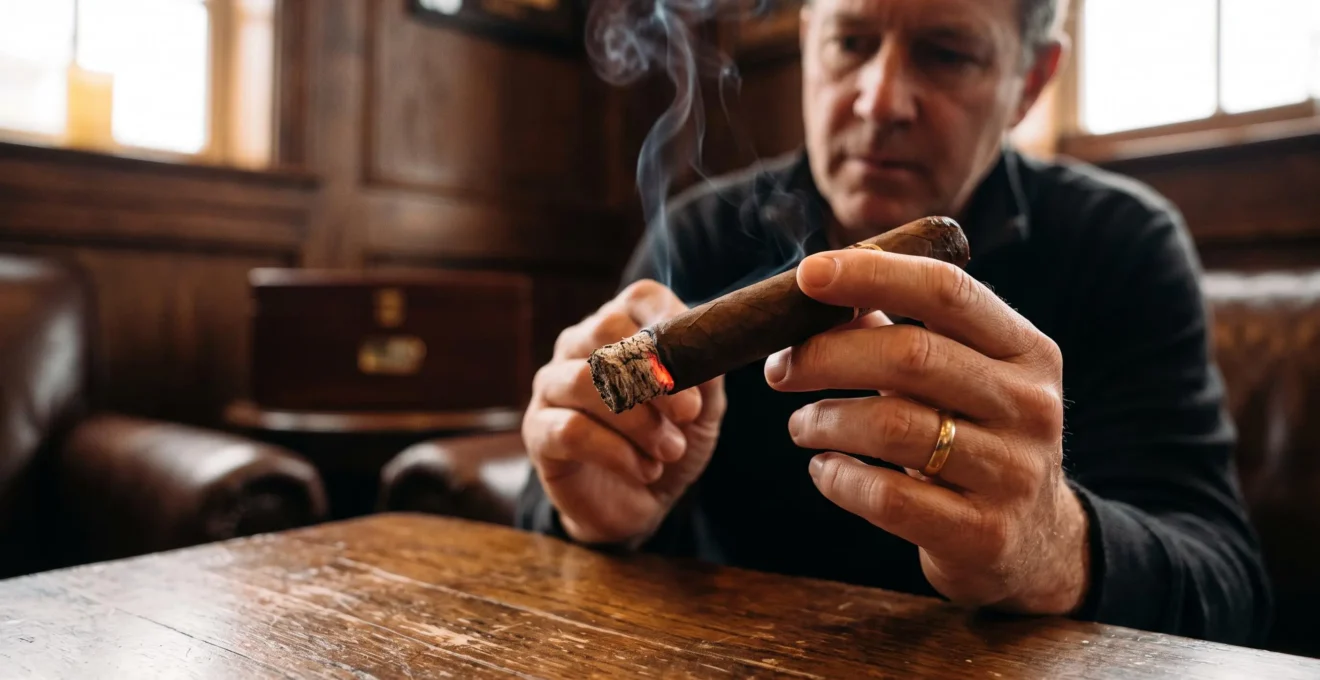
A cigar that starts canoeing in its first few minutes can remain troublesome throughout the first third. One side advances, the opposite edge lags behind, and a quick touch-up seems to work until the same problem returns. The visible defect may be easy to correct, but its underlying cause is not always obvious.
The opening eight minutes are a useful observation period because the initial ember is still developing. An incomplete light, uneven tobacco moisture, directional airflow or an irregular filler arrangement can become apparent before substantial tobacco has burned. Eight minutes is a practical coaching window, not a scientifically established threshold for cigar combustion.
The objective is to establish an even light, avoid unnecessary heat and recognise when intervention is justified. That means inspecting the foot, allowing a measured smoking rhythm, checking the surrounding airflow and resisting the temptation to correct every small irregularity. A cigar’s construction still matters, but the early routine can prevent manageable problems from escalating.
Early cigar burn control: the essentials
- Check the entire foot after lighting. A dark, unlit patch can develop into a persistent uneven burn.
- Keep the opening draws measured and avoid repeated flame corrections that add unnecessary heat.
- Judge an uneven burn by its progression, not one imperfect ash line. Consider wind, lighting and construction before acting.
- Why Do Early Burn Imbalances Keep Reappearing Even After You Fix Them Once?
- How to Stabilise the Burn Line in the First 8 Minutes Without Overheating?
- Touch Up Now or Wait: Which Uneven Burn Patterns Self-Correct in 5 Minutes?
- The Fan-and-Wind Mistake That Creates Runaway Burn From the Start
- When Should You Tap Ash in the First Third to Keep the Burn Even?
- Why Does a Bad Light Create Canoeing That Keeps Coming Back Even After Fixes?
- How to Light With a Torch Outdoors in a Breeze Without Overheating the Foot?
- Why Does Cigar Ignition Decide Whether You’ll Fight Canoeing for the Next 30 Minutes?
Why Do Early Burn Imbalances Keep Reappearing Even After You Fix Them Once?
Early burn imbalances return when a correction addresses the visible burn line without removing the condition causing it. Uneven filler distribution, inconsistent moisture, incomplete ignition or directional airflow can all make one side burn faster. Touching up the slower side may temporarily improve the appearance, but the imbalance can reappear if its cause persists.
Canoeing occurs when one side of the cigar burns ahead of the other, creating a lengthwise recess in the wrapper. According to Tobacconist University‘s explanation of cigar canoeing, several different factors can produce the same visible symptom, including cigar construction, lighting, moisture and environmental conditions.
This distinction matters because a repeated burn problem is not necessarily evidence of a badly rolled cigar. A fan positioned beside the smoker can produce a similar appearance to an irregular tobacco arrangement. Likewise, an incompletely lit foot can leave one section smouldering while another advances normally.
Consider two hypothetical situations. In the first, the burn line repeatedly advances along the same section despite calm surroundings and an apparently complete light. An internal construction or moisture difference becomes a plausible explanation. In the second, the fast-burning section changes after the smoker moves away from a draught. Environmental airflow becomes the stronger suspect.
A symptom fix changes the burning edge; a cause fix changes the condition producing the uneven burn. This is why repeatedly applying a lighter is a poor substitute for diagnosis.
The ash and exposed ember offer useful clues, but neither provides a definitive diagnosis. A pronounced ember, an unusually deep channel or a persistent lagging section can justify closer inspection. These appearances do not identify a precise filler defect or establish the cigar’s moisture content.
Use the first few minutes after a correction to compare three observations:
- Consistency: Does the same section continue to lag?
- Environment: Does the pattern change when the cigar is shielded from moving air?
- Heat: Does repeated correction produce increasingly hot or harsh smoke?
Frequent touch-ups introduce additional heat to tobacco that may already be burning adequately. They can also obscure the original pattern, making it harder to identify what caused the problem.
A mild imperfection may be preferable to repeatedly overheating the first third. Once the likely cause is identified, the next task is to establish a controlled combustion rhythm rather than forcing the ash line to look perfectly straight.
How to Stabilise the Burn Line in the First 8 Minutes Without Overheating?
To stabilise a cigar’s early burn, start with an evenly established light and use slow, measured draws rather than frequent puffing. Observe the developing ember between draws, check whether one side consistently advances and avoid adding flame unless a genuine imbalance persists. A steady approach reduces unnecessary heat while allowing minor variations to settle.
The first eight minutes can be divided into practical observation stages. These are coaching checkpoints, not fixed combustion timings or scientifically validated intervals.
- Immediately after lighting: Confirm that the foot has ignited across its surface. Look for obvious dark patches rather than demanding a perfectly uniform glow.
- During the opening minutes: Allow pauses between gentle draws. Notice whether the smoke becomes excessively hot or sharp.
- As the ash begins to develop: Compare both sides of the burn line. A slight difference is not necessarily progressive canoeing.
- By the end of the observation window: Decide whether the cigar is stabilising, worsening or showing signs of an underlying fault.
Smoking rhythm is especially important. Tobacconist University’s advice on smoking a cigar too hot describes how frequent puffing can generate excessive combustion heat and harsher smoke. Increasing the draw frequency simply to force a slow-burning section to catch up can therefore create another problem.
Ember shape offers a clue, not a temperature measurement. A relatively even ember is generally more reassuring than a pronounced or pointed one, but construction differences can also change its appearance. A thin-looking or patchy ember alone does not prove that additional drawing is required.
When the line begins to drift, follow a conservative decision sequence: assess the puffing pace, check for external airflow, change the cigar’s orientation if useful, and observe whether the slower section begins to catch up. If a substantial difference persists, a limited touch-up may be justified.
Rotating the cigar can help reveal whether one side is repeatedly exposed to moving air. It is not a reliable cure for an internal filler defect.
Five checks for a controlled opening burn
- Inspect the freshly lit foot and identify any clearly unlit area. Result: an initial ignition assessment.
- Take a gentle draw and allow a comfortable pause. Result: a baseline impression of smoke temperature and resistance.
- Observe both sides of the developing burn line. Result: a record of which side, if any, is advancing.
- Check nearby fans, windows and draughts. Result: an identified exposure to moving air or confirmation of relatively calm conditions.
- Reassess whether the imbalance is shrinking, stable or increasing. Result: a reasoned decision to wait, adjust the environment or make a limited correction.
Not every cigar will settle into a perfectly even burn. If a consistent internal restriction or irregular filler arrangement appears responsible, repeated interventions may provide diminishing returns.
The aim is controlled combustion, not visual perfection. Once the pace is stable, the important question becomes whether an imperfect line actually requires intervention.
Touch Up Now or Wait: Which Uneven Burn Patterns Self-Correct in 5 Minutes?
Minor burn-line dents, shallow shoulders and small differences between wrapper edges may resolve without intervention. A pronounced runner or an expanding canoe is less likely to improve without a change in conditions. Five minutes can serve as a short observation window when the cigar remains stable, but there is no universal rule that a particular pattern will self-correct within that time.
The distinction is between an uneven line that looks untidy and an imbalance that continues to grow. Treating both as emergencies can lead to unnecessary heating of the cigar.
The following comparison is a practical decision aid, not an experimentally validated classification.
| Burn pattern | What to observe | Practical response |
|---|---|---|
| Small shoulder or minor dent | The slower edge remains close to the rest of the burn. | Continue normal, measured smoking and reassess. |
| Uneven line that is narrowing | The slower side gradually catches up. | Allow the correction to continue naturally. |
| Persistent shallow imbalance | The difference remains visible but does not increase. | Check airflow and heat before considering a touch-up. |
| Expanding runner | A narrow section advances increasingly far ahead. | Investigate airflow and consider a limited correction. |
| Pronounced canoeing | One broad side continues burning significantly faster. | Address the likely cause; a careful touch-up may be necessary. |
To judge the trend, note where the slow section sits, continue a measured smoking rhythm and compare the line after several draws. The observation period should remain flexible: there is little benefit in waiting for a predetermined number of minutes if the imbalance is clearly becoming severe.
Equally, a slight protrusion or shallow recess that is already diminishing does not need to be attacked with a lighter.
Premature correction can create a new hot spot. Applying flame to one section adds heat that is not evenly distributed across the established ember. The newly heated area may then burn differently from its surroundings, potentially creating another irregularity.
A targeted touch-up is most defensible when the slow section is identifiable, the difference is increasing and external airflow has been considered. Apply only as much correction as necessary rather than continuously reheating the entire foot.
Sometimes the cigar’s internal construction makes a completely straight burn unattainable. In that situation, a modest visual flaw may be less disruptive than repeated intervention.
Recognising harmless irregularities reduces unnecessary corrections. The next potential cause to eliminate is external airflow, which can make a well-lit cigar appear badly constructed.
The Fan-and-Wind Mistake That Creates Runaway Burn From the Start
A fan, open window or outdoor breeze can create an uneven cigar burn by exposing one part of the ember to more moving air than another. The exposed area may burn faster, producing a runner or canoe-like pattern even when the cigar was lit correctly. Removing the airflow imbalance is often more useful than repeatedly touching up the slower side.
Directional airflow is easy to overlook because its effect appears at the foot while its cause may be elsewhere in the room. An air-conditioning vent across a lounge, a fan beside an armchair or a breeze entering through a window can all change the conditions surrounding the ember.
The same problem can occur outdoors. Walking while holding a lit cigar exposes it to changing air movement. A breeze across a terrace may be gentle enough to feel comfortable while still affecting the exposed burning end.
Several observations can help distinguish an environmental problem from an internal construction issue:
- The unevenness becomes more noticeable when the cigar is exposed to a particular draught.
- The fast-burning side changes after repositioning the cigar relative to the airflow.
- The pattern becomes less pronounced when the cigar is moved into calmer conditions.
- Frequent puffing appears to increase the heat without correcting the imbalance.
These clues are suggestive rather than definitive. A cigar may have both an internal irregularity and uneven exposure to wind.
Correct the environment before correcting the ember. Move away from the direct fan stream, close or reposition an open window where appropriate, or change seats. Outdoors, use a sheltered position and keep the cigar away from persistent crosswinds.
Briefly shielding the foot with a hand can reduce exposure, provided the hand remains safely clear of the flame and hot ember. This is not a reason to enclose the burning end tightly or attempt to control its oxygen supply precisely.
If the cigar appears to be burning faster than usual, allow a more relaxed interval between draws rather than using additional puffing as a corrective tool.
Repeated lighter use in a draught adds avoidable heat without addressing the uneven environment. Once the airflow changes again, the same pattern may reappear.
A stable environment makes the ember easier to interpret. It also helps avoid disturbing the ash unnecessarily, another common source of avoidable problems during the first third.
When Should You Tap Ash in the First Third to Keep the Burn Even?
Tap cigar ash when it becomes unstable or threatens to fall, rather than automatically after every few draws. A firm ash can remain attached while the burn develops, and removing it too aggressively risks disturbing the burning ember. Ash removal should be gentle and based on stability, not on an assumed need to keep the coal exposed.
Handmade long-filler cigars can retain a comparatively substantial ash before it needs attention. However, the length and firmness of that ash vary with tobacco arrangement and construction, so a single universal tapping interval would be misleading.
Cigar Aficionado‘s instructions for ashing a cigar recommend allowing ash to develop, with approximately one inch, or about 2.5 cm, offered as a practical guideline. Visible cracking is another reason to consider removing it.
The number is a handling recommendation, not a demonstrated combustion threshold. A cigar with fragile ash may require attention earlier, while a firmer ash can sometimes remain attached longer.
The ash around the ember also has an insulating role, although the practical effect on an individual cigar’s burn line has not been quantified by the selected sources. It would therefore be misleading to claim that preserving a particular ash length guarantees even combustion or regulates airflow to a measurable degree.
When removal becomes necessary, rest the ash gently against the ashtray and allow the loose portion to separate without force. A slight rotation against the ashtray can help produce a cleaner break.
Avoid flicking the cigar as though it were a cigarette. Excessive force can dislodge the burning ember itself, forcing an otherwise unnecessary relight. Rough handling close to the burning wrapper edge may also cause damage, although the source pack does not establish how frequently such damage occurs.
Early flaking can be consistent with differences in construction or tobacco condition, but it is not a reliable moisture test. Treat a fragile ash as a reason for more cautious handling, not as proof that the cigar has been stored incorrectly.
A stable ash is not a problem that needs fixing. The practical priority is preventing an uncontrolled fall or an aggressive removal that damages the coal.
Gentle ash management preserves the conditions needed to assess the burn. When canoeing continues despite sensible handling, the original ignition deserves closer examination.
Why Does a Bad Light Create Canoeing That Keeps Coming Back Even After Fixes?
A bad initial light can produce recurring canoeing because part of the cigar begins burning properly while another section remains incompletely ignited. The difference may become more pronounced as smoking continues. Touching up the visible lagging edge can help, but an incomplete initial light may require a more thorough correction of the unlit area.
The problem often begins before the first proper draw. One side of the foot receives enough heat to ignite, while another remains dark or only partially smouldering. A smoker may assume the cigar is ready because smoke is already being produced, even though the full foot has not established an even ember.
As smoking continues, the properly lit section can advance ahead of the slower one. The resulting burn line resembles canoeing caused by tobacco construction, even though ignition is the initial contributing factor.
Inspecting the entire foot immediately after lighting is therefore worthwhile. Look for a reasonably continuous glowing rim and check for obvious dark patches. A brief, gentle blow across the burning end can help reveal the distribution of the glow, but it should not be used forcefully.
When a clearly unlit patch is identified immediately, a careful targeted correction is generally preferable to allowing a major imbalance to develop. Heat the affected area without repeatedly scorching sections that are already burning.
If substantial canoeing has already developed, a minor correction may not be enough. In severe cases, removing the badly burned section and establishing a fresh, more even light can be an option. This involves sacrificing part of the cigar and should not be the default response to a small irregularity.
A complete relight is not automatically better than a targeted touch-up. The appropriate choice depends on how much of the foot is affected, whether the ember remains coherent and whether the previous corrections have introduced excessive heat.
Storage condition can also contribute. Tobacco with uneven moisture may burn inconsistently, while an excessively moist foot may resist ignition. Visible appearance alone cannot determine its precise moisture content, and a brief surface check should not replace attention to proper storage conditions.
When several cigars from the same storage environment are repeatedly difficult to light, storage becomes a reasonable factor to investigate. When only one cigar behaves badly, its individual construction may be more relevant.
Checking ignition reduces preventable problems, but lighting conditions themselves can be difficult to control outdoors, particularly when using a concentrated torch flame.
How to Light With a Torch Outdoors in a Breeze Without Overheating the Foot?
To light a cigar outdoors with a torch, shelter the flame from the breeze, keep the hottest part of the flame away from direct contact with the tobacco and rotate the cigar as the foot heats. Use controlled exposure rather than forcing a faster light. After ignition, inspect the full rim and correct any genuinely unlit area.
A torch lighter concentrates heat into a relatively small region. This makes deliberate movement particularly important: holding the flame against one section can char the wrapper or overheat the filler before the remainder of the foot has been evenly heated.
Wind adds two complications. It can disturb the lighter flame during ignition, and it can change the air movement around the newly established ember. The impulse to move the torch closer or apply more flame for longer may increase overheating rather than improve consistency.
Start by choosing a position where your body provides some shelter. Hold the cigar away from loose clothing and other combustible materials. Keep the torch controlled and avoid directing its hottest concentrated region continuously against the cigar foot.
Rotate the cigar while toasting the foot so heat reaches its circumference progressively. Follow with a measured draw and inspect the ember. If an isolated dark area remains, correct that section carefully rather than exposing the entire foot to unnecessary additional heat.
No single flame distance or lighting duration is supported by the supplied sources. The appropriate control depends on lighter intensity, wind conditions and how the tobacco responds. Visible charring or an excessively harsh first draw suggests that the lighting approach may have introduced too much heat.
In gusty conditions, waiting for a lull is more sensible than repeatedly attempting ignition while the flame is unstable. A sheltered location is preferable to trying to overcome the wind with greater flame intensity.
Patience is more useful than maximum torch power. The objective is an adequately established ember across the foot, not the fastest possible ignition.
Once the cigar is lit, continue observing the burn in the least exposed position available. Even a careful light cannot guarantee an even burn if the ember is immediately subjected to strong directional airflow.
Successful outdoor ignition depends on both flame management and the conditions surrounding the new ember. Together, these considerations lead to the broader principle that the initial light can influence how much correction is needed later.
Key takeaways before your next light
- Give the foot sufficient attention at ignition: a clearly unlit section is easier to identify before an uneven burn develops.
- Separate controllable factors, such as flame exposure and surrounding airflow, from internal construction irregularities.
- Use measured observation and limited corrections rather than assuming a perfectly straight burn line is necessary.
Why Does Cigar Ignition Decide Whether You’ll Fight Canoeing for the Next 30 Minutes?
Cigar ignition influences later burn behaviour because it establishes the initial ember across the foot. If one section is fully lit while another remains under-ignited, the burn can begin unevenly and require correction as smoking progresses. A complete, controlled light improves the starting conditions, although it cannot eliminate canoeing caused by construction, moisture differences or wind.
The initial light is therefore more than a preliminary ritual. It determines whether the cigar begins with a reasonably coherent burning surface or with distinct sections at different stages of combustion.
When one part of the foot advances ahead of another, the resulting temperature and combustion differences may reinforce the visible imbalance. Filler arrangement and airflow resistance can contribute, but the supplied evidence does not establish a permanent preferential airflow channel or prove that a bad light inevitably causes problems for the next thirty minutes.
The thirty-minute framing is best understood as a practical reminder that early mistakes can require attention later, not as a measured duration of their effects.
Before ignition, three areas deserve attention:
- Foot condition: Look for visible irregularities, damaged wrapper edges or an uneven tobacco arrangement. Appearance can reveal obvious defects but cannot establish precise internal moisture.
- Lighting conditions: Choose a suitable lighter and a relatively sheltered location. Avoid prolonged direct exposure to concentrated flame.
- Initial inspection: After lighting, check for a reasonably complete glow and observe how the ember behaves during the first few draws.
The essential lighting technique is straightforward. Hold the cigar near the flame rather than burying the tobacco directly in it, rotate the foot to distribute heat and verify ignition before settling into a normal smoking rhythm.
These principles are consistent with Cigar Aficionado’s cigar-lighting instructions, which emphasise rotation, controlled flame exposure and checking that the tip is evenly lit.
Not every cigar with an even starting ember will maintain a perfectly symmetrical burn. Long-filler tobacco is not a uniform manufactured fuel, and construction differences may become apparent as the ember progresses beyond the initially visible foot.
Likewise, a minor lighting irregularity does not necessarily condemn the rest of the cigar. Some differences resolve naturally, while others respond to a careful local correction.
The useful distinction is between preventable ignition errors and problems that emerge from the cigar or its environment despite competent lighting. Recognising the distinction prevents unnecessary corrective heat and unrealistic expectations.
On the next cigar, focus on one practical improvement: establish a complete, even light, then watch how the burn develops without immediately correcting every small variation. If the line begins drifting, diagnose the cause before applying more flame. This creates a more consistent process without relying on an unsupported promise of perfect combustion.
Does a slightly uneven burn line mean a cigar is defective?
No. Small irregularities can occur during normal combustion and may resolve without intervention. A persistent or expanding imbalance deserves investigation, but its causes can include lighting, moisture and environmental airflow as well as construction.
Can smoking too quickly make early canoeing worse?
Frequent puffing can increase combustion heat and produce harsher smoke. It may complicate an existing uneven burn, although puffing frequency alone does not explain every case of canoeing. Slowing the rhythm is a reasonable first adjustment when the cigar feels excessively hot.
Should you remove the ash before correcting an uneven burn?
Not automatically. Firm ash does not need to be removed simply because the burn line is imperfect. If ash obstructs the view or is becoming unstable, remove it gently without dislodging the ember. Repeated forceful tapping can create an additional lighting problem.
Can a cigar keep canoeing even after an apparently perfect light?
Yes. An even initial ember does not eliminate differences in filler construction, moisture distribution or surrounding airflow. If canoeing repeatedly returns, examine those factors rather than assuming another touch-up will permanently solve the problem.
Is eight minutes the scientifically established period for stabilising a cigar’s burn?
No. The eight-minute period is a practical observation framework, not an experimentally validated combustion threshold. The useful principle is to pay attention to the initial light, draw rhythm and developing burn pattern before an imbalance becomes substantial.