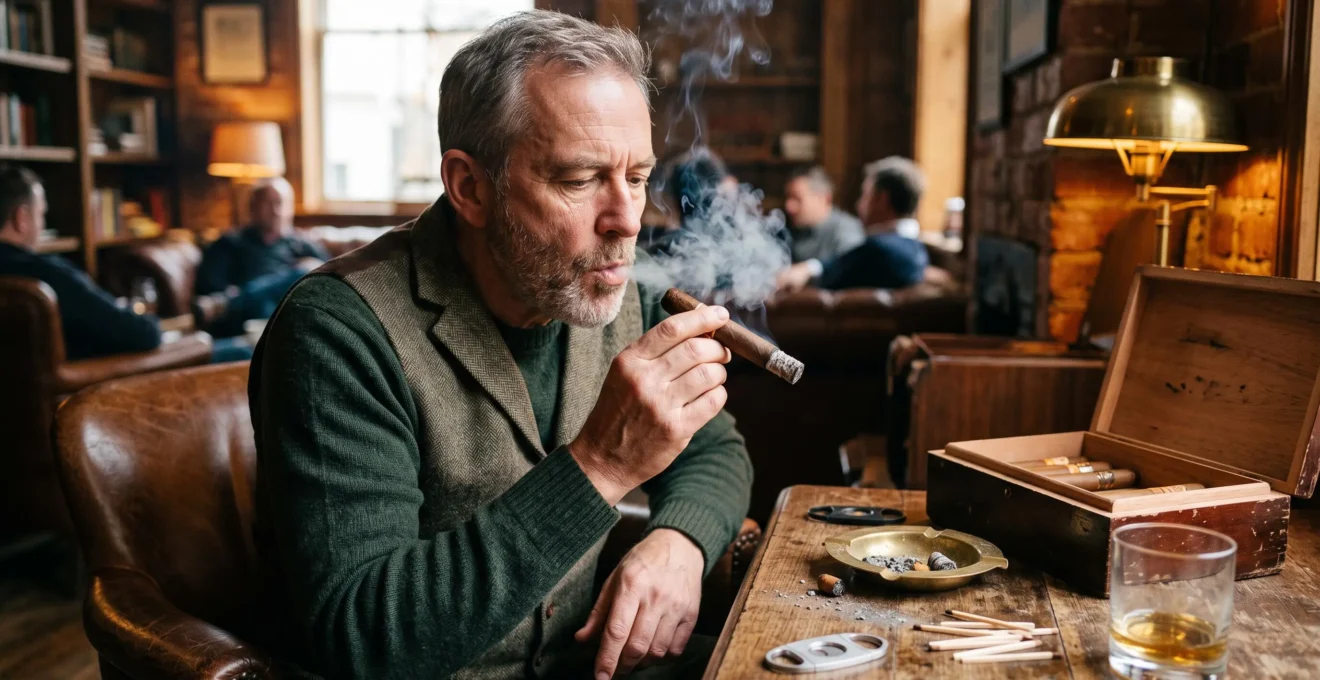
A cooler cigar draw is not simply a matter of producing less heat. The challenge is maintaining a comfortable smoke temperature while preserving enough combustion consistency for the blend’s characteristic flavours to remain recognisable.
A cigar may feel balanced during its opening minutes, then gradually deliver warmer smoke and increasingly sharp sensations. Sometimes the cause is frequent puffing. In other cases, restricted airflow, moisture, an uneven burn or an excessively open cut contributes to the experience. These problems call for different responses.
The most useful distinction is between **the temperature of the burning tobacco and the temperature of the smoke reaching your mouth**. They are related, but they are not interchangeable.
Changes in puff frequency, duration and airflow can affect combustion and smoke delivery. None of these adjustments eliminates the health risks of cigar smoking, and a smoother sensation should not be interpreted as reduced toxic exposure.
For an adult who already smokes cigars, understanding these variables provides a more reliable framework than chasing an arbitrary puff interval or assuming that cooler smoke always tastes better.
Cooler Cigar Draws: The Essentials
- Distinguish excessive puff frequency from moisture, construction and cutting problems before changing your approach.
- Consider puff frequency, duration and draw resistance separately; they influence smoke delivery in different ways.
- Treat flavour, warmth and burn consistency as observations rather than relying on a universal 60-second rule.
- Why Does a Cooler Draw Feel Smoother but Sometimes Less Flavourful?
- How to Cool the Draw Using Cadence Changes in Under 5 Minutes?
- Bigger Ring Gauge or Slower Cadence: Which Cools the Draw More in Real Life?
- The Overcutting Mistake That Makes the Draw Hotter Even Though It Feels Easier
- When Should You Slow Down if the Draw Starts Feeling Warm on Your Lips?
- How to Keep Heat Stable by Using a 60-Second Cadence Without Losing Smoke Output?
- How to Keep Leathery Texture Pleasant by Slowing Down Over the Next 15 Minutes?
- Why Does Internal Smoking Temperature Spike After 3 Relights and Kill Complexity?
Why Does a Cooler Draw Feel Smoother but Sometimes Less Flavourful?
A cooler cigar draw can feel smoother because the smoke arriving at the mouth produces less noticeable thermal irritation. However, reducing perceived warmth does not guarantee that flavour will remain unchanged. Puffing conditions also affect combustion, smoke composition and the delivery of aromatic substances, so a cooler sensation may accompany a different sensory profile rather than a straightforward improvement.
The first distinction concerns two temperatures that are often confused.
The combustion zone operates at temperatures far above those experienced at the mouthpiece. Historical measurements reviewed in the National Cancer Institute monograph on cigar chemistry and toxicology reported combustion-cone temperatures around 930°C during puffing and approximately 820°C between puffs under specified experimental conditions.
These are historical laboratory observations, not standard temperatures for every modern premium cigar.
The same scientific review describes mouth-end smoke temperatures around 25–30°C during early puffs, with substantially higher temperatures possible as the burning end approaches the mouth.
Above 50°C
Historical measurements reviewed by the National Cancer Institute found that mouth-end smoke temperature could exceed this level during later puffs. The result depends on cigar length and experimental conditions.
National Cancer Institute, Chemistry and Toxicology, 1998.
The sensory consequences require more caution.
Aromatic compounds differ in volatility, and changing combustion conditions can alter the mixture of substances carried in smoke. However, the available evidence does not establish a precise temperature at which a premium cigar’s heavier aromatic components stop contributing to flavour.
The idea of a **flavour floor** is therefore best treated as a tasting metaphor, not a scientifically measured threshold.
For example, an adult smoker might describe an initially distinct combination of cedar, earth and spice becoming less differentiated after changing their puffing pattern. That observation may be useful personally, but it does not prove that particular oils have failed to volatilise.
An overly humidified or tightly constructed cigar also differs from one that becomes hot during frequent puffing. Moisture and filler density can affect airflow, while puff frequency changes the demands placed on the burning tobacco.
Before blaming temperature alone, establish whether the draw feels restricted, unusually open or progressively warmer.
Coolness is a sensory characteristic, not a complete measure of combustion quality. The practical question is which variable has changed and whether the perceived improvement comes with an unwanted alteration in flavour.
How to Cool the Draw Using Cadence Changes in Under 5 Minutes?
Changing the interval between cigar puffs can alter smoking intensity, but there is no scientifically established five-minute protocol that guarantees a cooler draw without flavour loss. Puff frequency, duration and volume are separate variables. Any short observation period should therefore be treated as an individual comparison, not a validated method for achieving a particular smoke temperature.
A useful starting point is to understand what happens when successive puffs repeatedly draw fresh air through the burning tobacco.
Puffing supplies oxygen and affects combustion. The intervals between puffs allow the burning zone to evolve without the same forced airflow. Both the timing and the size of each puff matter.
A 2017 experimental investigation, available through the PubMed record of the 2017 cigar smoking-intensity study, examined how puff frequency and volume affected cigar smoke emissions.
The researchers found relationships between smoking intensity, the stage of combustion and emissions of nicotine, carbon monoxide and water.
Those findings establish that puffing conditions influence smoke chemistry. They do not demonstrate that adding 10 or 15 seconds between puffs produces a predictable improvement in sensory smoothness.
Longer pauses and shallower puffs should also be distinguished.
A longer pause changes the interval during which the ember continues to burn without an active puff. A shallower puff changes the duration or amount of smoke drawn through the cigar.
Changing both simultaneously makes it difficult to identify which factor caused the resulting sensation.
A short assessment can nevertheless help someone identify whether an unpleasant sensation appears suddenly or develops over several draws.
The important observations are whether warmth is increasing, whether draw resistance is changing, and whether the burn remains even.
Neither a visible ash line nor the ability to identify two flavour notes provides a scientifically validated threshold for ideal combustion.
Aggressively extending intervals also introduces another variable: a cigar may extinguish and require relighting. Repeated ignition can change the experience in ways unrelated to the initial complaint.
The apparent simplicity of a cadence adjustment should not obscure these competing effects.
Five Checks for Understanding a Warm Cigar Draw
- Identify when the sensation first becomes uncomfortable. Record the approximate point in the cigar, such as the opening, middle or final third.
- Distinguish temperature from resistance. Note whether the draw feels tight, normal or unusually open.
- Examine the burn line without touching the ember. Record whether the burning edge is broadly even or noticeably irregular.
- Review the cigar’s condition. Note any known storage or moisture concerns and whether the wrapper shows visible damage.
- Compare your observations. Produce a brief explanation of whether warmth, airflow or irregular combustion appears to be the main issue, without assuming that one observation proves the cause.
The most useful outcome is a clearer diagnosis. Before changing cigar size or cutting technique, determine whether the perceived heat is associated with the smoker’s rhythm or with the cigar’s physical characteristics.
Bigger Ring Gauge or Slower Cadence: Which Cools the Draw More in Real Life?
Neither a bigger ring gauge nor a slower puff cadence can be identified as the universally more effective way to cool cigar smoke. Ring gauge influences the cigar’s dimensions and potential airflow characteristics, while cadence affects the timing of active combustion. Their effects depend on construction, moisture, draw resistance and the smoker’s behaviour.
Ring gauge describes cigar diameter in sixty-fourths of an inch. It provides useful dimensional information but does not independently establish how hot or cool the smoke will feel.
A cigar’s length, filler arrangement, packing density and moisture content also influence the relationship between burning tobacco and smoke reaching the mouth.
Larger cigars may provide more distance and material through which smoke travels, depending on their design. However, that does not justify the claim that every wider cigar produces cooler smoke.
Nor does the evidence establish that larger ring gauges inherently dilute flavour.
The perceived intensity of a blend depends on numerous factors, including its tobacco composition and combustion behaviour.
Cadence represents a different type of variable. Unlike ring gauge, it is not fixed by the cigar’s dimensions, but changing puff timing can alter the combustion process and smoke emissions.
The following comparison separates what each factor controls from what cannot be assumed.
| Decision factor | Larger ring gauge | Puff cadence |
|---|---|---|
| Primary variable | Cigar diameter | Intervals between puffs |
| When it is determined | Before smoking, when choosing the cigar | During smoking behaviour |
| Other relevant factors | Length, filler density, tobacco blend and moisture | Puff volume, duration, velocity and combustion stage |
| Effect on temperature | Cannot be predicted from diameter alone | Can alter combustion and smoke delivery |
| Guaranteed flavour preservation | No | No |
| Main limitation | Diameter is an incomplete measure of cigar behaviour | No universally optimal puff interval has been established |
A particularly important interaction concerns restricted airflow.
A tightly packed wide cigar can still have substantial draw resistance. Conversely, a narrower cigar with an open draw may allow airflow more readily.
This is why diameter should not be used as a substitute for evaluating construction.
Similarly, a deliberately long interval cannot guarantee that combustion will remain even. A slow-burning cigar may extinguish, while an uneven burn may continue to progress irregularly.
Terms such as tunnelling and canoeing describe different burn irregularities, but neither can be diagnosed solely from ring gauge or a particular puff interval.
The available evidence supports examining these factors together rather than assuming that they have simple, additive effects.
The resulting choice should be based on observable cigar characteristics and personal sensory preferences, not on a claim that wider cigars automatically deliver cooler, equally complex smoke.
The Overcutting Mistake That Makes the Draw Hotter Even Though It Feels Easier
Overcutting can create an excessively open draw and may contribute to a cigar smoking hotter than expected. Removing too much of the cap can also damage the wrapper or compromise the cigar’s structure. However, a loose draw and rising smoke temperature do not prove that the cut is responsible, because airflow and heat depend on several interacting factors.
The cap holds the wrapper in place at the cigar’s head. Cutting creates an opening through which smoke can be drawn, but removing excessive material can affect both airflow and structural integrity.
Specialist guidance in Cigar Aficionado‘s cutting and lighting instructions recommends opening the cigar head without removing so much of the cap that its structure is damaged.
The article describes an approximately 2 mm cut from the end as a general approach for many cigars.
That figure is editorial guidance, not a scientifically proven optimum for every head shape.
The same publication warns that a particularly open wedge cut can sometimes result in a cigar smoking too hot.
This supports a practical distinction: **an easier draw is not necessarily a better draw**.
Airflow resistance affects how readily air and smoke pass through the cigar. Removing too much cap material can change that resistance, although the size of the cut alone does not determine the complete airflow pathway.
Consider two hypothetical situations.
In the first, a cigar has a broad opening but an otherwise intact head. Its draw feels loose, yet the burn remains comparatively even.
In the second, the cut extends into the wrapper and leaves filler exposed. Tobacco fragments detach, and the cigar becomes difficult to handle cleanly.
These situations may both involve excessive cutting, but their consequences are not identical.
An uneven ash line does not reliably distinguish either case from an underlying construction or moisture issue.
Once a substantial part of the cap has been removed, it cannot be restored through a simple adjustment.
Rolling the cigar between the fingers is also not an experimentally established way of redistributing internal combustion heat. Handling the burning end risks contact with hot ash or the ember.
The most defensible principle is preventive: preserve the cap structure and avoid treating maximum openness as the goal.
When a cigar develops both structural damage and an unpleasantly hot draw, further cutting is unlikely to provide a reliable solution. Understanding the difference between airflow and combustion problems is more valuable than trying to compensate for an irreversible cut.
When Should You Slow Down if the Draw Starts Feeling Warm on Your Lips?
Warmth at the lips indicates that the smoke or the cigar’s head feels hotter than before, but it is not a validated predictor of how many puffs remain before flavour becomes harsh. The appropriate response depends on whether the warmth is accompanied by faster burning, changing draw resistance or an uneven burn. Uncomfortable heat is a reason to stop rather than persist.
Lip warmth is a useful personal observation because it is immediate and easy to recognise.
It is not, however, a calibrated thermometer.
The sensation depends on the temperature of the material contacting the lips, smoke flow, moisture and individual sensitivity.
A smoker may notice rising warmth alongside a stronger, drier sensation. Another may experience hot smoke without identifying the change until irritation becomes obvious.
There is no established scientific rule that lip warmth precedes harsher flavour by a particular number of puffs.
Two different patterns deserve attention.
The first is gradual warming during a series of closely spaced puffs. Such a pattern may be associated with smoking intensity.
The second is a visibly irregular burn, where one part of the burning edge advances faster than another.
An uneven burn can arise from cigar construction, moisture distribution, lighting conditions or other variables. Its presence does not establish that puff frequency is the sole cause.
The distinction matters because changing cadence cannot correct every physical problem with a cigar.
Likewise, touching or manipulating hot ash to manage an irregular burn introduces an avoidable risk of burns.
A smoker who wishes to understand what happened can record three observations without undertaking a prolonged smoking experiment:
- Where the cigar was in its burning progression when warmth became noticeable.
- Whether the draw resistance changed at the same time.
- Whether the burn edge appeared even or irregular.
The records may reveal recurring patterns between sessions. They cannot establish an individual safe temperature threshold.
A further difficulty is behavioural consistency. People do not necessarily maintain the same puff interval, volume or duration throughout a cigar.
Consequently, two moments described as having the same cadence may still involve different airflow conditions.
A midpoint review can help identify a change in sensation, but it should not be mistaken for a controlled measurement of smoke temperature.
If the cigar becomes uncomfortably hot or irritating, discontinuing the session is preferable to chasing a particular flavour result through repeated adjustments.
How to Keep Heat Stable by Using a 60-Second Cadence Without Losing Smoke Output?
A 60-second interval between cigar puffs is not an established optimum for stable temperature or smoke output. Its effects depend on the cigar’s dimensions, moisture, construction and the duration and volume of each puff. A fixed interval may produce different combustion behaviour across cigars, and increasing puff volume to compensate can change smoke emissions rather than preserve an unchanged result.
The appeal of a 60-second cadence is understandable. It is easy to remember, creates a measurable rhythm and appears to offer a way of avoiding continuous puffing.
Yet a single interval describes only one part of the smoking process.
The National Academies report chapter on cigar characteristics identifies several components of smoking topography, including puff number, volume, duration, velocity and the time between puffs.
These variables cannot be reduced to cadence alone.
The report also describes a CORESTA laboratory protocol involving a 20 mL puff lasting 1.5 seconds every 40 seconds, subject to specified adjustments.
That is a standardised testing procedure, not a recommendation for optimising cigar flavour.
The report explicitly cautions that fixed laboratory puffing conditions may not represent actual human behaviour.
A separate small study cited in the chapter observed a mean interval of 16.6 seconds between puffs among its participants smoking large cigars. The result describes that particular sample and should not be generalised to all cigar smokers.
40 seconds
Interval in a documented laboratory cigar-smoking protocol. This is a testing parameter, not an established recommendation for comfortable smoking, flavour preservation or reduced exposure.
National Academies of Sciences, Engineering, and Medicine, Characteristics of Cigars, 2022.
The distinction between a consistent interval and a consistent result is particularly important.
A cigar may burn steadily at one point and become less stable later because its remaining length, moisture distribution and composition have changed.
Equally, a loosely constructed cigar may behave differently from one with densely packed filler even when both have the same ring gauge.
Increasing the size of a puff after a longer pause is not a proven solution to declining smoke output.
Larger puffs can change oxygen supply, combustion and chemical emissions. The 2017 smoking-intensity research examined precisely these relationships, without establishing a flavour-preserving compensation method.
A stable sensory experience therefore cannot be guaranteed by combining long intervals with deliberately fuller draws.
Nor is a visible ash line sufficient to verify that internal combustion temperatures remain constant.
The National Academies’ findings support a broader conclusion: **cadence is one measurement among several**, and any claim of an ideal rhythm requires evidence that is not currently available in the supplied research.
Rather than treating a numerical interval as an achievement, focus on the distinction between measured smoking behaviour and the unproven promise of consistently smooth flavour.
How to Keep Leathery Texture Pleasant by Slowing Down Over the Next 15 Minutes?
Leathery flavour notes may become less pleasant as a cigar progresses, but no controlled evidence in the available sources establishes a 15-minute slowdown that preserves them. Changes in smoke temperature and composition during the final portion of a cigar can affect sensory perception. The relationship between those changes and specific leather, earth or spice notes remains subjective and insufficiently quantified.
Leather is a familiar descriptor in cigar tasting language.
It usually refers to a combination of earthy, dry, rich or slightly tannic impressions rather than a single identifiable chemical substance.
A smoker might describe the note as supple and rounded earlier in a session, then increasingly dry or acrid as the cigar burns down.
That progression is plausible as a sensory observation, but it does not demonstrate that one particular aromatic compound has crossed a defined combustion threshold.
The strongest supporting evidence concerns the broader changes occurring during cigar consumption.
The National Cancer Institute’s historical measurements document rising mouth-end smoke temperatures as the burning end approaches the mouth.
The 2017 experimental study also reports accumulation effects and changes in chemical emissions as smoking progresses.
Neither establishes a specific relationship between a 15-minute cadence adjustment and preservation of a leathery flavour profile.
The proposed final-quarter-hour approach must therefore be understood as a tasting hypothesis rather than a proven technique.
A hypothetical example illustrates the limitation.
Imagine an adult smoker who describes a leathery note as distinct at the midpoint but reports increasing dryness near the end. There are several possible explanations: warmer smoke reaching the mouth, changes in smoke composition, accumulated sensory irritation or differences in smoking behaviour.
The observation alone cannot determine their relative contributions.
A retrohale is sometimes used in tasting culture to assess aroma, but directing tobacco smoke through the nasal passages creates additional exposure and potential irritation. It should not be presented as a necessary or risk-free diagnostic test.
Instead, ordinary sensory descriptions can distinguish between different kinds of unpleasantness:
- Warmth: a noticeable rise in the physical sensation of heat.
- Dryness: an increasingly drying feeling in the mouth.
- Acridity: a sharp, irritating sensation that may dominate subtler aromas.
- Reduced distinction: previously recognisable flavour descriptions becoming difficult to separate.
These categories are descriptive, not objective measurements of combustion.
There is also no requirement to finish a cigar once the final third becomes unpleasant. Continuing solely to recover earlier flavour notes may prolong exposure without restoring the experience.
The final third illustrates the broader lesson of cooler draws: the burning cigar is changing physically and chemically, so the sensory experience cannot be made perfectly constant through timing alone.
Key Takeaways Before Considering Relights
- Changes in smoking intensity can affect smoke chemistry, but no exact cadence guarantees a consistent sensory result.
- Cutting, moisture and construction problems should not be mistaken for problems caused entirely by puff frequency.
- When combustion becomes unstable or smoke feels harsh, additional ignition is not guaranteed to restore the original flavour profile.
Why Does Internal Smoking Temperature Spike After 3 Relights and Kill Complexity?
Repeated relighting can change a cigar’s combustion conditions and sensory character, but the available scientific evidence does not demonstrate that precisely three relights cause a predictable internal temperature spike or destroy flavour complexity. Each relight introduces another ignition event, while the cigar’s remaining length and accumulated combustion products may already have changed the smoke’s composition.
The central problem is that relighting and ordinary puffing do not represent identical combustion conditions.
During continuous burning, the ember progresses through the tobacco. When combustion stops, the remaining material cools, and a subsequent ignition creates a new period of heating.
The state of the tobacco at that point may differ from its condition before the cigar went out.
Moisture, partially burned material and the cigar’s shorter remaining length can all complicate the experience.
However, the evidence supplied does not quantify a specific internal temperature increase caused by a first, second or third relight.
Neither does it establish that accumulated tars and resins undergo a predictable process that permanently eliminates particular flavour compounds after three ignition events.
These are hypotheses that would require dedicated measurements.
The scientific evidence does provide a related, narrower conclusion.
Historical research reviewed by the National Cancer Institute found substantial changes in smoke temperature and composition over the course of a cigar.
The 2017 smoking-intensity investigation documented progression-related emission changes and accumulation effects.
Those findings support the idea that the remaining portion of a cigar does not behave identically to its opening portion.
They do not isolate relight count as a validated measure of flavour deterioration.
Calling the number of relights a smoker’s cumulative performance score would therefore overstate the evidence.
Relights can occur for several reasons, including interruptions, moisture problems, construction characteristics and changes in smoking behaviour.
Likewise, a cigar that repeatedly extinguishes does not necessarily indicate a single correctable cadence error.
The practical guidance should also remain proportionate. Repeatedly applying a flame to partially burned tobacco is not a scientifically established method for restoring aroma. Forceful drawing or purging is not proven to eliminate the exposure or sensory effects associated with relighting.
Where a cigar has become persistently harsh, difficult to keep lit or unpleasantly hot, ending the session is a reasonable alternative to repeated ignition.
There is no evidence-based obligation to recover the flavour profile that was present during the opening third.
For a more informed assessment of a cigar that becomes hot or unpleasant, record when the change occurred, whether the draw was restricted or unusually open, and whether the burn remained stable. Use those observations to understand the experience, rather than treating another relight or a precise puff interval as a guaranteed correction.
Does cooler cigar smoke contain fewer harmful substances?
Not necessarily. The temperature felt at the mouth is not a reliable indicator of toxicant exposure. Cigar smoke contains harmful substances, and changing puff frequency, volume or combustion conditions can affect emissions. A smoother sensation does not establish that the smoke is safer.
Can a cigar feel hot even when its ash burns evenly?
Yes. An even ash line does not guarantee low smoke temperature. Mouth-end temperature can rise as a cigar shortens, while puffing behaviour and airflow affect combustion. Ash appearance provides limited information about the actual temperature and chemical composition of the smoke.
Does storing a cigar at higher humidity make its smoke cooler?
Higher moisture content can affect cigar airflow and combustion, but the available sources do not establish that increasing storage humidity reliably produces cooler, more flavourful smoke. Excess moisture may contribute to draw or burn problems, and humidity alone cannot predict the smoking experience.
Is a very easy draw a sign of a well-cut cigar?
No. An easy draw can indicate low resistance, but excessive openness is not automatically desirable. Specialist cutting guidance warns that removing too much material can damage the cigar’s head and that certain highly open cuts may contribute to hotter smoking. Construction also affects resistance independently of the cut.
Can a cigar regain its original flavour after becoming excessively hot?
There is no reliable guarantee. Some changes in sensory experience may be temporary, while combustion-related changes in the remaining tobacco and smoke composition cannot simply be reversed. Neither a fixed waiting interval nor repeated relighting has been demonstrated to restore a cigar’s original flavour profile consistently.