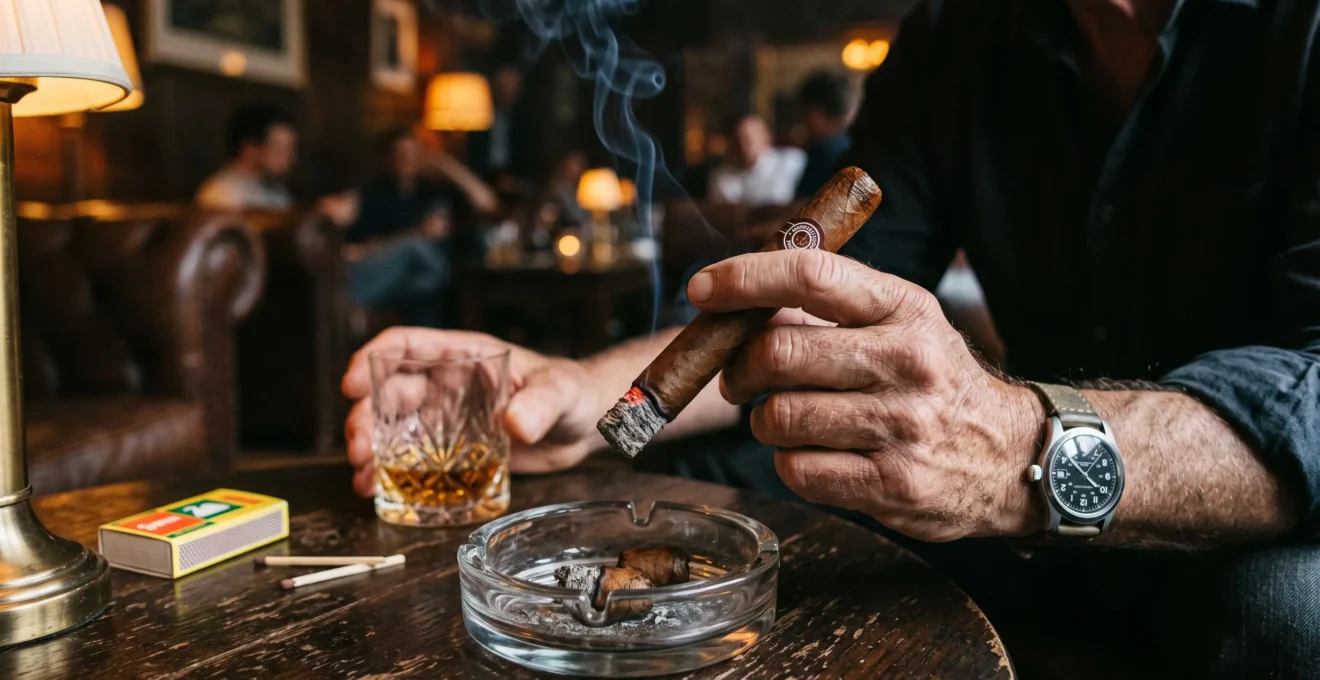
A cigar that begins with distinct cedar, cocoa and leather notes can become bitter and monotonous after several relights. The draw may still feel comfortable, and the smoke may remain plentiful, yet the original flavour distinctions become harder to recognise. The problem often involves combustion conditions rather than a sudden change in the tobacco itself.
Repeated ignition exposes residual char and partly burned tobacco to additional heating. Meanwhile, frequent or forceful puffs can accelerate combustion and introduce further harshness. As the cigar shortens, accumulated smoke constituents also affect what reaches the palate. These processes overlap, but they are not identical.
Importantly, three relights are not a scientifically established temperature threshold. There is no reliable evidence that a third relight automatically produces a particular internal temperature spike or permanently destroys flavour complexity. The useful question is what changes during each interruption and how to recognise a deteriorating burn before unpleasant flavours dominate.
For experienced smokers, the practical indicators are the ember’s shape, changes in smoke delivery, developing bitterness and the way mouthfeel evolves. None measures internal temperature directly, but together they can help distinguish an overheated cigar from one affected by construction, moisture or repeated interruptions. These techniques concern sensory experience, not reduced tobacco exposure or health risk.
Understanding cigar heat and repeated relights
- Relighting can reheat residual char, producing temporarily bitter or acrid smoke; a third relight is not a proven thermal tipping point.
- A roughly 30–60-second puff interval is a practical starting reference, not a universal temperature-control formula.
- Increasing harshness, a sharply pointed ember and changing mouthfeel can suggest deteriorating combustion, although none is a calibrated thermometer.
- Why Do Multiple Relights Make a Cigar Taste Bitter Even if the Draw Feels Fine?
- How to Keep Heat Stable Using a 60-Second Cadence Without Losing Smoke Output?
- Torch or Cedar Spill: Which Keeps First-Light Temperature Lower in the First 2 Minutes?
- The Overheated-Retrohale Mistake That Makes Pepper Feel Like Acid
- When Should You Slow Down to Stop the Final Third From Turning Hot and Sour?
- Why Does a Fast Burn Increase Harshness Even When the Cigar Isn’t Strong?
- Why Does Chewy Texture Increase as Temperature Rises Even When Flavour Stays Similar?
- Why Does Leather-Like Chewiness Feel Rich at 30 Minutes but Turn Acrid at the End?
Why Do Multiple Relights Make a Cigar Taste Bitter Even if the Draw Feels Fine?
Multiple relights can make a cigar taste bitter because fresh ignition reheats residual ash and partially burned tobacco before an even ember becomes established. The resulting smoke may contain unpleasant charred notes despite an unrestricted draw. Repeated relighting can compound the problem, but the number of relights alone does not establish how hot the cigar becomes.
When a cigar extinguishes, its burning end does not immediately return to the condition of fresh tobacco. Ash remains on the exterior, while a layer of partly combusted material sits between the ash and unburned filler. Relighting this material can generate unusually toasted, acrid flavours until more consistent combustion resumes.
Tobacconist University‘s instructions for relighting a cigar distinguish this residual char from both ash and fresh tobacco. The guidance explains why removing loose ash and reducing char before an even relight can help prevent an unpleasant first few draws.
It is tempting to attribute the bitterness to accumulated tannins or scorched oils. However, the available evidence does not specifically establish these substances as the cause of bitterness after repeated relights. Residual char and altered combustion provide a better-supported explanation.
A further complication is that relighting and overheating can occur together. A smoker may compensate for a fading ember with rapid, forceful puffs, creating a hotter burn. Alternatively, excessive moisture, irregular filler packing or airflow problems may repeatedly extinguish the cigar without the smoker maintaining an unusually fast cadence.
A comfortable draw does not guarantee an even burn. Draw resistance reflects airflow through the cigar, not a direct measurement of the burning tobacco’s temperature. A cigar may therefore feel mechanically acceptable while developing a pointed or irregular ember.
For a practical, non-validated diagnostic observation, distinguish two patterns:
- Relight-related char: bitterness is strongest immediately after ignition but gradually subsides when the burn becomes even.
- Persistent combustion trouble: bitterness continues, the ember remains uneven or the cigar repeatedly extinguishes despite changing the pace.
A 30–60second resting interval after relighting can be used as a personal observation period, but it is not an experimentally established test. The important distinction is whether the unpleasant flavour fades or persists, rather than treating the interval as a reliable temperature measurement.
If the first harsh draws settle, recovery may be possible. If bitterness persists despite an even burn, continued relighting is unlikely to solve the underlying problem. The next consideration is how smoking cadence influences that outcome.
How to Keep Heat Stable Using a 60-Second Cadence Without Losing Smoke Output?
A 60-second interval between puffs can provide a practical reference for keeping cigar combustion from becoming excessively aggressive. It is not a universally optimal cadence: cigar size, construction, moisture and surrounding conditions influence whether the ember remains lit. Consistent, measured draws matter more than forcing every cigar into an exact timetable.
Smoking advice commonly recommends leaving approximately 30 seconds to one minute between puffs. Cigar Aficionado‘s guidance on cigar smoking cadence and lighting explains the competing risks: puffing too frequently can create excessive heat and bitterness, while waiting too long may extinguish the cigar and require another relight.
The goal is therefore not to maximise the pause. It is to maintain an even combustion pattern without repeatedly accelerating the ember.
A thick cigar and a slender cigar may respond differently to the same cadence. Wrapper characteristics, filler arrangement, ventilation and ambient conditions can also change how readily a cigar burns. There is no evidence in the supplied research that every ring gauge performs best at precisely 60 seconds.
Nor does a longer interval mean that the next draw should compensate by becoming unusually deep. A forceful draw changes airflow through the burning region and may undermine the intended reduction in combustion intensity.
A useful practical approach is to begin with gentle, consistent draws and observe whether smoke output and the burning end remain reasonably stable. A substantially diminishing ember may indicate that the interval is too long for that particular cigar. A sharply pointed ember or developing bitterness may indicate overly aggressive combustion.
Ash colour alone is not a reliable temperature gauge. Tobacco composition and combustion conditions influence appearance, so colour should never be interpreted as an exact thermal reading.
Five observations for calibrating cigar cadence
- Record a starting interval: note the approximate time between two consecutive draws in a personal smoking log.
- Assess smoke delivery: describe whether the next draw produces consistent, reduced or unusually concentrated smoke.
- Inspect the ember: record whether the burning end appears relatively even, sharply pointed or irregular.
- Track flavour changes: note the first occurrence of bitterness, excessive warmth or persistent acridity, without assuming a measured temperature.
- Compare subsequent observations: note whether allowing more time between draws changes the flavour and burn pattern, creating a personal reference rather than a universal rule.
When a cigar becomes noticeably harsh, interrupting a rapid sequence of puffs is more useful than immediately compensating with further draws. A pause allows observation of whether the unpleasant character persists. Some experienced smokers also use a gentle purge, although the supplied sources do not experimentally establish a purge’s effect on internal temperature or flavour recovery.
More smoke is not necessarily better smoke. A consistent burn with recognisable flavour distinctions provides a more meaningful sensory benchmark than smoke volume alone. Before cadence becomes relevant, however, the initial lighting method has already influenced the cigar’s early combustion.
Torch or Cedar Spill: Which Keeps First-Light Temperature Lower in the First 2 Minutes?
A cedar spill offers a gentler, less concentrated way to approach the initial lighting process, while a butane torch delivers concentrated heat rapidly. Yet no supplied experiment directly compares internal cigar temperature during the first two minutes using these methods. Flame control and contact with the wrapper matter more than assuming either tool guarantees a particular temperature.
The difference begins with heat delivery. A torch produces a focused flame that can ignite tobacco quickly but also risks concentrating heat on a small part of the foot. A burning cedar strip produces a softer, less concentrated flame that can make gradual exposure easier to manage, although it is less convenient in some conditions.
The initial aim with either method is reasonably even ignition across the foot, rather than prolonged heating of one small region. Excessive direct flame contact can scorch exposed tobacco or wrapper edges and introduce unwanted charred flavours.
Toasting involves exposing the cigar’s foot to heat before establishing the full burn. Keeping the foot near rather than immersed in the flame provides greater control over direct flame contact. However, the available evidence does not quantify how much toasting changes internal temperature or establish that a particular method determines the thermal behaviour of the entire first third.
For a smoker deciding between these options, the relevant comparison involves practicality and the risk of applying excessive direct heat.
| Criterion | Butane torch | Cedar spill |
|---|---|---|
| Heat delivery | Focused, rapid flame application | Softer, less concentrated flame |
| Control concern | Greater risk of locally excessive heating through prolonged direct exposure | Requires care to avoid uneven lighting or prolonged exposure |
| Convenience | Compact and quick | Requires a cedar strip and an additional ignition source |
| Delicate wrappers | Particular care needed near exposed edges | Gradual application may be easier to manage |
| Measured first-two-minute temperature | No comparative measurement supplied | No comparative measurement supplied |
A smaller cigar or delicate wrapper may make precise flame placement particularly relevant. A larger foot may demand more attention to achieving an even initial burn. Available time and environmental conditions also affect the choice, without establishing one method as universally superior.
What happens after ignition remains important. A carefully lit cigar can still become harsh if subsequent draws are excessively frequent. Conversely, an imperfect first light does not establish that the entire smoking session is irretrievably compromised.
Neither lighting method guarantees low internal temperature, and sensory impressions during the opening minutes are not laboratory measurements. Once the ember is established, another common source of confusion is the tendency to interpret sharp smoke sensations as desirable flavour intensity.
The Overheated-Retrohale Mistake That Makes Pepper Feel Like Acid
Retrohaling harsh cigar smoke can intensify nasal irritation and make a peppery impression feel aggressively sharp rather than nuanced. The effect does not prove that the smoke has become chemically acidic or that a specific internal temperature has been reached. It reflects the combination of smoke composition, sensory exposure and individual sensitivity.
Retrohaling involves directing smoke from the mouth through the nasal passages. Smokers sometimes use the resulting smell and irritation sensations to describe additional flavour dimensions, particularly spice, wood or roasted notes.
However, pepper-like sensations in tobacco smoke should not automatically be attributed to capsaicin, the compound responsible for chilli heat. A similar subjective impression can arise through different sensory mechanisms. The supplied evidence does not identify a specific capsaicin-like chemical pathway responsible for overheated cigar smoke.
The distinction matters because a sharp nasal sensation can be misread as greater complexity. A cigar that previously produced recognisable spice alongside other notes may instead produce persistent burning or acridity when combustion becomes aggressive.
More irritation is not proof of more flavour. Increased sensory intensity can overwhelm subtle distinctions without introducing additional desirable characteristics.
Some cigar enthusiasts describe using very small, partial retrohales to assess changes in flavour. That is a tasting convention, not a validated temperature diagnostic, and it does not remove the health risks associated with tobacco smoke exposure.
In particular, retrohaling deliberately exposes nasal tissue to smoke. If a cigar already causes discomfort, additional nasal exposure is not necessary to establish that the experience has deteriorated. Avoiding further exposure is the more prudent response.
As a subjective observation, a sudden transition from familiar spice to intense acridity can justify reconsidering the pace or deciding to stop. It cannot distinguish excessive temperature from all other possible causes, including changing smoke composition as the cigar burns down.
The most useful interpretation is qualitative: if recognisable notes disappear behind persistent sharpness, the smoke is no longer delivering the intended sensory balance. This becomes especially relevant as the burning end approaches the final third.
When Should You Slow Down to Stop the Final Third From Turning Hot and Sour?
The final third deserves closer attention when familiar flavours begin fading, smoke feels increasingly warm or the burning end becomes irregular. These changes can coincide with altered combustion and accumulated smoke constituents as the remaining cigar shortens. Reducing rapid puffing may prevent additional harshness, but it cannot guarantee that the original flavours will return.
Several processes make the final stage different from the beginning. The remaining tobacco length is shorter, so smoke travels through less unburned material before reaching the mouth. Previously deposited constituents and moisture within the cigar can influence emissions during later stages of consumption.
A relevant 2017 experimental study on cigar smoking intensity and emissions examined smoke constituents at successive stages of cigar consumption under different puffing conditions.
The researchers identified accumulation, condensation and evaporation effects. Under a given smoking intensity, carbon monoxide emissions increased linearly as the cigar burned, while nicotine and water emissions increased exponentially. These findings describe measured emissions, not an experimentally established curve for flavour complexity or internal temperature.
The study therefore supports the broader principle that the composition of cigar smoke changes during consumption. It does not prove that every cigar becomes sour in its final third or that a particular puffing interval prevents this change.
For subjective monitoring, three observations can be especially useful: previously distinct notes becoming harder to identify, unpleasant warmth near the smoking end, and an increasingly irregular ember. Ash flaking may accompany changes in the burn, but it is not a validated measurement of overheating.
There is also a behavioural component. As the cigar shortens, a smoker may unintentionally increase puff frequency in an attempt to maintain smoke output or extract more flavour from the remaining tobacco.
That response can be counterproductive if it produces increasingly aggressive combustion. Equally, a cigar that repeatedly threatens to go out may indicate a construction or moisture problem rather than an insufficiently determined smoker.
The remaining decision involves three possible outcomes: continue at a less aggressive pace if the experience remains acceptable, put the cigar down and reassess whether it is worth returning to, or end the session altogether.
Finishing the cigar is not a requirement. Persistent acridity, unpleasant heat or discomfort are sufficient reasons to stop. There is no sensory benefit in forcing the final portion to resemble the earlier, more enjoyable stages.
Late-stage harshness is not always a sign of an unusually strong blend. Understanding the difference between tobacco strength and aggressive combustion helps explain why even a mild cigar can become unpleasant.
Why Does a Fast Burn Increase Harshness Even When the Cigar Isn’t Strong?
A fast-burning cigar can taste harsh even when its tobacco blend is considered mild because nicotine strength and combustion-related irritation are different characteristics. Frequent or forceful puffs can increase combustion intensity and create unpleasant charred sensations. A harsh experience therefore does not necessarily mean that the cigar contains unusually strong tobacco.
Cigar strength is commonly discussed in relation to the perceived physiological impact of nicotine. Flavour intensity, by contrast, refers to how prominent the sensory characteristics appear. Harshness describes a different quality: irritation, bitterness, acridity or an excessively aggressive smoke sensation.
These characteristics can occur together, but they should not be treated as interchangeable.
Heat influences chemical reactions in burning tobacco. Increasing combustion intensity can change the formation and delivery of smoke constituents. However, the available source material does not establish a specific threshold at which sugars or oils suddenly become responsible for an unpleasant taste.
That distinction prevents an oversimplified explanation in which every bitter note is attributed to scorching. Tobacco characteristics, storage, combustion uniformity and accumulated smoke constituents can all influence the experience.
Professional cigar guidance associates overly frequent puffing with a pointed ember and diminished flavour balance. The relationship is useful as a practical observation, but it does not provide a numerical measure of internal heat.
The same cigar can consequently seem smoother under one set of smoking conditions and more aggressive under another. This does not necessarily mean its nicotine content has changed. It means the conditions under which smoke is generated and perceived have changed.
A personal comparison across separate sessions could involve recording perceived harshness, cadence and burn irregularities while keeping the cigar blend consistent. Such a comparison is observational, not a controlled experiment, because individual cigars and environmental conditions vary.
One unpleasant session does not establish the cause. Consistent differences across observations may suggest a pattern worth investigating, but they do not eliminate construction and moisture as alternative explanations.
This separation also explains why flavour and texture can evolve at different rates. The defining notes may remain recognisable while the smoke begins to feel heavier or less comfortable in the mouth.
Why Does Chewy Texture Increase as Temperature Rises Even When Flavour Stays Similar?
A cigar can feel increasingly chewy while retaining similar flavour notes because smoke texture and recognised aromas are different sensory dimensions. Changes in smoke composition, concentration and condensation may influence mouthfeel without immediately obscuring familiar flavours. However, there is no validated evidence that increasing chewiness directly measures rising internal cigar temperature.
In tasting language, chewiness describes a dense, substantial or coating impression. It is not literally the physical texture of a solid material. The term attempts to capture the perceived weight and persistence of smoke in the mouth.
A cigar may continue to suggest leather, cocoa or toasted wood while the smoke begins to feel heavier. That perceived change does not automatically indicate a defect. Some blends are consistently described as rich or resinous, and their mouthfeel may be part of the intended tasting experience.
The problem arises when a formerly pleasant fullness becomes associated with persistent bitterness, irritation or an unpleasant coating sensation.
Condensation and accumulation during cigar consumption are supported by experimental emissions research. Nevertheless, the available study did not measure perceived chewiness or establish which individual constituents produce a particular mouthfeel.
Claims that hotter embers necessarily deliver a specific quantity of tarry material to the palate, thereby producing a measurable chewy texture, would exceed the evidence.
For sensory comparison, the useful question is whether texture changes independently of flavour recognition.
| Observation | Rich, acceptable chewiness | Potentially unpleasant chewiness |
|---|---|---|
| Mouthfeel | Full or coating without persistent discomfort | Heavy or coating alongside irritation |
| Flavour definition | Distinct notes remain identifiable | Bitterness or acridity increasingly dominates |
| Burn appearance | No obvious irregularity | May coincide with a pointed or uneven ember |
| Interpretation | Could reflect the blend’s normal character | May justify reassessing combustion conditions |
The table describes qualitative impressions, not scientifically validated categories. Neither type of chewiness proves a particular combustion temperature or smoke composition.
As a personal benchmark, noting when mouthfeel changes may be informative. If a familiar cigar normally remains balanced but develops an unpleasantly dense texture during a session with repeated relights, that difference can prompt closer attention to the burn.
The final question is how to interpret a longer progression: why an initially satisfying leathery weight can eventually become acrid, even without a dramatic change in the basic flavour description.
Key takeaways before assessing the final flavour transition
- Separate the cigar’s original richness from unwanted changes introduced by interrupted or uneven combustion.
- Consider storage, packing and the history of relights alongside smoking cadence when interpreting deteriorating flavour.
- Use changes across the session as a personal comparison, not as evidence of a universal 30-minute or third-relight threshold.
Why Does Leather-Like Chewiness Feel Rich at 30 Minutes but Turn Acrid at the End?
Leather-like chewiness may feel rich midway through a cigar but become acrid later because the smoke and remaining tobacco change throughout consumption. Accumulation, condensation, evaporation and combustion conditions can alter what reaches the palate. Thirty minutes is not an established turning point, and the same sensory progression does not occur in every cigar.
Leather is a descriptive tasting term rather than evidence that a particular chemical compound has been identified. Smokers commonly use it to describe earthy, dry, textured or savoury impressions that differ from sweet and floral notes.
During an enjoyable middle stage, those impressions may coexist with other recognisable characteristics. The cigar can feel full without becoming irritating, and the smoke may retain sufficient variation to seem balanced.
As combustion progresses, however, the remaining tobacco and the material deposited within it are no longer in the same condition as at the beginning. Experimental findings on changing cigar emissions demonstrate that smoke composition evolves as consumption advances.
This supports the possibility of a changing sensory experience, but it does not establish a direct experimental relationship between measured emissions, leathery mouthfeel and eventual acridity.
Relighting adds another variable. A cigar that has repeatedly extinguished may contain residual char at the foot, making the transition back to an even burn temporarily unpleasant. If the smoker responds with increasingly forceful puffs, combustion intensity can become an additional factor.
Storage and construction deserve consideration too. A cigar with unsuitable moisture conditions or an uneven filler arrangement may burn inconsistently. However, it would be too simplistic to conclude that every under-humidified cigar inevitably burns hotter or develops acridity sooner. Actual behaviour depends on multiple interacting variables.
A useful personal observation framework separates three stages:
- Early session: identify the first recognisable flavour notes and the initial weight of the smoke.
- Middle session: note whether leathery richness remains balanced or becomes increasingly coating and irritating.
- Late session: record whether flavour definition declines, the ember becomes irregular or relighting introduces persistent charred notes.
Rather than treating the elapsed time as a prediction, this approach uses the cigar’s own progression as the reference. A smaller cigar may reach its final stage quickly, while another format may maintain its middle-stage character for substantially longer. Neither duration determines a universal sensory outcome.
Even if a cigar tastes markedly worse after several relights, the evidence does not support diagnosing a precise internal temperature spike from flavour alone. The responsible factors may include the relighting process, burn intensity, altered emissions or conditions present before ignition.
For the next smoking-session observation, record the first point at which an enjoyable texture becomes unpleasant, alongside the burn pattern and relight history. Treat that record as a personal sensory benchmark, not a prescription to continue smoking. If acridity or discomfort persists, ending the session is a reasonable decision.
Does the third relight permanently ruin a cigar?
No fixed three-relight threshold has been established. Residual char can produce temporary bitterness, and flavour may improve after even combustion resumes. Persistent harshness can also reflect other combustion, storage or construction problems, so recovery is not guaranteed.
Can you measure a cigar’s internal temperature by looking at its ash?
No. Ash appearance and ember shape offer qualitative clues about combustion, but they do not provide an accurate internal temperature measurement. A sharply pointed ember may suggest excessive or uneven burning, while ash colour is influenced by factors beyond temperature.
Does a cigar with an easy draw necessarily burn cooler?
No. Draw resistance and combustion temperature are different properties. A cigar may allow comfortable airflow while burning unevenly or producing unpleasantly harsh smoke. Draw quality alone cannot establish thermal stability.
Is purging a cigar scientifically proven to remove bitter compounds?
The supplied evidence does not establish that purging removes a defined quantity of bitter compounds, lowers internal temperature by a predictable amount or consistently restores flavour. It should be understood as an enthusiast practice rather than a validated correction technique.
Does slower cigar smoking make tobacco smoke safer?
No conclusion of that kind follows from the available combustion or tasting evidence. Changing puff frequency alters combustion conditions and smoke emissions, but the research does not establish a risk-free or medically safer smoking cadence. Cigar smoke contains harmful substances, and avoiding tobacco smoke exposure is the reliable way to avoid those exposure-related risks.